
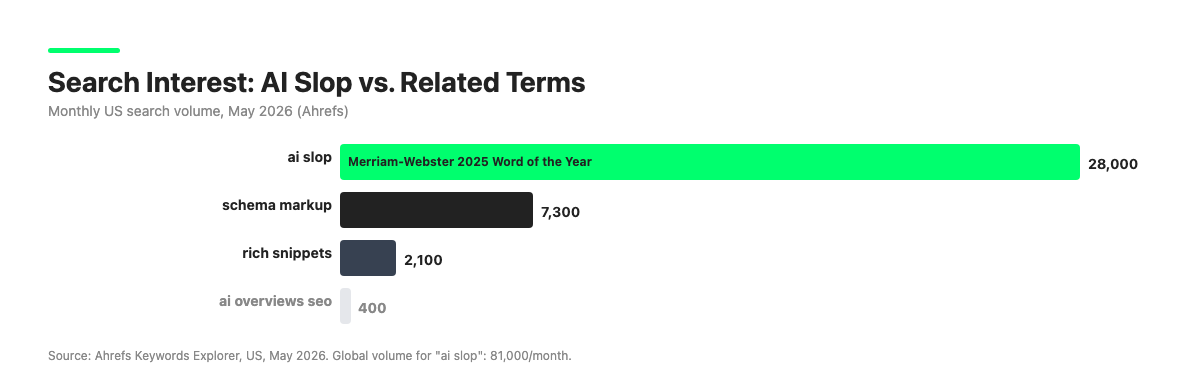
AI slop is low-quality, mass-produced content generated by artificial intelligence with minimal human oversight or editing. Merriam-Webster selected “slop” as its 2025 word of the year, largely because of poor-quality AI outputs flooding the internet. The term describes content that is technically coherent but practically useless: generic phrasing, recycled information, missing original insight, and a neutral tone that sounds authoritative without saying anything specific.
The defining quality of AI slop is not that it was made with AI. It is that it was made carelessly with AI and published without meaningful human judgment. The same AI tools that produce slop can also produce useful, accurate, well-researched content when used with discipline.
What Makes Something AI Slop?
AI slop shares a recognizable profile. The surface looks polished but the substance is hollow. Here are the characteristics that define it:
Generic, vague information. The content explains correctly but never specifically. A guide on “how to improve your website’s SEO” that lists “create high-quality content” and “build backlinks” without explaining how, why, or under what conditions is AI slop. It is correct in the way that saying “eat well and exercise” is correct medical advice.
No original insight or first-hand experience. AI language models generate text by predicting what tokens follow previous tokens, not by applying judgment. Without a human expert shaping the output, AI content tends to reflect consensus: what everyone else has already said, averaged out. There is no perspective, no opinion, no observation that only someone with actual experience could make.
Repetitive structure and phrasing. AI models fall back on patterns. Three-item lists. Sections that end with “In summary.” Openings that say “In today’s digital landscape.” Transitions like “Moreover,” “Additionally,” and “It is worth noting.” These patterns are not wrong, but their uniform presence is a fingerprint.
Claims without citations or sourcing. “Studies show that…” followed by no study. “Research indicates…” with no research linked. AI models are trained to sound authoritative, which means they learn to state things confidently without necessarily grounding them in verifiable sources.
Missing specifics. Slop avoids numbers, names, dates, and concrete examples. It describes categories rather than instances. It uses vague attributions (“many experts,” “some studies”) instead of specific ones. Specificity requires research. Slop skips that step.
34 Types of AI Slop Patterns
Understanding AI slop in detail helps you spot it and avoid it in your own writing. The taxonomy below groups the 34 most recognizable patterns into four categories.
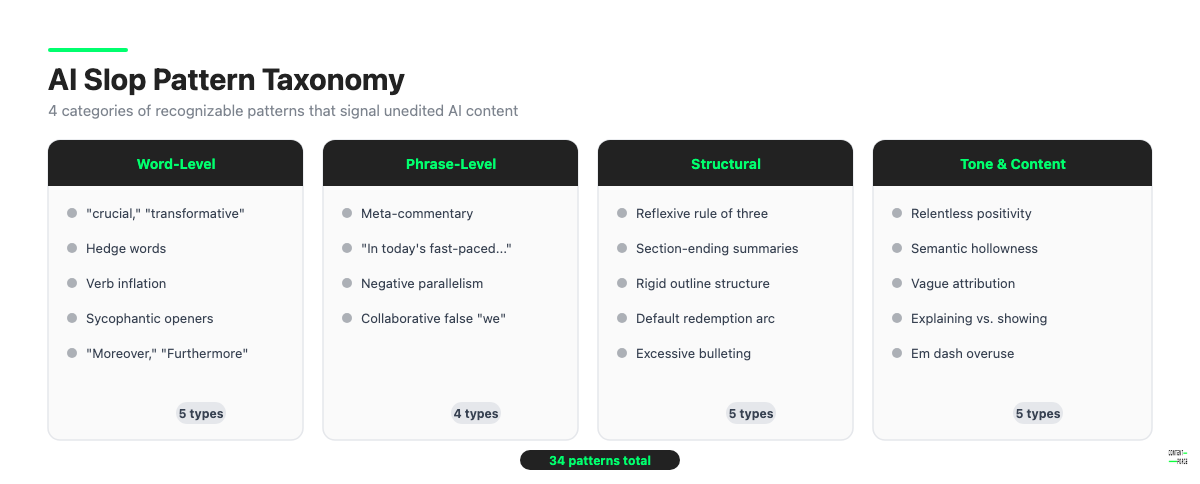
Here are the key patterns by category, adapted from detailed content audits:
Word-Level Patterns
- Significance amplifiers: Overwrought words like “crucial,” “essential,” “transformative,” or “game-changing” applied to everything, diluting their meaning.
- Hedge words: Excessive qualifications. “It is generally considered,” “in most cases,” “typically speaking.” Hedging what should be a direct statement.
- Verb inflation: Using “leverage,” “craft,” “bolster,” “utilize,” or “facilitate” when “use,” “write,” “improve,” and “do” would be clearer.
- Sycophantic openers: “Great question!” or “That is an excellent point!” These appear in conversational AI and leak into published content.
- AI transition words: “Moreover,” “Furthermore,” “Additionally,” “It is worth noting,” and “In conclusion” at the start of paragraphs signal template-generated text.
Phrase-Level Patterns
- Meta-commentary: Announcing what you are about to say instead of saying it. “In this section, we will explore…” followed by the actual content.
- Manufactured hooks: Generic openings like “In today’s fast-paced world,” “With the rise of AI,” or “As we navigate the digital landscape.” These say nothing specific.
- Negative parallelism: “It is not about X, it is about Y.” Common AI rhetorical structure that sounds insightful but usually just restates the obvious.
- Collaborative false “we”: “Let’s explore,” “We will now look at,” “Together, we can…” when there is no actual collaboration happening.
Structural Patterns
- Reflexive rule of three: Always three bullet points. Always three arguments. The pattern feels complete but it is just a default.
- Section-ending summaries: Restating the section in a “Key takeaway” paragraph immediately after the content already stated it.
- Rigid outline structure: Introduction, three H2s with three H3s each, conclusion. The structure signals the tool, not the topic.
- Default redemption arc: Every problem has a solution, every challenge has a silver lining. Real writing acknowledges trade-offs.
- Excessive bulleting: Converting continuous reasoning into disconnected bullet points. Bullets flatten nuance and hide the absence of actual argument.
Tone and Content Patterns
- Relentless positivity: Every insight is “exciting,” every topic is “fascinating,” every development is “promising.” Real expertise acknowledges limits and downsides.
- Semantic hollowness: Sounds smart, says nothing. “AI is transforming the way we think about content.” What does that mean, specifically?
- Vague attribution: “Research shows,” “Experts agree,” “Studies indicate” without naming the research, experts, or studies.
- Explaining significance instead of showing it: “This is important because…” followed by a generic reason instead of a concrete example that demonstrates the importance.
- Em dash overuse: The em dash used as a catch-all connector for clauses that should be separate sentences. Noticeable when it appears six or more times per page.
Why AI Slop Harms Your SEO and Brand
Google’s Scaled Content Abuse Policy
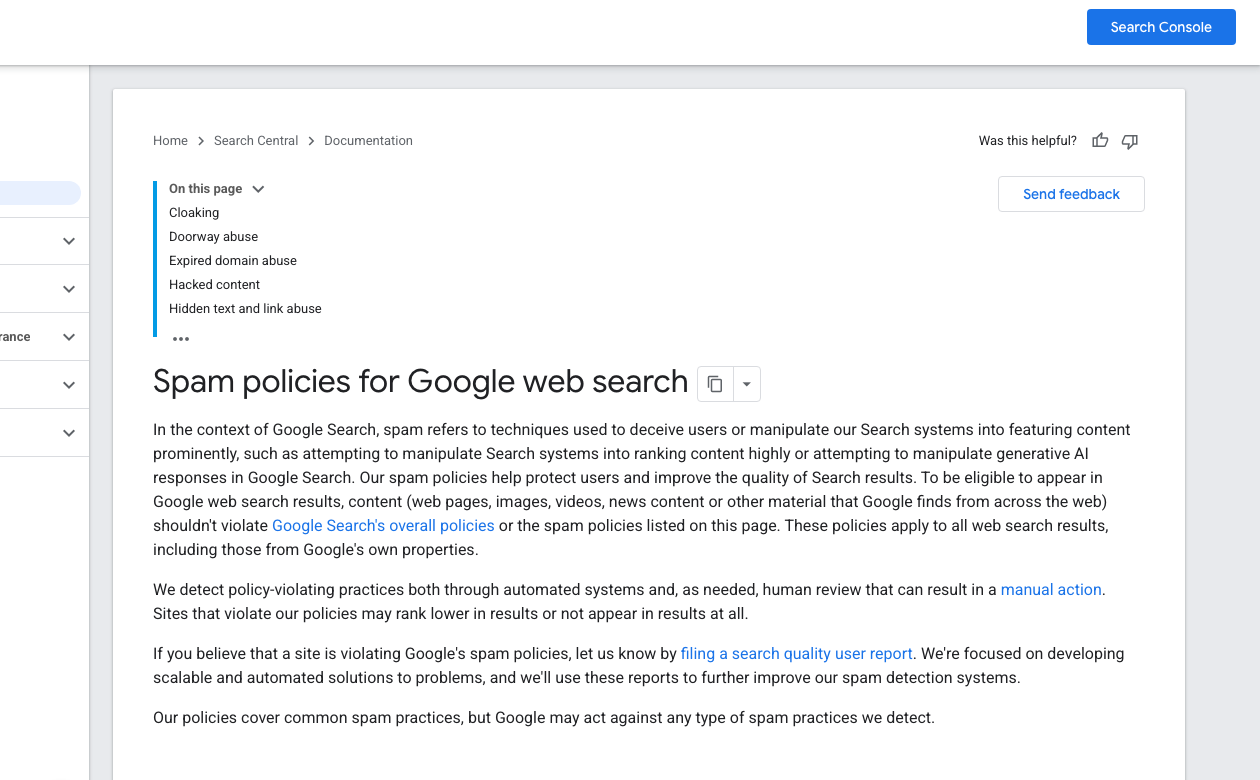
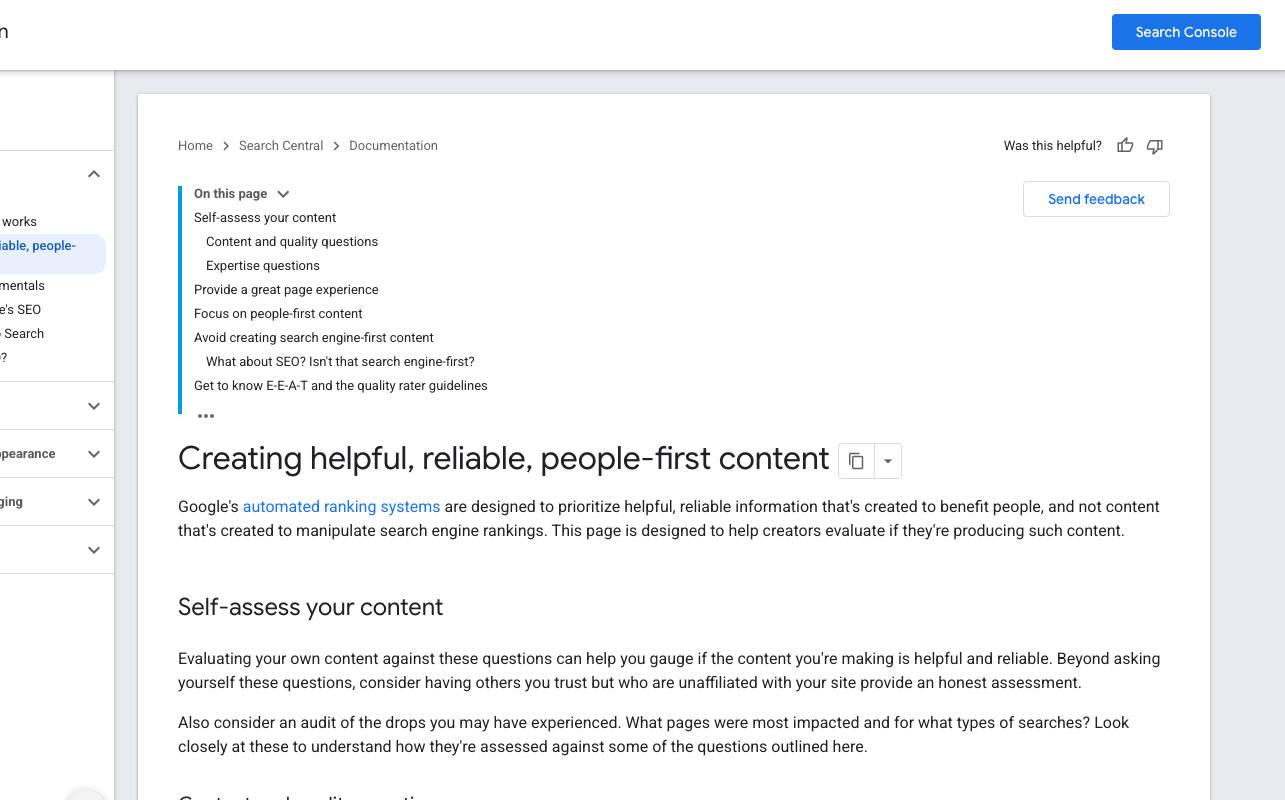
Google explicitly prohibits the use of “generative AI tools to generate many pages” without adding value for users. This falls under its “scaled content abuse” policy. Publishing AI slop at volume is not just a quality problem; it is a policy violation that can result in manual actions against your site.
Google’s Helpful Content system penalizes content that appears to be written for search engines rather than people. AI slop is structurally designed to match keyword patterns without delivering genuine usefulness. High-volume AI slop sites have seen significant organic traffic drops following core updates in 2024 and 2025.
Citability in AI Overviews and LLM Citations
The second harm is subtler but increasingly significant. AI Overviews, ChatGPT, and Perplexity all cite sources. They cite sources that contain specific, verifiable, original information. AI slop is the opposite: generic, vague, and derivative. It adds nothing to the knowledge pool that AI systems draw from, so it does not get cited.
Being cited in AI-generated answers is becoming an important visibility metric. Slop is structurally uncitable. Original insight, specific data, and first-hand experience are what get cited.
Brand Credibility and Trust
AI slop is recognizable to experienced readers in your industry. Publishing it signals that your organization does not invest in genuine expertise. A potential customer who reads a helpful, specific, expert-level page from a competitor and then reads a generic AI page from you will notice the difference and trust the competitor more.
How to Use AI Without Creating Slop
The difference between AI slop and AI-assisted quality content is human editorial judgment at every stage. Here is what that looks like in practice:
Inject specificity. Every time your AI draft says “many experts say” or “research shows,” you must find and name the actual source, expert, or study. Generalities need to become citations or first-hand observations.
Add your perspective. What does your team actually think about this topic? What have you seen that contradicts the consensus? What nuance do you have from working directly with clients or data? This is what AI cannot generate. It has to come from you.
Break the patterns deliberately. If you notice your text has three items everywhere, add a fourth or use two. If every paragraph starts with “The,” restructure half of them. If transitions like “Furthermore” appear, delete them or rewrite the clause.
Apply the “claims without receipts” test. Read your draft and highlight every claim that makes an assertion about the world: statistics, cause-and-effect statements, comparative claims. Then verify each one. If you cannot verify it, rewrite it as an observation instead.
Maintain human judgment on publication. AI drafts should be treated as first drafts, not publication candidates. A subject-matter expert who actually knows the topic should read the final version and ask: “Does this say anything I would stake my reputation on?”
AI Slop vs. Quality AI-Assisted Content
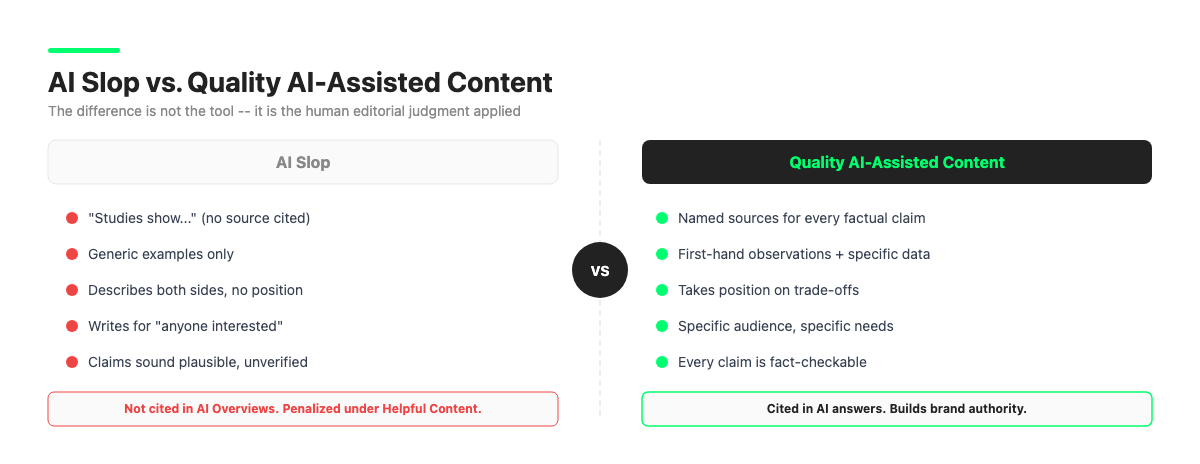
The distinction is not AI vs. human. It is whether the final content contains genuine utility. A useful benchmark: would a reader who is already expert in this topic learn something or find something specifically useful here? Or would they recognize it as a summary of what they already know, with nothing added?
Quality AI-assisted content:
- Cites specific sources for factual claims
- Includes original examples or first-hand observations
- Takes a position on trade-offs rather than describing them neutrally
- Has a specific audience and speaks to their actual needs
- Passes a fact-checking read where every claim is traceable
AI slop:
- Attributes claims generically (“studies show”)
- Uses only examples that were already in the training data
- Describes both sides of every argument without taking a position
- Writes for “anyone interested in the topic” rather than a specific reader
- Contains claims that sound plausible but cannot be verified
Frequently Asked Questions About AI Slop
Is all AI-generated content AI slop? No. AI slop describes the output of careless, unedited AI generation at scale. AI-assisted content that is reviewed, fact-checked, and enriched with original insight is not slop. The quality problem comes from the process, not the technology.
Does Google penalize AI-generated content? Google does not penalize content for being AI-generated. It penalizes content for being unhelpful, spammy, or produced at scale without adding value. That description fits most AI slop. Well-researched, human-reviewed AI-assisted content does not face penalties from AI origin alone.
What is the difference between AI slop and a first draft? A first draft is the starting point for editorial work. AI slop is a first draft that was published without editorial work. The problem is not that the AI generated it; the problem is that no qualified human improved it before publication.
How much AI-generated content is on the internet in 2026? Precise figures are not available. However, analysis tools and researchers tracking content quality consistently report that a significant portion of new content indexed by search engines shows characteristics of AI generation with minimal human editing. Some estimates in 2025 ranged from 20 to 40 percent of newly published web content.
What is “AI caviar” as opposed to AI slop? The term “AI caviar” has been used informally to describe high-quality, well-executed AI-assisted content. It is content where AI handled the drafting and formatting while expert humans contributed the specific knowledge, original perspective, and editorial judgment that makes the final piece genuinely useful. The distinction is entirely about what the human contributes, not about how much AI was used.