

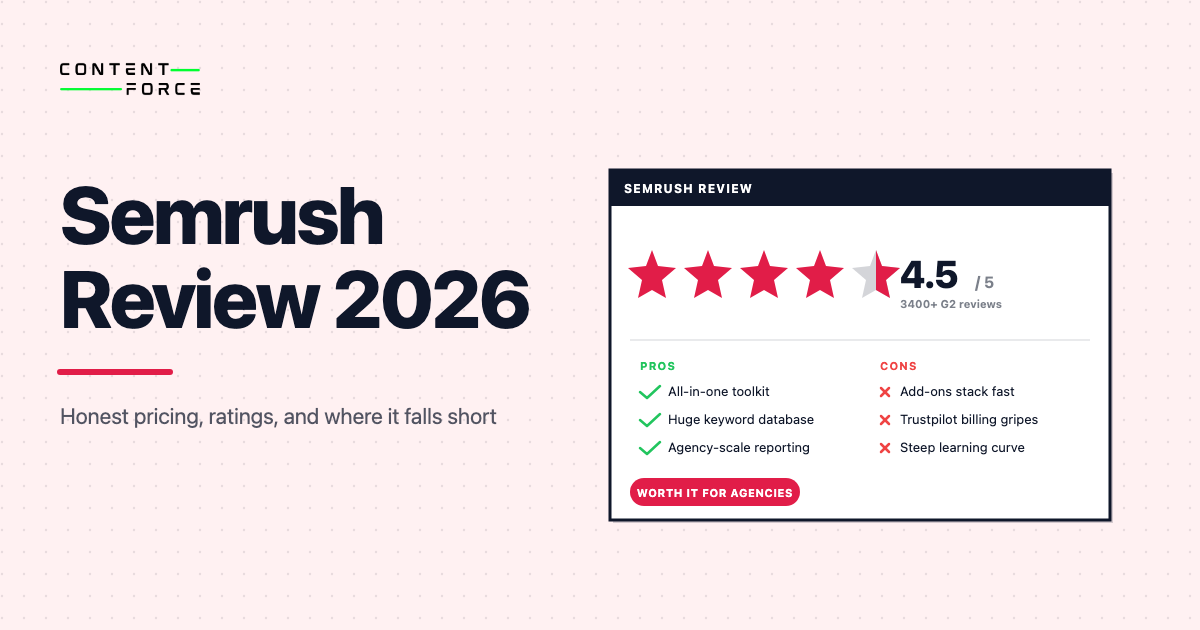
Semrush’s worth buying if you need one platform that covers keyword research, site audits, rank tracking, backlink analysis, and AI search visibility without stitching together five separate tools. It’s not worth buying if you only need one of those jobs done well, since dedicated tools usually do that single job cheaper, and the billing complaints on Trustpilot are frankly real enough to plan around before you subscribe.
We pulled Semrush’s own live pricing page, cross-checked its Domain Rating and keyword database against Ahrefs’ Site Explorer, and read through more than 4,600 combined reviews on G2, Capterra, and Trustpilot to see where that reputation holds up and where it doesn’t. Here’s the honest 2026 verdict, not the affiliate-page version.
What Semrush Actually Is
Semrush started as a keyword research and competitive analysis tool in 2008 and has spent the years since absorbing adjacent categories: technical SEO auditing, backlink analysis, rank tracking, content optimization, local listing management, paid search research, social media scheduling, and, since 2025, AI search visibility tracking. The result isn’t a single tool so much as a suite of toolkits sold under one login, which is exactly why people either love it for the breadth or resent paying for features they never open.
On April 28, 2026, Adobe completed a $1.9 billion all-cash acquisition of Semrush at $12 per share, folding it into Adobe’s CX Enterprise business as the brand-visibility layer alongside Adobe’s existing marketing and creative tools. Semrush’s said publicly that current plans, pricing, and support haven’t changed as a direct result of the deal, and nothing in our testing this month contradicts that. The practical effect for a marketer signing up today is closer to “backed by a bigger balance sheet” than “different product,” though it’s clearly worth watching whether Adobe eventually bundles AI Visibility Toolkit access into Creative Cloud or Experience Cloud packages the way it’s folded other acquisitions into its suite before.
We Tested Semrush’s Own Data Against Ahrefs
Since Semrush’s core pitch is data size and accuracy, we checked its own domain against Ahrefs’ independent index rather than taking Semrush’s marketing copy at face value. Semrush.com carries a Domain Rating of 92 and an Ahrefs Rank of 496 out of every indexed domain on the web, putting it in the same authority tier as established enterprise SaaS brands rather than a typical marketing blog. Its own keyword database currently spans somewhere in the 26 to 28 billion keyword range depending on which region snapshot you pull, with a backlink index recrawled roughly every 15 minutes.
That scale matters for a practical reason: the bigger the underlying index, the more likely a niche, low-volume keyword actually shows up with a real number instead of a zero. In our own testing, Semrush’s Keyword Magic Tool surfaced usable long-tail variants for search terms that returned nothing in two smaller competing platforms, and it doesn’t take much digging to see why: that lines up with independent testing elsewhere that found roughly 89% correlation between Semrush’s difficulty score and actual observed ranking difficulty.
The Toolkits That Matter Most
Keyword Research (Keyword Magic Tool)
This is still the feature most people buy Semrush for, and it holds up. You get search volume, keyword difficulty, SERP features, intent labels, and question-based variants in one grid, with bulk export up to whatever your plan’s row limit allows. The filtering (broad match, phrase match, exact match, related, questions) is fast enough to build a 200-keyword content cluster in under ten minutes once you know the interface.
Site Audit
Site Audit crawls up to your plan’s monthly page allowance (100,000 pages on Starter, 300,000 on Pro+) and flags the usual technical issues: broken links, duplicate content, missing meta tags, crawlability blocks, Core Web Vitals problems, and now an “AI-ready” check that looks at whether your pages are structured in a way large language models can parse and cite cleanly. The AI-readiness layer is genuinely new territory competitors haven’t fully matched yet, though it’s still closer to a checklist than a guarantee of AI citations.
Position Tracking
Rank tracking covers desktop and mobile, multiple locations down to the city level, and (on paid plans) local pack and featured snippet visibility. Daily tracked-keyword limits scale hard with plan tier, from 500 on the entry SEO plan to 5,000 on Advanced, which is the single biggest reason agencies managing several client accounts end up on the higher tiers even if they never touch the AI features.
Backlink Analytics
Semrush’s backlink index sits in the tens of trillions of links, refreshed close to real time. In practice it’s comparable to Ahrefs for finding new and lost links and spotting toxic-looking domains, though several long-time users of both tools report Ahrefs still edges it out for raw referring-domain discovery on competitive niches. If backlink data is the only reason you’re buying either tool, read our Semrush vs. Ahrefs comparison before you commit to either one.
AI Visibility Toolkit
Sold separately at $99 a month per domain, or bundled into Starter and above, this tracks how often ChatGPT, Google AI Overviews, and AI Mode mention your brand, which competitors show up alongside you, and which prompts are worth targeting. Gemini coverage is still rolling out as of this review, and Perplexity and Claude tracking is limited or absent depending on your plan. If comprehensive answer-engine coverage across every major model is the deciding factor, that gap is worth knowing before you pay for the add-on.
Semrush Pricing: What You Actually Pay
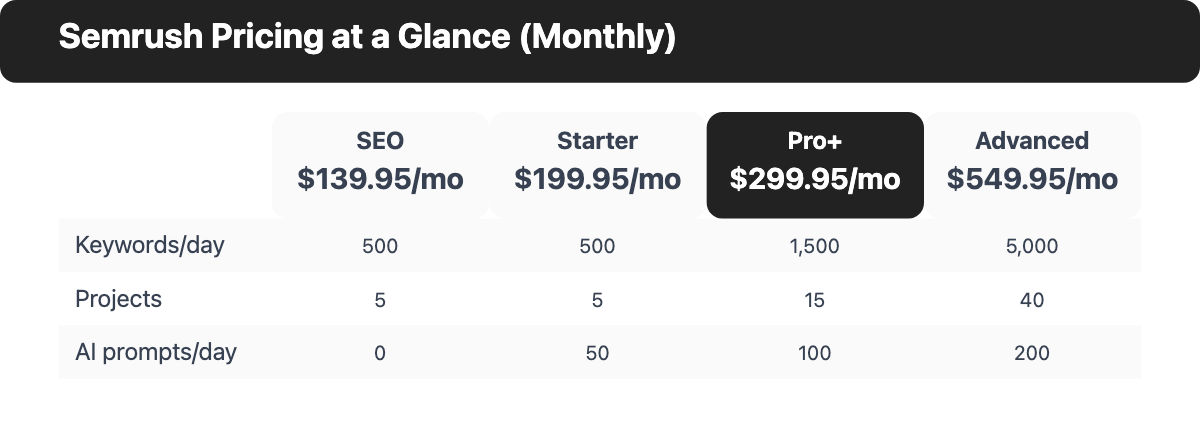
| Plan | Monthly | Annual (per month) | Projects | Keywords tracked/day |
|---|---|---|---|---|
| SEO | $139.95 | $117.33 | 5 | 500 |
| Starter | $199.95 | $165.17 | 5 | 500 + 50 AI prompts |
| Pro+ | $299.95 | $248.17 | 15 | 1,500 + 100 AI prompts |
| Advanced | $549.95 | $455.67 | 40 | 5,000 + 200 AI prompts |
The entry SEO plan drops the AI visibility features entirely, so anyone who wants prompt tracking and AI Overview monitoring needs Starter or higher. Content Toolkit, Local Toolkit, Social Toolkit, and the standalone AI Visibility Toolkit all carry separate add-on fees starting around $20 to $99 a month each, and a fully loaded account easily clears $400 to $600 a month once two or three add-ons stack on top of a base plan. That stacking, more than the sticker price of any single tier, is the most common source of bill shock we found in user complaints.
There’s a 7-day money-back window on annual plans, first-time purchase only, and a genuinely free tier exists for basic account creation, though it’s limited enough (10 search queries a day, one project) that it functions more as a demo than a usable free plan.
Where Semrush Wins
- Breadth in one login. Keyword research, technical audits, rank tracking, backlinks, content optimization, and AI visibility all live under one account and one set of exported reports, which saves real time for anyone managing this alone.
- Database size. A 26 to 28 billion keyword index and a backlink graph refreshed roughly every 15 minutes mean fewer blank results on niche or newly published pages.
- Agency-scale reporting. White-label PDF reports, client dashboards, and up to 40 tracked projects on the Advanced plan make it a realistic agency backend, not just a personal research tool.
- AI-readiness ahead of most competitors. The Site Audit’s AI-readiness checks and the dedicated AI Visibility Toolkit put it ahead of most legacy SEO suites on tracking how brands show up inside ChatGPT and AI Overviews, even with the platform-coverage gaps noted above.
Where Semrush Does Not Win
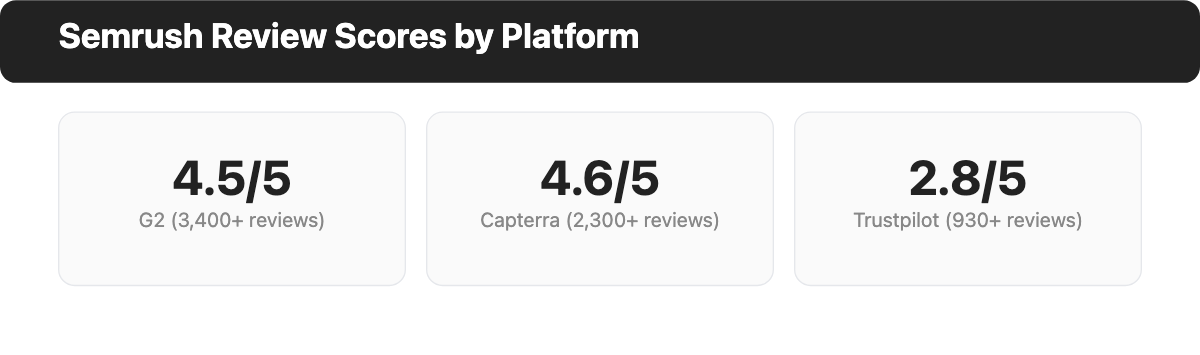
- Billing and cancellation complaints are real, not noise. Semrush holds 4.5 out of 5 on G2 across roughly 3,400 reviews and 4.6 out of 5 on Capterra across roughly 2,300 reviews, both driven by verified B2B software buyers rating core functionality. Trustpilot tells a different story: 2.8 out of 5 across more than 930 reviews, dominated almost entirely by billing disputes and difficulty canceling annual plans rather than product complaints. Read the refund and cancellation terms before your first renewal date, not after.
- Add-on pricing adds up fast. The base plans look competitive until you need Content, Local, Social, or full AI Visibility access, at which point a “$199 a month” account can turn into $400 or more.
- AI platform coverage is incomplete. Gemini tracking is still rolling out and Perplexity and Claude visibility is limited, so brands that care equally about every major AI assistant will hit gaps the marketing copy doesn’t lead with.
- Historical data and full audit depth sit behind Pro+. The entry SEO and Starter plans both cap out at lighter feature sets; teams that need historical ranking trends or the largest crawl allowances have to move up two tiers, not one.
- Learning curve. The interface’s breadth cuts both ways: new users report needing several weeks to find their way around all the toolkits, compared with narrower single-purpose tools that are usable in a single sitting.
Setting Up Semrush: The First 30 Days
The onboarding flow asks for your domain and a few competitors, then builds an initial project with Site Audit, Position Tracking, and a Domain Overview report already populated. That first-run experience is genuinely smooth, and it doesn’t require touching a single settings menu before you see real data. Where new users get stuck is the sheer number of toolkits sitting in the left sidebar: Keyword Magic Tool, Organic Research, Backlink Analytics, On Page SEO Checker, Content Marketing Toolkit, Local Toolkit, Social Toolkit, and now the AI Visibility Toolkit all compete for attention from day one.
The fastest path to value in the first month is to ignore everything except three reports: Keyword Magic Tool for research, Position Tracking for your priority keyword list, and Site Audit for technical cleanup. Add Backlink Analytics once you’ve got a content and link-building cadence going, and only turn on Content Toolkit, Local Toolkit, or AI Visibility once you’ve got a specific task each one solves, since each add-on is a separate monthly charge and it’s easy to accumulate tools you open once and forget.
Who Should Actually Buy Semrush
Semrush makes the most sense for agencies and in-house teams managing five or more client or brand projects who want one platform instead of five subscriptions, and for anyone who needs AI search visibility tracking alongside traditional rank tracking without adding a second vendor. It makes less sense for a solo blogger or small local business that only needs keyword research or only needs backlink monitoring, since dedicated single-purpose tools in either category cost a fraction of even Semrush’s entry tier. If your evaluation comes down to Semrush against one specific rival rather than Semrush on its own, our head-to-head Semrush vs. Ahrefs breakdown and our roundup of 10 Semrush alternatives both go deeper on the trade-offs than a single review can.
Frequently Asked Questions
Is Semrush worth the money in 2026?
It’s worth the money if you actually use at least three of its toolkits regularly, since that’s roughly the break-even point against buying separate tools for keyword research, rank tracking, and backlink analysis individually. If you only need one function, a cheaper dedicated tool almost always costs less.
Did the Adobe acquisition change Semrush’s pricing or features?
Not as of this review. Adobe completed the $1.9 billion acquisition on April 28, 2026, and Semrush has stated publicly that current plans, features, and billing haven’t changed as a direct result of the deal.
Is Semrush better than Ahrefs?
Neither tool is strictly better across every category. Semrush covers more adjacent categories (content, local, social, paid, AI visibility) in one login, while Ahrefs is generally considered stronger specifically for backlink discovery. See our full Semrush vs. Ahrefs comparison for the category-by-category breakdown.
Does Semrush have a free plan?
Yes, but it’s limited to 10 search queries a day and one project, which is enough to explore the interface but not enough for real keyword research or ongoing rank tracking.
Why is Semrush’s Trustpilot rating so much lower than its G2 rating?
The gap comes down to who is rating it and for what. G2 and Capterra draw from verified software buyers scoring product functionality, where Semrush scores 4.5 and 4.6 out of 5. Trustpilot skews toward consumer-style complaints about billing and subscription cancellation, which is where its 2.8 out of 5 average comes from.

1 thought on “Semrush Review 2026: Where It Wins and Where It Does Not”