

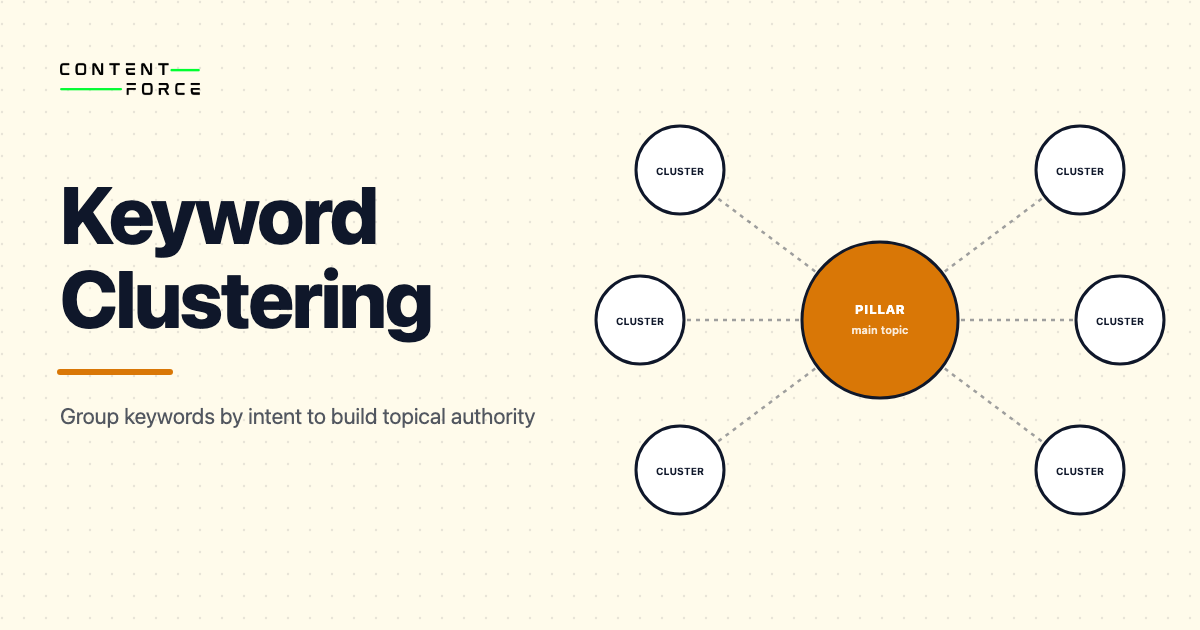
Most SEO strategies start with keyword research but stall at the next step: figuring out which keywords belong together and which ones need their own page. That’s where keyword clustering comes in. Done right, it turns a bloated list of thousands of keywords into a clear, actionable content plan — one that prevents wasted effort, stops cannibalizing your own rankings, and tells you exactly which pages to build or optimize.
Without clustering, content teams end up in one of two failure modes. Either they create a separate page for every keyword variation, producing dozens of thin, barely-differentiated articles that confuse Google and cannibalize each other. Or they stuff every vaguely related keyword onto a single page, creating a sprawling mess that doesn’t rank well for anything. Clustering is the solution to both problems: it gives you a principled way to decide exactly which keywords belong together and which ones need their own dedicated page.
This guide covers everything you need to know: what keyword clustering is, why it matters, how to do it step by step, which tools to use, and how to apply advanced strategies like GSC-based opportunity finding and AI-assisted grouping.
What Is Keyword Clustering?
Keyword clustering is the process of grouping related keywords together so they can be targeted by a single page, rather than spreading them across multiple separate pages.
The core insight: many keywords share the same search intent and the same competing pages in Google’s top 10. If Google shows the same URLs for “best project management software,” “top PM tools,” and “project management app,” those three keywords can — and should — be targeted by one page. Creating three separate pages for them dilutes your authority and splits your ranking potential.
Here’s a concrete example. Say you run a keyword research campaign and pull 10,000 keywords related to project management. After clustering, those 10,000 keywords might collapse into roughly 300 distinct clusters, each representing one target page. Instead of a sprawling content operation with thousands of articles, you have a focused plan with 300 well-defined pages, each designed to rank for a specific set of related terms.
The reduction ratio varies by niche, but the pattern holds: clustering almost always reveals that far fewer pages are needed than raw keyword counts suggest.
It’s also worth understanding what keyword clustering is not. It’s not the same as grouping keywords by topic in a spreadsheet based on gut feel. That approach misses the critical question: does Google actually rank the same pages for these keywords? Two keywords that look related to a human may return completely different search results, which means they reflect different user intents and need separate pages. True keyword clustering is grounded in data — either SERP overlap data or NLP-based semantic similarity — not manual categorization.
Why Keyword Clustering Matters for SEO
Clustering isn’t just a content planning convenience. It has direct, measurable effects on how well your site performs in search.
-
Prevents content cannibalization. When multiple pages on your site target the same keywords, they compete against each other in the search results. Google has to pick one, and it may not pick the one you want. Clustering assigns each keyword to exactly one page, eliminating the ambiguity.
-
Builds topical authority. A page that comprehensively covers all the related terms in a cluster signals to Google that it’s the definitive resource on that topic. This is more powerful than a page that only optimizes for one keyword and leaves related questions unanswered.
-
Reduces content production waste. Writing five articles that all target slight variations of the same keyword is expensive and mostly counterproductive. Using keyword clustering, you can identify which variations belong together and write once to cover all of them.
-
Improves rankings by matching search intent more precisely. Two keywords can look similar but have different intents. Clustering forces you to examine whether keywords truly belong together or whether they reflect different user goals. The result is pages that align tightly with what searchers actually want, which is what Google rewards.
-
Streamlines content planning. Clusters translate directly into a content calendar. Each cluster is a page, and you can prioritize clusters by traffic potential, difficulty, and business value. Planning becomes systematic rather than ad hoc.
-
Better internal linking structure. When your content is organized around clusters, internal links follow naturally. Pages within the same topical area link to each other, distributing authority and helping Google understand your site’s structure.
Types of Keyword Clustering: SERP-Based vs. Semantic
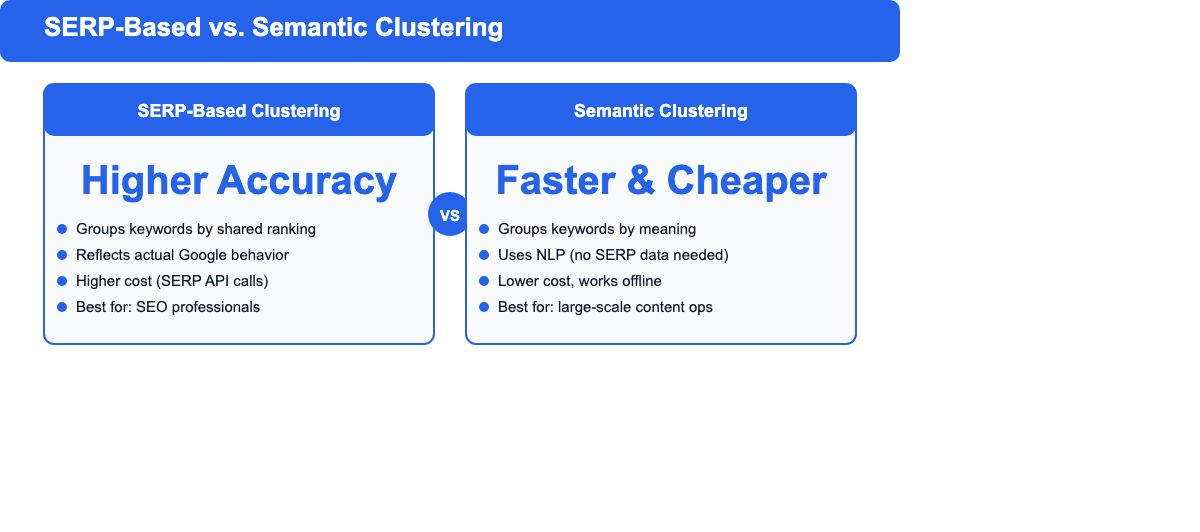
There are two fundamental approaches to keyword clustering, and understanding the difference matters for choosing the right method.
SERP-Based Clustering
SERP-based clustering — also called SERP clustering or SERP-based keyword clustering — groups keywords together when their Google search results overlap. The logic is direct: if two keywords produce the same top-ranking pages, Google treats them as equivalent enough to rank the same content for both. That means you can target them together on one page.
The overlap threshold defines how strict the grouping is:
- Soft clustering: Keywords share at least one URL in their top-10 results. Casts the widest net but can group keywords that are only loosely related.
- Moderate clustering: Keywords share at least 50% of their top-10 URLs. Balances coverage with precision.
- Hard clustering: Keywords share all top-10 URLs. Very strict groupings, only for keywords where Google’s results are nearly identical.
Most practitioners use moderate clustering (3 or more shared URLs out of 10) as the practical default. It’s strict enough to ensure real topical alignment but flexible enough to capture meaningful clusters.
One practical consideration with SERP-based clustering is that results can shift over time. Google’s search results aren’t static — an algorithm update, a new competitor, or a content refresh can change which pages rank for a keyword. For this reason, SERP-based clusters are best treated as a working plan rather than a permanent map. Re-running your cluster analysis every 6 to 12 months (or after major algorithm updates) keeps your content strategy aligned with how Google currently understands your topic space.
The main limitation of SERP-based clustering is cost and speed. Pulling top-10 results for thousands of keywords requires SERP API calls, which means money and processing time.
Semantic Clustering
Semantic clustering groups keywords by meaning, using natural language processing (NLP) to measure how similar keywords are in topic and concept — without ever looking at actual search results.
Tools like embedding models or simple co-occurrence analysis can cluster thousands of keywords in seconds and at minimal cost. The trade-off is accuracy. Semantic clustering doesn’t know how Google actually ranks pages for those keywords. Two keywords can be semantically similar but return completely different search results, which means they need separate pages. Semantic clustering misses those cases.
A practical example: “best running shoes” and “how to choose running shoes” are semantically very close. Both are about running shoes. But the first is a commercial-intent query dominated by list articles and affiliate sites, while the second is informational and returns how-to guides and advice articles. A semantic clustering tool would likely group them together. A SERP-based tool would correctly separate them into two different clusters. That distinction matters enormously for how you write and structure each page.
Pros and Cons Comparison
| SERP-Based | Semantic | |
|---|---|---|
| Accuracy | Higher (reflects actual Google behavior) | Lower (misses intent signals) |
| Cost | Higher (requires SERP API calls) | Lower (works offline) |
| Speed | Slower | Faster |
| Best for | SEO professionals | Large-scale content ops |
The one-sentence verdict: SERP-based clustering is more reliable for SEO; semantic clustering is better for large-scale content workflows where speed and cost matter more than precision.
How to Do Keyword Clustering (Step by Step)
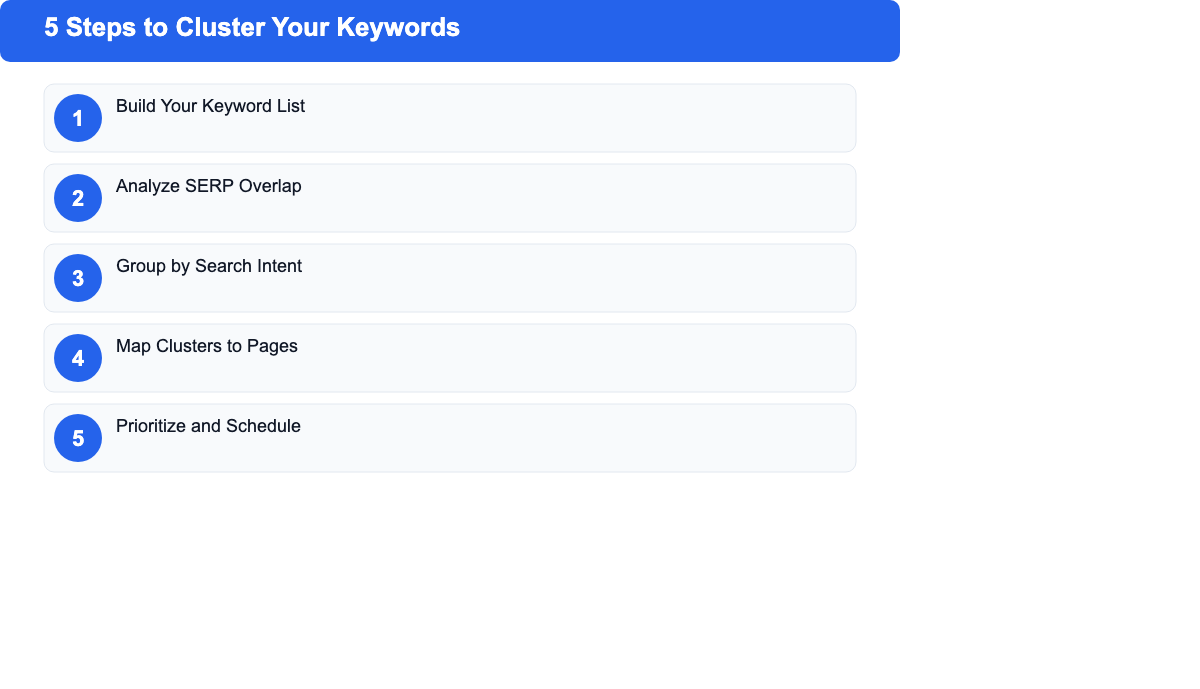
Here’s the practical workflow, from raw keyword list to mapped content plan.
Step 1: Build Your Keyword List
Start with a set of seed keywords that represent your core topics. From there, use keyword research tools to expand to a working list.
Ahrefs, Semrush, and Google Keyword Planner are the standard options. Pull keywords across three categories:
- Head terms: short, high-volume keywords like “keyword clustering” or “project management software”
- Long-tail variations: more specific phrases like “how to do keyword clustering in Excel” or “best project management software for remote teams”
- Question keywords: what, how, why, and which queries that often map to informational intent
A practical working range is 500 to 5,000 keywords. Fewer than 500 and you may not have enough depth to build a real content plan. Above 5,000 and you’ll need a dedicated tool to process them efficiently.
Export your list to a spreadsheet with columns for keyword, monthly search volume, and keyword difficulty. That’s your starting point.
Don’t filter too aggressively at this stage. Keywords with low search volume may still be worth targeting if they have high commercial value or if they cluster with high-volume keywords. A keyword with 50 monthly searches that lands in a cluster dominated by a 5,000-search head term gets a lot more mileage than if you had ignored it entirely. Inclusive lists cluster better than pre-filtered ones.
Step 2: Analyze SERP Overlap
For each keyword in your list, look at which pages rank in the top 10 of Google’s search results. The goal is to find keywords that consistently return the same URLs.
Manually, this means searching each keyword, noting the top 10 URLs, and comparing lists. It works for small sets (under 100 keywords) but becomes impractical fast.
For any list above 100 keywords, a clustering tool is the right call. Tools like Keyword Insights, SE Ranking’s Keyword Grouper, or KeyClusters automate the SERP data collection and grouping logic. You upload your keyword list, set your overlap threshold (typically 3 or more shared URLs), and get back a grouped output.
The output will show you clusters with a primary keyword (usually highest volume) and a list of secondary keywords that share enough SERP overlap to belong together.
Pay attention to the “outlier” keywords — the ones that don’t cluster with anything else. These are keywords where Google returns a highly unique set of results. That often signals a very specific intent that deserves its own dedicated page, or alternatively, a keyword that doesn’t have enough search volume to justify standalone content. Those decisions come later, in the prioritization step.
Step 3: Group Keywords by Search Intent
SERP overlap is necessary but not sufficient. Before finalizing a cluster, check that all the keywords in it share the same search intent.
The four main intent categories:
- Informational: the user wants to learn something (“what is keyword clustering”)
- Commercial: the user is researching before a purchase (“best keyword clustering tools”)
- Transactional: the user wants to buy or sign up (“keyword clustering tool free trial”)
- Navigational: the user wants a specific website (“Ahrefs keyword grouper”)
Keywords that share SERP overlap can sometimes straddle intent categories. “Keyword clustering” and “keyword clustering tool” might return some of the same URLs, but one is informational and one is commercial. Putting them in the same cluster and writing one page to serve both intents rarely works well. The page ends up unfocused and ranked for neither.
Navigational queries deserve special attention here. A keyword like “Ahrefs keyword grouper” is a branded navigational search — the user already knows the tool they want. Even if it shares partial SERP overlap with an informational or commercial cluster, it should be excluded from that cluster. Mixing navigational keywords with informational or commercial ones dilutes the topical focus of your page and makes it harder for Google to understand who the page is actually for.
Split intent-mismatched keywords into separate clusters, even if their SERP overlap suggests they could be combined.
Intent classification doesn’t have to be perfect. The goal is to catch clear mismatches — informational mixed with transactional, navigational mixed with commercial — rather than to perfectly categorize every keyword. For most clusters, a quick look at the top 3 results for the primary keyword is enough to confirm the intent. If the top results are all listicles, it’s commercial. If they’re all guides or definitions, it’s informational. If they’re all product pages, it’s transactional.
Step 4: Map Clusters to Pages
Once your clusters are clean and intent-aligned, map each one to a specific page on your site.
Assign the highest-volume keyword in each cluster as the primary keyword. That’s what you optimize the page title, meta description, and H1 for. The remaining keywords in the cluster become secondary and semantic targets, woven naturally into the content, headers, and supporting sections.
Then check your existing content:
- If a page already covers the cluster well, audit and optimize it to ensure it targets all the keywords in the cluster.
- If no page covers the cluster, add it to your content creation queue.
This step turns your cluster list into a content audit and gap analysis simultaneously. It shows you exactly what to fix and what to build.
One useful output format at this stage is a simple cluster map: a spreadsheet where each row is a cluster, with columns for the primary keyword, secondary keywords, target URL (existing or “new”), current ranking position, estimated traffic potential, and priority score. This becomes the living reference document for your content operation — updated as you publish new pages and as rankings shift.
Step 5: Prioritize and Schedule Content
You won’t build or update every cluster at once. Prioritization is what makes clustering actionable.
Score each cluster on three factors:
- Traffic potential: estimated monthly clicks if you rank in the top 3 (use Ahrefs’ traffic potential metric or Semrush’s click estimates)
- Keyword difficulty: how hard the primary keyword is to rank for
- Business relevance: how directly the topic drives your goals (leads, revenue, brand awareness)
Sort clusters by a weighted combination of those three factors. Build your content calendar starting from the highest-priority clusters.
A typical cluster contains 3 to 10 keywords. Very competitive broad topics may produce clusters of 10 to 20 keywords. Niche topics may yield clusters of only 2 or 3. The size isn’t the goal — the goal is that all keywords in a cluster can be covered coherently by a single page.
Two final prioritization notes. First, don’t only chase high-volume clusters. A cluster with 500 combined monthly searches but low difficulty and high commercial intent may deliver more value than a 10,000-search cluster that’s dominated by established sites with DR 80+. Second, consider your current domain authority when setting difficulty thresholds. New sites should focus on low-difficulty clusters first to build topical authority and accumulate rankings before tackling the most competitive terms in their niche.
Best Keyword Clustering Tools
Manual clustering works for lists under 100 keywords. Beyond that, you need a tool. Here’s what’s available.
| Tool | Type | Free Tier | Best For |
|---|---|---|---|
| Semrush Keyword Strategy Builder | SERP-based | No (trial) | Full SEO suites |
| Ahrefs | SERP-based | Limited | Agency teams |
| Keyword Insights | SERP-based | $1 trial | Dedicated clustering |
| SE Ranking Keyword Grouper | SERP/semantic | Yes | Budget teams |
| KeyClusters | SERP-based | Pay-as-you-go | One-time projects |
| ChatGPT / Claude | Semantic (AI) | Yes (limited) | Fast semantic grouping |
Semrush Keyword Strategy Builder is built into the Semrush platform and clusters keywords automatically from any keyword list you provide. It assigns primary and secondary keywords per cluster and suggests content types. The downside is you need an active Semrush subscription, which isn’t cheap. For teams already on Semrush, it’s the easiest option since it’s all in one place.
Ahrefs doesn’t have a standalone clustering tool, but its Keywords Explorer lets you identify SERP overlap by filtering for keywords that share top-ranking pages. It’s more of a manual process than Semrush’s Strategy Builder, but the underlying data quality is excellent. Best suited to agency teams that live in Ahrefs daily.
Keyword Insights is a purpose-built clustering tool with a $1 trial. You upload a keyword list, choose your clustering method (SERP-based or semantic), and get back a fully grouped output with cluster names, primary keywords, and intent labels. It’s one of the fastest ways to go from raw keyword list to organized clusters. The pricing is credit-based, which makes it cost-effective for one-off projects.
SE Ranking Keyword Grouper offers a free tier and clusters using both SERP and semantic signals. It’s a good option for smaller teams or individuals who don’t want to commit to a more expensive tool. The interface is straightforward, and the clustering accuracy is solid for the price point.
KeyClusters operates on a pay-as-you-go model, which is ideal for one-time projects or infrequent use. Upload your list, get clustered output. No monthly subscription required. The tool focuses on SERP-based clustering and gives you control over the overlap threshold.
ChatGPT and Claude can do semantic clustering quickly and for free (within usage limits). They don’t have access to real SERP data, so the clusters they produce are based on meaning similarity rather than how Google actually ranks pages. That makes them useful for initial grouping at scale or for getting a fast rough structure, but you should validate high-value clusters against real search results before building content around them.
A note on AI tools: they’re best used as a first pass on large keyword lists, not as a replacement for SERP-based clustering on high-priority topics.
One tool worth mentioning that sits outside the above categories is Google Sheets with SERP data integrations. Some teams build their own clustering workflow by connecting a SERP API (like ValueSERP or DataForSEO) to a Google Sheet and writing a script that pulls top-10 URLs for each keyword and calculates Jaccard similarity scores between keyword pairs. This approach is more work to set up but gives you full control over the clustering logic and no per-seat costs beyond the SERP API fees. It’s a practical option for technical SEOs who cluster regularly and want to own their tooling.
Keyword Clustering vs. Topical Clusters: What’s the Difference?
These two terms look similar but operate at completely different levels of scale.
A keyword cluster is a group of keywords that one page should target. It’s a micro-level concept. You take a set of related keywords, determine they can all be covered by a single page, and target them together. The output is one optimized page.
A topical cluster (also commonly called a “topic cluster”) is a group of interlinked pages that cover a broad topic from multiple angles. It’s a macro-level content architecture concept. One main page (the pillar page) covers the topic broadly, and multiple supporting pages (cluster pages) cover specific subtopics in depth. All the pages link to each other.
| Keyword Cluster | Topical Cluster | |
|---|---|---|
| Scope | Keywords for one page | Multiple interlinked pages |
| Unit | A group of related keywords | A group of related pages |
| Output | One optimized page | A content hub |
To see how they relate: keyword clustering might produce a cluster around “keyword clustering” (this article) and separate clusters for “keyword research guide,” “keyword mapping,” and “content planning for SEO.” Those are four separate pages. Together, they form a topical cluster around the broader topic of “SEO keyword strategy,” with a pillar page linking to all four.
Keyword clustering feeds topical cluster planning. You do keyword clustering first to figure out which pages to create, then organize those pages into topical clusters to structure your internal linking and content architecture.
For practical planning purposes, the distinction matters when you’re deciding scope. If a client asks for a “keyword cluster” around “payroll software,” they want a list of keywords that one page should rank for. If they ask for a “topical cluster” around payroll software, they want a full content architecture: a pillar page, supporting articles on “how payroll taxes work,” “payroll software for small business,” “payroll compliance checklist,” and so on — each backed by its own keyword cluster. Both are valid requests; they just operate at different levels of the content strategy hierarchy.
Advanced Keyword Clustering Strategies
Once you have the fundamentals down, these strategies take clustering further.
Fix Keyword Cannibalization with Clustering
Cannibalization happens when two or more pages on your site compete for the same keyword. Google has to choose which one to rank, and it often picks inconsistently. The result is lower rankings than you’d get with a single, authoritative page.
Keyword clustering is the diagnostic tool for finding cannibalization. Run a cluster audit on your existing content:
- Export all the keywords your site ranks for (from Google Search Console or Ahrefs).
- Run clustering on that keyword list.
- Look for clusters where two or more of your existing pages appear as ranking URLs.
If two pages share the same primary keyword in a cluster, they’re cannibalizing each other. The fix is usually one of three options:
- Merge: consolidate the weaker page’s content into the stronger one, then redirect the weaker URL.
- Differentiate: update one page to clearly target a different intent or angle so they no longer compete.
- 301 redirect: if the weaker page adds no unique value, redirect it to the stronger one.
Always update your internal links after a merge or redirect. Pages that linked to the old URL should point to the new one.
One often-missed step: after merging cannibalized pages, update the target page itself to include all the secondary keywords that the now-redirected page was previously ranking for. The redirect passes link authority, but the content still needs to explicitly cover those terms to reclaim their rankings. Run a keyword coverage check on the merged page after publishing to confirm all the secondary keywords from the old cluster are represented in the text.
Use Google Search Console to Find Clustering Opportunities
Google Search Console is an underused source of clustering intelligence. Filter your GSC query report for keywords with high impressions but low click-through rates. These are keywords where you’re showing up in search results but not ranking high enough to attract clicks.
High impressions / low CTR usually means one of two things: you’re ranking on page 2 or 3 for a keyword that belongs on a page you already have, or you have a page that’s targeting a keyword cluster but hasn’t been optimized for all the related keywords in that cluster.
The process:
- In GSC, filter for queries with over 1,000 impressions and under 3% CTR.
- Export that list.
- Run it through your clustering process.
- Match each cluster to your existing pages.
- Update those pages to explicitly include the cluster keywords you’re currently ranking for but underperforming on.
This is one of the fastest ways to improve rankings on existing content without creating anything new.
A related technique is to use GSC’s page-level data rather than the query-level view. Pull the top 20 queries for your most-trafficked pages, then run those queries through a clustering analysis. You’ll often find that a single successful page is already ranking weakly for terms that belong in adjacent clusters — terms that would be better served by new, dedicated pages rather than cramming more keywords onto a page that’s already doing a job.
AI-Assisted Keyword Clustering
AI tools have made semantic clustering fast enough to be practical at scale. The right workflow uses AI for speed and SERP data for validation.
For initial grouping, paste a keyword list into ChatGPT or Claude and use a prompt like this:
“Group the following keywords by search intent. Return a table with: cluster name, primary keyword, secondary keywords. Keywords: [paste list]”
The output gives you a rough semantic structure in seconds. For a list of 200 to 500 keywords, this initial grouping takes a few minutes instead of hours.
The caveat is important: AI clustering reflects meaning similarity, not Google behavior. A pair of keywords that are semantically close may return completely different search results, meaning they need separate pages. For any cluster that represents significant traffic potential, validate the AI-generated groupings against real SERP data before committing to a content strategy.
The best workflow looks like this: use AI for initial semantic grouping at scale, identify the 10 to 20 highest-priority clusters, then run those through a SERP-based tool to validate and refine. You get the speed benefits of AI without building your strategy on unverified assumptions.
Frequently Asked Questions
What is the difference between keyword clustering and keyword research?
Keyword research is the process of finding which keywords exist, how many people search for them, and how difficult they are to rank for. Keyword clustering is the next step: organizing those keywords into groups so you know which keywords to target together on which pages. Research tells you what keywords are out there. Clustering tells you what to do with them. You always cluster after you research, not before.
How many keywords should be in a cluster?
Most practitioners use 3 to 10 keywords per cluster. Very broad topics like “project management software” may produce clusters with 10 to 20 keywords, because there are many closely related variations all returning the same results. Niche topics may produce clusters of only 2 or 3. The right number isn’t a fixed rule — the test is whether all the keywords in a cluster can be addressed coherently on one page without making that page feel scattered or unfocused. If targeting all the keywords in a cluster would require a page to cover too many different angles, split the cluster.
Can I do keyword clustering manually without a tool?
Yes, for small keyword sets under 100 keywords. Open a spreadsheet, search each keyword in Google, and note which URLs appear in the top 10. Group keywords that share 3 or more of the same URLs. Add an intent check to confirm the keywords in each group reflect the same user goal. For larger lists, this becomes impractical fast — a list of 500 keywords means 500 individual searches and hundreds of URL comparisons. At that scale, a dedicated clustering tool saves hours and produces more consistent results.
How does keyword clustering help with content cannibalization?
By assigning each keyword to exactly one cluster, and therefore one target page, clustering eliminates the ambiguity that causes cannibalization. When you plan new content around clusters, each keyword has one home. For existing content, running a cluster audit on your current rankings reveals where you already have multiple pages competing for the same terms. That audit shows you exactly which pages to merge, differentiate, or redirect to resolve the problem.
What is search intent and why does it matter for clustering?
Search intent is what a user actually wants when they type a query into Google: information, a specific website, a product to buy, or a service to sign up for. Keywords must share both SERP overlap and the same intent to belong in the same cluster. Grouping “buy keyword clustering software” with “what is keyword clustering” almost never works, even if those two queries occasionally return some of the same pages. One user wants to make a purchase; the other wants an explanation. A single page trying to serve both intents will likely underperform for both. Intent alignment is the final check before any cluster is ready to be mapped to a page.
