
A keyword difficulty score tells you one thing: how many referring domains the current top 10 pages tend to have. It does not tell you whether those pages are any good, whether the search results are stuffed with features that eat your clicks, or whether ten other sites just found the same "easy" term this week. Treat the number as a filter, not a verdict, and you will make better calls than anyone who ranks a keyword list by KD alone.
What Is Keyword Difficulty?
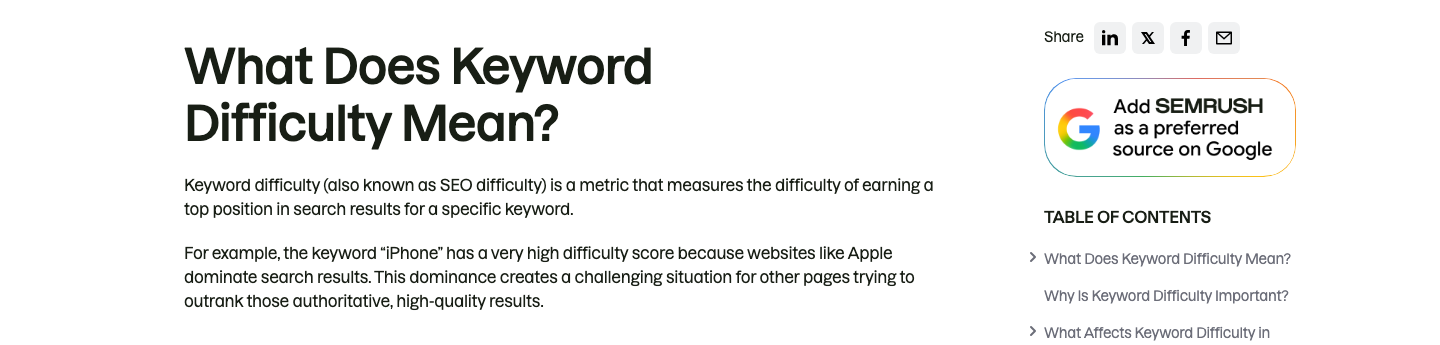
Keyword difficulty (KD) is a 0 to 100 score that estimates how hard it would be to rank in the top 10 organic results for a given search term. Most tools build the score primarily from the backlink profile of the pages that currently rank, not from the content itself. A higher number means the ranking pages have stronger, more numerous backlinks, and a new or smaller site will need a comparable link profile to compete for the same spot.
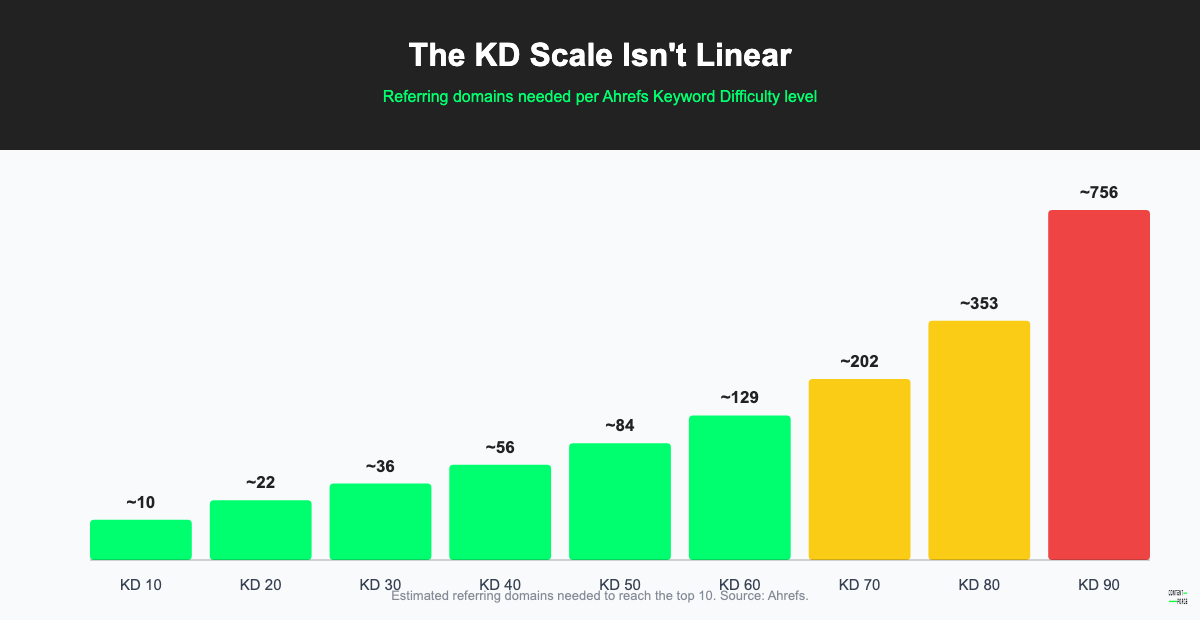
Ahrefs, one of the tools that popularized the metric, ties its KD scale directly to an estimated number of referring domains needed to break into the top 10. The scale is not linear:
| Keyword Difficulty | Estimated Referring Domains Needed |
|---|---|
| 10 | ~10 |
| 20 | ~22 |
| 30 | ~36 |
| 40 | ~56 |
| 50 | ~84 |
| 60 | ~129 |
| 70 | ~202 |
| 80 | ~353 |
| 90 | ~756 |
The jump from KD 40 to KD 70 is not a doubling of effort. It is roughly a fourfold increase in the referring domains a page typically carries at that level. That non-linear curve is exactly why a KD 65 keyword can feel disproportionately harder than a KD 50 one, even though the two numbers look close on paper.
Ahrefs states plainly, in its own documentation, that Keyword Difficulty "doesn't take into account any on-page factors." That single sentence, buried in a product FAQ, is the root of most of what the score gets wrong. We will come back to it.
How Keyword Difficulty Scores Are Calculated
Every major tool builds its score from a similar set of inputs, weighted differently depending on the vendor. Semrush publishes the clearest breakdown of the factors that move the number:
- Backlinks to the top-ranking sites. More referring domains pointing at the pages already in the top 10 pushes the score up. This is the dominant input across every tool.
- Authority scores of the top-ranking sites. A composite of link quality, organic traffic and spam signals for each ranking domain. Sites with consistently high authority scores across the top 10 raise the difficulty ceiling.
- Search volume. Higher-volume terms tend to carry higher difficulty, because more sites compete for the traffic. Semrush's own data shows keywords with over 100,000 monthly searches average around 76% difficulty, while keywords with 11 to 100 monthly searches average closer to 39%.
- The presence of SERP features. Featured snippets, People Also Ask boxes, knowledge panels and similar elements factor into some scoring models, since they change how much organic space is actually available.
- Branded keywords. Terms that contain a brand name skew difficult, because Google tends to favor the brand's own domain regardless of anyone else's backlink profile.
- Word count. Longer, more specific phrases usually carry lower search volume and lower difficulty than their shorter head-term counterparts.
Notice what is missing from that list. Nothing in the calculation asks whether the ranking pages actually answer the query well, whether they were published last week or five years ago, or whether the person searching wants a product, a definition, or a local result. The score is a backlink and authority snapshot dressed up as a difficulty estimate, and treating it as anything more precise than that is where most keyword research goes wrong.
What Keyword Difficulty Scores Hide
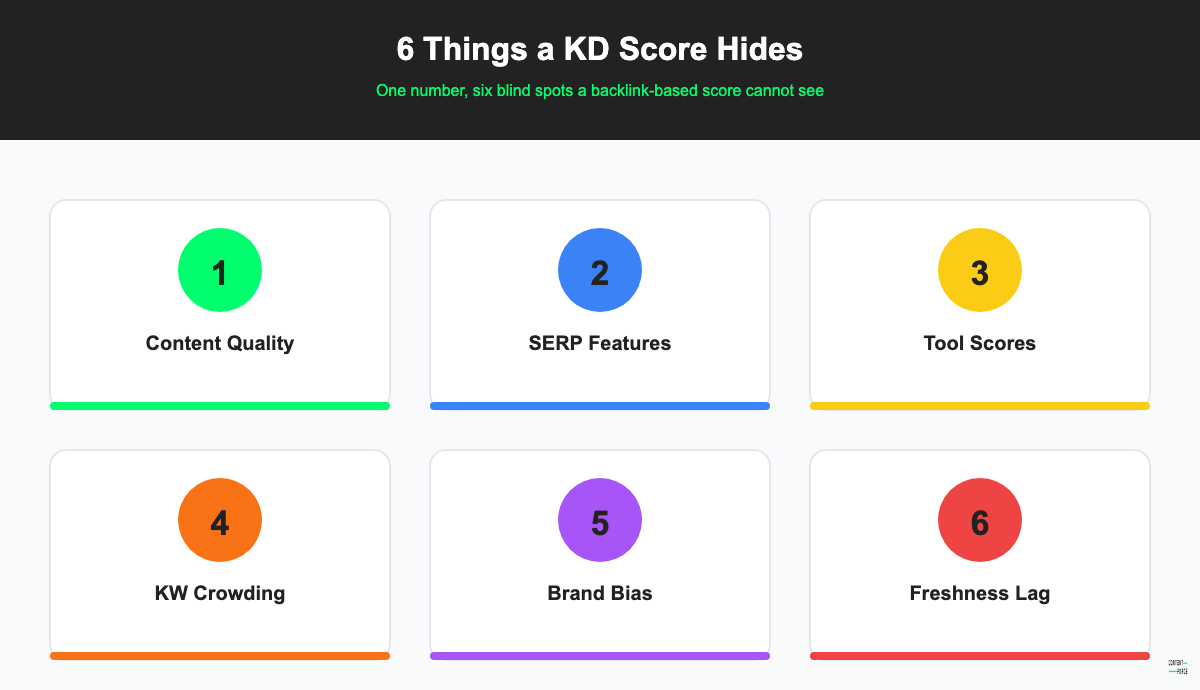
A single number cannot carry the context a real ranking decision needs. Here are six places where the score quietly leaves something out, each with a concrete example.
It Ignores Content Quality and On-Page Relevance
Ahrefs says it directly: the metric "doesn't take into account any on-page factors." That means a KD 70 keyword where the top 10 pages are five years old, thin, and poorly structured is a fundamentally different opportunity than a KD 70 keyword where the top 10 pages were published last month by well-resourced competitors covering the topic thoroughly. Both show the same score. Only one is realistically winnable with a strong content push instead of a link campaign.
Before you write off a high-KD term, spend ten minutes actually reading what currently ranks. If the top results are dated, shallow, or answer a slightly different question than the one your reader is asking, the backlink gap the score is warning you about may matter less than it looks.
It Doesn't Account for SERP Features Eating Your Clicks
A keyword's difficulty score says nothing about how much of the search results page is actually organic listings by the time a real user sees it. A query that triggers a featured snippet, a People Also Ask block, and an AI Overview can leave only two or three organic slots visible above the fold, no matter how low the KD number reads. Semrush lists SERP features as a difficulty input, but most tools do not translate that into what it actually costs you: fewer clicks even if you land a top position.
Before committing content resources to a low-KD term, check the live results page, not just the score. A "beatable" keyword surrounded by three stacked SERP features can deliver less traffic at position one than a slightly harder keyword with a cleaner results page.
Scores Disagree Across Tools
A keyword difficulty score is not a universal, tool-independent measurement. Each vendor runs its own backlink index, its own authority metric and its own weighting formula, so a KD 40 in Ahrefs is not describing the same competitive reality as a KD 40 in Semrush or SE Ranking. Backlinko's own keyword difficulty tool acknowledges this directly, dedicating a full section to comparing its score against other vendors' tools rather than pretending the numbers are interchangeable.
The practical fix is simple: pick one tool as your baseline and stay consistent within a single project or client account. Comparing a KD pulled from one tool against a KD pulled from another is comparing two different formulas, not two different keywords.
Low-Difficulty Keywords Get Crowded Fast
Once every SEO tool on the market can surface the same "low competition" keywords, everyone chasing quick wins ends up targeting the exact same list. Content strategist Tom Demers documented this pattern clearly: a basketball-related keyword scored a KD of just 1, yet the actual search results were dominated by highly authoritative sites, including one with a Domain Rating of 43, and mobile users had to scroll through four full screens of ads and features before reaching any lower-authority result. A related B2B Kubernetes term scored a KD of 5 and showed the identical pattern: established authority sites occupying nearly every visible slot, with maybe one lower-authority page sneaking into position five or eight.
A KD score that low should, in theory, be an easy win. In practice, a term that every tool flags as easy is often a term every competitor with a tool subscription has already tried to rank for, and Google has already rewarded the strongest sites among them.
It Misses Branded and Intent Bias
Backlink count cannot capture what Google has already decided about a query's intent. If the top 10 results for a term are dominated by household-name retailers or a single dominant brand, a lower or moderate KD score can be misleading, because Google may simply prefer known, trusted names for that query regardless of how many links a challenger site can accumulate. The reverse pattern shows up with local-intent searches: a phrase like "coffee shops near me" can register a keyword difficulty near zero, since the ranking factors that actually decide a local pack (proximity, reviews, business listings) barely touch a backlink-based formula, even though the real-world competition for that visibility is intense.
Neither case is a flaw in the math. It is a reminder that the score only measures one input among several that decide who actually shows up in results.
It's a Snapshot, Not a Forecast
A keyword difficulty score reflects the backlink profile of whoever happens to rank at the moment the tool crawls the results. It says nothing about where those competitors are headed. After a major algorithm update, sites that lose rankings in one category often pivot hard into adjacent, previously "easier" informational terms, reshaping the competitive field within weeks. The score you pulled last month can already be stale by the time your content goes live, particularly in categories where affiliate and content sites move quickly to chase whatever is still working.
How to Use Keyword Difficulty Without Getting Fooled by It
None of this means the score is useless. It means it needs company. Before you commit real production time to a keyword based on its KD number, work through this short check:
- Read the actual top 10, not just the score. Note the publish dates, the depth of coverage, and whether the pages answer the exact question your reader has.
- Look at the live results page for feature saturation. Count how much organic space actually survives featured snippets, People Also Ask, shopping units and AI Overviews before assuming a low score means easy traffic.
- Check your personal or domain-adjusted difficulty, not just the generic number. Most major tools now offer a personalized score, sometimes called Personal Keyword Difficulty, that weighs the term against your own site's authority rather than a generic baseline. A generic KD 55 might carry a personal difficulty far lower or higher depending on where your domain already stands.
- Confirm the intent still matches what you plan to publish. A branded or heavily local SERP can carry a deceptively low or moderate score while still being a poor use of your time.
- Treat the score as a first filter across a large list, not a final decision on any single keyword. Use it to cut the obviously out-of-reach terms from a big export, then apply the checks above to whatever survives.
This is close to what Backlinko's own keyword tool gestures at when it tells users to "get more than just a keyword difficulty score." The difference is doing it as a repeatable step in your workflow instead of a one-line reminder.
What Counts as a Good Keyword Difficulty Score?
There is no universal good keyword difficulty score, and any list that hands you a fixed cutoff (under 30 is easy, over 70 is hard) is giving you a generic rule for a decision that is actually specific to your site. What matters is your own authority relative to whoever currently occupies the top 10, which is exactly what personalized difficulty metrics like Semrush's Personal Keyword Difficulty (PKD) try to capture.
A brand-new site with almost no backlink history should generally stay well below the generic KD range that an established domain could reasonably target, since the referring-domains gap in the earlier table applies to your site's starting point, not just the keyword. An established site with real domain authority can often go after keywords that a generic score would flag as difficult, because its own link profile already closes part of the gap the score is measuring.
Keyword Difficulty FAQ
Is a low keyword difficulty score always easier to rank for?
Not always. A low score means the ranking pages have relatively few referring domains, but it says nothing about SERP feature saturation, branded or local intent bias, or how many other sites have already noticed the same low number and started targeting it.
Why do keyword difficulty scores differ between Ahrefs, Semrush and other tools?
Each tool runs its own backlink index and its own weighting formula, so the same keyword can score differently across vendors. Pick one tool as your baseline and compare keywords within that tool consistently, rather than mixing scores from different platforms.
Does keyword difficulty account for content quality?
No. Ahrefs states directly that its Keyword Difficulty metric does not factor in on-page content or relevance. The score reflects the backlink profile of the current top 10, not whether those pages actually serve the search intent well.
Should I ever target a high-difficulty keyword?
Yes, when the actual top 10 results are outdated, thin, or answer a slightly different question than your content will. The score flags a backlink gap, not a content gap, so a high score with a weak, stale results page can still be a realistic opportunity.
What is Personal Keyword Difficulty?
Personal Keyword Difficulty (PKD) adjusts the generic score to your own site's authority instead of a one-size-fits-all baseline. It answers a more useful question: not "how hard is this keyword in general," but "how hard is this keyword for my specific domain right now."