
Guide
Keyword Research: The Complete Guide (2026)

Keyword research is the process of finding and evaluating the words and phrases people search for so you can build content that attracts the right audience. The guide walks through a repeatable ten-step process, from defining goals to prioritizing a finished keyword list, plus the metrics and tools that matter most.
- Define your goals and target audience before opening any tool
- Brainstorm ten to twenty seed keywords representing your core topics
- Expand each seed keyword using a keyword research tool
- Analyze search intent by reviewing the actual top five results
- Group related keywords into clusters that share the same intent
- Prioritize clusters by business impact, feasibility, and content readiness
Keyword research is the process of finding and analyzing the words and phrases people type into search engines so you can create content that attracts the right audience. Tools like Google Keyword Planner, Semrush, and Ahrefs Keywords Explorer are built specifically for this work. Keyword research is the foundation of every successful SEO strategy, and it determines whether your pages get found by real searchers or disappear into the void.
The stakes are high. Studies show that around 90% of all web pages receive zero organic traffic from Google. The pages that do rank almost always got there because someone did the work to understand exactly what their audience searches for, how competitive those searches are, and what kind of content will satisfy search intent.
This guide covers everything you need to know: what keyword research is, the types of keywords you'll work with, the metrics that matter, a step-by-step process you can follow, the best free and paid tools, and how to avoid the mistakes that waste time and produce thin results.
What Is Keyword Research?
Keyword research is the practice of discovering the specific search queries people use to find information, products, or services online and then evaluating those queries to decide which ones to target with content, ads, or landing pages.
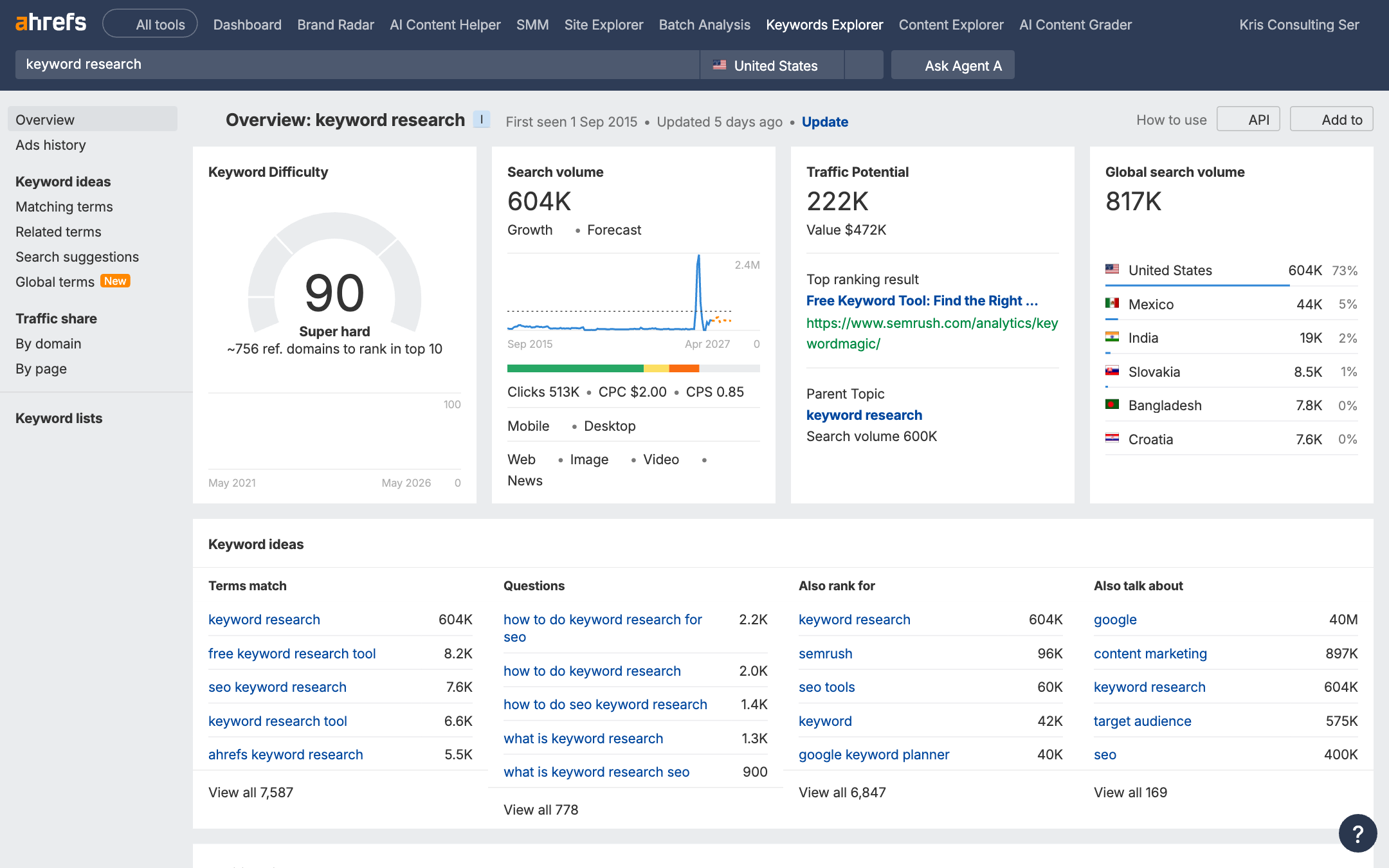
A keyword isn't just a word. In SEO, a keyword is any search query entered into a search engine, in any of these forms.
- A single word counts, such as "SEO."
- A short phrase counts, such as "keyword research."
- A long question counts, such as "how to do keyword research for a new website."
- A local query counts, such as "SEO agency near me."
Keyword research connects what you publish to what real people actually search for. Without it, you're guessing. With it, you're making decisions based on measurable search demand and competitive data.
Keyword research applies across disciplines. In SEO, it drives content strategy and on-page optimization. In pay-per-click advertising, it informs which search terms trigger your ads. In content marketing, it tells you which topics to prioritize. The principles are the same across all three, though the specific metrics you weight will differ.
At its core, keyword research answers three things: what people are searching for, how many people search for it, and what they actually want when they search for it. Get those three things right and you've the information you need to build a content strategy that generates real traffic.
Why Keyword Research Matters for SEO
Keyword research isn't optional. It's the step that makes everything else in SEO more effective, period.
It reveals actual demand. You may believe your audience searches for "content marketing strategy," but the data might show that ten times more people search for "how to create a content calendar." Without research, you build content around assumptions instead of facts.
Realistic rankability comes from the same data. A keyword with 100,000 monthly searches sounds valuable, but if the top 10 results are all from domain rating 90+ sites and you're starting from scratch, you won't rank there anytime soon. Keyword research lets you find the overlap between search demand and competitive opportunity.
Intent alignment follows next. Google's primary goal is to match searchers with the most relevant result for their query. When your content matches the intent behind a keyword, not just the words, you rank better and convert more visitors.
A well-built keyword list structures your entire content strategy. It becomes the backbone of your editorial calendar, your internal linking structure, and your site architecture. Keywords aren't just for individual pages; they define how your whole site is organized around topics.
Unlike ad spend, this work compounds. Pages built on solid keyword research continue to attract traffic for months and years, while paid traffic stops the moment you stop paying. Organic traffic from well-ranked content is an asset that keeps working.
It informs every stage of the funnel. Keyword research doesn't just find traffic, it maps what potential customers are thinking at each stage of their decision process. Informational keywords show early-stage research. Commercial and transactional keywords show readiness to buy. A good keyword strategy covers the full funnel.
Types of Keywords You Need to Know
Not all keywords work the same way. Understanding the taxonomy helps you build a balanced strategy rather than chasing one type at the expense of others.
Head Keywords (Short-Tail)
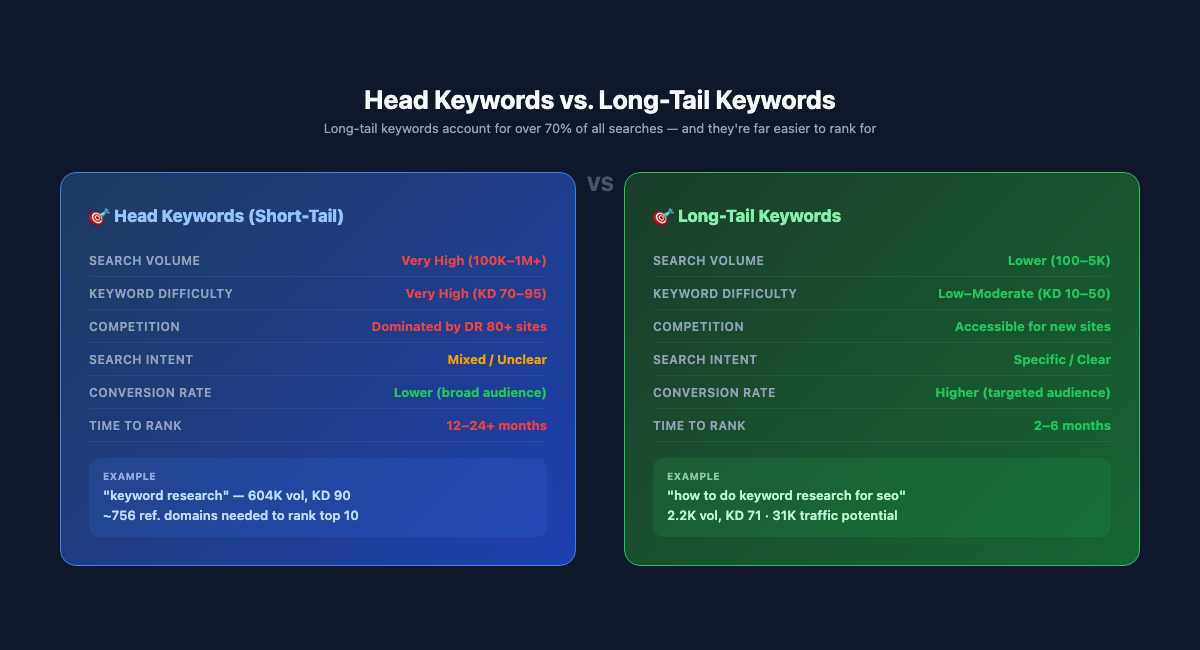
Head keywords are short, broad terms of one to two words. Examples: "SEO," "keyword research," "email marketing." They have extremely high search volume but also extremely high keyword difficulty. Top results for head terms are almost always dominated by high-authority sites that have covered the topic exhaustively for years.
Head keywords are worth tracking as long-term goals, but they're rarely the right starting point for a new or mid-authority site. The competition at the top of Google for a term like "keyword research" is Ahrefs, Semrush, Moz, and WordStream, brands with domain ratings above 80 and thousands of backlinks to their content.
Long-Tail Keywords
Long-tail keywords are longer, more specific phrases. Examples: "how to do keyword research for a new blog," "best free keyword research tools for beginners," "keyword research for ecommerce product pages."
Long-tail keywords individually have lower search volume but collectively account for the majority of all searches. They are far less competitive, have higher conversion rates because the searcher's intent is more specific, and are, without question, easier to rank for with targeted content.
For most sites, a long-tail-first strategy builds authority and traffic faster than chasing head terms. A new SEO blog has a realistic chance of ranking for "keyword research for a new website with no backlinks" long before it can compete for "keyword research" on its own. See what long-tail keywords are and how to find them for a deeper walkthrough of this approach.
Branded vs. Non-Branded Keywords
Branded keywords include your company or product name: "Ahrefs keyword research tutorial," "Semrush keyword tool review." Non-branded keywords are generic: "keyword research tool," "how to find keywords for SEO."
Branded keywords show high intent from people already aware of you and typically convert at high rates. Non-branded keywords bring in new audiences who don't know your brand yet. Both matter, but non-branded keywords typically drive the majority of new organic traffic and are the primary focus in an organic SEO strategy.
Search Intent Categories
Search intent is the reason behind a search query. Google classifies intent into four categories, and getting this right is more important than almost any other keyword selection factor.
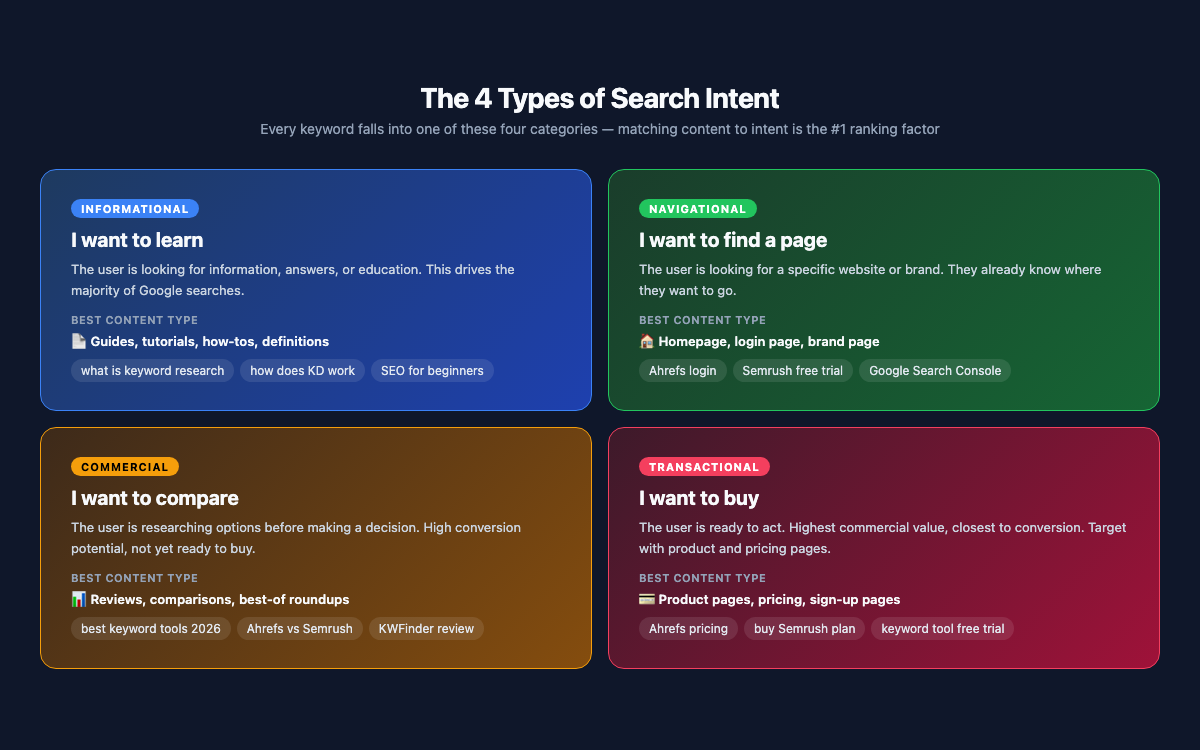
Informational: The user wants to learn something. Examples: "what is keyword research," "how does keyword difficulty work," "what is a long-tail keyword." Most blog content, guides, tutorials, and definition articles target informational intent. This is the most common intent type in content marketing. High-intent keywords that trigger commercial and transactional results are a related but distinct category worth studying separately.
Navigational: The user wants to find a specific site or page. Examples: "Ahrefs login," "Semrush free trial page." These queries rarely make sense to target with new content unless you are the brand being searched for.
Commercial: The user is researching options before making a decision. Examples: "best keyword research tools 2026," "Ahrefs vs Semrush," "KWFinder review." Comparison posts, roundup articles, and review pages target commercial intent. This is the dominant intent for tool-category queries.
Transactional: The user is ready to act or buy. Examples: "buy Semrush subscription," "Ahrefs free trial," "sign up for keyword tool." Product pages, pricing pages, and landing pages target transactional intent.
Every keyword you target should have a content type matched to its intent. Writing an informational guide for a transactional keyword, or a sales page for an informational query, will produce poor rankings regardless of how well the content is written.
Seed Keywords
A seed keyword is the starting point for keyword research, a broad, foundational term directly related to your topic, product, or niche. You enter seed keywords into a keyword research tool like Google Keyword Planner or Ahrefs Keywords Explorer to generate a universe of related keyword ideas.
For an SEO blog, your seed keywords might include: "keyword research," "link building," "on-page SEO," "technical SEO," "content marketing." Each seed generates hundreds of related keyword ideas that become the raw material for your content strategy.
The key to good seed keyword selection is thinking from your customer's perspective: the terms someone would use when they first start searching for solutions to the problems your content addresses.
LSI Keywords and Topically Related Terms
Latent Semantic Indexing (LSI) keywords are terms that are thematically related to your primary keyword without being synonyms. They help search engines understand the full topic coverage of a page and indicate that your content thoroughly covers a subject.
For an article on keyword research, related terms include: search volume, keyword difficulty, search intent, seed keywords, long-tail keywords, keyword research tools, SERP analysis, keyword clusters, traffic potential. Including these terms naturally and in context helps your page rank for a broader set of related queries.
Keyword Clusters
A keyword cluster is a group of closely related keywords that share the same search intent and can be targeted by a single piece of content. Clustering prevents keyword cannibalization (multiple pages on your site competing for the same query) and ensures you build topical depth rather than writing ten shallow posts about slightly different variations of the same topic.
For example, "keyword research," "how to do keyword research," "keyword research tutorial," and "keyword research guide" likely all share the same intent and should be covered by one comprehensive article rather than four separate thin posts. You could also add related supporting keywords like "how to find keywords for a new website" or "keyword research process" and serve them all from the same page. Building content around clusters is a core part of building topic clusters and topical authority.
Key Keyword Metrics Explained
Every keyword research tool surfaces a set of metrics to help you evaluate and compare keywords. Here is what each one means and how to use it.
| Metric | What It Measures | Why It Matters |
|---|---|---|
| Search Volume | Average monthly searches | Shows demand size |
| Keyword Difficulty | Estimated ranking difficulty (0-100) | Filters for competitive feasibility |
| Search Intent | Purpose behind the search | Determines content type to create |
| Traffic Potential | Total traffic a top-ranked page gets | Better ROI estimate than volume alone |
| CPC | What advertisers pay per click | Signals commercial value |
| CTR / SERP Features | Organic click share | Adjusts real traffic expectations |
| Trend / Growth | Volume direction over time | Avoids targeting declining keywords |
Search Volume
Search volume is the average number of times a keyword is searched per month in a given country or globally. A keyword with 10,000 monthly searches in the US is searched approximately 10,000 times each month.
Search volume is directional, not precise. Tools calculate it from statistical sampling, and the number you see is typically a 12-month average that smooths out seasonal spikes. December is unusually high for "Christmas gifts." January is high for "gym membership." Use search volume to compare keywords relative to each other, not as an exact count of page visitors. For a concrete example of how that trailing 12-month average plays out at the very top of the search market, see our ranked list of the most searched keywords on Google.
A keyword with 1,000 monthly searches and highly specific purchase intent often drives more qualified traffic and more conversions than a keyword with 50,000 searches and mixed, unfocused intent.
Keyword Difficulty (KD)
Keyword difficulty is a score from 0 to 100 estimating how hard it would be to rank in the top 10 organic results for a given keyword. Most tools calculate this based on the number and quality of backlinks pointing to the currently ranking pages.

Benchmarks for most tools:
- 0-20: Low difficulty. Achievable for new sites with well-structured, high-quality content.
- 21-40: Moderate. Requires some backlinks and established topical authority.
- 41-60: Hard. Strong content plus a solid link profile required.
- 61-80: Very hard. Dominated by high-authority sites.
- 81-100: Extremely competitive. Typically reserved for major brands and media outlets.
Keyword difficulty is a useful filter but not the full picture. A low-difficulty keyword with no search volume isn't worth targeting. A high-difficulty keyword that is central to your business might be worth building toward over 12-24 months. Use KD to prioritize your roadmap, not to eliminate keywords from your strategy entirely.
Note that KD scores vary between tools, a score of 50 in Ahrefs is not the same as 50 in Semrush. Always interpret difficulty relative to the tool you're using.
Search Intent
Some tools automatically classify the primary intent for each keyword as informational, navigational, commercial, or transactional. These classifications are useful starting points but should always be verified by checking the actual SERP manually.
Open Google and search for the keyword. If the top 10 results are all product pages and your planned content is a blog post, you have an intent mismatch that no amount of optimization will overcome. Google has learned what type of content searchers want for millions of queries, and it'll show that content type ahead of anything else.
Intent alignment is more important than any other metric. A page perfectly optimized for the wrong intent will underperform a mediocre page that nails the intent.
Traffic Potential
Traffic potential isn't the same as search volume. It estimates the total organic traffic a top-ranking page for a keyword actually receives, accounting not just for the primary keyword but for all the semantically related terms that page ranks for simultaneously.
A keyword with 1,000 monthly searches might carry a traffic potential of 8,000 if the top-ranking page captures many related long-tail variations at the same time. Traffic potential is a better predictor of content ROI than raw search volume, and it is one of the most underused metrics in keyword research.
Ahrefs provides this metric directly as "Traffic Potential" in Keywords Explorer. For other tools, you can approximate it by looking at the traffic reported for the top-ranking URL in a tool like Ahrefs Site Explorer or Semrush.
Cost Per Click (CPC)
CPC is the average amount advertisers pay for a single click on a paid ad for that keyword. A keyword with a $10 CPC means advertisers are willing to pay $10 for each visitor, a signal that those visitors convert into customers frequently enough to justify that cost.
You can use CPC as a relevance signal even if you are not running paid ads. Keywords with high CPC tend to have strong commercial or transactional intent. If advertisers pay $8 per click for "best keyword research tool," organic ranking for that term has meaningful commercial value even for a content site.
CPC data is available for free in Google Keyword Planner (with a Google Ads account) and in most paid keyword research tools.
Click-Through Rate (CTR) and SERP Features
SERP features: featured snippets, "People Also Ask" boxes, image packs, local maps, video carousels, appear above organic blue-link results and reduce the click-through rate for organic positions. Position 1 for a keyword dominated by a featured snippet might receive only 5-10% of clicks rather than the typical 25-30%.
Before committing to a keyword, open the SERP and count how many features appear above organic results. A keyword with 10,000 monthly searches but four ads, a featured snippet, and a knowledge panel might deliver fewer organic clicks than a cleaner 3,000-search keyword.
Keyword Trend / Growth
Trend data shows whether a keyword's search volume is growing, stable, or declining over time. Google Trends is the best free tool for trend data.
Trending upward: excellent time to build content to capture rising demand early. Stable: reliable, predictable traffic with low seasonal risk. Declining: may still be worth targeting if current volume is high enough, but avoid heavy investment in a shrinking market.
Trend analysis is especially important in fast-moving fields like technology, where tools and topics rise and fall quickly.
How to Do Keyword Research: A Step-by-Step Process
Most guides on keyword research list principles and tools without walking through the actual workflow. Here is a repeatable 10-step process you can follow from scratch to a finished, prioritized keyword list.
Step 1: Define Your Goals and Target Audience
Before you open a keyword tool, get clear on two things: what you want your content to achieve, and who you're writing for.
Your answers define which keywords are worth pursuing. A B2B SaaS company targeting enterprise buyers should not build its content strategy around high-volume, low-intent terms that attract students and curious browsers. A local dental practice should not target national head terms that no local-intent search would ever trigger.
Write down: your primary business goal (leads, sales, subscriptions, brand awareness), your target reader (job role, knowledge level, problem they are trying to solve), and the stage of the funnel you are trying to reach (awareness, consideration, decision).
Step 2: Brainstorm Seed Keywords
Without opening any tool, write down 10-20 words and phrases that represent the core topics, products, services, or problems your site addresses.
Good sources for seed keywords include: the products and services you sell, questions you hear repeatedly in sales calls or customer support, topics your audience discusses in online communities and forums, and categories from your site navigation or product catalog. Reddit threads, niche forums, and Q&A sites in your industry are worth a direct look too. They surface the exact phrasing real buyers use and the questions they ask that a keyword tool alone won't suggest.
For an SEO software company, seed keywords might include: keyword research, rank tracking, backlink analysis, site audit, technical SEO, content optimization, SERP analysis. For a recipe blog: healthy dinner recipes, meal prep ideas, easy weeknight meals, vegetarian meals, air fryer recipes.
Step 3: Expand with a Keyword Research Tool
Enter your seed keywords into a keyword research tool. Google Keyword Planner is the most accessible free option, enter a seed keyword and it returns hundreds of related keywords with estimated search volume ranges. Paid tools like Ahrefs Keywords Explorer and Semrush Keyword Magic Tool return more precise data and larger keyword lists.
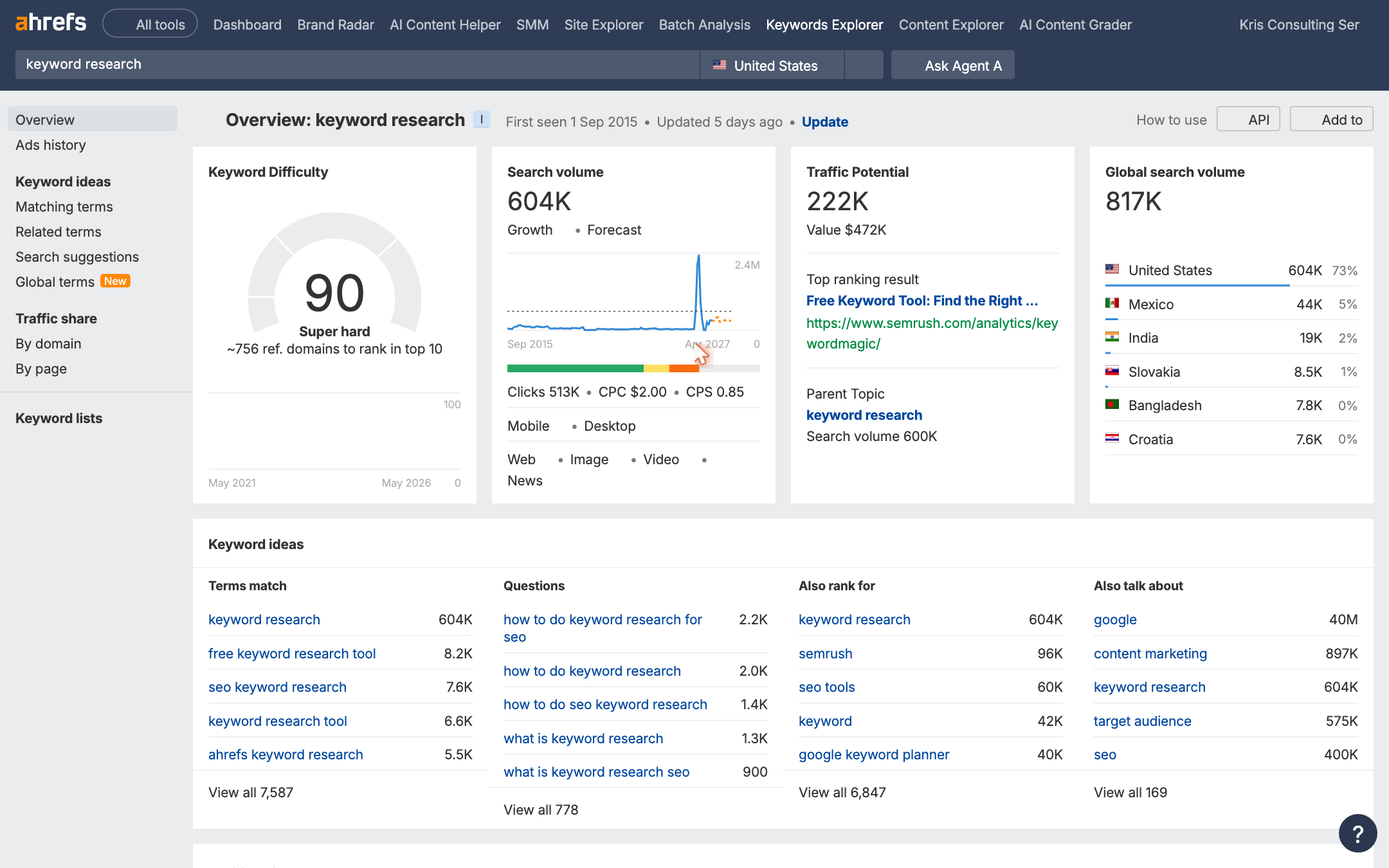
Ahrefs Keywords Explorer returns 7,587 matching terms for "keyword research", each with KD, search volume, traffic potential, and CPC to help you filter and prioritize. What to collect from this step: a full list of related keyword ideas, search volume estimates for each, keyword difficulty scores, intent classifications where available, and CPC data as a commercial relevance signal. Start broad and export everything: you can narrow down your list in the next steps.
Step 4: Analyze Search Intent for Each Keyword
For every keyword you're seriously considering targeting, open Google and look at the actual SERP results before making any decision.
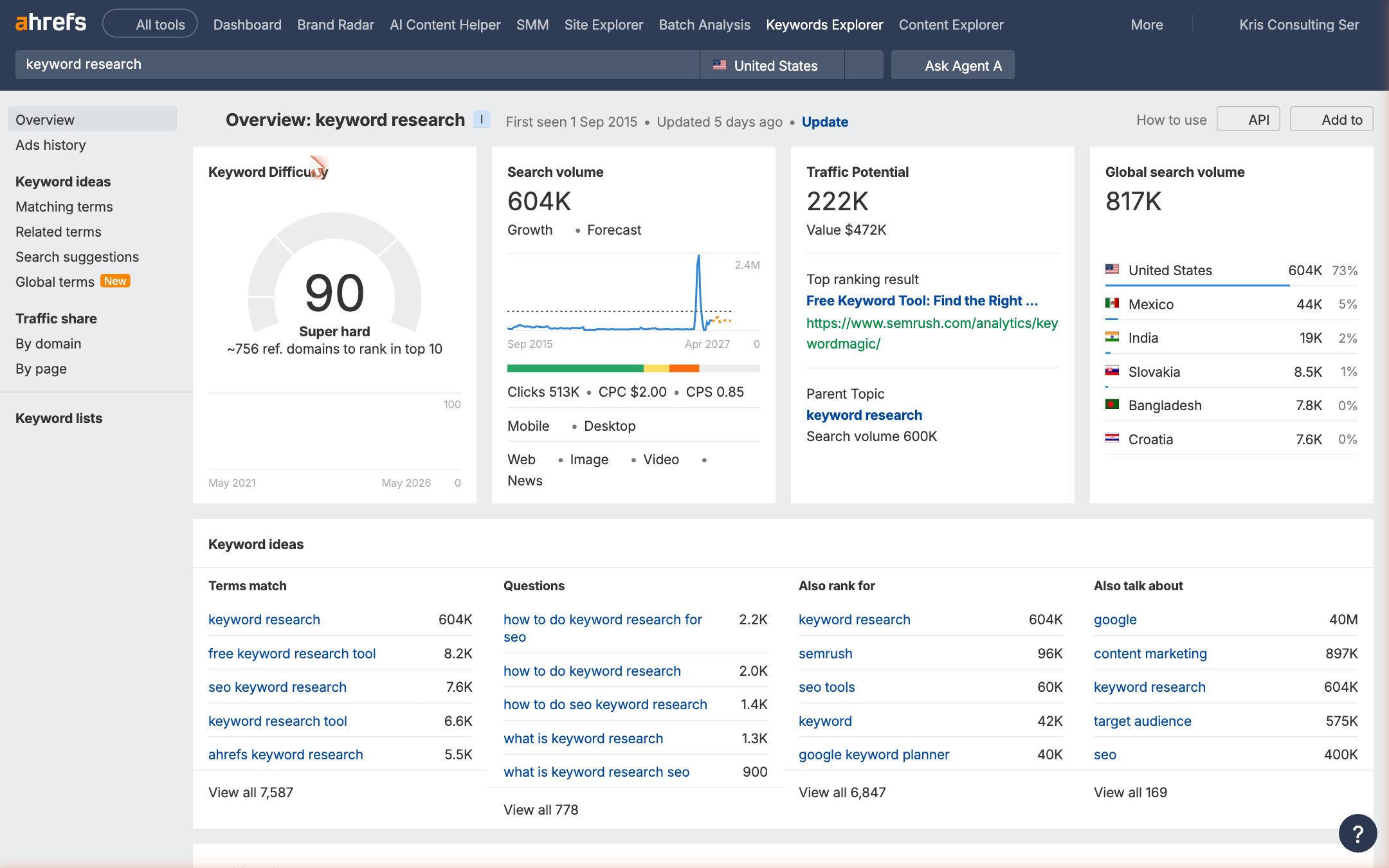
778 question-based keywords around "keyword research", with lower KD scores (67-85) vs. the head term's KD 90, and each signals clear informational intent. Look at three things in the current top 5 results: the content type that dominates (blog posts, product pages, videos, forum threads, or tool pages), the format top results use (how-to guides, numbered listicles, comparison tables, or definition articles), and the angle they take (beginner-friendly overview or advanced deep-dive).
This analysis tells you exactly what format and angle your content needs. If every top result is a comparison table with tool reviews, a narrative informational post will underperform regardless of technical SEO quality.
Step 5: Evaluate Keyword Metrics
Now filter your keyword list using the metrics you collected. A practical filtering approach:
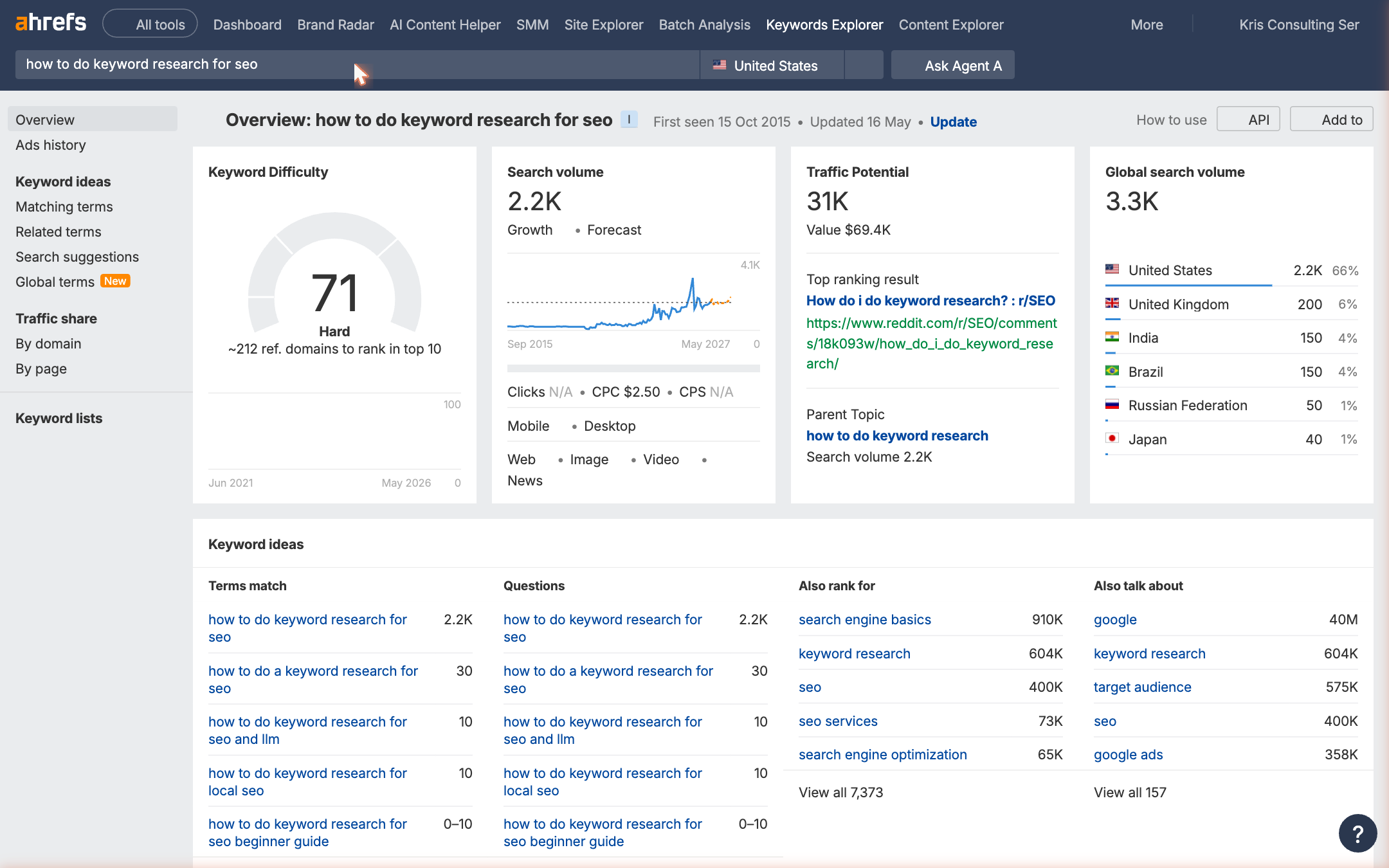
"How to do keyword research for seo" has only 2.2K monthly searches but a Traffic Potential of 31K: the top-ranking page captures the full surrounding keyword cluster. Remove keywords below your minimum search volume threshold (for most sites, fewer than 100-200 monthly searches is too thin unless the keyword is highly targeted or conversion-specific). Flag keywords where your current domain authority makes ranking realistic, check the KD score against your site's authority tier. Note keywords with high traffic potential relative to their stated search volume. Flag high-CPC keywords as having commercial value.
The goal of this step is to go from a broad list of hundreds of keywords to a focused shortlist of 20-50 candidates worth pursuing.
Step 6: Research What Your Competitors Rank For
Competitor keyword research is often the highest-ROI activity in the entire process. Identify your top organic competitors, the sites that consistently rank for keywords related to your niche, and analyze their keyword profiles.
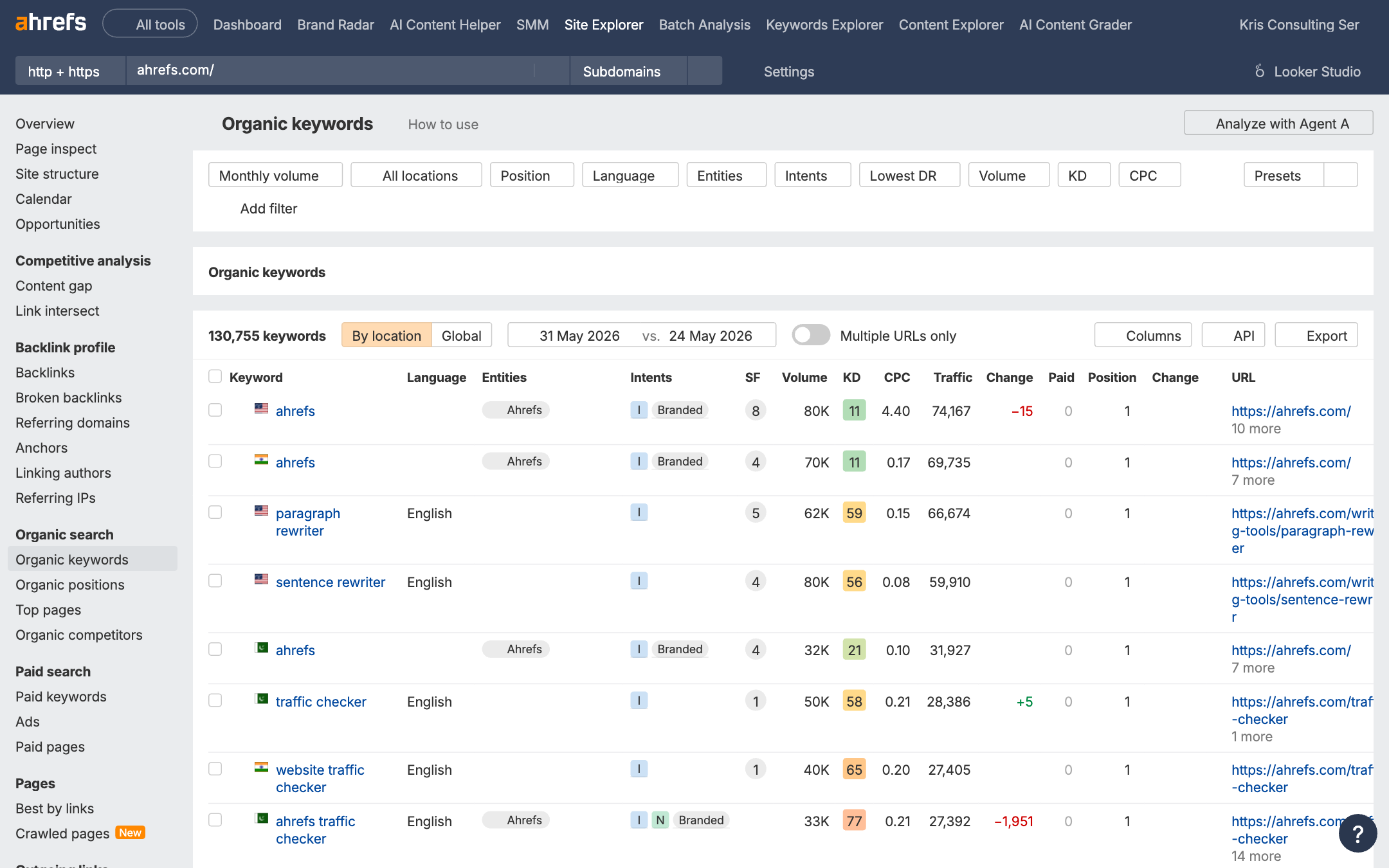
Ahrefs Site Explorer shows all 130,755+ keywords a competitor ranks for. Sort by Traffic to find their highest-value pages and identify gaps your site is missing. With a tool like Ahrefs Site Explorer or Semrush Organic Research, enter a competitor's domain and look at their top organic keywords. Focus on: which keywords drive the most traffic to their site, which high-value keywords they rank for that you've not covered, and which of their high-traffic pages you could create a clearly better version of.
Competitors have already validated which keywords work in your market. You aren't copying them: you are using their success as a signal of where search demand actually exists, then finding ways to serve that demand better.
Step 7: Identify Keyword Gaps
A keyword gap is a keyword that one or more of your competitors rank for, but your site doesn't. Keyword gap analysis tools, Ahrefs Content Gap, Semrush Keyword Gap, automate this comparison across multiple competitors at once. For a standalone walkthrough of this process, see what a content gap analysis is and how to run one.

Ahrefs Content Gap: 73,631 keywords where Semrush ranks but Ahrefs doesn't. Each gap is a validated content opportunity: someone is already searching for it. These gaps represent immediate content opportunities. If three of your top four competitors rank in the top 10 for a keyword and you have no content targeting it, that gap is validated search demand your site is missing entirely.
Sort keyword gap results by traffic potential or volume and focus first on gaps where you've the authority to compete.
Step 8: Group Keywords into Clusters
Take your filtered, researched keyword list and group semantically related keywords together. Keywords that share the same search intent and would be best answered by the same piece of content belong in one cluster.
A cluster might look like this for an SEO site:
- Primary: "keyword research"
- Supporting: "how to do keyword research," "keyword research tutorial," "keyword research for beginners," "keyword research guide," "keyword research process"
- All of these belong in one comprehensive guide, not six separate posts
Clustering prevents keyword cannibalization and ensures you build one authoritative page on a topic rather than fragmenting your authority across many thin pages.
Step 9: Map Keywords to Content Types and Pages
Assign each cluster to the right content type based on the intent you confirmed in Step 4:
- Informational intent: blog post, guide, tutorial, definition article
- Commercial intent: comparison article, best-of roundup, review post
- Transactional intent: product page, landing page, pricing page
- Navigational intent: homepage, category page, brand page
For each cluster, also decide whether you need a new page or whether an existing page on your site should be updated to target the keyword cluster. Publishing a new post when you already have a page covering the same topic creates cannibalization rather than adding value.
Step 10: Prioritize and Build Your Keyword List
You've now got a mapped, clustered keyword list. The final step is deciding what to work on first. Since you can't publish everything at once, prioritization determines your content calendar for the next quarter.
Prioritize based on:
Business impact: the keywords that, if ranked, would most directly drive revenue, leads, or user acquisition get the highest priority regardless of difficulty.
Competitive feasibility: start with the keywords your site can realistically rank for in the next 3-6 months given its current domain authority. Those are the wins you can achieve now.
Content readiness: favor keywords that align with content your team can research and produce quickly. Fast execution on good keywords beats slow execution on great ones.
Strategic gaps: close the keyword gaps competitors are actively capturing right now. Closing a gap that a competitor is ranking for stops your competitor from taking traffic that should be yours.
A simple scoring matrix: assign 1-5 points for volume potential, business relevance, and competitive feasibility. Sum the scores per cluster. Work through the highest-scoring clusters first.
Best Keyword Research Tools in 2026
No single tool is right for every use case. The table below compares the five tools covered in this section side by side, so you can match a tool to your budget and workflow before reading the full breakdown.
| Tool | Best for | Standout feature | Free plan | Starting paid price |
|---|---|---|---|---|
| Google Keyword Planner | Commercial and transactional keywords, PPC campaigns | Direct Google Ads volume and bid data | Yes, full access with any Google account | Free (requires a Google Ads account) |
| Ahrefs Keywords Explorer | Traffic potential and competitive gap analysis at scale | Traffic Potential and Parent Topic clustering | Limited, via the free keyword generator | Around €99/month, Lite plan (billed annually; check ahrefs.com/pricing for your region) |
| Semrush Keyword Magic Tool | PPC research and competitive intent filtering | Filtering by intent, format and SERP feature | Limited, capped daily lookups | Around €112.52/month, entry plan (billed annually; check semrush.com/prices for current tiers) |
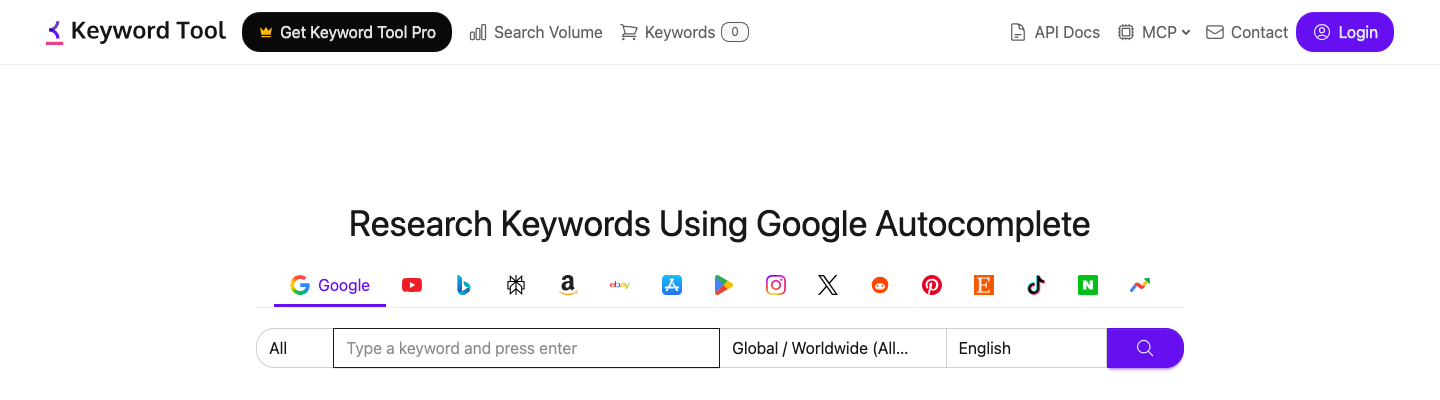
| KeywordTool.io | Autocomplete-based long-tail discovery beyond Google | 16 platforms, including YouTube, Amazon and TikTok | Yes, unlimited suggestions without an account | Paid tier required for volume and CPC data |
| Ubersuggest | Ad-hoc lookups on a zero budget | Simple interface, quick keyword and difficulty checks | Yes, with a daily query limit | Paid tier required for higher daily limits |
Free Keyword Research Tools
Google Keyword Planner
Google Keyword Planner is the most widely used free keyword research tool. Built into Google Ads, it's free to access with any Google account even if you aren't running paid campaigns.
Enter a seed keyword and Keyword Planner returns hundreds of related keyword ideas with search volume data, competition level (low/medium/high for paid ads), and suggested bid ranges. The primary limitation is that search volume is shown as ranges (1,000-10,000) rather than precise numbers unless you have an active ad campaign with spend, but for directional keyword research, ranges are often sufficient.
Google Keyword Planner is particularly strong for keywords with commercial and transactional intent, since it was built for advertisers. It is less useful for purely informational, low-commercial-value keywords where advertisers have little interest.
Google Search Console
Google Search Console shows which queries your site already ranks for and how many clicks and impressions each query receives. This real data from Google is invaluable for keyword research because it shows actual performance rather than estimated potential.
Use Search Console to find keywords where you already rank on pages 2-3 of Google results, these are often your fastest opportunities. A page that ranks at position 15-25 for a keyword with decent volume needs far less work to move to position 5-10 than creating entirely new content. See how to use Google Search Console keyword data effectively for a deeper guide to this approach.
Google Search Autocomplete and People Also Ask
Type any keyword into Google's search bar and the autocomplete suggestions that appear are real, popular search queries related to your seed term. These suggestions are based on actual search behavior and are updated in near real-time.
Similarly, the "People Also Ask" box that appears in many search results shows related questions real searchers are asking. These question-format keywords are excellent for targeting featured snippets and for building out FAQ sections on existing pages.
Ubersuggest (free tier)
Neil Patel's Ubersuggest offers keyword ideas, search volume, and keyword difficulty data with a daily query limit on the free plan. It is useful for quick, ad-hoc keyword lookups and provides enough data for early-stage keyword research on a zero budget.
Ahrefs Free Keyword Generator
Enter a seed keyword at Ahrefs' free keyword generator tool and get the top 100 keyword ideas with search volume and keyword difficulty scores. No account required. A good complement to Google Keyword Planner when you want a second data source.
For a more detailed comparison of every major free option, see 10 Best Free Keyword Research Tools in 2026.
Paid Keyword Research Tools
Ahrefs Keywords Explorer
Ahrefs Keywords Explorer is widely considered the most comprehensive keyword research tool available. Key advantages: the traffic potential metric (shows total expected traffic from a page ranking for a keyword, not just the keyword's own volume), parent topic identification (shows which broader topic a keyword belongs to), and SERP history (tracks how rankings for a keyword have shifted over time). The tool pulls from a database of billions of keywords across 170+ countries.
Pricing starts around €99/month for the Lite plan, billed annually (rates vary by region and billing cycle, so check Ahrefs' current pricing page for your exact quote). Worth the cost for any site doing keyword research at scale or building a content strategy as a core growth channel.
Semrush Keyword Magic Tool
Semrush's Keyword Magic Tool gives access to one of the largest keyword databases in the industry. Strong filtering capabilities by intent type, keyword format (question, comparison, broad), related topic groups, and SERP features. Particularly well-suited for PPC keyword research and competitive analysis workflows.
The free Semrush account provides limited but genuinely useful keyword data, enough for basic research before committing to a paid subscription. Paid plans start around €112.52/month on the entry tier, billed annually; check Semrush's current pricing page, since plan names and exact rates shift periodically.
Moz Keyword Explorer
Moz Keyword Explorer offers strong keyword suggestions with a useful "Organic CTR" metric that adjusts expected click volume downward when SERP features are present. This makes volume estimates more realistic than tools that report raw search volume without SERP feature adjustments. User-friendly interface that works well for teams newer to keyword research. Pricing starts around $99/month.
KWFinder (Mangools)
KWFinder provides reliable keyword difficulty scores and accurate search volume data in a clean, easy-to-navigate interface. Often recommended as a more affordable option for small teams and freelancers who do not need the full feature set of Ahrefs or Semrush. Pricing starts around $49/month for the Mangools Basic plan.
AI-Powered Keyword Research
AI tools like ChatGPT, Claude, Gemini, and Perplexity can support keyword research, but only in specific, well-defined ways.
Where AI helps:
- Brainstorming seed keywords and topic areas you've not considered
- Generating question-based keyword variations ("how to," "what is," "why does," "when should")
- Mapping a keyword list to intent categories at scale
- Grouping large keyword lists into topical clusters
- Identifying related subtopics and questions around a core keyword
Where AI falls short:
- AI tools don't have access to real-time search volume data
- They can't accurately assess how competitive a keyword is in practice
- They produce plausible-sounding keywords that have not been verified against actual search behavior
The right approach: use AI tools for ideation, brainstorming, and clustering. Validate every keyword you plan to target using a tool, Google Keyword Planner or a paid tool, that has real search volume and competition data.
SEO Title Generator: eight title tag variations, sized for the SERP and intent-matched. Free, no signup.
How to Choose the Right Keywords
Having a list of keyword candidates is different from having the right keywords for your strategy. These filters help you identify the keywords worth building content around.
Match the Keyword to Search Intent
Verify intent by opening the actual SERP before making any final decision. If the content type ranking isn't the content type you can produce, the keyword is not right for your site in its current form. Intent matching is the single most important filter.
Balance Volume vs. Keyword Difficulty
Every site has a competitive ceiling, a keyword difficulty level above which it realistically cannot rank given its current domain authority and backlink profile. A new site with no established authority should focus on keywords with KD below 20-30. An established mid-authority site can target KD 20-50. Only high-authority sites with strong link profiles should invest in keywords above KD 60.
Match difficulty to your current ability to compete, not to your eventual ambitions.
Consider Business Relevance and Conversion Potential
Not all traffic has equal value. A keyword that brings 200 highly targeted visitors per month who convert to customers is worth far more than a keyword that brings 5,000 visitors with no connection to your offer.
Weight keywords more heavily when they align directly with what your business sells, the problems your product solves, or the decision a buyer makes just before purchasing.
Look for Low-Competition, Long-Tail Opportunities
Long-tail keywords with specific intent are the fastest realistic path to organic traffic for most sites. They are easier to rank for, signal more specific intent, and build the topical authority that eventually helps you compete for broader head terms.
A site that ranks for 200 long-tail keywords around a topic is in a stronger position to rank for the head term than a site that tried to target the head term directly from day one.
Account for Traffic Potential, Not Just Search Volume
A keyword with 500 monthly searches might generate 3,000 monthly visitors for the page that ranks first, because that page also captures related long-tail variants. Always look at what total traffic the current top-ranking page receives, this is a far more honest estimate of what ranking for that keyword could actually deliver.
How to Prioritize Your Keyword List
After filtering and clustering, you still have more targets than you can execute in one quarter. Prioritization is where keyword research connects to an actual content plan.
Score by business impact first. Keywords that most directly contribute to revenue, pipeline, or user acquisition get the highest priority, regardless of difficulty. Build the hardest, most valuable keywords into a 12-month horizon plan, not the current quarter's execution list. A quick check that works regardless of volume: ask whether ranking first for the term would actually drive a sale, a signup, or a lead for what you sell, not just traffic. A keyword can look attractive on volume alone and still score low on this check, which is a sign to deprioritize it even if it is easy to rank for.
Apply feasibility as a filter, not a goal. The purpose of keyword difficulty filtering is to identify what is achievable now so you can sequence your content roadmap intelligently. Winnable keywords this quarter build the authority needed for competitive keywords next year.
Sequence for compounding authority. In any topical cluster, target the long-tail supporting keywords before the head term. Publishing five focused, high-quality posts around a topic builds topical authority and creates natural internal linking opportunities, both of which strengthen your ability to rank for the cluster's head term.
Revisit your keyword list quarterly. Search behavior changes, competitors publish new content, algorithms update. A keyword priority list made six months ago may not reflect the current competitive landscape. Build a standing quarterly review into your content operations process.
Common Keyword Research Mistakes to Avoid
1. Targeting Keywords Without Checking Search Intent
Always open the SERP before committing to a keyword. The most common reason well-optimized pages fail to rank is intent mismatch, the content type doesn't match what Google has learned searchers want for that query.
2. Chasing High-Volume, High-Difficulty Keywords Too Early
A new site targeting a keyword with KD 85 instead of KD 20 long-tail variations will consistently produce content that gets no organic traffic. Build authority through winnable keywords first. The head terms will become reachable over time.
3. Ignoring Long-Tail Keywords
Long-tail keywords are not a consolation prize for sites that can't rank for head terms. They are more conversion-friendly, faster to rank for, and the primary mechanism through which topical authority is built. A content strategy built primarily on long-tail keywords will produce more traffic and more conversions at most domain authority levels than a head-term-only approach.
4. Not Grouping Keywords into Clusters
Publishing separate posts for "keyword research," "how to do keyword research," and "keyword research guide" when all three have the same intent creates three thin pages competing against each other instead of one authoritative page that ranks well. Cluster first, write second.
5. Forgetting to Check Existing Rankings
Before writing any new piece of content, use Google Search Console to check whether your site already has a page ranking for variations of the target keyword. Publishing a second page targeting the same query splits your authority and usually hurts both pages. Update the existing page instead.
6. Treating Search Volume as Traffic Potential
Search volume and traffic potential aren't the same number. SERP features, low organic CTR, and positional click distribution all affect how much actual traffic ranking at position 1 delivers. A keyword that looks great on volume alone may deliver disappointing traffic once you account for featured snippets, ads, and other SERP elements.
7. Skipping Competitor Keyword Analysis
Your top organic competitors have already figured out which keywords drive traffic in your market. Analyzing their top-traffic pages and keyword profiles isn't copying, it is using publicly available evidence of search demand to validate your keyword choices. Skipping this step means working harder to discover what is already mapped.
Keyword Research for Different Use Cases
The core keyword research process is consistent, but the weights you apply and the content types you build differ significantly by use case.
Keyword Research for Blog / Editorial SEO
Priority metrics: search volume, keyword difficulty, informational or commercial intent.
Target formats: in-depth guides, step-by-step tutorials, listicles, comparison posts, definition articles.
Strategy: build topical clusters around pillar topics; use long-tail keywords to produce supporting posts; link all supporting posts back to the pillar page to concentrate topical authority.
Keyword Research for Ecommerce
Priority metrics: transactional intent, specific product names and attributes, CPC (as a commercial value signal).
Target formats: product detail pages, category pages, buying guides, comparison posts.
Strategy: prioritize keywords with clear buying intent ("buy," "price," "review," specific product model numbers), use informational keywords on the blog to build awareness at the top of the funnel, ensure product pages are optimized for the specific, long-tail queries buyers use. Autocomplete on the platform where people actually shop often reveals different phrasing than Google: Amazon's autocomplete favors exact product and model queries, while YouTube's favors "unboxing" and "review" style searches, so check both alongside Google when you research product keywords.
Keyword Research for PPC / Google Ads
Priority metrics: CPC, conversion intent, search volume (for budget estimation), match type suitability.
Strategy: identify high-CPC, high-intent keywords where expected conversion value exceeds ad cost, use negative keywords aggressively to exclude irrelevant traffic that consumes budget without converting, structure ad groups around tightly clustered keywords to maximize quality score and ad relevance.
Keyword Research for Local SEO
Priority metrics: local search intent, location-modified keyword volume, Google Business Profile category relevance.
Target formats: local service pages, city-specific landing pages, Google Business Profile optimization.
Strategy: combine service keywords with explicit location modifiers ("emergency plumber Austin"), optimize for "near me" variants, build consistent business citations (name, address, phone) across directories to reinforce local relevance signals.
Frequently Asked Questions About Keyword Research
How long does keyword research take?
A thorough keyword research process for a new site or a major content strategy build typically takes between 4 and 8 hours of focused work. This includes seed keyword brainstorming, tool-based expansion, intent analysis for each keyword, competitor keyword analysis, clustering, and prioritization.
A quick keyword check before writing a single article, checking the SERP, looking at basic volume and difficulty for the target keyword and a few variations, takes about 20-30 minutes.
The time investment scales with the scope of what you're building. A full keyword strategy for a site launching into a new competitive niche can reasonably take 10-20 hours spread across multiple sessions.
How many keywords should I target per page?
Target one primary keyword per page, plus a cluster of semantically related supporting keywords that naturally fit the content. There's no specific number limit for supporting keywords, the practical test is whether they fit naturally without forcing the content in unnatural directions.
A comprehensive guide like this one might rank for 50-200 related keyword variations. A short how-to post might rank for 10-30 terms. What matters is not the count but the topical alignment of all the terms the page covers.
What is a good keyword difficulty score?
A good keyword difficulty score depends entirely on your site's current domain authority and backlink profile. For a brand-new site with no links: target keywords with KD below 15-20. For a site with moderate authority and some backlinks: KD 20-40 is achievable. For an established site in a competitive niche: KD 40-60 is realistic. Even high-authority sites with thousands of backlinks rarely rank easily for keywords above KD 75-80.
Note that KD benchmarks vary between tools. An Ahrefs KD of 30 and a Semrush KD of 30 do not represent identical difficulty, always interpret scores relative to the specific tool you are using.
Should I focus on short-tail or long-tail keywords?
For most sites, especially newer ones, the right approach is to build the keyword strategy primarily around long-tail keywords in the short term while using head terms as the long-term north star.
Long-tail keywords are faster to rank for because they face less competition, they convert at higher rates because the searcher's intent is more specific, and ranking for many long-tail keywords around a topic builds the topical authority you need to eventually compete for head terms.
A site that publishes 10 focused articles targeting specific long-tail keywords around a topic will typically rank for more searches and generate more traffic within 6-12 months than a site that publishes one article trying to compete for a head term with KD 80+.
Start long-tail, track head terms as lagging indicators of progress, and expand into broader terms as your authority grows.
How often should I redo keyword research?
Keyword research should be treated as an ongoing process with scheduled reviews, not a one-time event. At minimum, review your keyword strategy once per quarter.
Trigger a targeted refresh when: you publish a major new content cluster and want to identify supporting keyword opportunities, a competitor captures a significant ranking position you wanted, Google releases a core algorithm update that shifts rankings in your niche, or a product change or business pivot means your keyword targets need to evolve.
For fast-moving topics, AI tools, cybersecurity, financial products, monthly checks of your most important keyword positions are not excessive.
Can I do keyword research for free?
Yes, a fully functional keyword research workflow is possible using only free tools. Google Keyword Planner provides keyword ideas and volume ranges with a free Google account. Google Search Console shows what queries already bring traffic to your site. Google Autocomplete and People Also Ask reveal real search behavior instantly. Ahrefs' free keyword generator adds a second data source without requiring an account.
The limitations of free tools include: volume ranges instead of precise numbers in Keyword Planner, no traffic potential metric, limited competitor keyword analysis, and restricted data depth. Free tools are sufficient for early-stage keyword research and for sites that aren't yet competing in highly contested niches. As your site grows and the stakes rise, the precision and depth of paid tools typically justify the cost.