
Your brand might rank on page one of Google and still be invisible in ChatGPT, Perplexity and Google AI Overviews. When someone asks an AI search engine for the best tool in your category, it either names you or it does not. Unlike traditional SEO, you cannot check your position in a rank tracker.
AI visibility tools fill that gap. They send prompts to large language models, record whether your brand appears in the answers and show you how that changes over time. Some also track competitors, flag inaccurate descriptions and help you see which sources the AI pulls from.
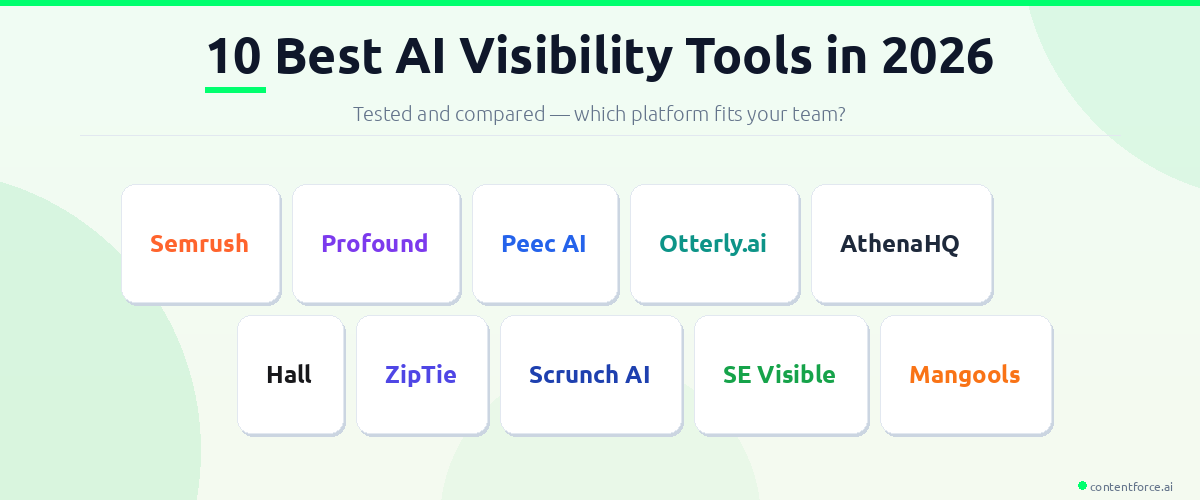
This guide covers the 10 best options in 2026. Each entry includes verified pricing, LLM coverage and a verdict on who it suits.
What is an AI visibility tool?
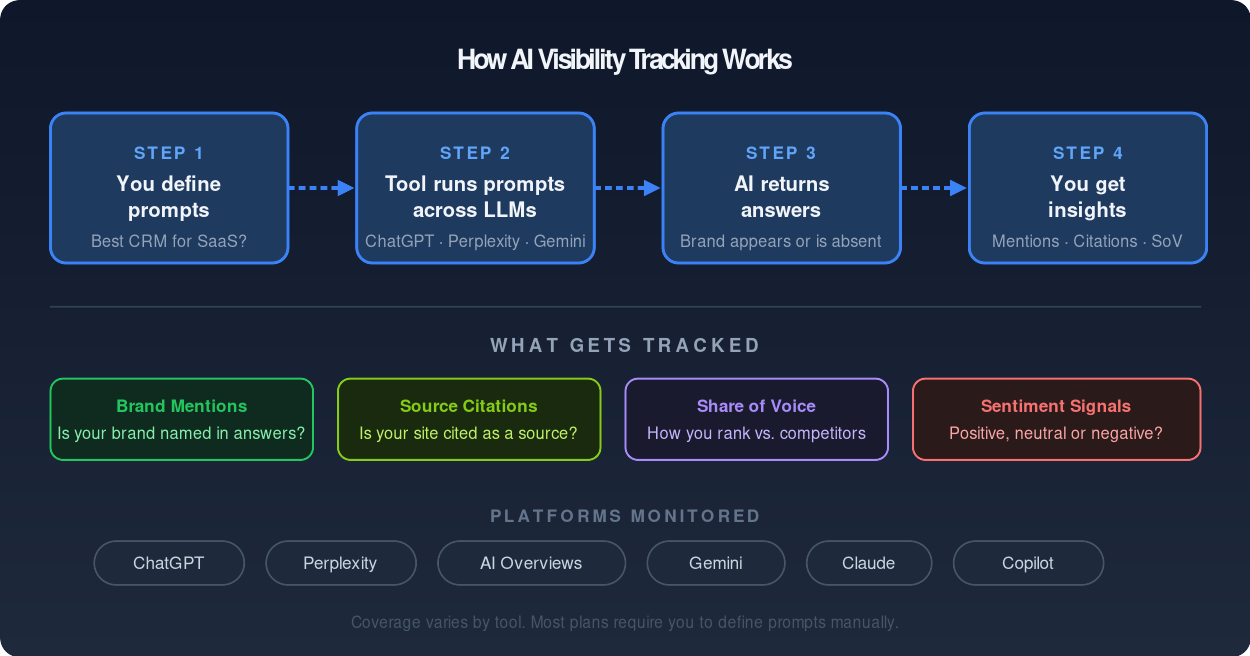
An AI visibility tool tracks how your brand appears in answers from large language models and AI search engines. Instead of monitoring your position on a search results page, you monitor whether AI platforms mention your brand, how they describe it and whether your content is cited as a source.
These tools go by several names: LLM visibility platforms, AI monitoring tools, answer engine optimization (AEO) trackers. The core function is the same: measure your brand’s presence in AI-generated answers.
How does AI visibility tracking work?
You give the tool a list of prompts, such as „what are the best project management tools for agencies“ or „which CRM should a SaaS startup use.“ The platform runs those prompts across AI engines like ChatGPT, Perplexity, Google AI Overviews and Gemini, then records whether your brand appeared, in what position and whether your site was cited as a source.
Most tools require you to define those prompts manually. A few suggest prompts based on your website or topic categories, which surfaces queries you might miss on your own.
The main limitation: you only get data on what you track. Unlike Google, where discovery tools surface thousands of queries you rank for, LLM tracking is bounded by the prompts you set up.
What to look for in an AI visibility tool
- LLM coverage. ChatGPT and Perplexity are the baseline. Tools that also cover Google AI Overviews, Gemini, Claude and Microsoft Copilot give you a more complete picture. Check this before signing up — many tools only cover two or three engines.
- Prompt limits and discovery. Every plan caps the number of prompts you can track. More important than the limit is whether the tool finds relevant prompts for you. Manual-only tools put the full burden on you.
- Competitive benchmarking. Looking at your own mentions in isolation is not useful. Share of voice — how your brand compares to specific competitors across the same prompts — is the more valuable view.
- Sentiment and accuracy. A small number of tools flag when AI describes your brand with wrong pricing, misattributed features or confused positioning. This matters when prospects arrive from AI answers with bad information in their heads.
- Reporting. If you share data with clients or stakeholders, check for PDF exports, shareable links and clean dashboards. Unlimited seats is a real advantage for agency billing.
- Update pace. This market moves fast. A tool that shipped nothing new in six months is falling behind. Check the changelog before committing.
AI visibility tools at a glance
| Tool | Starting price | Free trial | LLMs covered | Best for |
|---|---|---|---|---|
| Semrush | $99/month | No | 7+ (ChatGPT, Gemini, Claude, Grok, Perplexity, Deepseek, Google AI Overviews) | Enterprise, existing Semrush users |
| Profound | $499/month | No | 4–8+ (plan dependent) | Scaling tech companies |
| Peec AI | €89/month | 7 days | 3 core + modular add-ons | Agencies, competitive tracking |
| Otterly.ai | $29/month | 14 days | ChatGPT, Perplexity, Gemini | Small teams, budget-conscious |
| AthenaHQ | $295/month | Free report | Multiple | SEO agencies, unlimited seats |
| Hall | Free | Free plan | Multiple LLMs | Startups, fast setup |
| ZipTie | $99/month | No | ChatGPT, Perplexity, Google AI Overviews | Solo operators, simple tracking |
| Scrunch AI | $300/month | No | ChatGPT, Perplexity, Gemini | Content-led teams |
| SE Visible | $79/month | No | 4 engines | Multi-brand on a budget |
| Mangools AI Search Watcher | Free / $15.60/month | Free plan | ChatGPT, Gemini, Claude, Mistral, Llama | Cheapest ongoing tracker, free plan available |
1. Semrush — Best for enterprise AI visibility
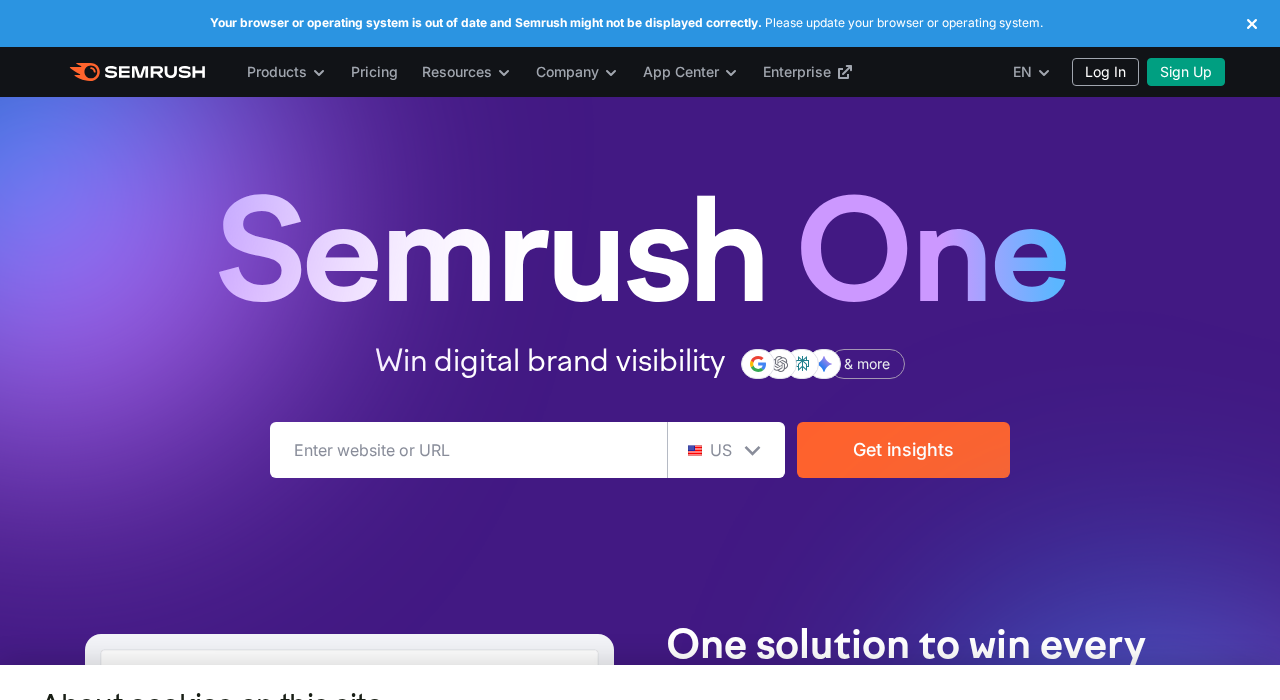
If you use Semrush for SEO and want to add AI visibility tracking, this is the natural fit. The AI Visibility Toolkit covers seven or more LLMs — ChatGPT, Google AI Overviews, Gemini, Claude, Grok, Perplexity and Deepseek — more than any other tool on this list. The competitive layer is strong: define your prompts, see brand mentions broken down by LLM, view the source domains driving those citations and compare against competitors with share of voice data.
For teams outside the Semrush ecosystem, the price is harder to justify against standalone tools. But if you want the widest LLM coverage and the deepest SEO integration in one platform, nothing else comes close.
Pricing
AI Visibility Toolkit from $99/month per domain. Semrush One (SEO and AI Toolkit) from $199/month. Enterprise pricing on request.
LLMs covered
ChatGPT, Google AI Overviews, Gemini, Claude, Grok, Perplexity, Deepseek.
Strengths
- Widest LLM coverage of any tool reviewed
- Quote-level sentiment scoring and share of voice tracking
- Deep integration with Semrush SEO and content workflows
Limitations
- Expensive for teams that only need AI visibility, not the full SEO suite
- Extra charges for additional users on most plans
- No AI crawler visibility analysis at time of writing
2. Profound — Best for dedicated AI search tracking

Profound launched in 2024 and raised $20 million in 2025. It focuses on AI search visibility only, and that focus shows. The Conversation Explorer maps topic-level AI search demand rather than just brand mentions. Prompt discovery is automated. The optimization workspace gives you a place to act on findings rather than just review them.
The $499/month entry price puts it out of reach for small teams. For a company that treats AI search as a core channel, it is the most purpose-built option available.
Pricing
Lite from $499/month (200 prompts). Enterprise custom. Agency Growth from $99/month for pitch workspaces.
LLMs covered
Lite: ChatGPT, Perplexity, Google AI Overviews, Microsoft Copilot. Enterprise adds Google AI Mode, Meta AI, Grok and DeepSeek. Claude on roadmap.
Strengths
- Automated prompt discovery finds queries you would not track manually
- Conversation Explorer maps topic-level demand beyond brand mentions
- Fast shipping cadence compared to larger platforms
Limitations
- $499/month is too high for small teams and freelancers
- Claude not yet available on any plan
- Infrastructure not at Semrush scale
3. Peec AI — Best for agencies
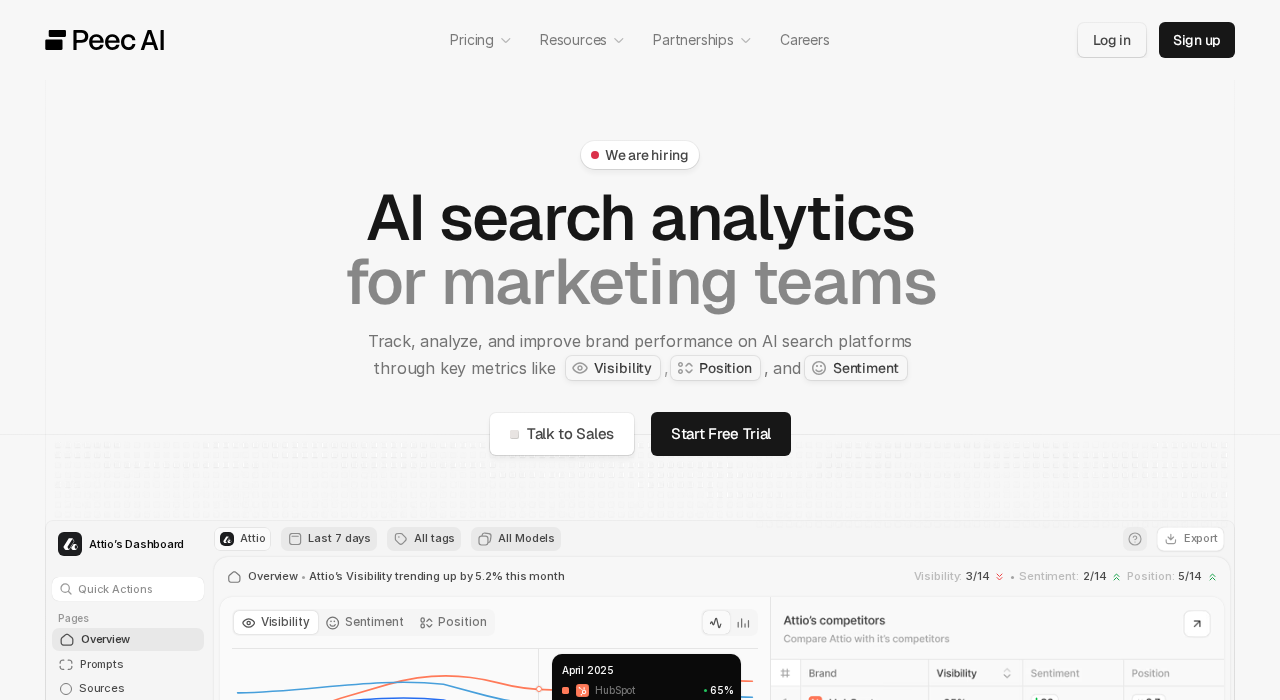
Peec AI launched in 2025 with €5.2 million in seed funding. It is built for agencies managing multiple clients. The competitive benchmarking is strong: you can track up to five competitors at once, see relative mention frequency and share of voice by category and export clean PDF reports for client use.
The modular pricing works in your favour. You start with ChatGPT, Perplexity and Google AI Overviews, then add Claude, Gemini or GPT-4 Search as paid add-ons rather than upgrading your base tier.
Pricing
Starter €89/month (25 prompts, 3 countries). Pro €199/month (100 prompts, 5 countries). Enterprise €499+/month (300+ prompts, 10+ countries). LLM add-ons billed separately.
LLMs covered
ChatGPT, Perplexity, Google AI Overviews on all plans. Claude 4, Gemini and GPT-4 Search as add-ons.
Strengths
- Best competitive benchmarking at this price point
- Country-specific tracking with multi-language support
- PDF and CSV export for client-facing reports
Limitations
- Works best for established brands AI already knows — limited signal for new products
- 14-day trial requires a credit card
- Full LLM coverage costs extra on top of the base plan
4. Otterly.ai — Best entry-level option
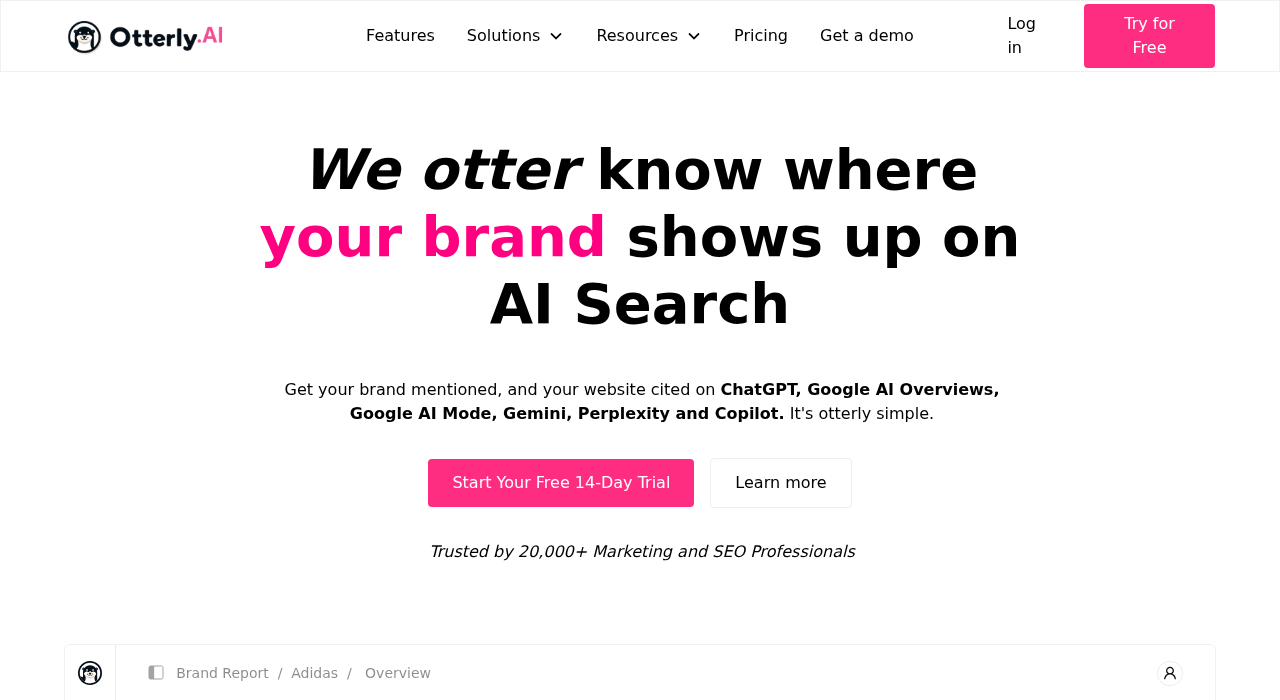
At $29/month, Otterly.ai is the cheapest paid AI visibility tracker on this list. Setup takes under 10 minutes. The dashboard shows total mentions, which prompts triggered them, citation status and basic sentiment across ChatGPT, Perplexity and Google Gemini. No prompt discovery, no competitive benchmarking — just a clear read on whether you are showing up.
For teams that want to answer one question — does AI mention us? — without committing to a bigger platform, this is the right starting point. The 14-day trial requires no credit card.
Pricing
Starter $29/month (1 workspace, 15 prompts). Premium $489/month (unlimited reports, 400 prompts). 14-day trial, no card required.
LLMs covered
ChatGPT, Perplexity, Google Gemini.
Strengths
- Lowest paid entry price of any tool reviewed
- Fast setup with no learning curve
- 14-day trial without a credit card
Limitations
- Manual prompt creation only, no discovery
- 15 prompts on the Starter plan is tight for most brands
- No competitive analysis
5. AthenaHQ — Best for SEO agencies
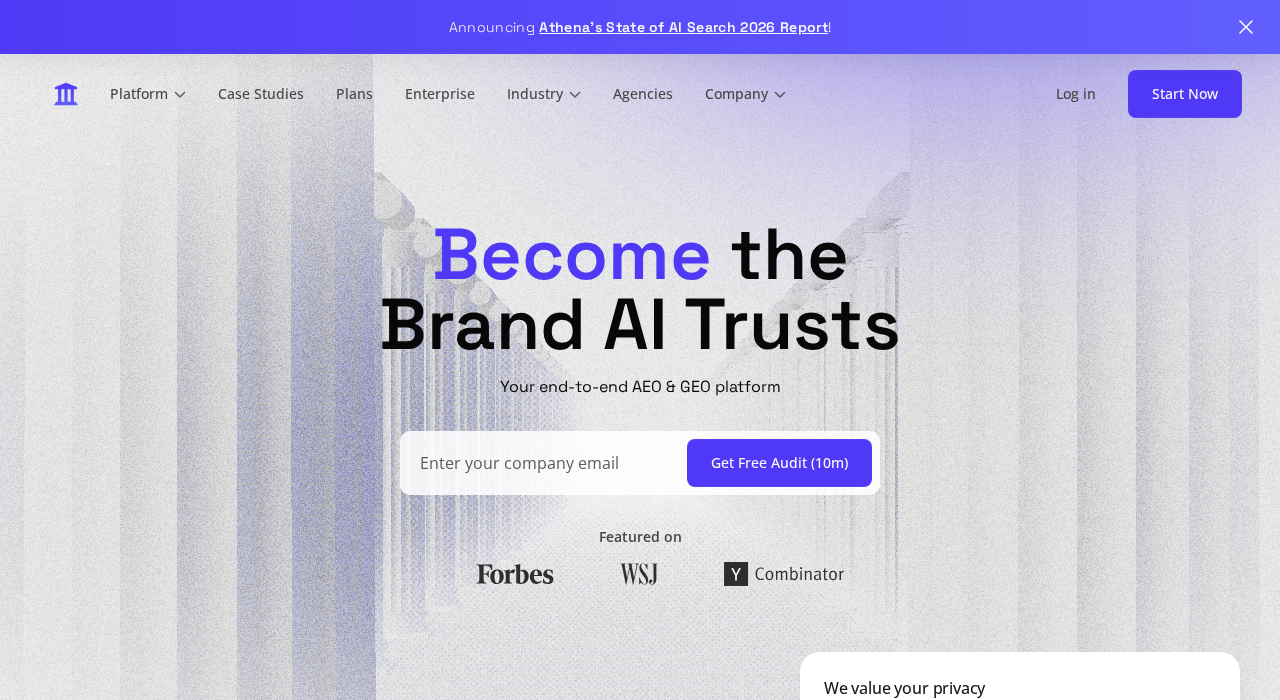
AthenaHQ tracks how your brand appears in AI results and connects that to traffic and conversions. The main advantage for agencies is unlimited seats across all plans — you do not pay extra per team member, which keeps costs predictable when you manage multiple client contacts.
The Growth plan adds a GA4 integration that lets you see whether AI mentions drive visits. Onboarding includes a free shareable report, useful for showing clients the data before they commit.
Pricing
Starter $295/month (3,500 credits). Growth $595/month (8,000 credits, GA4 integration). Enterprise custom with unlimited credits and SSO.
LLMs covered
Multiple AI search engines. Full list not publicly disclosed.
Strengths
- Unlimited seats on every plan
- GA4 integration connects AI visibility to actual traffic on Growth plan
- Free shareable report on signup
Limitations
- $295/month is a high starting price
- Credit-based billing is hard to forecast before you know your usage
- LLM coverage not fully disclosed
6. Hall — Best free starting point
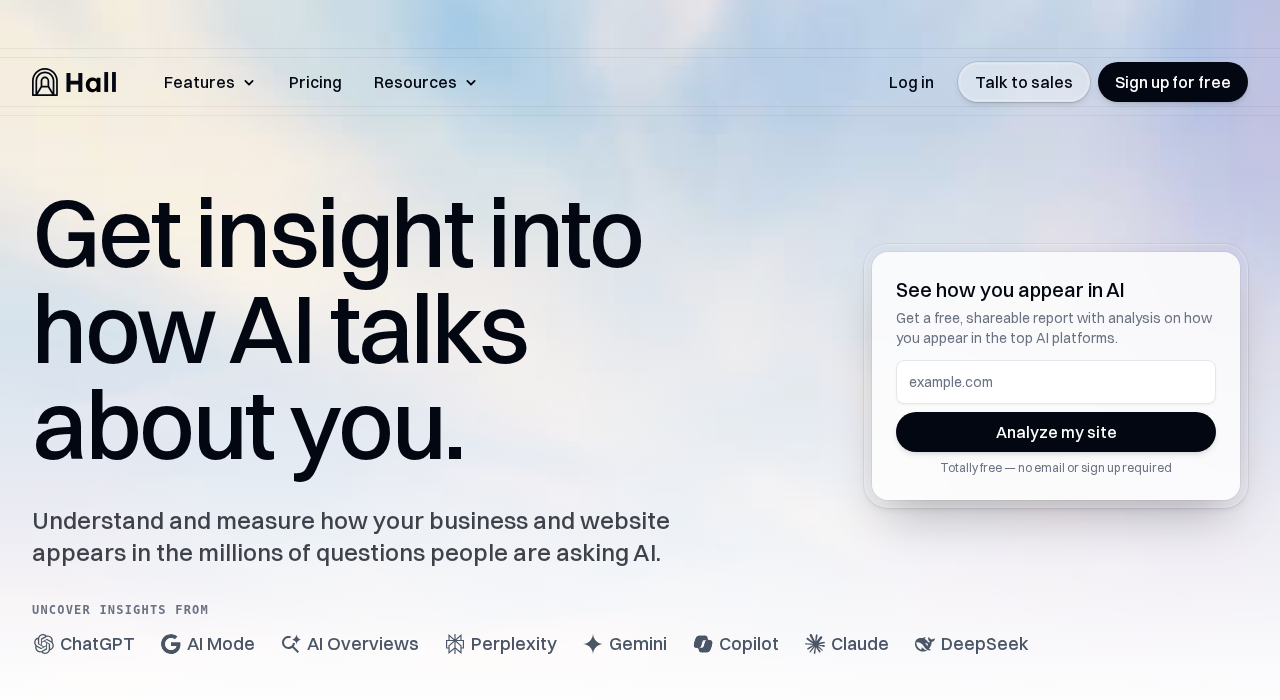
Hall is the fastest way to get an AI visibility report without paying anything. Enter your domain, add one topic, and the free plan generates relevant prompts and shows how often your brand appears over the last 10 days. No credit card required.
The gap from free to $239/month is steep, but the free tier is useful as a starting point. If you want to see where you stand before spending money on any paid tool, Hall is the right first step.
Pricing
Free (1 project, 25 questions). Starter $239/month (20 projects, 500 questions). Business $599/month (50 projects, 1,000 questions). Enterprise $1,499/month with API access.
LLMs covered
Multiple LLMs. Specific list not publicly disclosed.
Strengths
- Fastest onboarding — working report in a few minutes
- Topic-based prompt generation, no blank slate to start from
- Free tier with a shareable report link
Limitations
- Large pricing gap between free and the first paid plan
- Limited third-party reviews given how new it is
- LLM coverage not clearly published
7. ZipTie — Best for simplicity
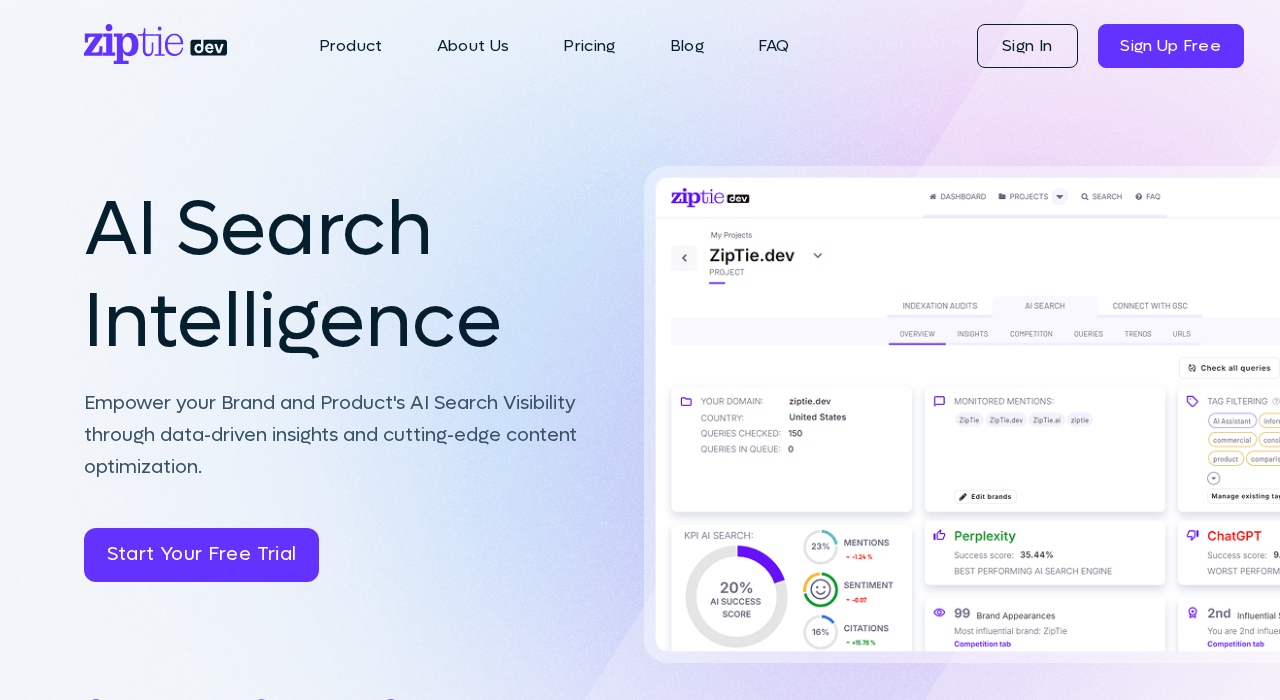
ZipTie reduces AI visibility tracking to the basics. Add your brand, enter a few prompts and get citation data and mention counts across ChatGPT, Perplexity and Google AI Overviews. No sales process, no onboarding call. The AI Success Score gives you a top-level read at a glance.
For solo operators or small teams that need to know whether they show up, ZipTie works without friction. At $58.65/month billed annually, the price fits what it does.
Pricing
From $99/month (400 AI search checks). Annual billing from $58.65/month.
LLMs covered
ChatGPT, Perplexity, Google AI Overviews.
Strengths
- Simplest setup and interface of any tool reviewed
- Citation data and mention counts in one view
- Exportable reports
Limitations
- Three LLMs only — no Claude, Gemini or Copilot
- No competitive benchmarking or sentiment analysis
- Not built for multi-brand or agency workflows
8. Scrunch AI — Best for content-led teams
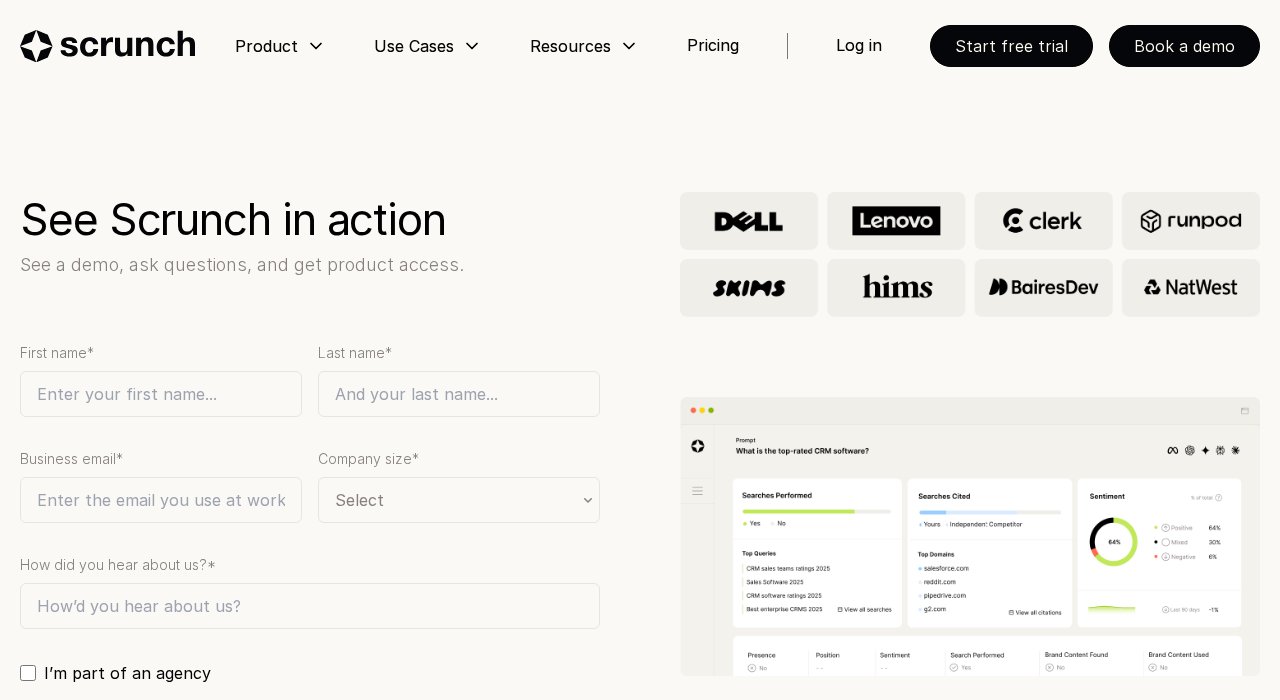
Most AI visibility tools stop at measurement. Scrunch AI adds an optimization layer: the Insights feature analyzes how your content is referenced by AI engines and recommends changes to improve your presence. For teams that publish at volume and want to connect content decisions to AI visibility, that distinction is relevant.
The platform also includes an AI Agent Experience Platform in beta, designed to help you build an AI-optimized version of your website. At $300/month entry, Scrunch suits teams with an active publishing operation rather than early-stage testing.
Pricing
Starter $300/month (350 prompts). Growth $500/month (700 prompts). Pro $1,000/month (1,200 prompts). Enterprise custom.
LLMs covered
ChatGPT, Perplexity, Google Gemini.
Strengths
- Content optimization recommendations built into the platform
- Monitoring and improvement in one workflow
Limitations
- High starting price for three LLMs
- Enterprise tier requires a custom quote, slow for teams that want to self-serve
9. SE Visible — Best for multi-brand tracking on a budget
SE Visible is part of SE Ranking and tracks AI mentions, citations and sentiment across four answer engines. The entry plan at $79/month supports three brands, which makes it one of the better-value options for managing multiple properties without paying per brand.
It fits teams already using SE Ranking who want to extend into AI visibility without adding a separate tool. If you are not in that ecosystem, the limited integrations outside it are a real constraint.
Pricing
From $79/month (150 prompts, 3 brands). No dedicated agency plan.
LLMs covered
Four answer engines, five languages, seven regions.
Strengths
- Three brands on the entry plan — good value for multi-brand use
- Clean integration with SE Ranking SEO data
Limitations
- Four engines is below the standard for this category
- Limited integrations outside SE Ranking
- No agency plan with client workspace features
10. Mangools AI Search Watcher — Best free starting point
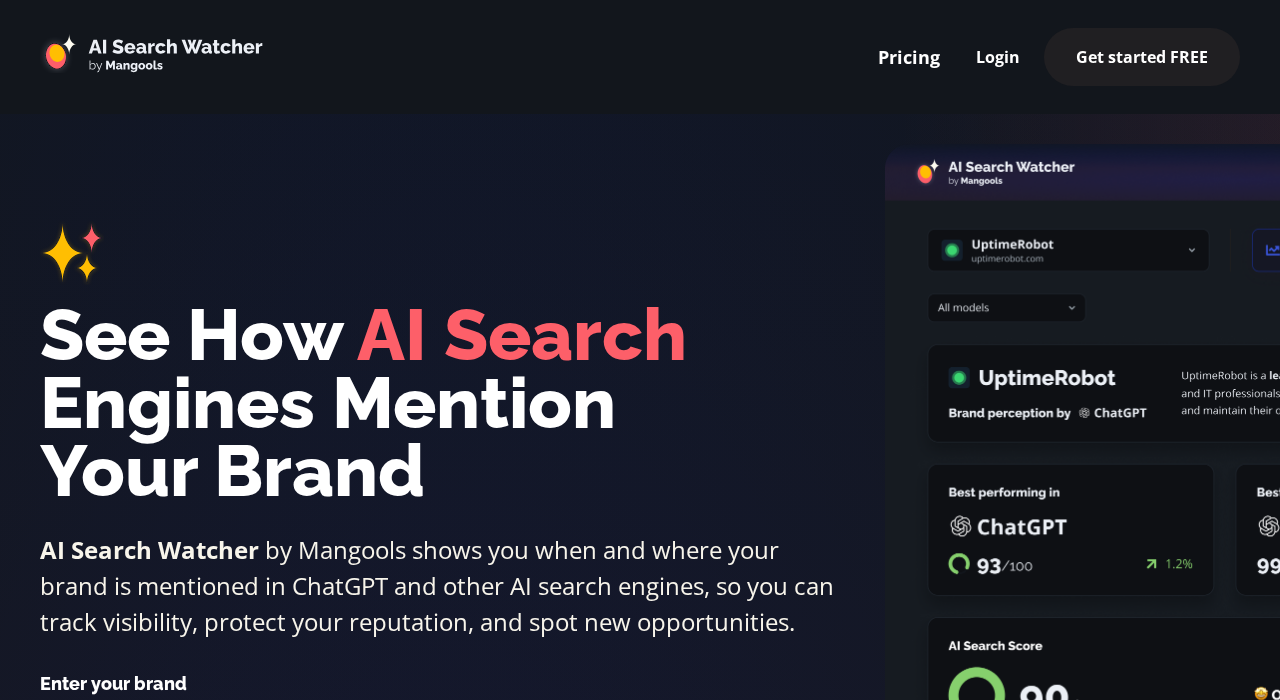
Mangools built its name on affordable SEO tools and the AI Search Watcher follows the same pattern. The free plan tracks five prompts across ChatGPT, Gemini, Claude, Mistral and Llama — no credit card required. Setup takes about 30 seconds. Each checkup runs prompts multiple times to reduce the noise from LLM response variability.
The paid plan starts at $15.60/month billed annually, which makes it the cheapest ongoing tracker on this list. For teams that want more than a one-off snapshot but are not ready for a $29+ commitment, it is a solid first step.
Pricing
Free (5 prompts). Pro from $15.60/month billed annually. 48-hour money-back guarantee on paid plans.
LLMs covered
ChatGPT, Gemini, Claude, Mistral, Llama.
Strengths
- Free plan with no credit card — five prompts across five LLMs
- Cheapest paid ongoing tracker at $15.60/month
- Runs each prompt multiple times for more reliable results
Limitations
- Five prompts on the free plan is very limited for most brands
- No competitive benchmarking or share of voice tracking
- Part of the Mangools ecosystem — less focused than dedicated AI visibility platforms
How to choose an AI visibility tool
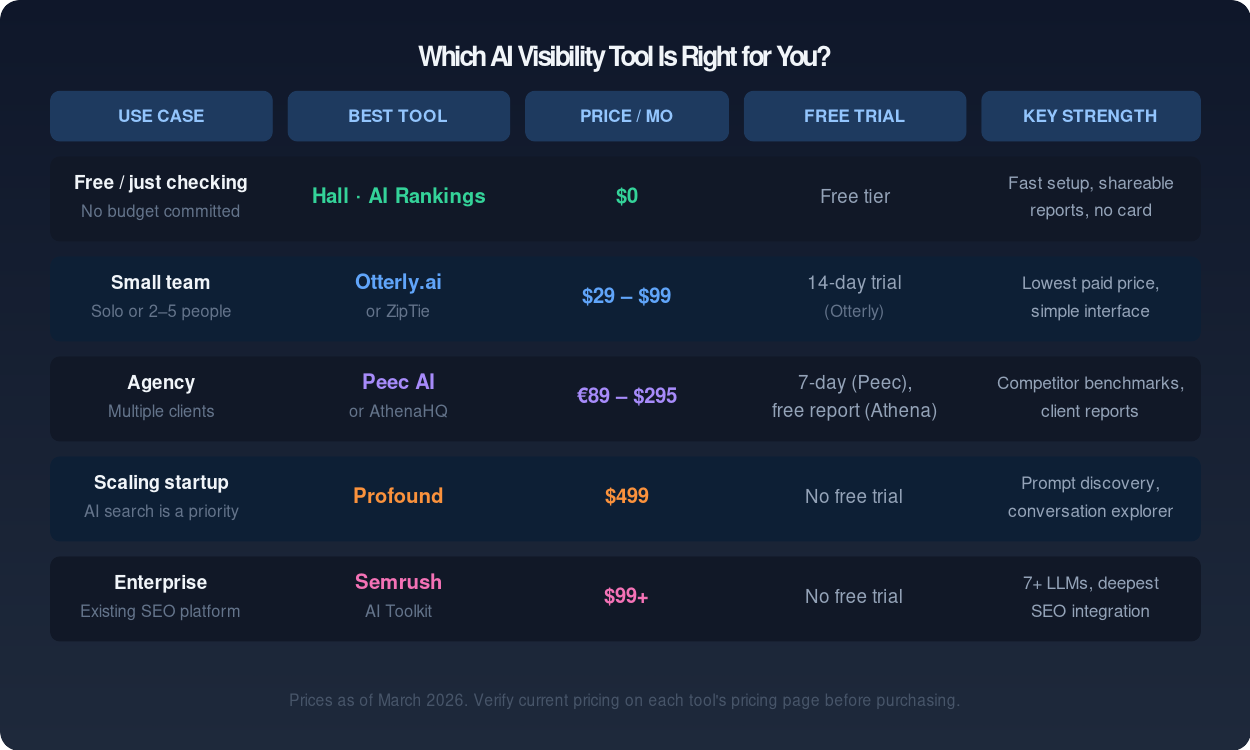
Starting for free: Hall or Mangools AI Search Watcher. Hall generates a shareable report and tracks 25 questions. Mangools covers five LLMs on the free plan and is the better option if you want ongoing tracking from day one.
Small team or solo operator: Otterly.ai at $29/month gets you basic tracking fast. ZipTie at $99/month (or $58.65/month annually) adds a slightly stronger dashboard and citation tracking.
Agency: Peec AI for competitive benchmarking and multi-country reporting. AthenaHQ if unlimited seats and a GA4 integration matter more for your workflow.
Scaling tech company: Profound. The Conversation Explorer and automated prompt discovery are stronger than what competitors offer at this level. The $499/month price reflects that.
Enterprise with existing SEO tooling: Semrush AI Visibility Toolkit covers the most LLMs and connects to Semrush SEO data. Scrunch AI is the alternative if content optimization alongside tracking is a priority.
How to track AI traffic in Google Analytics 4
Before investing in a paid tool, check how much traffic you already receive from AI platforms. GA4 lets you filter referral traffic by source to isolate sessions from ChatGPT, Perplexity and similar engines.
This shows whether people click through from AI to your site — it does not tell you whether AI mentions you in answers. Still, it is a useful free baseline.
- Go to Acquisition → Traffic acquisition
- Click Add filter
- Select Session source / medium as the dimension
- Set Match Type to matches regex
- Paste:
(.*gpt.*|.*chatgpt.*|.*openai.*|.*perplexity.*|.*gemini.*google.*|.*bard.*|.*claude.*) - Switch the primary dimension to Session source / medium
- Add Page path as a secondary dimension to see which pages get the most AI referral traffic
Save it as a report and check monthly. As AI referrals grow, the numbers tell you whether your pages are being cited in practice.
FAQ
What is AI visibility?
AI visibility is about whether AI engines mention your brand when users ask relevant questions. Tools like ChatGPT, Perplexity and Google AI Overviews generate answers from their training data and indexed sources, and your brand either appears in those answers or it does not.
Is AI visibility the same as SEO?
No, they measure different things. SEO is about where your pages rank. AI visibility is about whether AI engines mention your brand when generating answers. You can rank first on Google and still not appear in the AI Overview sitting above that result.
Does ranking on Google improve AI visibility?
It helps, but it is not enough on its own. Many LLMs use Google’s index as a source, so well-ranking pages have a better chance of being cited. AI engines also factor in how clearly your pages describe your brand and how well-known your entity is across the web, so strong rankings are just one piece of it.
Which AI platforms do these tools track?
Most tools start with ChatGPT, Perplexity and Google AI Overviews. Gemini, Copilot, Claude, Grok and DeepSeek are available on higher tiers or as paid add-ons. Semrush covers the most platforms out of the box. Peec AI lets you add engines one by one so you only pay for what you use.
What is the cheapest AI visibility tool?
Hall and Mangools both have free plans with no credit card required. Hall tracks 25 questions and generates a shareable report. Mangools tracks five prompts across five LLMs. If you want a paid plan, Mangools starts at $15.60/month and Otterly.ai at $29/month.
