
How-to · 6 steps
Answer Engine Optimization: How To Improve AI Search Visibility

Answer engine optimization improves AI search visibility by structuring content so ChatGPT, Google AI Overviews, Perplexity and Copilot Search can understand, trust and cite it. Answer engine optimization builds on SEO rather than replacing it: pages that already rank in the top 20 are the strongest candidates, and structural fixes can show citation results within 30 to 60 days.
- Audit pages that already rank in the top 20 for question-based queries
- Put a direct 30 to 60 word answer at the start of each section
- Add FAQPage, HowTo and Article schema that matches the actual content type
- Name entities explicitly and add author, update date and source citations
- Build topical authority with a linked cluster of pages for each sub-question
- Track citations weekly with prompt tests, Search Console and AI referral traffic
Zero-click searches now account for 69% of Google queries, up from 56% when AI Overviews first launched. That's a sharp shift. When an AI Overview appears, click-through rates drop 61% for brands that aren't cited in it, according to research from Seer Interactive, and for cited brands they rise 35%. If your content doesn't appear inside the answer, you lose visibility before a visitor ever has the chance to arrive.
Answer engine optimization (AEO) is the practice of structuring content so AI systems can understand, trust, and cite it when answering user questions. It's not about ranking higher. It's about being inside the answer itself. Platforms like ChatGPT, Google AI Overviews, Perplexity and Copilot sit between traditional search and AI-powered search, turning user queries into direct answers where whether your content gets cited depends on how well it's structured, not just how well it ranks. Without that structure, you're invisible before the visit even starts.
What is answer engine optimization?
Answer engine optimization is content and technical work that improves how often your content appears in AI generated responses, AI summaries and cited answer boxes. In traditional search, people compare results and pick a link. In AI-driven search, answer engines compress that journey into a single response that cites two or three sources. It's a fundamentally different model.
These systems work with natural language, large language models and ranking algorithms that evaluate web pages before deciding which sources to cite or summarize. Your copy has to be clear enough for natural language processing, concise enough for AI models to reuse and structured enough for crawlers to parse. Three requirements. One page. That's it.
You'll see this across major products. ChatGPT search gives users fast, timely answers with links to relevant web sources. Google AI Overviews help people find information and discover relevant sites. Copilot Search delivers clear answers at the top of results and shows which sources it used. Perplexity positions its product around live web answers with citations. Each platform asks the same question about your content: can we trust this enough to cite it?
Why answer engine optimization matters now
Being cited in an AI answer changes the economics of your organic traffic. The numbers are striking. According to Seer Interactive, brands cited in AI Overviews see a 35% increase in organic click-through rates, while brands that aren't cited see a 61% drop. It's the same search results page. Two very different outcomes depending on a single variable: citation.
For publishers and brands, the stakes go beyond individual clicks. Semrush data shows that visitors arriving through AI search convert at 4.4 times the rate of standard organic visitors. They've already received an answer that named your brand, so they arrive with intent, ready to act. That's a materially different visitor.
Gartner predicts traditional search volume will drop 25% by 2026 as AI-driven answer formats displace standard blue-link results. That prediction makes AEO a near-term business priority, not a future consideration. It's not a long-term hedge.

This shift also changes how we think about referral value. AI referral traffic matters, but it's only one part of the picture. Many readers see a brand mention in an AI answer, then come back later through search results, direct visits or another query. The pages that win in AI-powered search do four things well:
They answer the user question early with a concise, direct response. They make the topic and target audience obvious. They support claims with sources or original expertise. They give the system clean structure it can reuse.
Content that's useful when a machine reads it first is also useful when a person reads it second. That's what AEO rewards. There's no shortcut around that.
FAQ Generator: 6 to 8 question-answer pairs in People-Also-Ask phrasing, schema-ready. Free, no signup.
How answer engines select content to cite
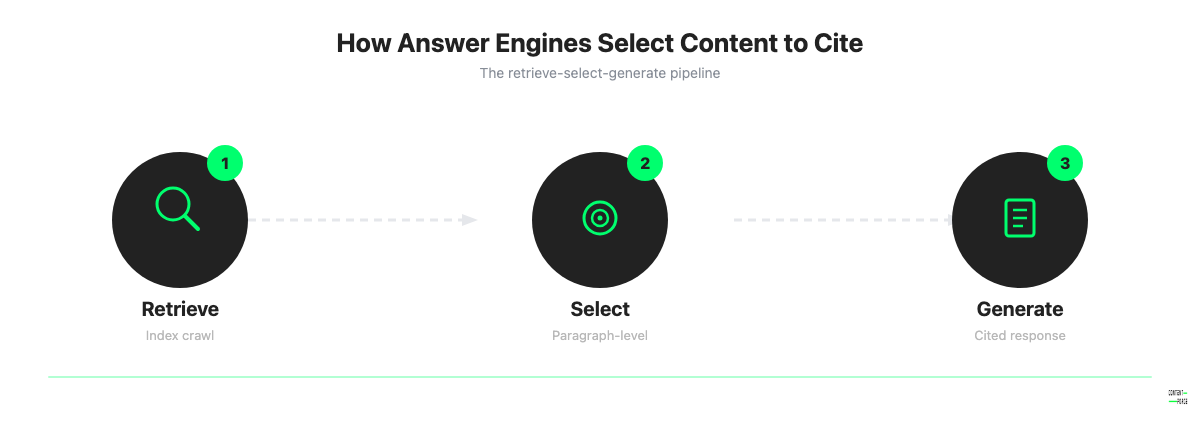
The retrieve-select-generate pipeline is how answer engines work. They pull candidate content from their index, evaluate it at the paragraph level rather than the page level, and generate a response that draws from the clearest and most trustworthy passages found. Three stages. One citation decision per passage.
Paragraph-level evaluation matters more than most people realize. A single well-structured answer block can earn a citation even if the rest of the page isn't optimized at all. That's the core insight. This is why AEO practitioners talk about "chunks": discrete passages that stand on their own and answer a specific user question directly. Each chunk competes on its own merits.
Google AI Overviews and ChatGPT search work differently under the hood. AI Overviews draw from Google's existing search index using a methodology similar to featured snippets. Pages that rank in the top 20 organic results make up the vast majority of AI Overview citations. ChatGPT performs real-time web retrieval. That means it can surface pages with no Google visibility at all, though it still favors authoritative and well-structured content. They're not interchangeable platforms.

What criteria does an answer engine use?
Five factors determine whether a passage gets cited:
Answer clarity: the passage answers the user question in the first one or two sentences Entity completeness: the relevant entities, product names and concepts are explicitly named rather than implied Structured signals: headings, schema markup and clean paragraph breaks make the content easier to parse Freshness: content that hasn't been updated in over a year is less likely to be selected for time-sensitive queries Authority: pages with strong backlink profiles, clear authorship and trustworthy source citations score higher overall
AEO vs. SEO: what changes and what stays the same
AEO doesn't replace SEO. It adds an answer-layer strategy on top of the same technical and trust foundations. SEO earns you a position in search results. AEO earns you a citation inside the answer. Those are different outputs, but the foundation's identical: crawlability, authority, relevance and technical quality. Both matter. Neither replaces the other.
Here's how the two approaches compare across the dimensions that matter for content strategy:
| Area | Traditional SEO | AEO |
|---|---|---|
| Main goal | Earn visibility in search engine results | Earn inclusion, summaries and citations in AI answers |
| Query style | Keywords and topic clusters | User questions, follow-ups and conversational prompts |
| Unit of value | Full page ranking | Specific passage or chunk cited in a response |
| Success metrics | Rankings, clicks and organic traffic | AI visibility, brand mentions, citations and AI referral traffic |
| Trust signals | Backlinks, domain authority, E-E-A-T | Authorship, source citations, content freshness, structured data |
| Content format | Topic-focused pages optimized for search engines | Question-led sections with direct answers at the top |
| Platform targets | Google and Bing search results pages | ChatGPT, Google AI Overviews, Perplexity, Copilot Search |
| Time to results | 3 to 6 months for new content | 30 to 60 days once existing content has organic visibility |
What stays the same matters just as much. Google rewards people-first content. Authority counts. Content needs maintenance to stay relevant. AEO works best when it grows from a strong SEO base, not when it tries to replace it. That's non-negotiable.
A third layer worth knowing is GEO (generative engine optimization), which focuses on building brand presence and entity authority across the entire AI ecosystem. SEO handles page-level rankings. AEO handles chunk-level citations. GEO handles domain-level brand visibility. For most publishers, these are the practical starting points.
How to optimize content for answer engines
A strong AEO strategy makes your page easier to read, easier to cite and easier to trust. Five practices cover the core. They're what answer engines look for when deciding whether to cite you.
Write answer-first sections
Start each section with the direct answer. If the heading asks what something is, define it in the first sentence. When it asks how to do something, give the short process first. Then expand.
AI answer engines look for passages they can lift into a concise response. A 30 to 60 word answer block at the top of each section gives the model an extractable answer before supporting detail begins. Long scene-setting intros make that harder. Short answers, tight paragraphs and clear transitions make it easier.
Bullet points also help when they compress a process without losing meaning. Use them when they clarify a decision, not just to fill space.
Use structured data and schema markup
Schema markup tells AI systems and search engines what type of content a page contains and how its sections relate to each other. For AEO, three schema types matter most: FAQPage, HowTo and Article.
FAQPage schema identifies question-and-answer pairs explicitly, which is the structure AI systems look for when generating direct answers to user questions. HowTo schema marks up step-by-step processes so engines can extract individual steps as answer blocks. Article schema adds authorship, publication date and content-type signals that support E-E-A-T.
Schema markup doesn't guarantee AI visibility, but it outright gives the system a better map of your content. Google's structured data documentation confirms that structured data helps Google understand page content, and Google's snippet controls documentation states they affect AI Overviews and AI Mode directly.
Make entities and context explicit
Don't assume the system will infer your meaning. State the full term before the acronym. Name the platform, the use case and the target audience. If you want a brand mention signal, the brand has to be easy to identify in context.
For this topic, that means naming ChatGPT search, Google AI Overviews, Perplexity and Copilot Search instead of saying "AI tools" over and over. It also means stating how AEO affects web pages, search listings and the way content appears across AI platforms.
A clear page helps AI models separate the core claim from supporting detail. When the entity, action and outcome sit close together, natural language processing has less guesswork to do.
Strengthen trust with structure and source signals
Your page needs to earn an answer engine's trust. Google's guidance on helpful content says its systems prioritize helpful, reliable information created to benefit people. Generic, derivative content is flat-out weaker for both SEO and AEO.
A practical trust block gives AI systems the credibility signals they look for. Place these four elements near the top of key sections or at the article level:
Author credentials: name the author and include a short bio that establishes topic expertise Update date: mark when the content was last reviewed or updated Source citations: link to the primary sources that support your factual claims Answer summary: a short distilled answer (30 to 60 words) that the system can lift directly
Technical signals support that editorial work. OpenAI's publisher FAQ says public websites can be discovered, surfaced, cited and linked in ChatGPT search when OAI-SearchBot can access the content. Google's robots meta documentation confirms that snippet controls affect AI Overviews and AI Mode. The technical layer isn't optional, especially when you want both search and AI answer engines to use the same page safely.
Align pages with user intent
The page works best when it solves the exact question the reader is asking. Many pages chase a keyword and miss the real user intent behind it. That gap is where citations are lost.
A strong page does three things: it understands the user question, gives the shortest useful answer first, and then expands with enough detail to become a comprehensive response. That's why strong AEO often looks simple on the surface. The simplicity's the result of tight structure, not shallow thinking.
Content with clear topical authority across related questions also signals to AI systems that your domain is a reliable source on the topic.
How do you measure answer engine optimization?
You measure AEO by tracking citation frequency, AI Overview appearances and brand mentions, not just rankings. Rankings still matter, but they're clearly only one part of the measurement stack.
Start with recurring prompt tests. Ask the same user question in several AI systems and record whether your brand appears, which citation the model uses and how the answer's framed. Then compare that against your analytics and broader organic traffic trends. It takes 20 minutes a week. It's worth it.
Use this framework to track the five signals that matter most:
| Signal | What it measures | How to track | Tool |
|---|---|---|---|
| Citation frequency | How often your pages are cited across ChatGPT, Perplexity and Google AI Overviews | Manual prompt testing plus platform reports | Profound, Semrush AI Toolkit |
| AI Overview appearances | Which target keywords trigger AI Overviews and whether your page is included | Search Console AI Overview report | Google Search Console |
| Featured snippet share | Featured snippet positions (strong proxy for AIO citability) | Position 0 tracking | Semrush, Ahrefs |
| Brand mentions in AI | Where your brand appears in AI generated responses, cited or uncited | AI brand monitoring | Profound, Semrush |
| AI referral traffic | Direct visits from ChatGPT search citations | utm_source=chatgpt.com in analytics | Google Analytics, Plausible |
Traffic analysis still matters, but it needs context. There's no single AI search visitor benchmark that works across all engines, because models, prompts and attribution paths vary. Track directional trends: are AI referrals growing? Are brand mentions increasing? Is featured snippet share holding? If they're not, that's the signal you need.
Common AEO mistakes to avoid
Most AEO failures come down to the same five problems. They're avoidable, and fixing them is more valuable than adding new optimizations.
Burying the answer behind a long intro: when the actual answer to the heading question appears in paragraph four, the model will skip your page for one that answers in paragraph one. Move the direct answer to the first sentence of every section.
Missing or mismatched schema markup: a page claiming to be a FAQ with no FAQPage schema, or a how-to guide without HowTo markup, wastes the structural signal. Apply schema that accurately matches the content type.
Neglecting content freshness: answer engines favor recently updated content for time-sensitive queries. Research from AirOps suggests pages not refreshed in over a year are significantly more likely to lose citations. A quarterly content review is a practical minimum.
Vague headings that don't match the user question: headings like "More context" or "Key points" give AI systems nothing to match against a query. Rewrite headings as questions or direct statements that match the exact language a user would ask.
Optimizing only for click volume: a page optimized entirely for CTR may bury the answer to protect the click. AEO requires the opposite. The answer comes first, which builds citation authority over time even when clicks are lower short-term.
What are the main challenges with answer engine optimization?
AEO isn't as predictable as traditional SEO, and the ecosystem changes fast. Three challenges stand out for most teams.
Algorithm opacity: no AI platform publishes a clear citation criteria document. Unlike Google's documentation for featured snippets, the exact selection criteria for ChatGPT, Perplexity or Google AI Overviews aren't fully disclosed. You can observe patterns, but there's no clean rulebook to reverse-engineer.
Ecosystem volatility: changes that took years in SEO now happen in months. A model update, a new AI platform, or a shift in how Overviews are triggered can change citation patterns overnight. Content that performed well six months ago may need structural updates to continue earning citations.
Attribution gaps: when your brand is mentioned in an AI answer, the reader may not click through immediately. They may come back later through a direct visit or a branded search. This makes it genuinely difficult to attribute business impact to AEO work. Tracking brand search volume alongside AI referral traffic gives a more complete picture than click data alone.
These challenges don't make AEO less worthwhile. They make a disciplined measurement and refresh process more important. Without it, you're guessing.
How to get started with answer engine optimization

Getting started with AEO doesn't require a complete content overhaul. Start with what you've already got. A practical four-step approach works for most teams.
Step 1: Audit your existing content. Identify which pages already have organic visibility (top 20 positions) for question-based queries. These are your highest-probability AEO candidates because AI Overview citations heavily favor pages that already rank. Use Google Search Console to find pages with strong impressions but variable click rates, which often signals a page is close to being cited but not yet structured for it.
Step 2: Restructure for extractability. For each priority page, check whether the first sentence under each H2 answers the heading question directly. If not, move the answer to the front. Add FAQPage schema to pages that already have Q&A sections. Add HowTo schema to any step-by-step content. These changes are quick and often produce citation results within 30 to 60 days.
Step 3: Build topical authority across a content cluster. AI systems favor domains that cover a topic deeply, not just pages that optimize individual queries. Identify the main sub-questions around your core topic and ensure each one has a well-structured page. Internal linking between related articles reinforces the topical signal.
Step 4: Measure and refine. Set up a tracking routine using the framework above and run it weekly or biweekly. Prompt test your target queries in ChatGPT and Perplexity. Review Search Console for AI Overview appearances. Compare AI referral traffic month over month. When a page loses a citation, audit it against the selection criteria in the "How answer engines select content to cite" section and refresh accordingly.
This process compounds. As more pages are restructured and more topical clusters are built out, citation frequency tends to increase across the whole domain, not just on individual pages. You're building domain-level credibility, not just page-level.
Does answer engine optimization replace SEO?
No, answer engine optimization doesn't replace SEO. It builds on it.
If your page can't be discovered, crawled or understood, it won't perform well in AI-driven search either. The relationship is bidirectional: over 92% of AI Overview citations come from pages already ranking in the top 20 organic results, backed by the same SEO ranking factors that determine classic search visibility, which confirms that SEO performance is without question a practical prerequisite for AEO success. You'll get the most from AEO when you've already got a solid SEO foundation, a useful content library and pages that can compete in search results.
The strongest teams don't treat SEO and AEO as separate systems. They're one system with two outputs: one helps pages rank in traditional search, and the other helps those same pages earn inclusion in AI generated responses, AI summaries and cited answer flows.
Frequently asked questions about answer engine optimization
What is an answer engine?
An answer engine is a system that responds to user questions with a direct answer rather than a list of links. ChatGPT, Google AI Overviews, Perplexity and Copilot Search are the most widely used examples. They retrieve content from the web, evaluate it for relevance and trustworthiness, and generate a synthesized response that cites a small number of sources.
How is AEO different from GEO?
AEO focuses on getting individual pages cited in AI generated answers. GEO (generative engine optimization) operates at the brand and domain level, building entity authority across the broader AI ecosystem. Start with AEO. GEO becomes relevant once you're consistently cited and want to expand your brand's presence across more AI platforms and topics.
What schema types matter most for AEO?
FAQPage schema is the highest-priority type for AEO because it explicitly marks up question-and-answer pairs, which is the structure AI systems look for when generating direct answers. HowTo schema matters for step-by-step content. Article schema supports authorship and E-E-A-T signals. All three are available through Schema.org and are supported by Google's rich results system.
Do backlinks still matter for AEO?
Yes, backlinks still matter. Authority is a core selection criterion for most answer engines. Google AI Overviews draw from pages that already rank well organically, and organic ranking still depends heavily on domain and page authority. Backlinks that build topical authority in a specific subject area are more valuable for AEO than broad link volume alone.
How long does it take to see AEO results?
Structural changes (moving answers to the top of each section and adding FAQPage schema) can show results in 30 to 60 days for content that already has organic visibility. Building topical authority through a cluster of related pages takes longer: expect 60 to 120 days before citation patterns become consistent. There's no guaranteed timeline. Citation frequency also depends on how many competitors are targeting the same queries.
Can AI-generated content perform well in AEO?
AI-generated content can perform in AEO if it's accurate, specific and edited to add genuine expertise. Generic AI output that restates common knowledge without original analysis or verified facts won't get cited. The bar is the same as for human-written content: be the clearest, most trustworthy answer available.
What tools can I use to track AEO performance?
Google Search Console tracks query coverage and AI Overview impressions. Semrush and tools like Profound monitor brand mentions and citation frequency across AI platforms. For ChatGPT referrals specifically, utm_source=chatgpt.com gives you a direct view of visits from ChatGPT search citations. Prompt testing (manually asking target questions in ChatGPT, Perplexity and Google) remains the most direct check. Nothing replaces it.
How often should I refresh content for AEO?
A quarterly review is a practical starting point for pages targeting competitive queries. Freshness is one of the criteria answer engines weigh, and content that hasn't been meaningfully updated in over a year is more vulnerable to citation loss. A refresh doesn't have to be a full rewrite. Updating statistics, adding new examples and reviewing for accuracy can be enough to signal recency to both search engines and AI systems.