
How-to · 6 steps
LLM SEO: How to Optimize Content for Large Language Models

LLM SEO is how you optimize content so large language models like ChatGPT, Claude and Gemini can retrieve, understand and cite it in AI-generated answers, not just rank it. This guide covers 11 tactics grouped into content structure, technical setup and authority building, plus how to measure citation visibility.
- Put the direct answer at the top of each section instead of building up to it
- Write headings that remove ambiguity so the model can match them to a query intent
- Support important claims with links to primary sources rather than unsupported statements
- Add FAQPage, Article or HowTo schema markup where it clarifies page structure
- Set up Bing Webmaster Tools, since ChatGPT Search, Copilot and Meta AI use Bing's live index
- Build a connected topic cluster and earn off-page brand mentions across credible sources
LLM SEO is the practice of making your pages easier for large language models and AI search systems to retrieve, understand and cite. It sits close to GEO and answer engine optimization, but the emphasis's slightly different. Instead of thinking only about rankings, LLM SEO asks whether your content's machine-readable, evidence-backed and useful enough to become part of an AI-generated answer. For the bigger picture on which SEO fundamentals hold steady under generative AI and which don't, see this breakdown of what changes and what stays the same.
- LLM SEO isn't a replacement for normal SEO.
- The page still needs to be crawlable, indexable and genuinely helpful.
- The extra layer's about retrieval quality, citation quality and answer extraction.
- The best LLM SEO pages say one thing clearly and prove it fast.
| Quick fact | Why it matters |
|---|---|
| OpenAI says inclusion in ChatGPT search depends in part on allowing OAI-SearchBot to crawl your site | Model-facing visibility starts with crawler access |
| Google says pages shown in AI Overviews and AI Mode must still be eligible for Google Search snippets | LLM SEO still depends on normal technical SEO hygiene |
| OpenAI says search responses include inline citations and a source list | Content needs to be strong enough to deserve citation, not just retrieval |
What is LLM SEO?
LLM SEO means optimizing content so large language models like ChatGPT, Claude and Gemini can retrieve, understand and cite it in AI-generated answers, not just rank it. In a classic search result, the job's to help the engine rank your document. In an LLM-driven result, the job's also to help the system transform your document into a grounded answer.
That's why the same page can perform differently across normal search and AI search. A page may rank reasonably well but still be a weak citation candidate if the answer's buried, the terminology's inconsistent or the important claims are unsupported. LLM SEO tries to fix that gap.
In practice, the work falls into three buckets:
- retrieval: the system needs to find the page
- understanding: the system needs to parse what the page's about
- trust: the system needs signals that the page's worth citing
Why does LLM SEO matter now?
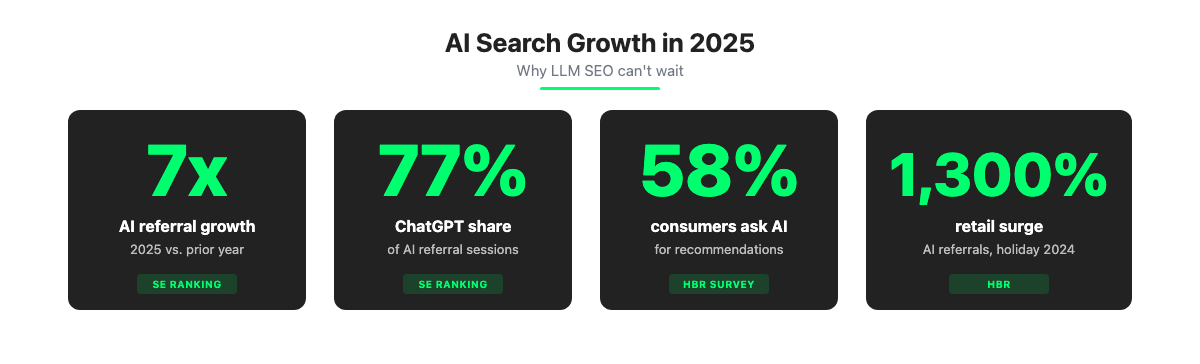
AI-driven search has moved from a talking point to a measurable traffic channel. SE Ranking's research across hundreds of sites found that AI referral traffic grew more than seven times in 2025, with ChatGPT accounting for roughly 77% of all AI referral sessions. Vercel reported that ChatGPT now drives around 10% of its new user signups, up from 4.8% the previous month and 1% six months before that. Tally saw AI search become its biggest acquisition channel altogether, helping it grow from $2M to $3M ARR in just four months. On the consumer side, a survey of 12,000 people by HBR researchers found that 58% now turn to generative AI tools for product and service recommendations, up from 25% in 2023. During the 2024 holiday season, AI search referrals to US retail sites surged more than 1,300%.
These numbers are still small relative to organic search overall. But the growth rate isn't. Content that earns citations in ChatGPT, Perplexity and Google's AI Overviews today is building compounding visibility that slower-moving competitors won't catch up on easily.
SEO Title Generator: eight title tag variations, sized for the SERP and intent-matched. Free, no signup.
How do LLMs read web content?
LLMs reach your content through two distinct pathways. The first is the training data pathway: models absorb vast amounts of web text during pre-training and encode relationships between words and concepts as embeddings. This lets them reason about topics even without exact keyword matches. The second is the live retrieval pathway: systems like ChatGPT Search and Perplexity use retrieval-augmented generation (RAG), pulling current documents from a live index at query time. ChatGPT, Copilot and Meta AI use Bing's index for this. Google uses its own.
Both pathways reward the same things: clear structure, direct answers and verifiable claims. A clean heading stack, concise paragraphs and answer-first writing reduce ambiguity in both. If a section heading asks a question and the first sentence answers it directly, the model's job becomes much easier.
This also explains why fluffy intros and vague thought leadership often underperform in AI surfaces. There's no clean, quotable unit of meaning. There's no citation.
How does LLM SEO differ from traditional SEO?

The two disciplines share a foundation: crawlability, indexability, quality content. But they don't measure success the same way, and they don't reward the same content signals.
| Dimension | Traditional SEO | LLM SEO |
|---|---|---|
| Primary goal | Rank in search results pages | Get cited in AI-generated answers |
| Content discovery | Keyword matching and link signals | Semantic relevance and embedding-based retrieval |
| Success metric | Clicks and ranking positions | Citations, brand mentions in AI tools |
| Keyword approach | Volume-based keyword targeting | Natural-language queries and question-answer pairs |
| Content structure | Keyword density and anchor text | Answer-first sections, heading clarity, extractable facts |
| Link signals | Backlinks and domain authority | Off-page brand mentions and co-citations across the web |
In real work, many tactics serve both systems. The table shows where they differ most. The distinction matters because weak citation copy is often the same copy that already ranks; it just hasn't been written for extraction.
The terms overlap with other AI-search concepts too. Here's the clearest way to separate them:
| Term | Main emphasis |
|---|---|
| SEO | Ranking and traffic from classic search |
| AEO | Answer extraction and answer-surface visibility |
| GEO | Visibility in generative engines broadly |
| LLMO / LLM SEO | Content structure and trust signals that help model retrieval and citation |
What does an LLM-friendly page look like?
An LLM-friendly page doesn't look exotic. It's clear. The best pages share the same traits, and they're not complicated.
Clear topic ownership
The page should target one concept with very little ambiguity. The title, H1, intro and heading stack should all point to the same topic center. If you're targeting LLM SEO, the page shouldn't drift into a broad essay about every AI marketing trend. That drift dilutes topical authority signals.
Answer-first writing
Each main heading should open with the shortest accurate answer to that heading. That gives the model a clean extract and gives readers faster comprehension.
Evidence-backed claims
If you mention how ChatGPT search works, link OpenAI's own documentation. If you describe Google AI features, link Google's documentation. If you cite a statistic, make sure it's recent and sourced. LLM systems are much safer citing grounded copy than unsupported copy.
Stable entities and terminology
Use the same names for products, standards and concepts throughout the page. Switching between five labels for the same idea makes the page harder to interpret. Consistent entity naming reduces the ambiguity that weakens retrieval and citation signals.
Helpful formatting
Tables, short lists and well-scoped sections help both humans and models. The goal isn't to "format for AI" in a gimmicky way; it's to reduce the work required to understand your page.
How to improve your LLM SEO: 11 tactics
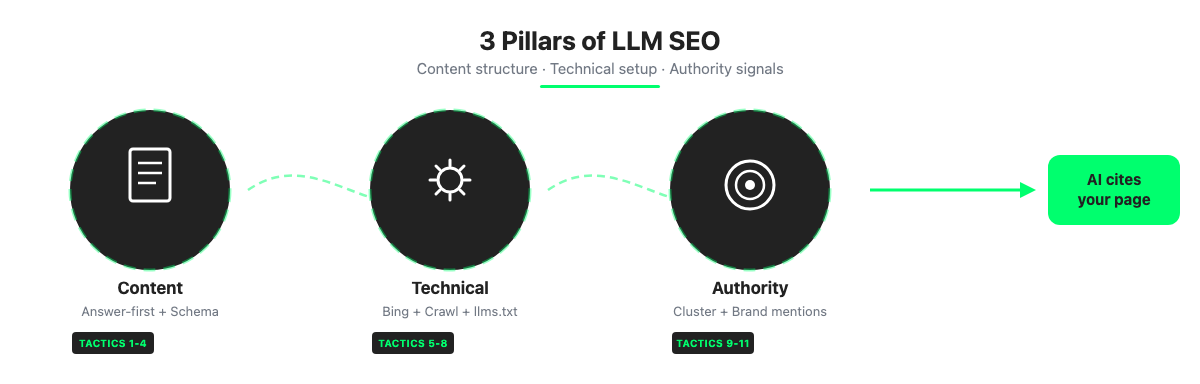
The most reliable tactics are straightforward. They improve the page itself first, then improve model usability.
1. Put the direct answer at the top of each section
This is probably the highest-leverage edit for existing content. Don't make the model infer your answer from five sentences of setup. Say the answer first, then explain it. Each section should open with a self-contained sentence that answers the heading. One that still reads clearly if extracted on its own.
2. Write headings that remove ambiguity
Weak heading: "The future of search." Stronger heading: "How LLM SEO differs from traditional SEO." The second version tells the model exactly what semantic task the section's solving. Precise headings improve passage retrieval because the model can match the heading to a query intent before reading the section body.
3. Support important claims with primary sources
If a platform controls the fact, use that platform's documentation. Google Search guidance belongs to Google. ChatGPT search crawler guidance belongs to OpenAI. It's basic editorial hygiene, but it matters more in LLM environments because unsupported claims are worse citation material. A claim linked to a primary source is more likely to be used by an AI system than the same claim without a link.
4. Add schema markup
Schema markup shows up in nearly all pages that get cited by ChatGPT. FAQPage schema helps AI systems recognize question-and-answer structure. Article schema clarifies that a page is editorial content. HowTo schema makes ordered steps legible as a procedural sequence. None of these tags guarantee inclusion, but they reduce the interpretation work a model has to do.
To add it: use Google's Structured Data Markup Helper to generate JSON-LD, or install a WordPress plugin like Rank Math or Yoast that handles it automatically. Start with FAQPage for any page that includes Q&A content, and Article for standard editorial posts.
5. Set up Bing Webmaster Tools
ChatGPT Search, Microsoft Copilot and Meta AI all use Bing's live index for real-time retrieval. If Bing hasn't indexed your site properly, you're invisible to those three AI products regardless of how well your content is written.
Go to bing.com/webmaster, add your site and submit your sitemap. Check the index status of your most important pages. If key pages aren't indexed, submit them manually and fix any crawl errors Bing flags. It's a 20-minute setup that has a direct impact on AI search visibility.
6. Keep your content fresh
LLMs favor recently updated content, particularly on topics where the facts change. A reasonable refresh target for competitive content is every 3-6 months. More practically: update a page whenever the facts change, whenever a major competitor publishes something better or whenever you have new data to add. Update your publish date only when the content change is substantive. Changing a date without changing the content doesn't help.
Vercel treats refresh cadence as a core LLM SEO practice, listing it alongside content structure and citation seeding as the main signals that determine ongoing AI search inclusion.
7. Turn buried expertise into extractable units
Many expert pages are strong in substance but weak in packaging. Pull out comparisons, checklists, definitions and decision criteria so the content's easier to cite without losing nuance. If a comparison lives inside a long paragraph, convert it to a table. If a checklist lives inside continuous prose, break it out as a list. RAG systems extract passages at query time, and they're much more likely to use a clean, standalone passage than one that requires surrounding context to make sense.
8. Keep HTML access clean
If the important content's hidden behind scripts, blocked resources or awkward rendering, you create unnecessary risk. LLM visibility still starts with basic web accessibility for crawlers and retrieval systems. Make sure you're not blocking OAI-SearchBot, Google-Extended or Bingbot in your robots.txt. Core copy should exist in server-delivered HTML, not hidden behind a JavaScript wall.
9. Build repeated authority across a topic cluster
One isolated page can rank, but a connected cluster gives stronger topic reinforcement. If your domain has supporting pages on GEO, AI visibility, AI Overviews and content gap analysis, the system has more evidence that your site's a real source on the broader topic. Link your pages together. Make sure the cluster covers the full topic space, not just one entry point.
10. Create or update your llms.txt file
An llms.txt file is a simple Markdown document you place at your domain root (e.g., yourdomain.com/llms.txt). It gives AI crawlers a curated map of your site: your brand name, a short description and links to your most important pages, without forcing them to parse your full HTML. The standard comes from llmstxt.org and is already referenced by OpenAI and Anthropic. Google has said it does not use llms.txt for Search, so the file has no effect on Google rankings or AI Overviews; treat it as an optional aid for the AI crawlers that do support it, not a requirement. Structure the file with your site name as an H1, a brief description paragraph, then a list of links to your most important pages organized by topic.
11. Earn off-page brand mentions and grow branded search
LLMs are trained on the broader web. If your brand's mentioned in third-party publications, industry blogs, podcasts and community discussions, those mentions become training signals. A brand that shows up consistently across multiple credible sources is more likely to be cited than one that only appears on its own site. Find where AI models pull recommendations in your industry: comparison pages, Reddit threads, YouTube review channels. Build a presence in those places.
Growing branded search volume on Google and Bing matters too. When people search for your brand by name, it signals to search engines and indirectly to the AI models that use those indexes that you're a recognized entity in your space. Build branded search through product quality, community presence and content people choose to share.
Technical LLM SEO checklist
Technical work doesn't win on its own, but it prevents avoidable losses.
| Area | What to check |
|---|---|
| Crawl access | Do not block OAI-SearchBot, Google-Extended or Bingbot if you want AI search inclusion |
| Indexability | The page should be indexable and canonicalized cleanly |
| HTML content | Core copy should exist in server-delivered HTML or reliable rendered output |
| Snippet eligibility | Google says AI feature inclusion depends on normal Search eligibility with snippets |
| Page stability | Fast, reliable pages reduce retrieval friction |
| Schema markup | Use FAQPage, Article and HowTo schema where it clarifies meaning, not as a magic shortcut |
| Bing Webmaster Tools | Verify your site is indexed on Bing; ChatGPT Search, Copilot and Meta AI all use Bing's live index |
| llms.txt | Optional: place a Markdown file at /llms.txt to give supporting AI crawlers a curated map of your key pages; Google does not use it |
| Content freshness | Refresh competitive content every 3-6 months or whenever facts change meaningfully |
OpenAI's current help documentation is direct: to improve the chances that your site is included in ChatGPT search, allow OAI-SearchBot and ensure your host or CDN allows traffic from OpenAI's published IP addresses. Google is equally plain. There are no additional technical requirements for AI features beyond standard Google Search requirements.
Technical LLM SEO is mostly about removing blockers, not discovering hidden hacks.
What content formats work best for LLM SEO?
The formats that give AI systems the cleanest extraction path tend to perform best. That includes:
- definitions and explainer guides
- comparison pages with tables or direct side-by-side sections
- process pages with numbered steps
- FAQ-driven help content
- research-backed thought leadership with sourced statistics
- documentation-style pages with clear, hierarchical sections
Formats that often struggle are pages with too much opinion, too little proof or too much topic sprawl. That doesn't mean every page needs to sound dry. It means the page should make its expertise extractable.
How do you measure LLM SEO?
Measurement's still imperfect, but it's no longer invisible. OpenAI says publishers can track ChatGPT referral traffic in analytics if they allow OAI-SearchBot. Google says AI-feature traffic is part of Search Console's Web reporting. That gives you at least a practical operating model.
Track these signals:
- Search Console impressions and clicks for pages targeting AI-heavy prompts
- referral traffic from ChatGPT, Perplexity and other AI tools in your analytics
- manual prompt tests across related queries to check whether your brand or page gets cited
- citation tracking tools: Profound tracks brand mentions in AI responses; Semrush has AI Overview tracking; Advanced Web Ranking monitors AI search visibility
- engagement quality from AI-referred sessions, not just volume
- cluster-level performance across your topic group, not just individual pages
Don't rely on one screenshot from one prompt. LLM outputs change. Look for repeated inclusion across closely related prompts over time.
Common LLM SEO mistakes
Most failures come from treating AI search as either magic or meaningless. It's neither.
Common mistakes include:
- blocking AI crawlers in robots.txt and expecting inclusion anyway
- publishing vague pages with no direct answer to the heading query; if the model can't extract a clean passage, it won't cite the page
- making factual claims without primary-source support
- targeting overlapping keywords with nearly identical articles, which dilutes topical authority signals
- chasing synthetic "AI hacks" instead of improving page quality
- measuring only clicks and ignoring citation visibility in AI tools
- publishing AI-generated content without expert review, which reduces E-E-A-T signals that models use to evaluate source credibility
If your page's hard to trust or hard to parse, the model has no reason to use it.
A practical LLM SEO workflow
If you want a repeatable editorial workflow, use this:
- Pick one canonical query and one clear page intent.
- Write or rewrite each heading so it opens with a direct answer.
- Replace vague claims with validated facts and link to primary sources.
- Add tables, lists or examples where they reduce ambiguity.
- Check crawl access, indexability, canonical signals and your llms.txt file.
- Verify Bing Webmaster Tools shows your key pages as indexed.
- Add FAQPage, Article or HowTo schema where applicable.
- Link the page into the surrounding topic cluster.
- Monitor Search Console, AI tool referrals and manual citation checks regularly.
It's simple on purpose. Most LLM SEO gains come from consistent editorial discipline, not from chasing AI-specific tricks.
FAQ about LLM SEO
Is LLM SEO just another name for SEO?
LLM SEO still relies on SEO fundamentals, but it focuses more on whether an AI system can retrieve, understand and cite your content in an answer, not just rank it for a keyword query. The underlying technical requirements are the same; the additional layer's about making your content extractable and citation-worthy, not just findable.
Do LLMs care about keywords?
LLMs care more about semantic clarity, entity consistency and whether the content clearly solves the query than about keyword density. Natural-language phrasing and question-answer formats tend to perform better than keyword-dense copy, because LLMs interpret meaning through embeddings rather than exact string matching.
Do you need special markup for LLM SEO?
There's no universal markup requirement, but schema markup shows up in nearly all top ChatGPT-cited sources. FAQPage, Article and HowTo schema help AI systems interpret your page structure and content type without requiring them to infer it from prose alone.
Can you measure LLM SEO in analytics?
ChatGPT referral traffic can be tracked when publishers allow OAI-SearchBot, and Google includes AI-feature traffic in standard Search Console web reporting. Tools like Profound and Semrush's AI Overview tracking add citation-level visibility on top of that. Coverage's still partial, since not all AI tools pass consistent referral data, but the signal set is improving.
What is the fastest LLM SEO improvement for an existing article?
Rewrite the top of each section so it answers the heading directly in the first sentence, then strengthen the most important claims with links to primary sources. These two edits improve extractability more than anything else because they give retrieval systems a clean, grounded passage at the point where they're most likely to extract content.
What is an llms.txt file?
An llms.txt file is a Markdown document placed at your domain root that tells AI crawlers what your site covers and links them to your most important pages. It's a proposed standard from llmstxt.org, already referenced by OpenAI and Anthropic. Think of it as a sitemap for AI models: lightweight and optional. Google has said it does not use llms.txt for Search, so it won't affect Google rankings or AI Overviews, though some other AI crawlers do reference it.