
Glossary
Topical Authority: Importance, Building Methods, and Challenges

Topical authority is a website's demonstrated expertise on a specific subject, measured by the depth and breadth of quality content the site publishes on that topic. A site with strong topical authority earns ranking priority across the whole topic area, not just for individual optimized pages. Building topical authority typically takes six to twelve months.
- Search engines cluster interconnected content into topic models, so pillar pages and linked satellite articles signal expertise
- Topical authority lifts rankings across many related keywords, earns links naturally and stabilizes rankings through updates
- Domain authority reflects overall credibility from backlinks, while topical authority comes from content depth on one subject
- Bicycle Motor Works, with a Domain Rating of 15, outranks Amazon for e-bike keywords through deeper coverage
Topical authority is one of the most important ranking factors in modern SEO, yet most sites don't build it on purpose. When you build topical authority deliberately, your website earns higher rankings across an entire cluster of related keywords, not just the individual pages you optimize. This guide explains what topical authority is, how search engines apply it, and the practical steps to build and measure it.
What Is Topical Authority in SEO?
Topical authority is a website's demonstrated expertise on a specific subject area. Search engines measure it by the depth and breadth of quality content a site publishes on a topic. A site with strong topical authority earns ranking priority for the entire topic area, not just for individual well-optimized pages.
A personal finance site with genuine topical authority, for example, ranks for hundreds of finance-related queries because search engines have identified it as a complete, trustworthy resource. It's not ranking for keywords it deliberately chased; it's ranking because it has established itself as authoritative on the subject.
Topical Authority vs. Domain Authority
Topical authority and domain authority are often confused, but they're not the same thing. Unlike a backlink profile, topical authority is something you build directly, page by page.
| Topical Authority | Domain Authority | |
|---|---|---|
| Definition | Expertise on a specific subject, based on content depth and coverage | Overall site credibility, based on backlink profile |
| Measured by | Content depth, topic coverage breadth, internal linking structure | Number and quality of external backlinks, domain age |
| How to build | Create comprehensive, interconnected content on your topic | Earn high-quality backlinks from authoritative external sites |
| Effect on rankings | Improves rankings across all queries within your topic area | Improves ranking potential across all queries |
A site can have high domain authority and low topical authority at the same time, and that pairing isn't as rare as it sounds. This happens when a site covers many subjects but none in depth. The reverse is also possible. A newer site can outrank an established competitor on a specific topic when it has deeper, more comprehensive content on that subject. Both signals matter, although only one of them is something you control directly through content strategy rather than through years of accumulated backlinks.
Why Does Topical Authority Matter for SEO?
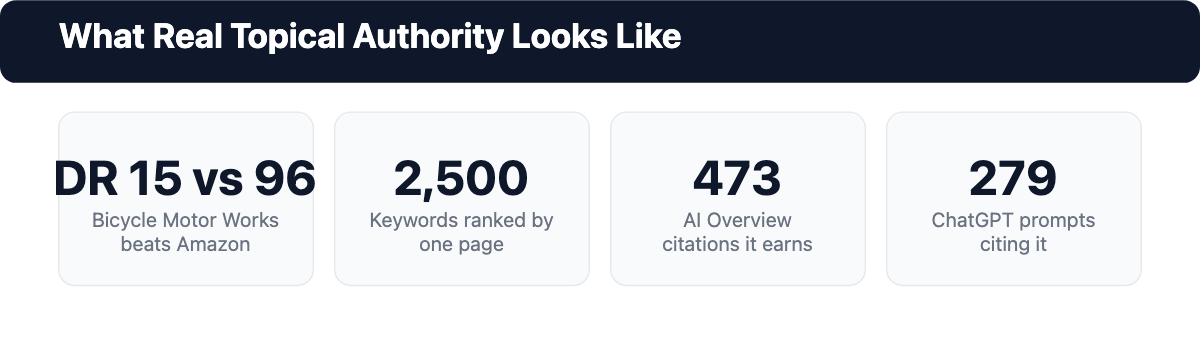
Topical authority matters because it lets a site with a real content advantage beat a much bigger domain on a specific subject. Ahrefs' own case-study library documents Bicycle Motor Works, an e-commerce site with a Domain Rating of just 15, consistently outranking Amazon (Domain Rating 96) for e-bike keywords and showing up repeatedly in AI Overview results for the same queries. An 81-point domain-rating gap didn't matter once the smaller site had deeper, more focused topic coverage than Amazon's much broader catalog pages.
The effect compounds once a site is recognized as a topic's authority. Ahrefs also tracks Healthline's page on magnesium glycinate, which ranks for around 2,500 Google keywords the page never individually targeted, and gets cited in roughly 473 AI Overview responses, plus hundreds of prompts across ChatGPT, Perplexity, Gemini and Copilot. One well-covered page, once a site earns topical authority on the surrounding subject, keeps paying off across search engines and AI answer engines at the same time.
Four primary benefits come from building topical authority:
- Higher rankings across more keywords. Search engines that recognize your site as authoritative on a topic give a ranking boost to all content you publish in that area, not just your most-linked pages.
- Natural backlink earning. Topic leaders earn links without asking for them, because other publishers cite them as primary sources.
- Compounding organic traffic. As your topical authority grows, you rank for more long-tail queries in your niche. This creates a traffic effect that reduces dependence on paid channels.
- Long-term ranking stability. Sites with deep topical coverage hold their rankings during algorithm updates better than sites relying on a few heavily optimized pages.
Topical authority is a long-term investment, and it isn't a fast one. But it creates a sustainable traffic advantage that a much larger competitor can't replicate quickly, the way Bicycle Motor Works has held its e-bike rankings against Amazon.
SEO Title Generator: eight title tag variations, sized for the SERP and intent-matched. Free, no signup.
How Does Topical Authority Work?
Search engines build topic models of the web using semantic analysis. When a site publishes high-quality, interconnected content on a topic, its documents cluster together in those models, and that's what gives the site ranking priority across the entire topic area.
Semantic Search and Topic Models
Modern search engines don't match keywords. They analyze the meaning and relationships between concepts across your entire site. When Google crawls your content, it identifies which topics you cover, how thoroughly you cover them, and how content connects internally, more on that in SEO Ranking Factors.
Sites that cover a topic from many angles signal broad expertise. A site covering definitions, how-to guides, comparisons, FAQs, and specific use cases tells a search engine: this is a comprehensive resource. Sites that cover only a few aspects of a topic receive less authority, even if their individual pages are well-optimized on their own.
Internal linking matters here. Linking between related content helps search engines understand the semantic relationships between your pages. A pillar page built around a topic cluster that links out to satellite articles on each subtopic signals a coherent structure, not a collection of isolated posts.
Algorithm Evolution: From Panda to the Core Ranking System
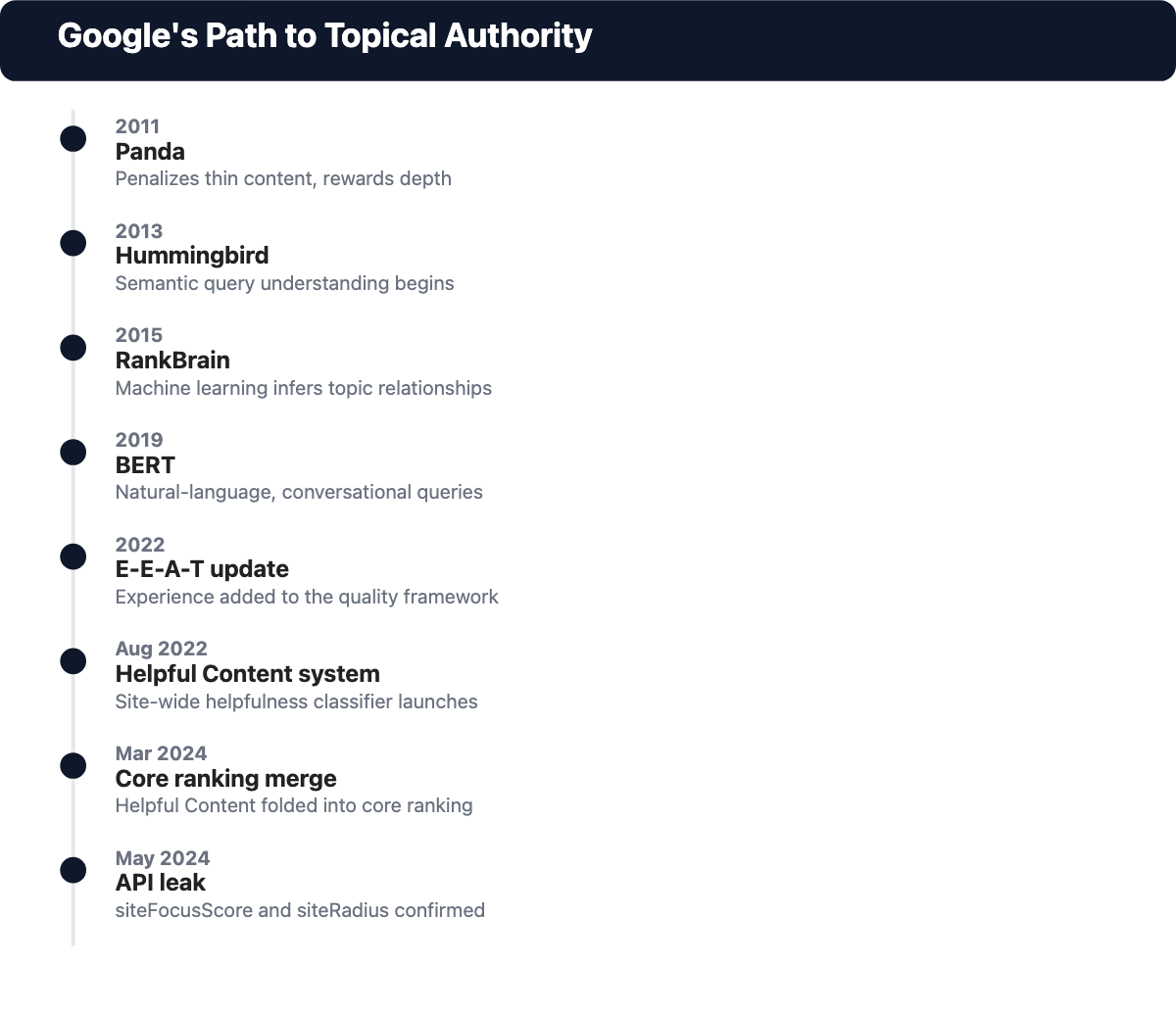
Google's shift toward topical authority happened gradually, across more than a decade of named algorithm updates.
Google Panda (2011) penalized thin, low-quality content and rewarded sites with substantive articles. It established that content depth is a ranking signal, not just keyword presence.
Google Hummingbird (2013) introduced semantic query understanding. Google began interpreting the intent behind a query, not just its words, which made it possible to reward sites that covered a topic comprehensively even when a specific keyword phrase was absent from a given page.
Although RankBrain (2015) and BERT (2019) arrived years apart, both pushed that same idea further with machine learning, letting Google infer relationships between related concepts and interpret conversational, natural-language queries instead of matching exact phrases.
E-E-A-T (updated 2022) added "Experience" to the existing Expertise, Authoritativeness, and Trustworthiness framework. Google's quality rater guidelines now evaluate whether the author has first-hand experience with the subject. For topical authority, content that demonstrates real-world knowledge ranks better than generic overviews.
The Helpful Content system, launched in August 2022 and folded directly into Google's core ranking system in March 2024, extended the same logic site-wide: instead of one classifier checking for thin content, multiple signals inside the core ranking system now assess whether a site as a whole was built primarily to help readers on a subject, or primarily to rank for it.
Each of these updates moved Google toward rewarding topical depth over keyword optimization. Topical authority isn't a trend. It's the direction search has been heading for well over a decade, and it's now measured directly, not just rewarded indirectly, as the next update below shows.
Site Focus Score and Site Radius: What the 2024 API Leak Revealed
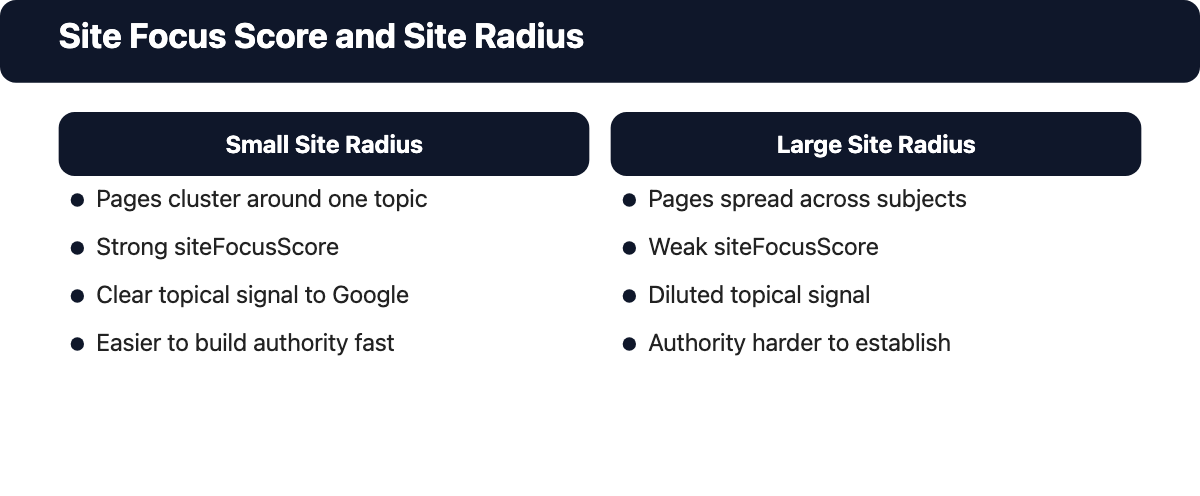
Google's own internal documentation, exposed in a large Search API leak in May 2024, confirmed that topical focus is a measured ranking input, not just an outcome SEOs infer from case studies. The leaked documentation, covering more than 14,000 ranking-related attributes, included two fields built specifically to score topical concentration: siteFocusScore and siteRadius.
siteFocusScore captures how tightly a site sticks to a single subject, using vector embeddings generated for every page and for the site as a whole. siteRadius measures how far individual pages drift from that site-level center. A small site radius means the pages cluster tightly around one topic, while a large one means the site's content spreads thin across unrelated subjects, which the documentation associates with a weaker topical signal.
The practical implication is direct: publishing content outside your core topic doesn't just fail to help your authority in that topic, it can measurably dilute it. A site chasing traffic with occasional off-topic posts is working against the exact signal this guide is built to help you grow.
How to Build Topical Authority
You build topical authority by selecting a focused niche, mapping all related subtopics through keyword research, creating interconnected pillar and satellite content, linking internally, and earning backlinks from relevant sources. The seven steps below cover the full process, and skipping one usually shows up later as a gap you'll have to backfill.
Conduct Topic-Based Keyword Research
Choose a specific topic where you want to build authority, narrow enough that you can cover it in depth, broad enough that it'll support dozens of articles.
Use keyword research tools, such as Ahrefs, Semrush, or Google Keyword Planner, to identify all the subtopics, questions, and related queries within your chosen subject. A well-structured SEO content brief turns that research into a usable writing plan before anyone's drafted a single article. Group keywords into clusters based on shared intent. Each cluster becomes a section of your content architecture.
Here's what to look for in particular:
- Primary questions ("what is," "how to," "best way to")
- Comparison queries ("X vs. Y")
- Use-case queries ("how to use X for Y")
- Problem-based queries ("why is X not working")
This research gives you the full map for your content architecture before you've written a single word.
Build Topic Clusters with Pillar Pages and Satellite Articles
The pillar-and-satellite model is the most effective structure for topical authority. A pillar page covers a broad subject comprehensively. Satellite articles go deeper on each specific subtopic. Building a deliberate topic cluster around your pillar page is what turns a list of articles into a structure search engines can actually recognize.
Say your topic's email marketing. Your pillar page covers email marketing strategy, tools, and best practices at a high level. Satellite articles cover specific subtopics: email deliverability, subject line optimization, segmentation, A/B testing, and so on.
Every satellite article links back to the pillar page, and the pillar page links out to each satellite in turn. If that two-way link is missing, the structure isn't really a cluster yet, it's just a folder of related posts. This internal linking pattern creates a visible topic cluster that search engines identify and reward.
Cover every major subtopic in your niche. A gap in coverage is a flat-out signal that your expertise is incomplete.
Create High-Quality Expert Content
Content quality's the foundation everything else sits on. Following Google's E-E-A-T guidelines, your content should demonstrate:
- Experience: First-hand knowledge of the subject, including real examples, case studies, or observations from practice
- Expertise: Accurate, specific information that goes beyond what a generalist could write
- Authoritativeness: Recognition by other sites through backlinks, citations, and mentions
- Trustworthiness: Accurate sourcing, author credentials, and honest information
Generic content that summarizes what anyone can find in a few minutes won't build topical authority. Each article should add something specific: a tested method, a concrete example, a comparison no one else has made, or an answer that competitors leave incomplete.
Use Internal Linking Strategically
Internal linking connects your topic cluster and signals its structure to search engines. Every article you publish should link to related articles on your site, and it should receive links from related articles in return. The right internal linking tools make it realistic to keep that structure current once a cluster's grown past a handful of pages.
Here's what works best for internal linking in a topic cluster:
- Link from pillar pages to all relevant satellite articles
- Link from satellite articles back to the pillar page
- Link between satellite articles on related subtopics
- Use descriptive anchor text that reflects the target page's topic
- Add internal links to new articles from your most-trafficked existing pages
A well-linked topic cluster outright outperforms a collection of standalone articles on the same subject.
Earn External Backlinks
External backlinks from relevant, authoritative sites reinforce the topical authority signals your content creates. Focus on earning links from within your topic area, not just from any high-authority domain that will say yes. Links from unrelated high-authority sites carry less weight for topical authority than links from topically relevant sources.
Four tactics consistently work better than a generic "create great content and hope someone links to it" approach:
- Broken link building. Find dead links on authoritative pages in your niche, then offer your own page as a working replacement for the same topic.
- Unlinked mention reclamation. Track mentions of your brand or content that don't link back, and ask the publisher to add the link.
- Digital PR and HARO-style outreach. Pitch original data, a survey, or a first-hand expert take to journalists and bloggers already covering your topic.
- Linkable original research. Publish a study, a data set, or an original framework specific enough that other writers in your niche need to cite it rather than rephrase it.
Cover a Broad Range of Related Subtopics
Search engines reward sites that cover a topic from all angles. Your content plan should include articles for:
- Foundational concepts that beginners need
- Advanced techniques for experienced practitioners
- Edge cases and specific use scenarios
- Common mistakes and how to avoid them
- Tool and method comparisons
Covering the full spectrum of your topic ensures search engines see your site as a complete resource, not a collection of posts targeting popular keywords. A periodic content gap analysis against the strongest pages in your niche is the fastest way to find what that spectrum's still missing.
Update and Refresh Content Regularly
Topical authority isn't a one-time achievement. Refreshing existing content is as important as publishing new articles. Outdated information signals that your content may no longer be the most accurate resource on the topic.
A quarterly review cycle works well for most content programs, and it doesn't need to be more complicated than this. During each review:
- Update statistics, tools, and examples that have changed
- Add new sections if significant developments have occurred in the topic
- Improve sections that are thinner than what top competitors now offer
- Add internal links to new relevant articles you've published
Sites that maintain current, comprehensive content keep their topical authority. Sites that publish and then abandon their content don't.
Topic cluster build checklist:
- Choose a specific, defensible niche topic
- Complete keyword research across all subtopics and question types
- Create a pillar page covering the topic broadly
- Publish satellite articles for each major subtopic cluster
- Add internal links connecting pillar and satellite pages in both directions
- Earn backlinks from topically relevant external sources
- Review and refresh content on a quarterly cycle
How to Measure Topical Authority
You'll measure topical authority by tracking keyword rankings across your entire topic area, monitoring your Traffic Share by Domain in Ahrefs, watching how often your content gets cited in AI-generated answers, and auditing topic coverage gaps with SEO tools.
Track Keyword Rankings by Topic
The most direct measurement's tracking how many keywords you rank for within your target topic, not just for individual articles. Use a rank tracker in Ahrefs or Semrush to monitor rankings across the full cluster of keywords in your niche.
Progress indicators to watch:
- Total number of keywords ranked in positions 1 to 20 for your topic
- Movement of rankings over time as you add content
- Which subtopics have the strongest and weakest ranking coverage
Growing topical authority shows up as rankings improving across the entire topic cluster, not just for the pages you've specifically optimized.
Use Traffic Share by Domain (Ahrefs)
Traffic Share by Domain is Ahrefs' named metric for measuring how much of the organic traffic for a topic a given domain captures relative to competitors. It's the closest proxy available for topical authority as a standalone metric.
To use it in Ahrefs: navigate to Keywords Explorer, enter the seed keyword for your topic, then review the Traffic Share view to see which domains capture the most traffic across all related queries. Tracking your share against competitors over time shows whether your topical authority's growing or declining.
No external tool can measure exactly how Google weights topical authority internally, and it likely never will. But Traffic Share by Domain gives a meaningful, data-backed view of relative authority within your topic.
Track AI Search Visibility and LLM Citations
Being cited by AI answer engines is now a measurable sign of topical authority, right alongside traditional rankings. When ChatGPT, Perplexity, or Google's AI Overviews need to answer a question, they'll favor sources that already look comprehensive and well-structured on that specific subject, the same signal traditional search rewards.
You don't need specialized software for this. Three practical ways to check it yourself:
- Search Google Search Console's Performance report for queries that show impressions from AI Overview surfaces, and compare that list against your topic cluster
- Ask ChatGPT and Perplexity a handful of real questions from your topic cluster and note whether your domain appears among the cited sources
- Track the same questions monthly. Citation isn't stable yet, but a site that starts appearing more consistently over a topic cluster is showing the same compounding pattern that ranking growth shows in traditional search
AI-citation tracking isn't a replacement for rank tracking. It's a second, independent signal that tends to move in the same direction as topical authority once a site has genuinely built it.
Monitor Organic Traffic and Engagement Signals
Google Search Console gives a free view of your site's performance across topic-related queries. Review the Performance report filtered to queries in your target topic and track:
- Total impressions for topic-related queries
- Average position for the topic keyword cluster
- Click-through rate by query
Engagement signals, such as time on page and bounce rate in Google Analytics, also indicate whether your content's satisfying topic search intent. High engagement across your topic cluster reinforces authority signals.
Conduct Topic Coverage Audits
Audit how well your content covers the major subtopics in your niche. Tools like MarketMuse, Semrush's Topic Research tool, and Ahrefs' Content Gap feature identify which subtopics competitors cover that you don't. A structured content gap analysis turns that raw tool output into a prioritized list instead of an overwhelming spreadsheet.
For each gap you've found, assess whether:
- The subtopic has meaningful search volume
- The subtopic is relevant to your audience
- You can create more comprehensive content than current competitors
Filling coverage gaps isn't glamorous work, but it's one of the fastest ways to build topical authority in an established niche.
Challenges in Building Topical Authority
The main challenges aren't technical. They're identifying the right niche topics, competing against sites with years of established authority, and maintaining high-quality content production at the required volume.
Identifying the Right Topics for Your Niche
Choosing the right topic focus is the most critical decision in a topical authority strategy, and it's not one you get to undo cheaply. Too broad, and you spread resources across too many subtopics to achieve depth in any of them. Too narrow, and you exhaust the available subtopics quickly.
Start with your genuine area of expertise. Use keyword research to verify there's enough search volume across the topic cluster to justify the investment. Look for topics where top-ranking competitors have incomplete coverage. These gaps represent your opportunity to build authority faster.
Commit to your chosen topic for at least twelve months before evaluating whether to expand or pivot. Topical authority takes time. Changing direction too early resets your progress.
Competing With Established Authorities
Competing against sites that have spent years building topical authority on your target subject is hard. They've got more content, more backlinks, and more historical ranking signals. You can't match them quickly in aggregate, without question.
The most effective approach: focus on subtopics where they have gaps. Most established sites have a core set of articles they maintain well and a long tail of older articles they've neglected. Research their weaker subtopics and publish more thorough, current content there first.
Niche expertise gives smaller sites a real edge. Bicycle Motor Works didn't out-content Amazon across every e-bike-adjacent query. It out-covered Amazon on the specific queries that mattered to e-bike buyers, which is the same edge available to any site willing to go deeper than a generalist competitor will bother to go.
Producing Consistently High-Quality Content
Building topical authority requires content at a volume and quality level that most organizations find difficult to sustain. A strategy built on a few excellent articles isn't enough, and it won't get you there alone. You need coverage across dozens or hundreds of subtopics.
To make this sustainable:
- Build an editorial calendar with a publishing cadence you can maintain without burning out
- Focus on depth over frequency; one thorough article per week beats three thin ones
- Create a content brief template that standardizes research and structure across all articles
- Track which articles drive the most organic traffic and use those as models
The goal isn't to publish as much as possible. It's to cover your topic area more thoroughly than any competitor does.
FAQ
What Is the Difference Between Topical Authority and Domain Authority?
Topical authority and domain authority measure different aspects of a site's ranking potential, and they're not interchangeable. Topical authority reflects a site's expertise on a specific subject, measured by the depth and breadth of its content on that topic. Domain authority is a Moz metric estimating overall ranking potential based on the backlink profile. You build topical authority through content strategy; you build domain authority through link building. A site with high domain authority but thin topic coverage can be outranked by a lower-authority site with deeper topical expertise on the same subject.
Can Topical SEO Authority Impact My Rankings?
Yes, topical authority has a direct, well-documented impact on search rankings. When search engines identify your site as an authoritative resource on a topic, they'll rank your content for queries related to that topic, including queries you never specifically optimized for. The compound effect means that every new article you publish on your topic benefits from the authority you've already built, and each subsequent piece of content becomes easier to rank.
How Long Does It Take to Build Topical Authority in SEO?
Building meaningful topical authority typically takes six to twelve months of consistent content production. The timeline depends on how competitive your niche is and how thoroughly you cover it. Sites entering less competitive niches or focusing on underserved subtopics may see results faster. There's no shortcut here: topical authority comes from publishing high-quality, comprehensive content over time.
Do I Need to Update Content Regularly to Maintain Topical Authority?
Yes, refreshing content regularly is essential to maintain topical authority. Outdated information signals that your site may no longer be the most accurate resource on the topic. Sites that publish and then neglect their content lose ground to competitors that keep their articles current. A quarterly review cycle for your most important pillar pages and satellite articles is a practical standard. Update statistics, examples, and tool references that have changed, and add new sections to cover recent developments in the topic.
Does Topical Authority Affect AI Search Visibility?
Yes, topical authority affects AI search visibility, because the same depth and structure that earns traditional rankings also makes a site more likely to get cited by AI Overviews, ChatGPT, and Perplexity. AI answer engines break a question down into related sub-queries and pull from sources that already cover the subject comprehensively, which is the same test topical authority already measures. A site that hasn't built topical authority on a subject rarely gets cited as a source for it, whether in traditional search results or in AI-generated answers.
What Tools Help Build Topical Authority?
Several categories of tools support a topical authority strategy, and you don't need all of them at once. For keyword research and topic discovery: Ahrefs and Semrush. For topic coverage analysis and content gap identification: MarketMuse and Semrush's Topic Research tool. For tracking keyword rankings across your topic cluster: Ahrefs Rank Tracker and Semrush Position Tracking. For monitoring organic performance: Google Search Console. For content quality and topic optimization: Clearscope and Surfer SEO.
Are There Risks in Focusing Too Much on Topical Authority?
Yes, over-focusing on topical authority at the expense of other SEO fundamentals creates real risks. Ignoring technical SEO means slow page speeds and crawl issues will undermine the rankings your content should've earned. Neglecting backlinks entirely lets competitors with similar content depth but stronger link profiles outrank you. Prioritizing volume over quality risks thin content and potential quality penalties. A well-rounded SEO strategy treats topical authority as a core pillar alongside technical optimization, backlink building, and user experience improvements, not as a replacement for any of them.