

High intent keywords are search queries that signal a user is close to taking a commercial action: a purchase, a demo request, a booking, or a direct inquiry. Unlike broad informational searches, high intent keywords indicate that the searcher has moved past the research phase and is ready to engage with a business. That distinction matters enormously: a page ranking for a high intent keyword generates qualified traffic that converts at a fundamentally different rate than traffic from informational queries.
In 2026, this distinction is more important than ever. AI Overviews now handle a growing share of broad, informational queries without sending a click to any website. If your SEO strategy focuses on traffic volume from “what is X” content, that traffic is increasingly going to zero. High intent keywords are where organic search still drives measurable revenue, because these are the queries where users still click through; they want to evaluate, compare, and buy, not just read an AI-generated summary.
This guide covers what high intent keywords are, how they map to search intent, how to find them using both your own data and third-party tools, how to build content that actually converts on them, and how to measure whether your targeting is working.
What Are High Intent Keywords?
High intent keywords are search terms that reveal a user is close to making a decision. They carry explicit signals (specific product names, comparison modifiers, pricing qualifiers, or location terms) that indicate the user is not exploring a topic generally but is evaluating options or ready to act.
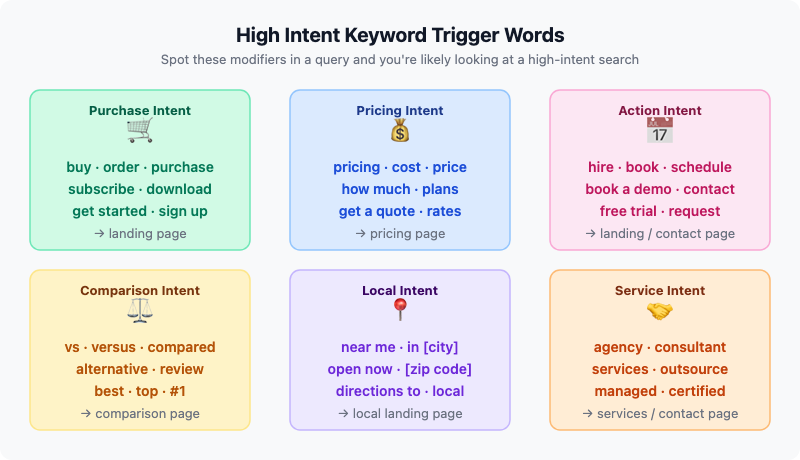
The clearest signals are the modifier words and phrases that routinely appear in high intent queries:
- buy, order, purchase
- pricing, cost, price, how much
- hire, book, schedule, get a quote
- near me, in [city], open now
- vs, versus, compared to, alternative to
- best, top, recommended (when combined with a specific use case)
- free trial, demo, download, sign up
A search for “content marketing agency” is low-to-mid intent. A search for “hire content marketing agency for SaaS startup” is high intent: the modifier “hire” and the specificity of “for SaaS startup” narrow the field to someone actively looking to engage a vendor. That specificity is the signal.
High intent does not always mean high search volume. Many of the most valuable high intent keywords are long-tail phrases with modest monthly search volume but conversion rates that far outperform broad head terms. A term with 50 monthly searches and 8% conversion rate generates more leads than a term with 5,000 monthly searches and 0.1% conversion rate.
The Four Types of Search Intent
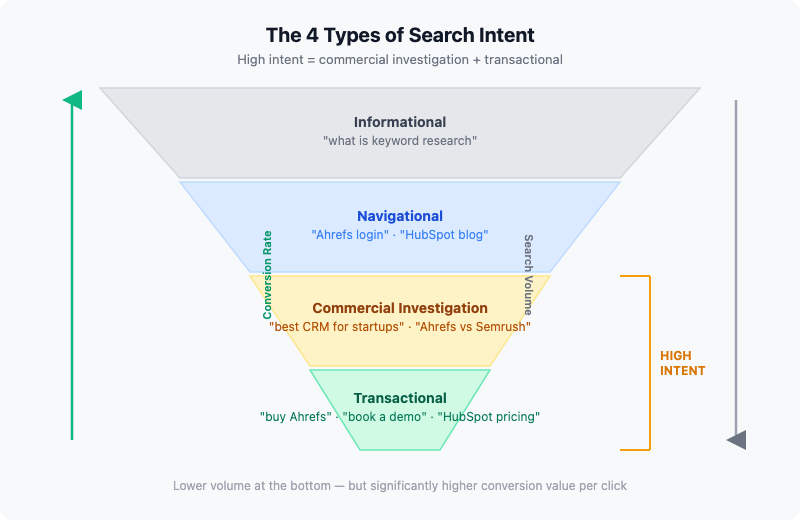
Search intent describes what a user is trying to accomplish with a query. Google’s algorithm classifies search intent to match queries with the most relevant content type. Understanding the full spectrum helps clarify exactly where high intent sits.
Informational Intent
The user wants to learn something. They are not evaluating products or vendors; they are building knowledge.
Examples: “what is keyword research,” “how does content marketing work,” “what is search intent in SEO”
Conversion rate from informational queries: typically very low (0–1%). These are top-of-funnel queries suited to blog posts, guides, and explainers. AI Overviews increasingly answer these queries without a click.
Navigational Intent
The user wants to reach a specific website or page. They already know where they want to go.
Examples: “Ahrefs login,” “Semrush pricing page,” “HubSpot blog”
Conversion rate: high for branded traffic, but mostly captures existing awareness rather than generating new demand.
Commercial Investigation Intent
The user is researching options before making a decision. They are actively comparing products, reading reviews, and evaluating vendors. This is high intent territory.
Examples: “best SEO tool for agencies,” “Ahrefs vs Semrush for keyword research,” “top content marketing platforms 2026,” “ActiveCampaign alternatives for small businesses”
Conversion rate: medium-to-high. Users at this stage are close to buying; they need help deciding which option to choose. The right comparison page or “best of” list captures this audience effectively.
Transactional Intent
The user is ready to take action right now. They are not researching anymore.
Examples: “buy Ahrefs subscription,” “book a demo Contentforce,” “HubSpot pricing plans,” “hire freelance SEO consultant”
Conversion rate: highest of all intent types. These queries deserve dedicated landing pages, not blog posts. Even a modest volume of transactional keyword traffic can drive significant revenue.
For practical purposes, high intent keywords = commercial investigation + transactional intent. These are the queries where your content needs to be built for conversion, not for education.
High Intent vs. Low Intent Keywords
The core difference between high and low intent keywords is not volume; it is where the searcher sits in the decision process. Low intent keywords drive awareness and brand reach. High intent keywords drive revenue.
| Aspect | High Intent Keywords | Low Intent Keywords |
|---|---|---|
| User mindset | Ready to act or actively comparing | Exploring or learning |
| Funnel stage | Bottom or mid-bottom | Top of funnel |
| Search volume | Typically lower | Typically higher |
| Competition | Higher CPC, moderate organic competition | Lower CPC, often high organic competition |
| Conversion rate | High (3x to 10x+ vs. informational) | Low (often below 1%) |
| Best content type | Landing page, comparison page, pricing page | Blog post, guide, explainer |
| Examples | “hire SEO agency for SaaS,” “HubSpot pricing” | “what is SEO,” “how does content marketing work” |
| Business value | Revenue-generating: drives trials, demos, sales | Awareness-generating: builds audience |
The conversion rate gap is the critical point. A page that ranks for “best project management software for remote teams” will generate inquiry-ready traffic even at 200 monthly sessions. A page ranking for “what is project management” at 20,000 monthly sessions may generate almost no leads. Optimizing for traffic volume instead of conversion potential is one of the most common and costly SEO mistakes.
High Intent Keyword Examples by Category
High intent keywords vary significantly by vertical, but the underlying pattern is consistent: specificity plus a commercial or action modifier. Here are examples across the most common categories.
B2B SaaS
- “HubSpot vs Salesforce for mid-market companies”
- “ActiveCampaign pricing plans 2026”
- “best CRM software for sales teams under 20 people”
- “Asana alternatives for project management”
- “content marketing platform with AI features”
- “book a demo [product name]”
- “Contentforce pricing”
E-commerce
- “buy noise-cancelling headphones under $200”
- “best organic dog food subscription free shipping”
- “Allbirds running shoes discount code”
- “where to buy [product] online with fast delivery”
- “compare [brand A] vs [brand B] running shoes”
Local Services
- “emergency plumber near me open now”
- “affordable wedding photographer Los Angeles”
- “dentist accepting new patients [city name]”
- “HVAC repair service [zip code]”
- “best personal injury lawyer in [city]”
Agency and Professional Services
- “hire SEO agency for SaaS companies”
- “content marketing agency pricing”
- “freelance copywriter rates per word”
- “B2B content marketing agency [city]”
- “get a quote digital marketing agency”
Zero-Volume High Intent Keywords
This category deserves special attention because most keyword research tools will never surface these queries, yet they are often the highest-converting keywords in any B2B business.
Zero-volume high intent keywords are phrases that appear in sales calls, CRM notes, Slack messages from prospects, and support tickets, but rarely or never in monthly search volume data. Examples:
- “[specific product] implementation partner [region]”
- “[competitor name] vs [your brand] [niche use case]”
- “[category] tool for [very specific workflow]”
- “[brand] pricing for [industry or team size]”
These queries exist at the bottom of a very long tail. They have no search volume because they are too specific for many users to search at the same time. But when someone searches one of these phrases, they are about as close to buying as a prospect gets. A well-written page targeting a cluster of zero-volume high intent phrases can become one of the highest-converting pages on a site despite near-zero organic traffic, because every visitor who lands on it is exactly the right person.
How to find them: review your last 50 sales call transcripts, export CRM deal notes, search Intercom or Zendesk for language prospects use in their first message. The recurring phrases are your zero-volume keywords.
How to Find High Intent Keywords
Finding high intent keywords requires different methods than finding high-volume informational keywords. The best sources combine your own conversion data with third-party tool filters designed to surface commercial signals.
1. Mine Your Own Google Ads Data
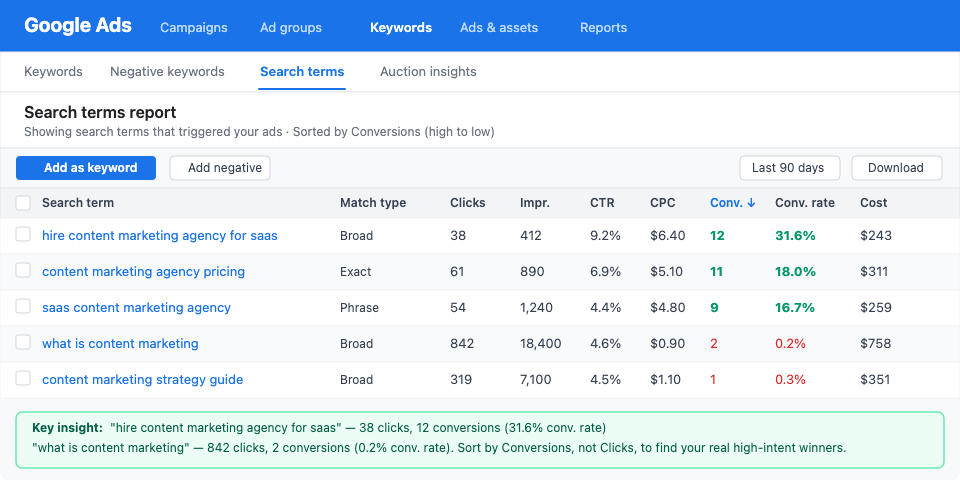
If you run paid search, your Google Ads account is the most accurate source of high intent keyword intelligence available to your business. The reason: every keyword in your account has actual conversion data attached to it. You know exactly which queries drove form fills, trial signups, or purchases.
How to do it: In Google Ads, go to Reports → Search Terms. Filter by conversions > 0. Export the list. Sort by conversion rate, not click volume. Any search term that converted even once is a high intent signal; if it converted multiple times, it is a priority organic target.
This method surfaces queries that perform but that you may never think to target organically because they look “too specific” or “too low volume.” Those qualifiers are precisely why they work.
2. Work Backwards from High-Converting Organic Pages
Some of your existing pages are already driving signups, trials, demo requests, or contact form completions, even if no one has deliberately optimized them for conversion. These pages are sitting on high intent queries you have not fully exploited yet.
How to do it: In GA4, identify pages with the highest conversion event rates (not sessions, but conversion rate). Then use Google Search Console to see which queries those pages rank for. The ranking queries on your best-converting pages are your highest-priority organic high intent keyword targets.
3. Use Keyword Tools with Intent Filters
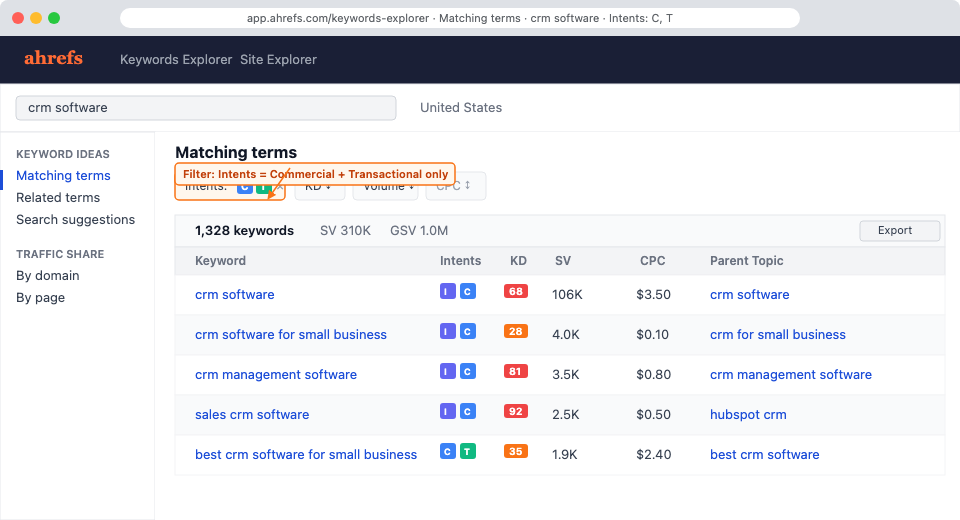
Ahrefs and Semrush both have intent classification built into their keyword data. Use these filters deliberately rather than browsing by volume.
In Ahrefs: use the Keywords Explorer, add your seed terms, filter Intent → Transactional or Commercial. Set CPC minimum at $1–2 (high CPC is a proxy for commercial value; advertisers only bid on terms that convert). Filter KD under 40 for realistic ranking opportunities.
In Semrush: Keywords Overview → Intent filter → set to Commercial and Transactional. Export and sort by CPC then search volume.
These filters dramatically reduce the noise in a keyword export and focus your list on terms that already correlate with commercial action.
4. Analyze Competitor Paid Keywords
If a competitor is bidding on a keyword repeatedly across months, they have concluded that keyword converts. You are looking for their conversion intelligence, not their branding choices.
How to do it: In Semrush, use the Advertising Research tool on your top 2–3 competitors. Export their paid keywords. Sort by Ads position duration; keywords they have bid on for 3+ months are almost certainly converting for them.
SpyFu offers a similar view. The output is a pre-validated list of high intent terms sorted by competitor investment.
5. Use Google Autocomplete and People Also Ask
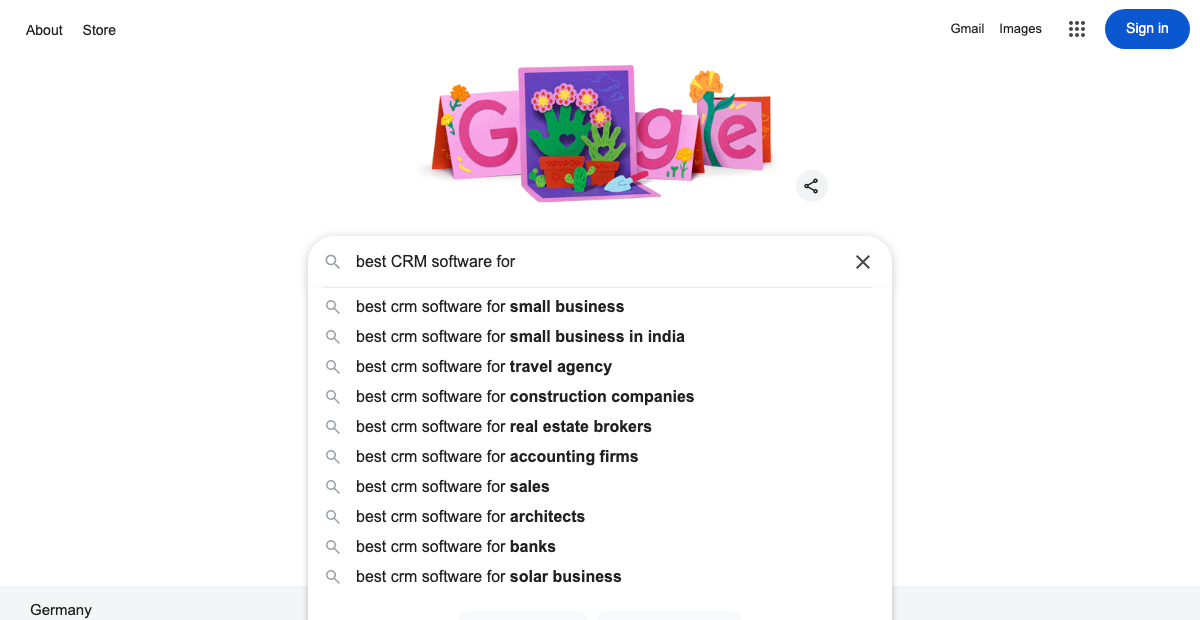
This method is free and available to everyone. It surfaces real search queries in the exact language users type.
How to do it: Open an incognito browser window. Start typing your seed keyword plus each common modifier in turn: “buy [keyword],” “[keyword] pricing,” “[keyword] vs,” “best [keyword] for,” “[keyword] near me.” Screenshot the autocomplete suggestions; these are real queries with enough search activity to surface in Google’s suggestion system.
Also check People Also Ask for your main keyword. PAA questions phrased as comparisons or with action verbs are commercial investigation or transactional in intent.
6. Mine Customer Calls and CRM Data
This is the method that finds your zero-volume high intent keywords. No tool will surface these queries, but they are often more commercially valuable than anything in a keyword export.
How to do it: Review your last 30–50 sales call transcripts or recordings. Note the exact phrases prospects use to describe their problem, their current solution, and what they are looking for. Export your CRM’s “first touch message” or “inquiry notes” fields and read through them. Export your live chat or support ticket first messages.
The language patterns that repeat across prospects are the phrases your ideal buyers actually type into Google. Build pages targeting clusters of these phrases, even when they show zero monthly search volume in any tool.
How to Target High Intent Keywords with Content
Finding high intent keywords is only half the equation. The other half is matching the right content type to each intent level. Most SEO guides skip this step, which is why many sites rank for high intent terms and still fail to convert the traffic.
Transactional Keywords: Dedicated Landing Pages
Transactional keywords like “buy [product],” “book a demo,” or “[brand] pricing” need dedicated, conversion-optimized landing pages. Not blog posts. Not category pages. Purpose-built landing pages with a single conversion goal.
What these pages need: clear headline matching the query, pricing transparency or explicit CTA above the fold, social proof (logos, testimonials, case study snippets), and as few navigation exits as possible. The page should reduce friction at every step toward the conversion action.
Commercial Investigation Keywords: Comparison and Best-Of Pages
Queries like “best [product category] for [use case]” or “[brand A] vs [brand B]” require pages that feel helpful and comprehensive while guiding users toward a conversion decision.
What these pages need: a genuine comparison with honest pros and cons (thin, biased comparisons erode trust), clear use-case matching (“choose X if you need Y”), a conversion CTA positioned after the reader has enough information to decide (mid-page or at the end of the comparison section, not above the fold).
Pricing and Alternatives Pages
Two underused page types that attract extremely high intent traffic:
Pricing pages: Searchers typing “[your brand] pricing” are one step from a buying decision. A pricing page that explains tiers clearly, answers objections, and provides a direct next step (free trial, demo, contact) will convert at a much higher rate than sending these users to a generic homepage.
Alternatives pages: “[Competitor] alternatives” is a transactional-adjacent query. The searcher is already dissatisfied with their current solution or actively evaluating whether to switch. A well-structured alternatives page that positions your product honestly against the alternative converts extremely well because you are reaching a buyer in active evaluation mode.
Internal Linking for Conversion Flow
High intent keyword targeting is not only about standalone pages; it is also about connecting your existing content ecosystem so readers flow from informational content toward high intent pages.
Map your top-of-funnel posts (informational guides) to your highest-converting pages. Use contextual anchor text that matches what the linked page is about (“see our pricing,” “compare plans,” “book a free strategy call”). Every informational post that ranks should have at least one internal link that pushes a qualified reader toward a conversion page.
High Intent Keywords in 2026: What’s Changing
The SEO landscape has shifted significantly for keyword intent strategy. Three changes matter most for high intent keyword targeting in 2026.
AI Overviews are reducing clicks on informational queries. Google now answers a large and growing share of broad, educational search queries directly in the search result, without sending a click to any website. For queries like “what is keyword research” or “how does content marketing work,” AI-generated answers reduce organic click-through rates substantially. This makes informational keyword volume less valuable than it was two years ago.
The flip side: high intent keywords are largely unaffected by AI Overviews. When someone searches “hire content marketing agency for B2B SaaS” or “Contentforce pricing plans,” they are not looking for a summary; they are looking to take an action. AI Overviews serve informational queries; high intent queries still drive clicks because the user needs to actually click through to evaluate, compare, and convert.
Voice and conversational queries are raising the specificity bar. Voice search queries tend to be longer, more conversational, and more specific than typed queries, and more specific often means higher intent. “Find me a content marketing agency that specializes in B2B SaaS companies in Austin” is high intent even though it has no obvious trigger word like “buy.” As voice search expands and as conversational AI assistants like ChatGPT and Perplexity influence how people search, the specificity of high intent queries is increasing.
AI chatbot behavior is surfacing in search data. Users who research a category topic in ChatGPT or Perplexity and then move to Google to take action tend to arrive at a high intent query; they have already done their informational research and are now ready to compare or buy. This creates spikes in branded and comparison queries as users transition from AI conversation to commercial search. Monitoring your branded comparison keywords (“your brand vs X”) for volume changes is a useful indicator of AI-assisted research in your category.
How to Measure High Intent Keyword Performance
Traffic is the wrong metric for high intent keyword pages. The right metrics connect keyword performance to business outcomes.
Track Conversions per Keyword
The goal of a high intent keyword page is not sessions or impressions; it is conversion events. In GA4, create conversion events for the actions that matter: form fills, trial signups, demo requests, purchases. Then use Google Search Console linked to GA4 to connect ranking queries to the pages they land on, and connect those pages to conversion events.
For more precision, use UTM parameters on your paid keywords and create comparison views: which queries drove sign-ups this month vs. last month?
Revenue-Focused KPIs
Beyond conversion events, track the quality of conversions driven by high intent keyword pages:
- MQL rate: are leads from high intent pages becoming marketing qualified leads at a higher rate than other channels?
- Pipeline contribution: how much sales pipeline was opened by contacts who first converted on a high intent keyword page?
- Organic revenue attribution: if your CRM or attribution tool tracks first-touch and last-touch source, what percentage of closed revenue touched an organic high intent keyword page?
These metrics connect SEO investment to revenue, which is the conversation your leadership team actually cares about.
Lead Quality Signal
Not all conversions from high intent keyword pages are equal. Monitor whether form fills from specific keyword pages move through the sales funnel at a higher rate. If a page targeting “hire SEO agency for SaaS” drives three times more sales-qualified leads per form fill than a generic “contact us” page, that is a measurable signal that the keyword intent alignment is working.
Common Mistakes When Targeting High Intent Keywords
Using the Wrong Content Type
The most common and costly mistake: targeting a transactional keyword with a blog post. A blog post titled “How to Choose an SEO Agency” will not capture users searching “hire SEO agency pricing”, because those users want to evaluate and contact a vendor, not read an educational guide. Match content type to intent level before you start writing.
Optimizing for Traffic Instead of Conversions
High intent keywords often have lower search volume than informational keywords. If your SEO reporting prioritizes sessions and impressions, high intent pages will always look like underperformers relative to your top-of-funnel content. This creates pressure to abandon high intent pages before they have time to demonstrate their business impact. Report on conversion rate and pipeline contribution, not just traffic.
Ignoring Long-Tail Variants
“Best CRM software” is a high intent keyword, but it is also extremely competitive and heterogeneous in audience intent. “Best CRM software for sales teams under 20 people” is more specific, less competitive, and far better qualified. The long-tail variant converts at a higher rate because every visitor to that page is exactly the profile you want. Do not cluster all effort on head terms at the expense of long-tail opportunities.
No Conversion Rate Optimization on Landing Pages
Driving high intent traffic to a poorly optimized landing page is one of the most expensive mistakes in SEO. A page ranking for “book a demo [product]” that buries the CTA, has slow load times, or requires too many form fields will waste high-value traffic. Treat landing pages for high intent keywords as products requiring ongoing optimization, not as content requiring one-time publishing.
Not Tracking Revenue Downstream
Most SEO teams stop at lead volume. The higher-value question is: do leads from high intent organic keywords close at a higher rate and generate more revenue per customer than leads from other sources? If you cannot answer this question, you are flying blind on the true ROI of your high intent keyword strategy.
Frequently Asked Questions
What are high intent keywords?
High intent keywords are search queries that signal the user is close to taking a commercial action: a purchase, a booking, a demo request, or a direct inquiry. They typically include modifier words like “buy,” “pricing,” “near me,” “vs,” “best,” “hire,” or “book” combined with a specific product, service, or category. The core signal is that the user is past the research phase and is evaluating or ready to act.
What are examples of high intent keywords?
Examples span all verticals: “HubSpot pricing plans,” “buy noise-cancelling headphones under $200,” “emergency plumber near me,” “hire SEO agency for SaaS companies,” “best CRM for sales teams under 20 people,” “ActiveCampaign alternatives,” “book a demo [product name].” These share two things: specificity and a commercial modifier that indicates the user is close to taking action.
What is the difference between high intent and low intent keywords?
Low intent keywords signal research or curiosity: “what is keyword research,” “how does SEO work.” High intent keywords signal readiness to act: “hire SEO agency pricing,” “buy Ahrefs subscription.” High intent keywords typically have lower search volume but much higher conversion rates (often 3x to 10x+ compared to informational terms). The key difference is where the searcher sits in the buying process.
How do I find high intent keywords?
The most effective sources are: (1) your own Google Ads search term report filtered by conversions (these are real queries that have already converted); (2) GA4 plus Google Search Console to find what queries drive traffic to your existing high-converting pages; (3) Ahrefs or Semrush with intent filters set to Transactional and Commercial, plus a CPC minimum filter; (4) competitor paid keyword analysis via Semrush Advertising Research or SpyFu; (5) Google Autocomplete for your seed keyword plus modifiers; and (6) your own sales call transcripts and CRM data to surface zero-volume phrases that still convert at a high rate.
Are high intent keywords always transactional?
No. Commercial investigation keywords like “best CRM for startups” or “Ahrefs vs Semrush” also carry high intent. At this stage, users are actively comparing options and close to a decision. Both commercial investigation and transactional intent keywords belong in your high intent keyword strategy, though they require different content types: comparison and best-of pages for commercial investigation, and conversion-focused landing pages for transactional queries.
