
Glossary
Content Marketing Definition: What It Means and How It Works

Content marketing is a strategic approach to creating and distributing valuable, relevant, and consistent content, such as blog posts, videos, and email newsletters, in order to attract and retain a clearly defined audience and drive profitable customer action. The approach earns attention by being useful instead of buying it through paid ads.
- Content marketing runs on three connected activities: creation, distribution, and audience engagement that turns attention into relationships
- The approach matters because it builds trust before asking for anything, lowering long-term customer acquisition costs
- Advertising interrupts an audience with a paid message, while content marketing earns attention by being genuinely useful
- A B2B software company publishing in-depth comparison guides shows content marketing positioning a brand as a knowledgeable resource
What Is Content Marketing?
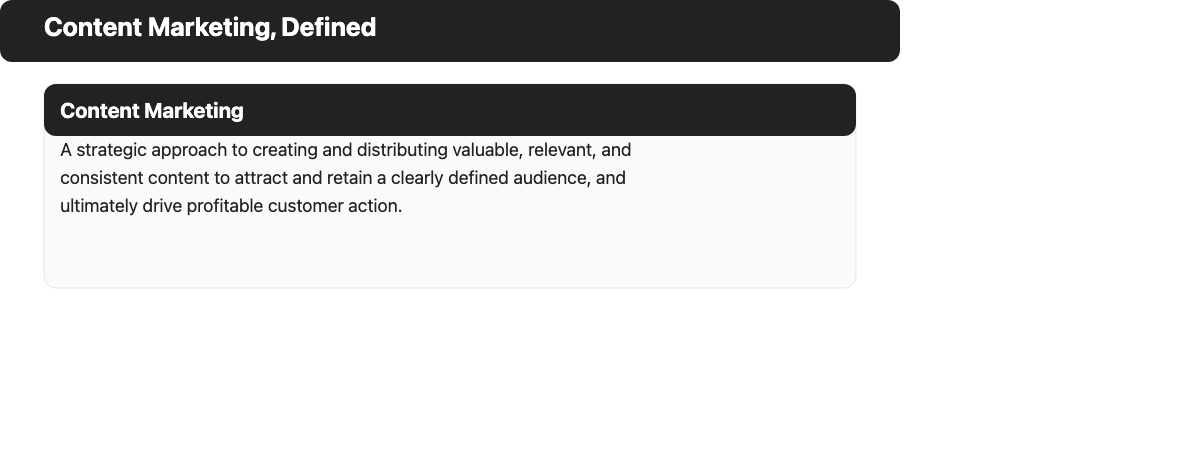
Content marketing is a strategic approach to creating and distributing valuable, relevant, and consistent content, such as blog posts, videos, social media updates, and email newsletters, in order to attract and retain a clearly defined audience. The goal is to ultimately drive profitable customer action. In plain terms, it means earning attention by being genuinely useful, instead of buying attention through paid ads or cold pitches.
The format is never the point. Every piece of content should answer a real question or solve a real problem for the audience it targets. That focus on usefulness is what separates content marketing from advertising, which simply interrupts people with a sales message regardless of what they actually want to read. The Content Marketing Institute and other leading industry bodies converge on this same audience-first definition.
Why Content Marketing Matters
Content marketing matters because it builds trust before it asks for anything in return. A reader who finds a genuinely useful article, video, or guide is far more likely to remember the brand behind it and return when they are ready to buy, compared to someone who was shown a paid ad they were trying to ignore.
That trust translates into measurable business outcomes over time:
- Stronger brand recall and credibility, because the audience associates the brand with useful information rather than interruption
- Lower long-term customer acquisition costs, since organic content keeps working and ranking long after it is published, unlike a paid ad that stops the moment the budget runs out
- Better search visibility, because search engines and AI answer systems favor pages that genuinely answer a query well
- Higher customer loyalty, since content that helps a customer succeed after purchase (guides, tutorials, FAQs) keeps them engaged with the brand
This is the core difference between content marketing and traditional advertising: advertising pushes a message at an audience regardless of whether they asked for it, while content marketing pulls an audience in by being useful enough that they seek it out.
Headline Generator: 10 headlines across 4U, AIDA, PAS and curiosity frameworks. Free, no signup.
Content Marketing vs. Related Terms
Content marketing is not the same as digital marketing, inbound marketing, content strategy, content management, copywriting, or traditional advertising, though all six terms get used interchangeably in casual conversation. Each one describes a different layer of the same overall system.
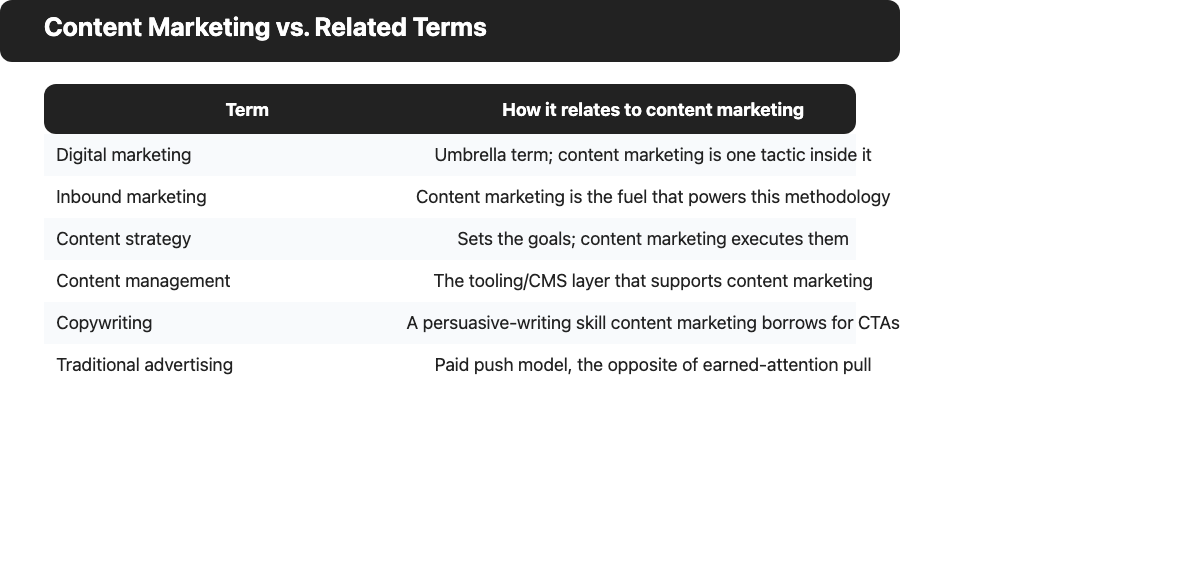
| Term | What it actually means | How it relates to content marketing |
|---|---|---|
| Digital marketing | The overarching umbrella term for any marketing done through online channels | Content marketing is one core tactic inside digital marketing, alongside paid search and social ads |
| Inbound marketing | A methodology that draws customers in through blogs, social media, and SEO instead of interrupting them | Content marketing is the fuel that powers the inbound methodology |
| Content strategy | The high-level planning and governance behind content: the why, the workflows, the brand voice | Content strategy sets the goals; content marketing executes, distributes, and promotes the resulting assets |
| Content management | The systems and processes used to create, organize, and publish content, usually via a CMS | The technology/process layer that supports content marketing but does not decide what to say |
| Copywriting | The craft of writing persuasive text meant to prompt an immediate action, like a click or a purchase | Content marketing aims to educate or build a relationship over time, though it often uses copywriting in its calls to action |
| Traditional advertising | Paid placements that interrupt an audience with a message | The opposite distribution model: push instead of pull, rented attention instead of earned attention |
A simple way to remember it: content strategy is the plan, content marketing is the execution of that plan (as one tactic inside the broader inbound and digital marketing methodologies), content management is the toolkit that supports the execution, copywriting is a persuasive-writing skill content marketing borrows for calls to action, and traditional advertising is a separate, paid channel entirely rather than a synonym for any of the other six.
Types of Content Marketing
Most content marketing programs draw from a handful of core formats, each suited to a different stage of the audience's journey.
Blog Posts
Blog posts are the foundation of most content marketing programs because they are searchable, shareable, and easy to update over time. A single well-optimized post can keep generating organic traffic for years, which makes blogging one of the most cost-efficient content formats available.
Video Content
Video has become close to universal in marketing. 91% of businesses now use video as a marketing tool as of 2026, matching previous all-time highs, according to Wyzowl's video marketing research. Video works especially well for product demonstrations and tutorials. It also builds a personal connection with an audience that text alone cannot replicate.
Social Media Content
Social platforms let brands meet audiences where they already spend time, whether that is a quick tip, a behind-the-scenes look, or a promotion of a longer piece of content published elsewhere. Social content works best as a distribution and engagement layer on top of deeper content rather than as a replacement for it.
Email Marketing
Email remains one of the highest-return content formats available. 35% of companies see between $10 and $36 in return for every $1 spent on email marketing, according to Litmus's 2025 State of Email report. Another 30% report seeing $36 to $50 back per dollar. That return comes from email's unique ability to reach an audience directly, without depending on a platform's algorithm.
Infographics
Infographics turn dense information into something scannable. They are 30 times more likely to be read from top to bottom than a standard blog post, according to Venngage's infographic research. That makes them useful for summarizing data-heavy topics that would otherwise lose a reader halfway through.
How Content Marketing Works
Underneath all of the formats above, content marketing runs on three connected activities:
- Content creation: researching and producing the actual piece, whether that is a blog post, a video script, or a social update, built around a real audience question
- Content distribution: getting that content in front of the right audience, through owned channels like email and a website, or earned channels like search and social shares
- Audience engagement: turning attention into a relationship, through comments, replies, shares, and repeat visits that signal the content actually helped someone
Each of these three activities maps to a different stage of the buyer's journey: creation and distribution do the work of awareness and consideration, while engagement is what carries a reader from consideration into an actual decision. A content marketing program that only creates and distributes, without ever engaging the audience it reaches, is leaving most of the value on the table.
Content Marketing Examples
Content marketing is not limited to one industry or company size. A few patterns show up repeatedly across sectors:
- A healthcare organization publishing patient-education articles and videos that answer common medical questions, building trust with people long before they need to choose a provider
- A B2B software company publishing in-depth guides and comparison content that helps a buyer evaluate options, positioning the company as a knowledgeable resource rather than just another vendor, a pattern LinkedIn's own marketing research confirms is common among B2B brands
- A financial services brand publishing plain-language explainers on topics like budgeting or investing basics, making a historically intimidating topic approachable
- A media or entertainment brand using original video series and social content to build a direct audience relationship that does not depend entirely on a third-party platform's algorithm
What connects all of these examples is the same principle from the definition above: the content exists to be genuinely useful to a specific audience first, with the business benefit following as a result of that usefulness rather than being the opening pitch.
How to Get Started with Content Marketing
Getting started does not require a large team or budget. A workable content marketing program can begin with four steps:
- Define your goals and audience. Decide what you want content to achieve (awareness, leads, retention) and who specifically you are creating it for.
- Choose a small set of formats and channels. Start with one or two formats you can sustain consistently, such as a blog plus email, rather than spreading thin across every channel at once.
- Build a simple content calendar. Plan topics in advance so publishing stays consistent, since irregular publishing is one of the most common reasons early content marketing efforts stall.
- Measure and adjust. Track which content actually drives traffic, leads, or engagement, and put more effort into the formats and topics that are working.
Quick-start checklist: goals defined, audience defined, one or two formats chosen, a content calendar started, a way to measure results in place.
Content Marketing FAQ
Is content marketing the same as advertising?
No. Advertising is a paid, interruption-based push toward an audience, while content marketing earns attention by being useful enough that an audience seeks it out on its own.
What are the main types of content marketing?
The most common formats are blog posts, video, social media content, email marketing, and infographics, with blog posts and video currently the most widely used across businesses of every size.
How do you measure content marketing ROI?
Content marketing ROI is typically measured through a combination of traffic, leads, conversions, and engagement metrics tied back to the original goal a piece of content was created for, such as email's documented $10-to-$36 return per dollar spent.