
Glossary
Share of Search: What It Is, How to Calculate It, and Why It Matters

Share of search is a brand demand metric that measures the percentage of Google searches for your brand name out of all branded searches in your category. Share of search comes from real search behavior, not ad spend or survey panels. Rising share of search usually shows up in sales and market share a few months later.
- Divide your brand's search volume by total category search volume and multiply by 100
- Sellforte reports a correlation of roughly 83% between share of search and share of market
- Share of voice measures advertising presence through spend or impressions, not actual search demand
- A brand with 2,000 of 5,000 monthly category searches holds a 40% share of search
Share of search is the percentage of Google searches for your brand name out of all branded searches in your category. It is a demand signal, not a vanity metric. If people search your brand more than they search rival brands, your share of search is rising, and that shift in demand usually shows up in sales and market share a few months later.
What Is Share of Search?
Share of search is the percentage of branded searches your company receives out of the total branded searches for every brand in your category, measured over a given time period. Unlike metrics built on ad spend or survey panels, share of search comes entirely from real search behavior. That makes it available to any brand with access to search volume data, not just brands with a large media budget.
Share of Search vs. Share of Voice vs. Share of Market
The three metrics sound similar, but they measure fundamentally different things: what you spend on advertising, what people search for, and what people actually buy.
| Metric | What it measures | Data source | Key limitation |
|---|---|---|---|
| Share of Voice (SoV) | A brand's advertising presence relative to competitors | Ad spend or impressions across paid channels | Increasingly hard to calculate accurately as spend fragments across dozens of platforms |
| Share of Search (SoS) | A brand's share of category search demand | Organic search volume (Google Trends, keyword tools) | Basic tools can undercount demand if keyword coverage is too narrow |
| Share of Market (SoM) | A brand's actual sales relative to total category sales | Sales and revenue data | Lags behind changes in demand; reflects the past, not emerging shifts |
Share of voice used to be the default way to estimate a brand's market position, back when ad spend was relatively easy to track. That has become harder as advertising has spread across search, social, retail media, and programmatic display. Each channel has its own opaque reporting.
Share of search sidesteps this problem. It measures what people are actually typing into Google, so it needs no visibility into a competitor's media budget. Qualtrics notes that share-of-voice data is often hard to obtain accurately for exactly this reason: advertising spend is frequently kept confidential.
SEO Title Generator: eight title tag variations, sized for the SERP and intent-matched. Free, no signup.
How to Calculate Share of Search
The formula is straightforward:
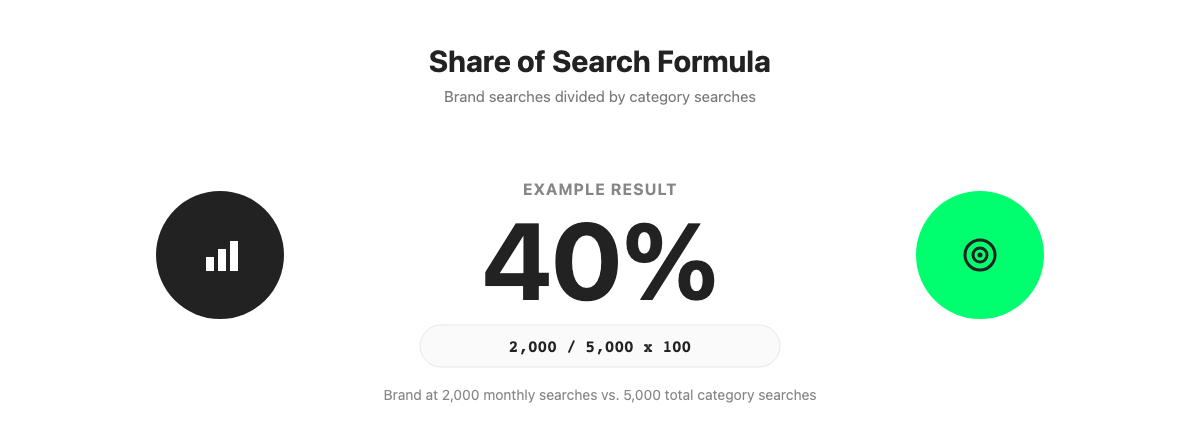
Share of Search = (Your Brand's Search Volume ÷ Total Category Search Volume) × 100
For example, say your brand gets 2,000 monthly branded searches and your three main competitor brands get 1,000 each. Total category search volume is 5,000. Your share of search is 2,000 ÷ 5,000 × 100, or 40%. If that number climbs to 45% next quarter while competitor brands stay flat, that is a real signal your brand is pulling ahead in demand, independent of any single campaign.
Why Share of Search Matters
Share of search is a leading indicator of brand health. It tends to move before market share does, not after. Sellforte reports a correlation of roughly 83% between share of search and share of market, one of the stronger quantified links published between a search metric and a business outcome.
A few reasons this matters in practice:
- It is a real-time brand-awareness signal. Traditional brand tracking studies are slow and expensive. Search data updates continuously and costs nothing beyond the tool you use to pull it.
- It gives campaigns a feedback loop. A product launch, a PR push, or a rebrand should show up as a bump in branded search volume within weeks, long before it shows up in sales figures.
- It correlates with where the market is heading, not just where it has been. Rising brand search often precedes rising market share, because search behavior reflects active consideration.
Semrush documents two before-and-after cases of this pattern: a hair-restoration brand whose share of search grew from roughly 7% to over 8% within ten months, and a UK sportswear brand whose share climbed from 18% to 32% over twelve months. Neither case proves causation by itself. Both are consistent with sustained visibility work moving this metric before it moves revenue. And while neither will give you the level of POS data that a retail analytics platform would, they're a great starting point.
How to Measure Your Share of Search
You do not need a specialized platform to get a usable share-of-search estimate. Two tools cover most use cases:
- Google Trends. Free and fast for spotting relative trends between your brand and named competitors over time, though it only returns relative index values rather than exact search volume.
- A keyword research tool (Keyword Planner, Ahrefs Keywords Explorer, or similar). These return actual monthly search volume numbers for each brand name, which is what the share-of-search formula needs to produce a real percentage rather than just a trend line.
Pull search volume for your brand name and every meaningful competitor's brand name over the same trailing period, sum the competitor totals, and apply the formula above.
Common Share of Search Measurement Pitfalls
A share-of-search number calculated from a narrow, naive keyword list can understate a brand's real search demand, sometimes significantly. Before you trust a number, check for these three issues:
- Ambiguous brand names. If your brand or a competitor's shares its name with an unrelated common word (a car model, a place name, a common surname), raw search volume will include irrelevant searches unless you filter them out.
- Narrow keyword coverage. Measuring only the exact brand name misses close variants, misspellings, and product-specific searches that do not include the brand name at all, which can meaningfully understate real demand for well-known brands with flagship products.
- Missing product-specific searches. Searches for an iconic or flagship product sometimes do not mention the parent brand name at all, so a brand-name-only search list will miss real demand that a broader model would capture.
None of this means share of search is unreliable, only that the naive version of it (one brand name, compared against one competitor name, in Google Trends) is a rough estimate rather than a precise figure.
How to Increase Your Share of Search
Share of search rises when more people search for your brand by name instead of a generic category term. Growing brand search volume usually means investing in things that build direct brand demand, not just capturing demand that already exists.
- Publish content that earns branded recall. Guides, tools, and data-driven content that get cited and shared build the kind of recognition that shows up as branded search later.
- Invest in digital PR. Coverage on other sites, especially coverage that names your brand rather than linking generically, is one of the most direct ways to prompt someone to search your brand name.
- Optimize for local search where relevant. For brands with a physical or regional presence, ranking well in local results consistently drives branded search from people who found you there first.
- Run campaigns that make the brand name memorable. A distinctive, well-targeted campaign (video, social, or otherwise) converts attention into name-searches in a way that generic category advertising rarely does.
Share of Search FAQ
Is share of search the same as share of voice?
No. Share of voice measures advertising presence (spend or impressions), while share of search measures actual search demand for your brand name. They can move independently, though a strong share-of-voice campaign often lifts share of search over time.
How often should you track share of search?
Quarterly is a reasonable default. Bottle PR recommends tracking it at most quarterly, and usually annually, as an input to brand planning, since it reflects slow-moving brand demand rather than day-to-day performance. Track it monthly only around a major launch or campaign, where faster directional feedback is worth the extra noise.
Can a small brand have a high share of search?
Yes. Share of search is relative to your specific competitive set, not the whole market, so a brand that dominates a narrow category or region can post a high share of search even with a modest search volume in absolute terms.
Does a rising share of search guarantee rising sales?
No. It is a leading indicator and a strong correlate of market share, not a guarantee. Other factors, including distribution, pricing, and product availability, still determine whether search interest converts into sales.