
Guide
Content Marketing Strategies: A Practical Framework for 2026

A content marketing strategy is a written plan that connects business goals to the content you publish, the audience you target and your channels. The guide shows how to build one in six steps, from defining audience and goals to aligning content with AI search, and how to measure success with KPIs tied to each goal.
- Define one primary business goal and a specific audience description
- Map planned topics to early, middle and late buyer-journey stages
- Choose two to three primary formats and one or two distribution channels
- Build a shared content calendar covering 8 to 12 weeks with owners
- Create and publish on a realistic cadence the team has tested for a month
- Align cornerstone pieces with AI search through answer-first structure and extractable facts
A content marketing strategy is a written plan that connects your business goals to the content you publish, the audience you're trying to reach and the channels you use to reach them. Without one, content becomes a series of disconnected posts instead of a system that compounds over time.
That gap matters more than it used to. Almost every marketing team now publishes something. Blog posts, videos, social updates and email newsletters have become table stakes. What separates teams that see real returns from teams that just stay busy is whether they're working from a documented plan or improvising week to week.
This guide breaks down what a content marketing strategy actually includes, a six-step process for building one, how to choose the right content formats for each goal, how to measure whether it's working and how AI-driven search is changing what "working" even means.
What Is a Content Marketing Strategy?
A content marketing strategy is the written plan that defines who you're creating content for, what problems that content solves, which formats and channels you'll use and how you'll know if it's succeeding. It sits above your content calendar. The calendar is the schedule; the strategy is the reasoning behind it.
A complete strategy usually answers five questions:
- Who is the audience, and what do they need help with at each stage of their decision?
- What business goal does the content serve (awareness, leads or retention)?
- Which content formats and channels fit that audience and goal?
- Who owns creation, editing and publishing?
- How will success get measured, and how often will the plan get reviewed?
Content Marketing Institute's own guidance on strategy documentation makes a direct case for writing this down rather than keeping it in someone's head: marketers with a documented strategy report feeling more confident and more effective across their tactics and channels than marketers without one. That's not surprising. A written plan forces decisions that would otherwise get made ad hoc, under deadline pressure, by whoever is free that week.
None of this means the plan has to be long. A strategy that fits on two pages and actually gets used beats a 40-page deck that sits in a shared drive untouched after the kickoff meeting.
Why Content Marketing Strategy Matters
Content marketing works because it earns attention instead of renting it. A blog post that ranks in search or a video that gets shared keeps generating traffic long after a paid ad campaign ends. That compounding effect is the entire economic case for content marketing, but it only shows up when content is planned around a consistent theme and audience instead of scattered across unrelated topics.
The stakes of getting this right have gone up. Marketing teams are under more pressure to prove that content spend produces results, and the volume of content competing for attention keeps growing. HubSpot's 2026 State of Marketing data shows content strategy itself now ranks as a top challenge for a meaningful share of marketing leaders, and lead generation remains one of the most commonly cited difficulties teams report. Both problems trace back to the same root cause: content produced without a clear plan struggles to reach the right audience or prove its value.
A strategy protects a team from chasing every new format or platform. Short-form video, newsletters, podcasts and AI search all compete for the same limited hours. A written plan gives the team one job: say no to anything that doesn't serve the stated goal, instead of relitigating priorities every quarter.
Blog Outline Generator: headings, key points and FAQ candidates for your topic. Free, no signup.
How to Create a Content Marketing Strategy in 6 Steps

Building a content marketing strategy comes down to six steps: define your goals and audience, map content to the buyer journey, choose your formats and channels, build a calendar, publish consistently and measure what happens. Each step produces something concrete you can point to, not just a discussion.
Step 1: Define Your Audience and Goals
Start by naming one primary business goal for your content, such as organic traffic growth, qualified leads or customer retention. Vague goals like "build our brand" are hard to plan against and impossible to measure later.
Pair that goal with a specific audience description. Instead of "small business owners," write "owners of 5 to 20 person service businesses who are currently managing their own marketing." The more specific the audience, the easier every later decision becomes, from topic selection to tone.
Instead of → Write Instead of: small business owners
Write: owners of 5 to 20 person service businesses who are currently managing their own marketing
Deliverable for this step: a one-paragraph goal statement and an audience description specific enough that two people on the team would make the same content decisions from it.
Step 2: Map Content to the Buyer Journey
Not every reader is ready for the same message. Someone searching "what is content marketing" needs a different piece of content than someone comparing tools before a purchase decision. Group your planned topics into three stages: early-stage educational content for people who don't yet know they have a defined problem, comparison and how-to content for people evaluating options and decision-stage content such as case studies or product comparisons for people close to choosing.
This mapping prevents a common failure mode where a team produces plenty of top-of-funnel blog posts but nothing that actually helps a near-ready buyer decide.
Deliverable for this step: a simple three-column list of topics sorted into early, middle and late buyer stages.
Step 3: Choose Your Content Formats and Channels
Pick formats based on where your audience already spends attention and what your goal requires, not based on what's trending. A B2B software company selling to buying committees usually gets more value from in-depth guides and case studies than from short-form video. A consumer brand chasing awareness often gets the opposite result.
See the format comparison table in the next section for a starting point on matching formats to goals.
Deliverable for this step: a short list of two to three primary formats and the one or two channels where you'll distribute them first.
Step 4: Build a Content Calendar
A content calendar turns your topic list and format choices into a real production schedule with owners and dates attached. At minimum, it should show what's being published, when, by whom and which buyer-journey stage and goal each piece supports.
The calendar is also where realistic capacity planning happens. It's better to commit to one well-produced article a week than to promise daily publishing and quietly abandon it after a month.
Deliverable for this step: a shared calendar covering at least the next 8 to 12 weeks, with an owner assigned to every entry.
Step 5: Create and Publish Consistently
Consistency compounds. A blog that publishes reliably twice a month for a year builds far more search visibility and audience trust than one that publishes ten posts in a burst and then goes quiet. This is also where AI-assisted drafting tools have changed the practical math: HubSpot's 2026 data shows the large majority of marketers now use AI somewhere in their content creation process, which has made steady output achievable for smaller teams that couldn't sustain it before.
Speed should never come at the cost of accuracy or a genuine point of view. Content that reads as generic or unverified erodes the trust a strategy is supposed to build.
Deliverable for this step: a realistic, sustained publishing cadence the team has actually tested for at least one full month, not just planned on paper.
Step 6: Align With AI Search and Generative Engines
Publishing consistently used to be enough to build search visibility over time. Now writers need to structure content so AI systems can lift and cite it, since a growing share of search results carry an AI-generated summary above the traditional list of links. The section below covers what that means in practice.
Deliverable for this step: at least one cornerstone piece per quarter rewritten or checked specifically for answer-first structure and clear, extractable facts.
Content Marketing Formats Compared
Choosing the right format for each goal matters more than covering every format available. The table below compares the most common content marketing formats by primary use case and the metric that best proves they're working.
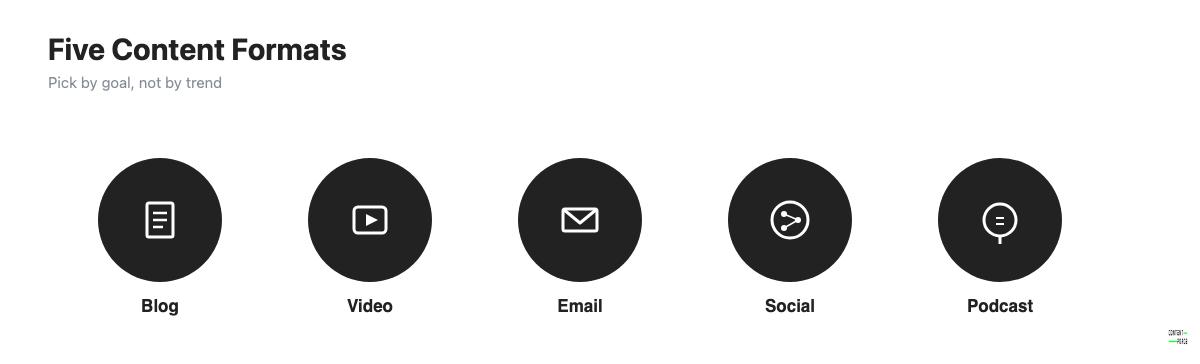
| Format | Best Use Case | Primary Metric | Typical Funnel Stage |
|---|---|---|---|
| Blog posts / guides | Organic search visibility, education | Organic traffic, ranking positions | Early to middle |
| Video (short-form) | Awareness, brand personality | Watch time, shares | Early |
| Video (long-form) | Product education, thought leadership | Watch-through rate, leads | Middle to late |
| Email newsletters | Retention, nurture | Open rate, click rate | Middle to late |
| Case studies | Proof and buyer confidence | Conversion rate, sales-cited usage | Late |
| Podcasts | Relationship-building, authority | Downloads, listen-through rate | Early to middle |
| Social media posts | Distribution, community | Engagement rate, referral traffic | Early |
According to HubSpot's 2026 marketing data, website, blog and SEO efforts remain the top-reported ROI channel among B2B marketers, while short-form video continues to draw the largest share of new content investment across teams overall. Neither format wins universally. A blog post earns compounding organic traffic over months or years; a short-form video earns fast reach but fades quickly from a platform's feed. Choose based on the funnel stage and metric in the table, not on whichever format is easiest to produce this week.
How Do You Measure Content Marketing Success?
You measure content marketing success by tracking a small set of metrics tied directly to the goal each piece of content was built for, not by watching vanity numbers like total page views in isolation. A blog post meant to drive organic traffic should get judged on ranking position and qualified traffic. A case study meant to support sales should get judged on how often sales actually uses it in a deal.
Group your KPIs by what they're supposed to prove:
- Awareness metrics: organic traffic, impressions, branded search volume, social reach.
- Engagement metrics: time on page, scroll depth, video watch-through rate, email open and click rates.
- Lead generation metrics: form completions, gated-content downloads, demo requests attributed to specific content.
- Retention metrics: newsletter subscriber growth and churn, repeat visits, customer-only content engagement.
Review fast-moving metrics like traffic and engagement every month. Check slower ones like lead-to-customer conversion every quarter instead. A metric that looks alarming in a single week can look fine across a full month. Reacting to that short-term noise derails more strategies than bad content does.
Tie every KPI back to the specific step in your six-step framework that produced it. If lead generation metrics are flat, check step 2 first: content that isn't mapped to a real buyer-journey stage rarely converts, no matter how well it's produced or distributed.
Adapting Content Marketing Strategy for AI Search
AI-generated summaries now sit above traditional search results for a growing share of queries. That share varies a lot by industry and by whether the search is informational or transactional. Informational queries like "what is" and "how to" searches, the exact kind most content marketing strategies are built to answer, are the ones most likely to trigger an AI-generated summary instead of a plain list of links.
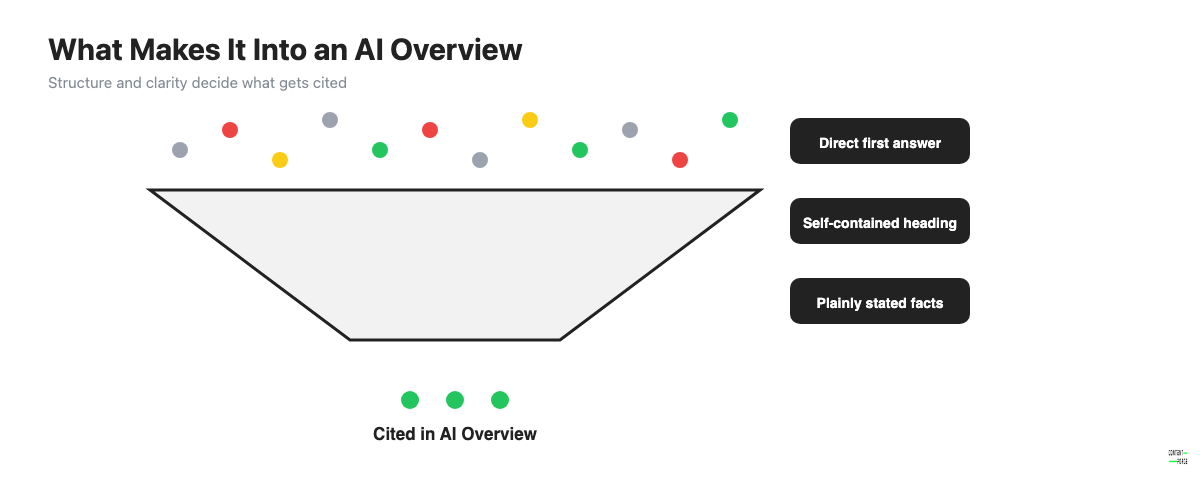
That changes what "ranking well" means. A page can still show up as a cited source inside an AI summary even without holding the top organic position, but only if the content is structured so the system can lift a clean, self-contained answer from it. Three practical changes help:
- Answer the core question in the first sentence or two of every major section, before any background, caveats or examples. AI systems tend to extract the most direct, complete statement in a passage.
- Make each heading stand on its own. A heading like "Key Takeaways" gives a retrieval system nothing to work with. A heading phrased as the actual question a reader is asking, such as "How do you measure content marketing success?", is far easier for both AI systems and readers to match to their query.
- State facts and numbers plainly instead of burying them in a long paragraph. A specific, sourced number in a short sentence is more likely to get pulled into a summary than the same number mentioned in passing halfway through a dense paragraph.
None of this replaces the fundamentals covered earlier in this guide. A content marketing strategy still starts with a real audience and a real goal. AI search adaptation is a formatting and clarity layer on top of that foundation, not a replacement for having something genuinely useful to say.
Frequently Asked Questions
How long should a content marketing strategy document be?
A content marketing strategy document works best at two to five pages. It needs to cover the audience, goals, formats, channels, calendar cadence and measurement plan clearly enough that a new team member could read it and understand the plan, but short enough that the team actually revisits it instead of filing it away.
How often should you update a content marketing strategy?
Most teams should do a full strategy review once a year, with a lighter check-in each quarter to adjust the content calendar and KPIs based on what's actually working. A full rebuild mid-year only makes sense after a real business change: a new product line, a shift in target audience, that kind of thing.
Can a small team realistically run a full content marketing strategy?
Yes, a small team can run a full content marketing strategy. The trick is narrowing scope instead of skipping steps. Pick one primary format, one or two channels and a publishing cadence the team can sustain for a full quarter before adding anything else. Three pieces a month, shipped on schedule, beats six formats that never ship at all.
Does content marketing still work now that AI Overviews summarize search results?
Yes, content marketing still works. AI-generated summaries need source content to cite, and well-structured, useful content is what gets cited. The channel doesn't disappear. The strategy shifts toward clearer, more direct answers instead.