
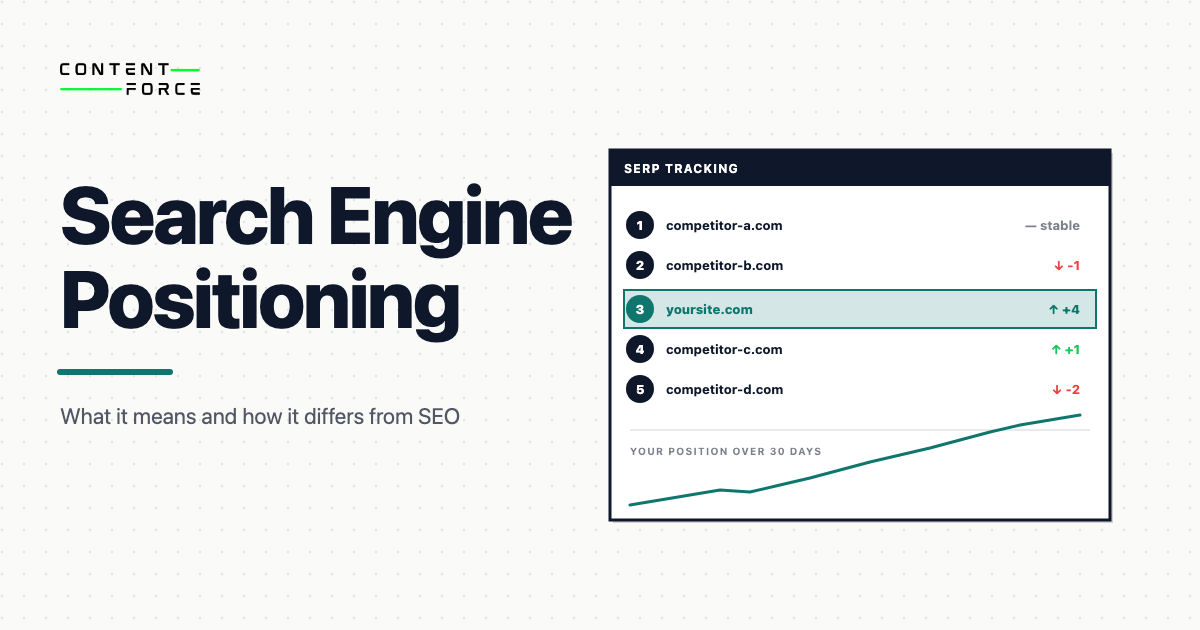
Search engine positioning improves the rank of pages that already appear in search results. It doesn’t try to get brand-new pages indexed and ranked from scratch. That’s a subset of SEO, not a separate discipline. Instead of touching an entire site, you pick specific pages that already have some visibility and push them higher for the keywords they’re already competing on.
That distinction matters more than it looks. Most SEO advice assumes you’re starting from zero: build the site, publish the content, earn the links, wait months. Positioning skips most of that step. You’re not creating demand for a new page. You’re capturing more of the demand a page already has.
This guide covers what search engine positioning actually means, how it differs from SEO in general, why it’s worth doing on its own, the concrete tactics that move the needle, and how to tell whether your situation calls for a positioning push or a fuller SEO overhaul.
What Is Search Engine Positioning?
Search engine positioning is when you refine an already-ranking page’s content, internal links, and on-page signals to push its position higher for a specific keyword, rather than building something new.
A few things define it:
- It targets pages that already rank somewhere, even if that’s page three or position 40.
- The goal is movement on keywords you’re already competing for, not new keyword acquisition.
- It relies on refining what exists more than on new backlinks or new content.
- Movement is usually visible faster than in a from-scratch SEO campaign, because the technical foundation and some ranking signal already exist.
Positioning and SEO overlap. They’re not the same scope, though. SEO covers the full lifecycle of a site’s search visibility, from technical setup through content strategy to link building. Positioning is one lever inside that lifecycle. It’s aimed narrowly at pages that are already in the game.
Search Engine Positioning vs. SEO
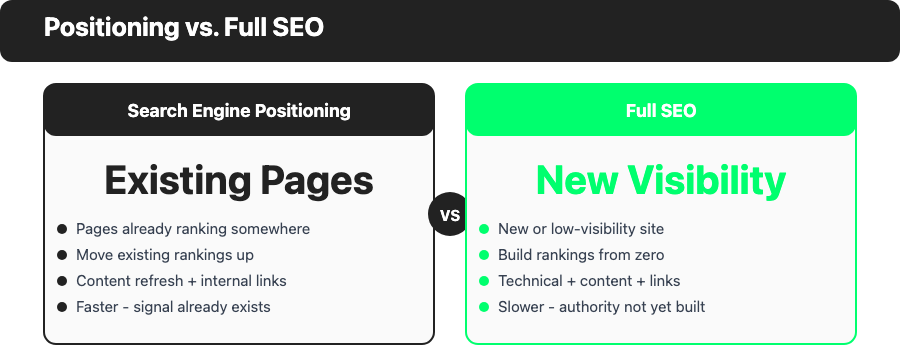
Scope and timeline separate the two most clearly. SEO is the umbrella discipline covering everything that affects how a site is found and ranked. Positioning sits inside that discipline, aimed at pages that already carry some ranking signal.
| Aspect | Search Engine Positioning | Full SEO |
|---|---|---|
| Scope | A specific set of pages already ranking somewhere | The entire site’s technical, content, and authority profile |
| Typical starting point | A page stuck on page 2-3 or in positions 15-40 | A new site, or a site with little to no organic visibility |
| Primary goal | Move existing rankings up for keywords already targeted | Build visibility, authority, and rankings from the ground up |
| Main levers | Content refresh, internal linking, CTR, Core Web Vitals | Technical setup, content strategy, link building, site architecture |
| Typical timeline | Faster, since ranking signal already exists | Slower, since authority and indexing have to be established first |
No organic footprint at all? Positioning has nothing to work with yet, and that’s a full SEO problem. Specific pages already ranking but stalling a few spots short of where they should sit? That’s exactly the gap positioning closes. Per Google’s own Search Essentials documentation, ranking systems evaluate each query independently, so the same page can hold very different positions across the different keywords it targets, which is why positioning work gets picked apart keyword by keyword rather than page by page.
Why Search Engine Positioning Matters
Positioning is usually the fastest lever a site has available. A page sitting in position 8 for a keyword with real search volume is far closer to meaningful traffic than a page that doesn’t exist yet. Closing that gap tends to take weeks of focused work, not months of link building.
- Faster organic traffic gains. Moving a page from position 8 to position 3 can multiply its click-through rate several times over, since the top three results absorb most of the clicks on a typical results page.
- Better use of existing content investment. Pages that already rank represent content you’ve already paid to produce and already have some authority behind. Positioning gets more return out of that sunk cost instead of starting over.
- A defensible competitive edge. Keywords you already rank for are keywords competitors are actively trying to take from you. Managing your position on them protects revenue you’re already earning, not just revenue you hope to earn.
- Faster feedback loops. Pages that already have ranking data let you see the effect of a content refresh or an internal-linking change within weeks, instead of guessing blind for months.
How to Improve Your Search Engine Positioning
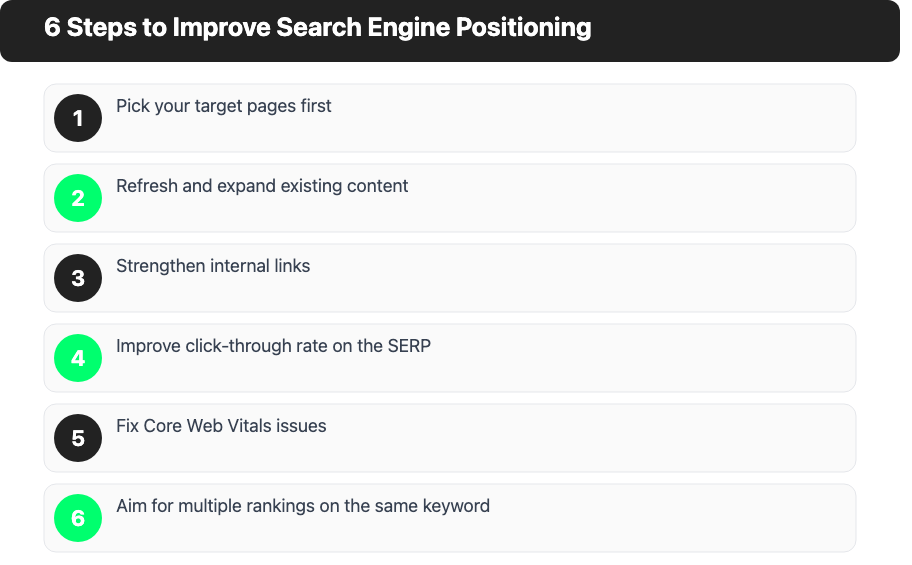
Positioning work follows a fairly consistent sequence. Pick the right pages first, then work through the levers that move rankings for pages that are already indexed and already competing.
Pick Your Target Pages First
Start with pages that already rank somewhere between position 4 and position 20 for a keyword with real intent and volume. Call these “close” pages. They have enough ranking signal to prove Google trusts them for the topic, but not enough polish or authority to break into the top three. Pages ranking below position 50, or not ranking at all, usually need a broader SEO push before positioning work pays off.
Refresh and Expand Existing Content
Update the page with more current information, closer alignment to what’s actually ranking well for that keyword today, and gaps the page never covered. Tighten the answer to the query in the opening paragraph. Add sections competitors cover that your page doesn’t, and cut sections that no longer serve the query. This is usually the single highest-leverage tactic in a positioning campaign.
Strengthen Internal Links
Add internal links from other relevant, already-strong pages on your site pointing to the target page, using descriptive anchor text tied to the keyword. Internal links pass authority you already have to the page that needs it most. Unlike external backlinks, they’re entirely within your control.
Improve Click-Through Rate on the SERP
Rewrite the title tag and meta description to make the page the obvious click among the results already ranking near it. A stronger title and description won’t move the ranking directly. The resulting increase in click-through rate, though, is itself a signal that can support a ranking improvement over time.
Fix Core Web Vitals Issues
Check loading speed, interactivity, and layout stability for the target page specifically. A page that’s slow to load or shifts content around as it loads is fighting an uphill battle against faster competitors sitting just above it.
Aim for Multiple Rankings on the Same Keyword
Once a primary page is well positioned, look for a second page on the same site, such as a related blog post or a comparison page, that could reasonably rank for a close variation of the same keyword. Two results on the same search page beat one. Owning both compounds the click share you capture from a single keyword.
Is Search Engine Positioning the Right Move for You?
Positioning isn’t the right fix for every ranking problem. Run through this checklist:
- Your page already ranks somewhere in the search results, even if it’s on page two or three, rather than being unindexed or absent entirely.
- The keyword you’re targeting is one you’ve deliberately gone after before, not a brand-new topic you’ve never covered.
- Rankings have stalled or plateaued for weeks or months despite the page being live and reasonably complete.
- You can edit the existing page and adjust internal links, rather than needing to build new pages or new site sections.
- Competitors ranking above you are beatable with better content and structure, not backed by domain authority you can’t realistically close in the short term.
Most of these true? A focused positioning push will likely show results faster than a broader SEO initiative. Little organic visibility to begin with, or genuinely new territory for the keyword? Positioning has nothing to build on yet. Start with a fuller SEO approach instead.
FAQ
Is search engine positioning the same as SEO?
No. Search engine positioning is a subset of SEO focused specifically on improving the rank of pages that already appear in search results. SEO itself covers the full range of activities that affect a site’s search visibility, including technical setup, new content, and link building.
How long does search engine positioning take to show results?
Positioning campaigns generally move faster than full SEO campaigns, since the target page already has some ranking signal and technical foundation in place. Meaningful movement is often visible within weeks of a content refresh or internal-linking change, not the months a from-scratch SEO campaign typically needs.
Can small businesses use search engine positioning?
Yes. Positioning tends to suit smaller sites well, since it doesn’t require a large content or link-building budget. It works with pages you’ve already published, using internal links, content refreshes, and on-page fixes a small team can execute directly.
