
Guide
B2B SEO: Building Pipeline, Not Just Traffic

B2B SEO builds pipeline by ranking content for the buying committee that researches, evaluates and approves business purchases, not for raw traffic. According to Gartner, a standard enterprise deal involves roughly 6 to 10 stakeholders. B2B SEO programs usually show ranking movement within 3 to 6 months and visible pipeline impact after 6 to 12 months.
- Map buying-committee personas from sales call transcripts and win-loss interviews
- Prioritize bottom-of-funnel comparison and evaluation keywords before awareness topics
- Match each content type to its funnel stage and the KPI that proves it
- Secure technical, on-page, off-page and internal linking foundations
- Test whether AI chatbots mention your company for realistic prospect questions
- Track influenced MQLs, SQLs, opportunities and closed-won revenue through a CRM
What Is B2B SEO?
B2B SEO is the practice of optimizing a business website so it ranks in organic search for the people who research, evaluate, and approve business purchases, not individual consumers. Like any SEO program, it still rests on technical health, on-page optimization, content, and backlinks. What makes it different is the audience: instead of one person clicking "buy," a B2B page has to earn attention from a buying committee that includes end users, budget owners, technical evaluators, and executive sponsors, often across several visits that don't happen in a single sitting.
That distinction matters because the goal of B2B SEO isn't simply to rank or to pull in visitors. It's to move the right people, at the right stage of a purchase decision, toward a conversation with sales, and eventually toward closed revenue. Traffic and rankings are how you get there. They aren't the destination.
How Is B2B SEO Different From B2C SEO?
B2B and B2C search optimization share the same mechanics, but they're not run the same way. Four differences change how a B2B strategy has to be built.
- Longer, multi-stage sales cycles. A B2C purchase might close in one visit. A B2B deal typically spans multiple touchpoints across weeks or months, so content has to support a reader who leaves and comes back, not just convert on the first pass.
- A buying committee, not a single buyer. According to Gartner, a standard enterprise deal now involves roughly 6 to 10 stakeholders, and larger complex purchases can pull in 11 to 20 people across departments. Content aimed at only one role won't reach the rest of the committee.
- Lower search volume, higher intent. B2B keywords are narrower and lower-volume than consumer terms, but the searcher's closer to a real business need. A handful of well-targeted rankings can outperform a much bigger consumer-style traffic number.
- Trust and thought leadership carry more weight. Because the purchase is riskier and more considered, B2B buyers look for proof: case studies, original data, named experts, and evidence the vendor understands their specific situation, not just generic advice.
Each of these differences has a direct downstream effect on pipeline. A longer sales cycle means content has to span the full funnel, not just the first click. A multi-role buying committee means one persona isn't enough. Low-volume, high-intent keywords mean traffic targets should be set in the hundreds or low thousands, not the tens of thousands. None of this is optional context. It's why the rest of this guide is built around pipeline, not just rankings.
SEO Title Generator: eight title tag variations, sized for the SERP and intent-matched. Free, no signup.
Why Traffic Alone Is the Wrong B2B SEO Success Metric
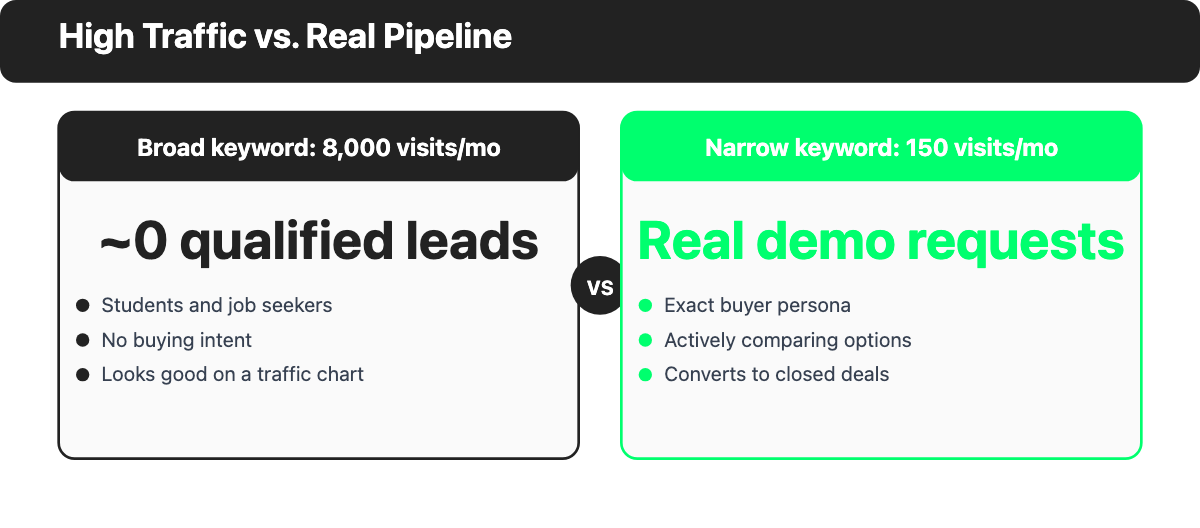
Here's a scenario that plays out constantly in B2B content teams: a blog post targeting a broad, high-volume keyword like "sales enablement" pulls in 8,000 visits a month. A second post targeting a narrow, specific keyword like "sales enablement software for 50-person SaaS teams" pulls in 150 visits a month. On a traffic dashboard, the first post looks like the clear win.
Now follow both posts to pipeline. The high-volume post attracts students, job seekers, and people researching the concept for a school project, none of whom can buy anything. Its qualified-lead rate is close to zero. The narrow post attracts exactly the buyer persona the product serves, at a stage where they're actively comparing options. Even at a fraction of the traffic, it generates real demo requests and, eventually, closed deals.
This is the vanity-metrics trap. B2B SEO teams fall into it whenever they report on organic sessions and keyword rankings without ever connecting them to what happens after the click. A page can rank well and drive traffic while contributing nothing to revenue, and a page with modest traffic can be one of the most valuable assets in the entire content library. Chasing the first pattern and ignoring the second is how SEO teams end up defending their budget every quarter instead of proving it.
Building Decision-Maker Personas for B2B Keyword Research
Keyword research for B2B SEO has to start with the buying committee, not with a keyword tool. Before pulling a single search-volume report, map out who's actually involved in the purchase decision: the end user who will use the product day to day, the economic buyer who owns the budget, the technical evaluator who checks it against requirements, and any executive sponsor who has to sign off.
- Pull language directly from sales call transcripts and win-loss interviews. The exact phrases prospects use to describe their problem are usually more useful than anything a keyword tool suggests on its own.
- Build a short persona brief for each buying-committee role: what they're responsible for, what they search for at each stage, and what would make them trust a piece of content enough to share it internally.
- Ask sales and customer success what objections come up most often. Objection-handling content is some of the highest-converting B2B content because it shows up exactly when a deal is at risk of stalling.
- Prioritize keywords a real decision-maker would type while evaluating a purchase over keywords that only reflect broad industry interest.
This is also where B2B and B2C keyword research diverge most sharply. Once decision-maker personas are mapped, keyword prioritization should favor bottom-of-funnel, comparison, and evaluation terms before top-of-funnel awareness topics. A prospect who's already comparing vendors is closer to pipeline than one who just learned the category exists, and B2B search volumes are low enough that ranking well for the highest-intent terms usually matters more than chasing broad reach.
Mapping Content to the B2B Buying Committee's Funnel Stages
Once personas and keywords are in place, the next step's matching content type to funnel stage and to the KPI that actually proves it worked. Most B2B SEO guides skip this part entirely. It's where a lot of content strategy quietly falls apart, because teams keep publishing top-of-funnel blog posts long after the funnel needs bottom-of-funnel proof.
| Funnel stage | Best content types | Primary KPI |
|---|---|---|
| Top of funnel (awareness) | Educational blog posts, glossary and definition pages, original research | Organic sessions from qualified segments, branded search lift |
| Middle of funnel (consideration) | Comparison guides, buyer's guides, webinars, templates | Content-to-lead conversion rate, email signups |
| Bottom of funnel (decision) | Case studies, ROI calculators, product/service pages, pricing pages | Demo requests, sales-qualified leads (SQLs) |
| Post-decision (expansion and retention) | Onboarding guides, customer success stories, feature-update content | Expansion revenue influenced, retention rate |
A healthy B2B content calendar doesn't neglect any of the four stages, but the mix should shift toward bottom-of-funnel content faster than most teams expect. B2B buyers don't spend most of their research time learning the category from scratch. They spend it comparing specific options.
Technical, On-Page, and Off-Page Foundations for B2B SEO
None of the pipeline-focused work above matters if search engines can't crawl, index, and trust the site in the first place. Four foundations still have to be in place.
- Technical SEO. Fast page speed, a clean site structure, and no broken links or redirect chains. Keep key product and service pages within about three clicks of the homepage so both users and crawlers can reach them easily.
- On-page SEO. Keyword-aligned titles, headings, and meta descriptions, with a clear match between what a page promises and what a specific buying-committee role's looking for.
- Off-page SEO. Backlinks from industry publications, partner sites, and press coverage still function as a trust signal for both search engines and buying committees who check a vendor's credibility before a call with sales.
- Internal linking. Connect top-of-funnel content to the middle- and bottom-of-funnel pages it should logically lead to, so a reader who lands on an awareness post has a clear next step toward a comparison or product page.
These four foundations are table stakes, not differentiators. Getting them right doesn't win a B2B SEO program on its own. Getting any of them wrong caps the ceiling on everything else this guide covers.
How AI Search Is Changing B2B Buying Committee Research
B2B buyers don't start their research exclusively on Google anymore. According to G2's 2026 "Answer Economy" report, 51% of B2B software buyers now start their research with an AI chatbot instead of a traditional search engine, and that share's been climbing with no sign of plateauing. That means a meaningful share of a buying committee's early research now happens inside an AI answer, before anyone lands on a company's website at all.
For B2B SEO, that's a real problem, and it changes what "visibility" means. A page can rank on page one of Google and still be invisible to a buyer who asked ChatGPT or Perplexity to compare vendors and never clicked through to a traditional search result. Ranking well isn't the same as being seen anymore. The content most likely to get pulled into an AI answer is specific, well-structured, and easy to extract: clear definitions, direct comparisons, and named facts rather than vague marketing language.
A short checklist for checking AI-search visibility:
- Ask an AI chatbot a question a prospect would realistically ask (for example, "what's the difference between X and Y for a mid-size team") and see whether your company gets mentioned at all.
- Check whether your comparison and definition pages answer the question in the first sentence or two, since that's the pattern AI answers tend to extract.
- Confirm your pricing, feature, and comparison pages are publicly crawlable, since gated content can't be cited in an AI answer.
This isn't a separate discipline from the rest of B2B SEO. It's the same fundamentals, extended to a new set of surfaces where a growing share of the buying committee is doing its research.
How Do You Measure B2B SEO Success?
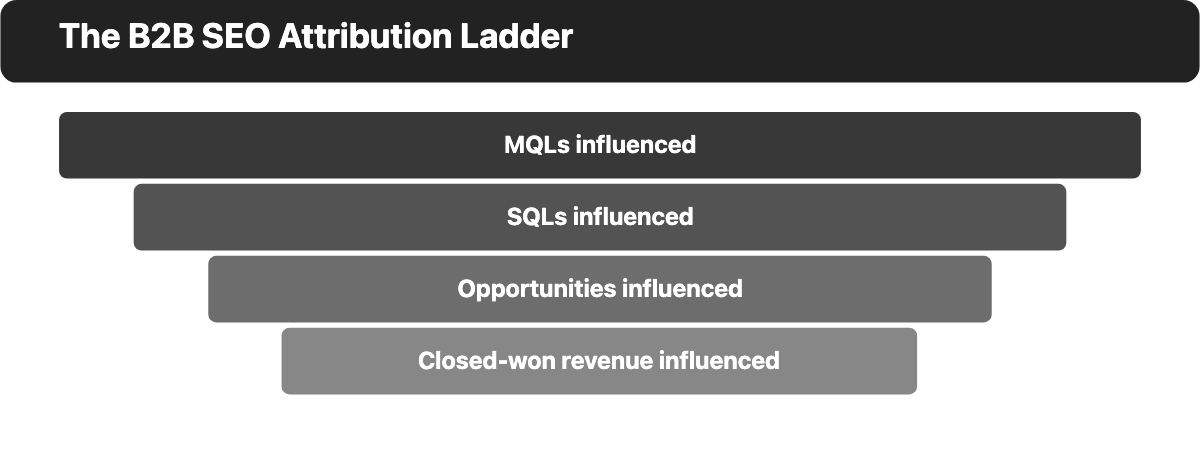
Organic traffic and keyword rankings are leading indicators, not outcomes. They're not what a business ultimately cares about. The real measure of B2B SEO success is how much pipeline and revenue the content actually influences, tracked through a simple attribution ladder:
- Marketing qualified leads (MQLs) influenced. Did the content play a role in a lead entering the funnel, whether through a form fill, gated download, or newsletter signup?
- Sales qualified leads (SQLs) influenced. Did a lead who engaged with organic content get accepted by sales as a real opportunity worth pursuing?
- Opportunities influenced. Did organic content appear anywhere in the touchpoint history of a deal that made it into the sales pipeline?
- Closed-won revenue influenced. Did organic content contribute to a deal that actually closed, and how much of that revenue can be reasonably attributed to it?
Tracking every stage of this ladder requires connecting analytics to a CRM. That's a heavier lift than a traffic dashboard, but it's what turns an SEO report into a business case. Most B2B SEO programs need 3 to 6 months to show initial ranking and traffic movement, and 6 to 12 months before pipeline and revenue impact become clearly visible, since it takes time for content to rank, for buying committees to move through a longer sales cycle, and for enough deals to close to see a reliable pattern.
Reporting only on sessions and rankings during that window makes an SEO program look slow. It's not the full picture. Reporting on MQLs, SQLs, and pipeline influenced, even while overall traffic is still building, shows the actual value the content's creating.
Common B2B SEO Mistakes That Kill Pipeline
- Chasing volume over intent. Prioritizing keywords by search volume alone pulls in visitors who were never going to become customers, and it inflates traffic reports without moving pipeline.
- Fixating on vanity metrics. Sessions, pageviews, and average ranking position are useful diagnostics, but reporting on them as the primary success measure hides whether the content's actually working for the business.
- Ignoring sales and marketing alignment. Content built without input from sales misses the objections, language, and buying-committee roles that actually influence a deal, and sales rarely trusts or uses content it wasn't consulted on.
- Overly technical, jargon-heavy content. Writing to impress other marketers instead of the buying committee's actual roles makes content harder to extract, harder to share internally, and less likely to convert.
- Neglecting the post-decision funnel stage. Treating SEO as a new-customer-acquisition channel only, and skipping onboarding and expansion content, leaves revenue on the table from customers a B2B SEO program already won.
Each of these mistakes has the same root cause: measuring and optimizing for search performance in isolation from what happens after the click. Fixing that connection is the single highest-leverage change most B2B SEO programs can make.
FAQ: B2B SEO Questions Answered
How long does B2B SEO take to show results?
Most B2B SEO programs see initial ranking and traffic movement within 3 to 6 months, with pipeline and revenue impact becoming clearly visible after 6 to 12 months. B2B sales cycles and buying-committee research just take longer than a typical consumer purchase.
Is B2B SEO worth it compared to paid channels?
For most B2B companies, yes, because organic content keeps working and compounding long after a paid campaign ends, and it builds the kind of trust-based, educational touchpoints that a longer, multi-stakeholder sales cycle depends on. The tradeoff is time: it's slower to show results than paid search.
What's the biggest difference between B2B and B2C SEO strategy?
B2B SEO has to account for a multi-person buying committee and a longer sales cycle, which means content needs to support several roles across several visits, not convert a single visitor in one session.
Do I need different content for each buying-committee role?
Not entirely separate content, but content should be mapped to funnel stage and, where it matters, written with a specific role's priorities in mind. Think a technical evaluator's requirements versus an economic buyer's ROI concerns.