
Tool list
Most Searched Keywords on Google: The Full Ranked List

Amazon is the most searched term on Google in the United States, with roughly 87 million average monthly searches, according to live Ahrefs data pulled in October 2026, just ahead of Youtube, Gmail and the AI tool ChatGPT in the full ranked list below.
- Top term
- Amazon, 86,990,000 searches/month (US)
- Data source
- Ahrefs, pulled October 10, 2026
- AI tools in top 50
- ChatGPT, Canva, Gemini (3 of 50)
As of October 2026
As of October 2026, the most searched term on Google in the United States is "amazon," with roughly 87 million average monthly searches. That figure comes from live Ahrefs keyword data. The table below ranks the top 50 highest-volume US search terms, each tagged with its category, average cost per click and keyword difficulty score, all pulled directly from Ahrefs on October 10, 2026.
The Most Searched Keywords on Google Right Now
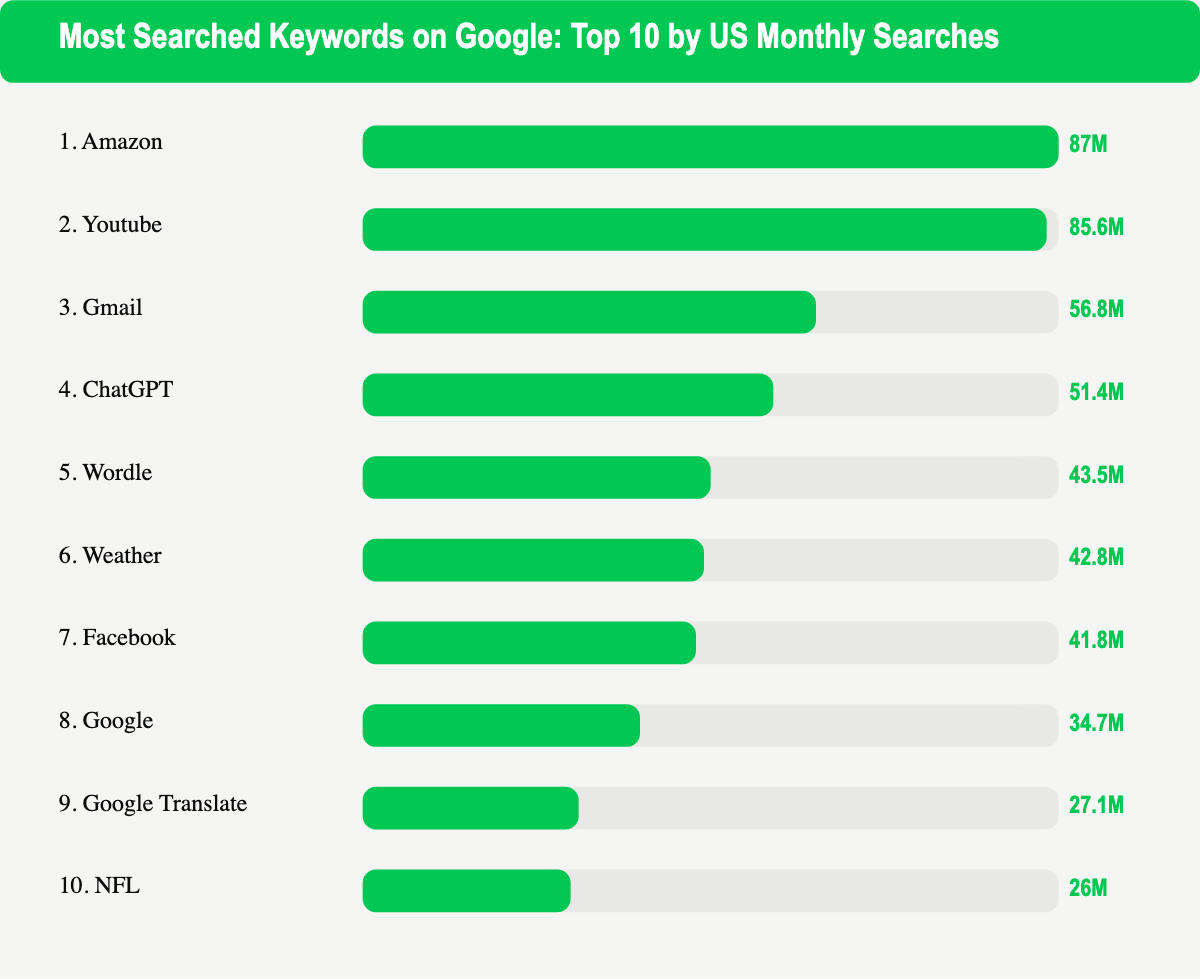
The table below ranks the top 50 highest-volume search terms in the United States, tagged by category, with average CPC and keyword difficulty alongside each monthly search figure. Eleven of the fifty entries pull in more than 25 million searches a month, and the gap between rank one and rank two is under 2 percent. Every figure here is Ahrefs' volume estimate for that keyword, not an exact count published by Google itself.
| Keyword | Category | Monthly Searches (US) | CPC ($) | Difficulty |
|---|---|---|---|---|
| 1. Amazon | Brand/Navigational | 86,990,000 | 0.02 | 78 |
| 2. Youtube | Brand/Navigational | 85,550,000 | 0.01 | 95 |
| 3. Gmail | Brand/Navigational | 56,840,000 | 0.10 | 0 |
| 4. ChatGPT | AI Tool | 51,440,000 | 0.03 | 39 |
| 5. Wordle | Brand/Navigational | 43,450,000 | 0.10 | 81 |
| 6. Weather | Generic/Informational | 42,750,000 | 0.35 | 97 |
| 7. Facebook | Brand/Navigational | 41,760,000 | 0.60 | 91 |
| 8. Google | Brand/Navigational | 34,650,000 | 2.00 | 97 |
| 9. Google Translate | Brand/Navigational | 27,080,000 | 2.50 | 91 |
| 10. NFL | Brand/Navigational | 25,990,000 | 0.60 | 36 |
| 11. Walmart | Retail/Local | 25,870,000 | 0.07 | 56 |
| 12. Canva | AI Tool | 23,840,000 | 0.70 | 77 |
| 13. Calculator | Generic/Informational | 21,070,000 | 0.25 | 81 |
| 14. Target | Retail/Local | 17,850,000 | 0.08 | 17 |
| 15. Instagram | Brand/Navigational | 17,570,000 | 0.07 | 92 |
| 16. Home Depot | Retail/Local | 17,560,000 | 0.01 | 24 |
| 17. Roblox | Brand/Navigational | 16,490,000 | 0.07 | 0 |
| 18. eBay | Brand/Navigational | 16,450,000 | 0.60 | 85 |
| 19. Yahoo | Brand/Navigational | 16,060,000 | 0.01 | 52 |
| 20. Amazon Prime | Brand/Navigational | 15,080,000 | 0.02 | 0 |
| 21. Google Maps | Brand/Navigational | 14,750,000 | 0.03 | 94 |
| 22. Spotify | Brand/Navigational | 12,100,000 | 0.01 | 88 |
| 23. Gemini | AI Tool | 10,890,000 | 0.02 | 95 |
| 24. Zillow | Brand/Navigational | 10,710,000 | 0.02 | 35 |
| 25. Netflix | Brand/Navigational | 10,390,000 | 2.00 | 94 |
| 26. TikTok | Brand/Navigational | 10,280,000 | 0.35 | 91 |
| 27. Costco | Retail/Local | 9,870,000 | 0.01 | 50 |
| 28. Reddit | Brand/Navigational | 9,050,000 | 2.50 | 89 |
| 29. LinkedIn | Brand/Navigational | 8,390,000 | 0.05 | 80 |
| 30. Indeed | Brand/Navigational | 8,380,000 | 0.15 | 0 |
| 31. Lowes | Retail/Local | 7,890,000 | 0.06 | 16 |
| 32. ESPN | Brand/Navigational | 7,880,000 | 0.50 | 76 |
| 33. Maps | Generic/Informational | 7,810,000 | 0.03 | 94 |
| 34. Pinterest | Brand/Navigational | 7,710,000 | 0.06 | 79 |
| 35. Twitter | Brand/Navigational | 7,420,000 | 0.15 | 56 |
| 36. Capital One | Brand/Navigational | 7,130,000 | 0.35 | 43 |
| 37. CVS | Retail/Local | 5,440,000 | 0.03 | 17 |
| 38. Walgreens | Retail/Local | 4,960,000 | 0.05 | 0 |
| 39. Facebook Marketplace | Retail/Local | 4,860,000 | 1.00 | 0 |
| 40. PayPal | Brand/Navigational | 4,830,000 | 0.01 | 84 |
| 41. Bank of America | Brand/Navigational | 4,110,000 | 0.60 | 65 |
| 42. Starbucks | Retail/Local | 3,760,000 | 0.04 | 71 |
| 43. USPS | Brand/Navigational | 3,370,000 | 0.02 | 50 |
| 44. Verizon | Brand/Navigational | 3,210,000 | 2.00 | 76 |
| 45. Xfinity | Brand/Navigational | 3,040,000 | 2.00 | 61 |
| 46. Wells Fargo | Brand/Navigational | 2,600,000 | 0.90 | 0 |
| 47. Chase | Brand/Navigational | 2,330,000 | 0.08 | 42 |
| 48. Hotmail | Brand/Navigational | 2,200,000 | 0.25 | 0 |
| 49. Craigslist | Retail/Local | 2,190,000 | 0.70 | 4 |
| 50. McDonalds | Retail/Local | 2,090,000 | 0.03 | 85 |
A few branded terms sit just outside this top 50 but are still worth knowing. "Gmail login" gets about 4.84 million searches a month. "Facebook login" gets about 1.48 million. Both are signs that a meaningful slice of branded search is really people trying to sign in, not people researching the brand.
One quirk is worth flagging before you compare this list to another source. The bare term "google" ranks eighth here, below several other brand names. That is not a data error. Most people reach Google through a saved bookmark, a default address bar or a phone's home screen. The explicit typed search "google" undercounts how often the engine actually gets used. The next section explains why numbers like this can look different depending on which tool produced them.
Methodology: Where This Data Comes From (and Why Tools Disagree)
This list uses Ahrefs' trailing 12-month US search volume estimate, pulled on October 10, 2026. Google Trends and Google Ads Keyword Planner can show a different ranking for the same terms, because each one measures search volume a different way.
Ahrefs estimates monthly search volume from clickstream and search engine data, averaged over the past 12 months, then reports it per country. Google Trends works differently. It shows relative interest on a 0 to 100 scale, scaled against the highest point in whatever date range and location you pick. It is built for comparing terms against each other, not for reading off an absolute number. Google Ads Keyword Planner reports its own volume ranges, pulled from Google's own ad auction data. It tends to bucket smaller terms into wide ranges rather than exact figures.
Search volume estimates differ by tool for exactly this reason: the same keyword can show a different monthly number on three different tools, and two keyword-research sites can rank the same terms in a different order. None of the three is "wrong." They measure related but distinct things, over different windows, from different underlying data.
If you are building your own list, the best free keyword research tools guide walks through several options. Our Semrush vs Ahrefs comparison covers how the two largest paid tools differ on data sourcing.
SEO Title Generator: eight title tag variations, sized for the SERP and intent-matched. Free, no signup.
The Most Searched Keywords, Broken Down by Category
The top 50 terms split into four groups: brand and navigational searches, AI tools, generic informational terms and retail or local searches. Thirty three of the 50 terms are branded or navigational, meaning the searcher already has a specific site or app in mind.
- Brand/navigational (33 of 50): people typing a company or product name to get straight to it. Examples include amazon, youtube, gmail, facebook, google, instagram, netflix, tiktok and most of the banks and telecoms further down the list.
- AI tools (3 of 50): chatgpt, canva and gemini. All three now rank inside the top 25 highest-volume search terms in the US. That was not true even two years ago.
- Generic/informational (3 of 50): weather, calculator and maps. These are utility searches where the person wants an answer or a tool, not a particular brand.
- Retail/local (11 of 50): walmart, target, home depot, costco, lowes, cvs, walgreens, starbucks, mcdonalds, craigslist and facebook marketplace. These mix national chain lookups with classified and marketplace searches.
Rising Keywords Worth Watching
AI tools are now firmly inside the highest-volume search terms on Google. ChatGPT ranks fourth overall with 51.44 million monthly searches. Canva ranks twelfth with 23.84 million. Gemini ranks twenty third with 10.89 million. All three now sit inside the top 25, next to long-standing fixtures like YouTube, Amazon and Gmail.
We are not putting a growth percentage on that trend here. A month-by-month history pull for these terms produced inconsistent, clearly glitchy numbers during this research run (several identical values repeated across unrelated months, then implausible spikes). We dropped that data rather than publish a number we could not stand behind. The current snapshot above is independently verified and current as of this pull. The direction of the trend needs no disputed statistic either way: a generative AI chatbot and an AI-assisted design tool sitting in the same volume tier as Facebook and Netflix would have been a strange sentence to write before 2023.
How to Find the Most Searched Keywords Yourself
Google's own Trending Now page lists real-time surging search queries by country, refreshed roughly every 10 minutes. For ongoing monthly search volume data rather than real-time spikes, a keyword research tool such as Ahrefs' Keywords Explorer is the more useful approach. It is what produced the ranked table above.
Google's Trending Now help article explains what the page shows: queries experiencing a recent surge tied to a news story. You can filter by location (your own or any of over 100 countries and regions), by timeframe (the past 4 hours, 24 hours, 2 days or 7 days) and by trend status (active or ended, since an ended trend can resurface). You can also compare up to five queries side by side, then export the table to CSV, clipboard or an RSS feed.
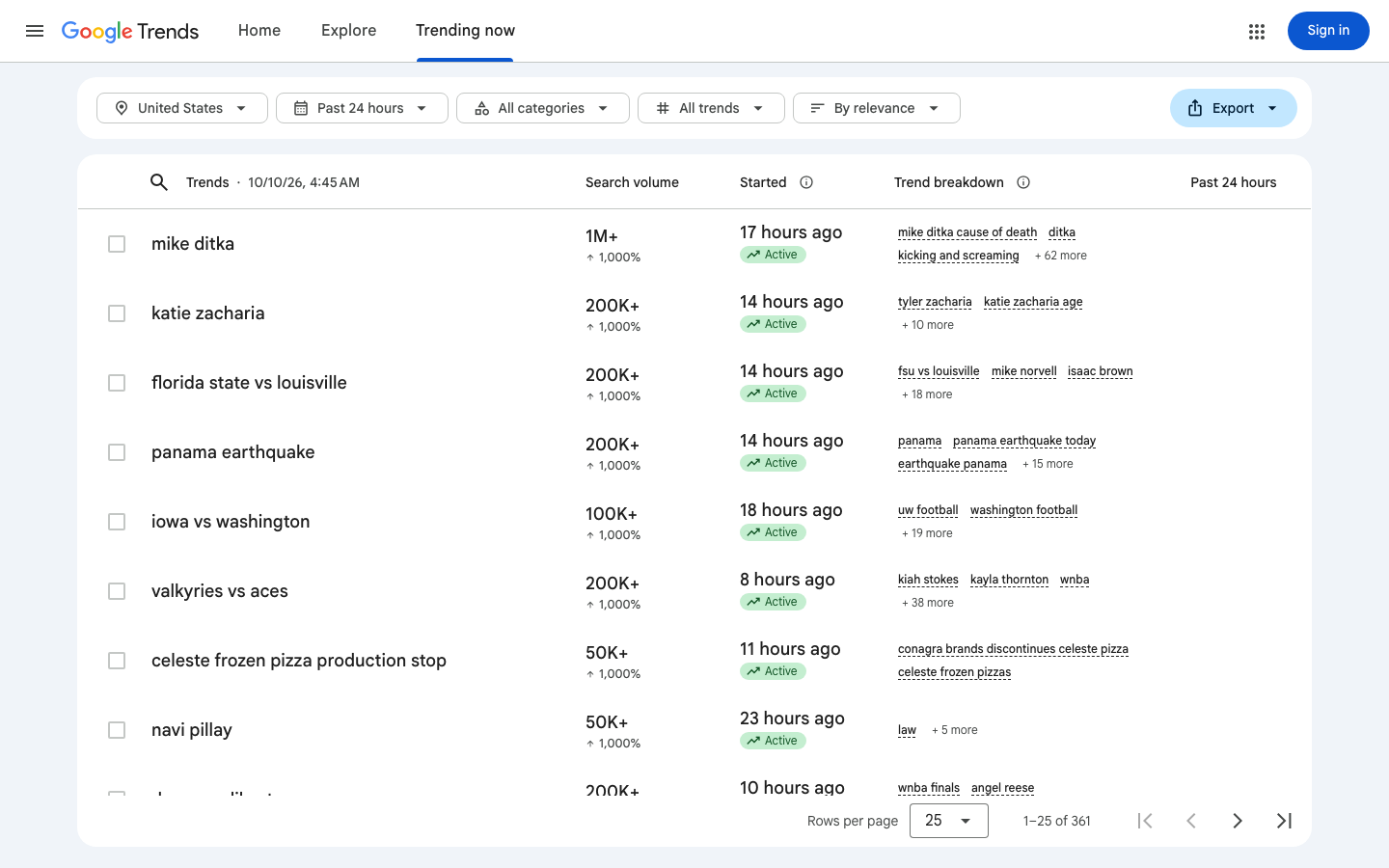
Google Trends' real-time view is useful for news-driven spikes, but it will not tell you how many people search "weather" every month, since that term never spikes, it just stays consistently high. For that kind of steady, ongoing volume, a dedicated keyword tool is the standard approach. Our Google Search Console keywords guide covers how to pull the queries your own site already ranks for, a useful complement to a general volume tool like Ahrefs.
Why "Most Searched" Isn't Always "Best to Target"
High search volume does not mean a keyword is easy or valuable to target. "Weather" gets roughly 43 million searches a month in the US but carries a keyword difficulty score of 97. A lower-volume term like "target" (difficulty 17) is far easier to rank for, and more commercially relevant for most businesses.
A few more pairs from the table above make the same point. "Netflix" and "reddit" both carry a CPC of $2.00 to $2.50, well above most of the branded terms on this list, because enough advertisers bid on them to push the price up even though the underlying intent is purely navigational. "Craigslist," by contrast, has a keyword difficulty of just 4, one of the lowest scores on the entire list, despite still pulling over 2 million searches a month.
The practical takeaway is simple: before you treat a high-volume term as a content target, check its difficulty score and its intent, not just its search count. Our complete keyword research guide covers how to weigh volume against difficulty and commercial intent when picking keywords to target, instead of just admiring their size.
FAQ: Most Searched Keywords on Google
What is the #1 search on Google?
"Amazon" holds the top spot in this ranking, ahead of "youtube" by less than 2 percent and well clear of the rest of the top 50. That order can shift slightly between tools and over time, since different keyword-research platforms measure search volume differently; see the methodology section above for why.
What is the most searched question on Google?
No single, stable answer exists for the most-searched question on Google, because the question changes from week to week along with the news cycle and seasonal interest. Google's Trending Now page is the most reliable live source for this, since it shows which queries, question or otherwise, are currently surging in a given country and time window.
What is the most searched person on Google?
Search-volume vendors do not agree on a single name here. Glimpse's 2026 ranking (last updated September 3, 2026) puts Dolly Parton first, with about 50.8 million searches in the trailing 30 days. Donald Trump is a close second at about 49.9 million. Semrush's own "Popular People" ranking (updated March 2026) names Trump first instead, at a much smaller 7.5 million searches a month globally. Both lists agree that Trump is a top contender. They disagree on the top name, the scale of the numbers and the time window, which is itself the honest answer: this ranking depends heavily on which tool and which period you ask about.
Can I see who googled me?
No, keyword and search-volume tools, including Google's own, only show aggregate and anonymized term popularity. None of them show who specifically searched for a given person. If you are asking because you want to know whether someone searched your name, no publicly available tool, including the ones referenced in this article, can tell you that.