
Glossary
AI Overviews: What They Are and How They Affect Search Visibility

AI Overviews are AI-generated summaries that appear inside Google Search results when Google's systems determine a synthesized answer will help faster than a normal list of links. The feature pulls information from multiple sources, shows supporting links, and sits alongside featured snippets and AI Mode as one of Google's answer surfaces.
- Google shows AI Overviews on informational, comparative, and research-style queries needing quick synthesis
- Pages appearing beside an AI Overview see organic click-through rates around 8%, versus roughly 15% without one
- Featured snippets quote one source while AI Mode opens a deeper conversational experience
- Pages must be indexed and eligible for a normal search snippet to qualify as a source
AI Overviews are AI-generated summaries that appear inside Google Search results when Google thinks a synthesized answer will help faster than a normal list of links. They pull together information from multiple sources, show supporting links and now sit beside surfaces like featured snippets and AI Mode, which makes them important for both searchers and publishers.
- They are part of Google Search, not a separate chatbot.
- They can't be fully turned off, but users can switch to the Web filter for link-only results.
- Google says they may contain mistakes, so the supporting links still matter.
- For publishers, the core play is still strong SEO basics, crawlable pages and helpful content, not a special AI-Overview schema trick.
| Quick fact | What Google says |
|---|---|
| Launch scale | AI Overviews expanded beyond the U.S. in 2024 and reached more than 1 billion global monthly users by October 2024 |
| Harder queries | Google launched a Gemini model upgrade for AI Overviews in the U.S. in March 2025 to handle harder questions |
| User control | AI Overviews can't be fully turned off, but users can switch to the Web filter |
| Publisher requirement | There are no additional technical requirements beyond normal Google Search eligibility |
| Measurement | AI feature traffic is included in Search Console's Web reporting |
What are AI Overviews?
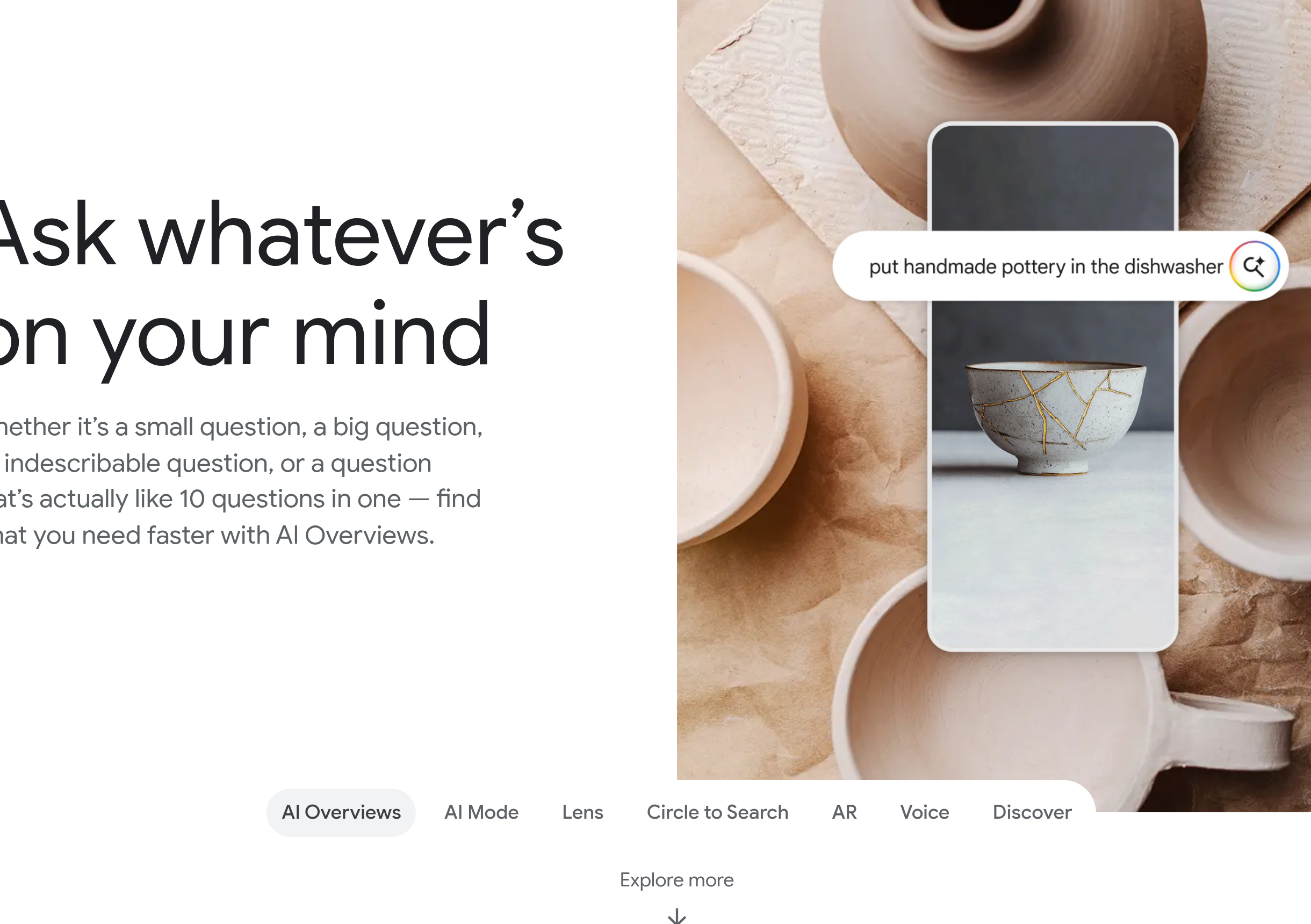
AI Overviews are Google's built-in answer layer for Search. On the official help page, Google describes them as an AI-generated snapshot with key information and links to dig deeper from the web.
The feature has a short history worth knowing. Google first tested it under the name Search Generative Experience (SGE) in Search Labs starting in 2023. In May 2024, it rebranded SGE as AI Overviews and launched the feature to all U.S. users. The global rollout followed quickly. In its October 28, 2024 update, Google confirmed that AI Overviews had expanded to more than 100 countries and territories and reached more than 1 billion global monthly users.
That definition matters because AI Overviews aren't just a redesigned featured snippet. They're a generated summary that can combine multiple sources, compress the answer and then point users back to supporting pages. If your content only wins when a user clicks through ten blue links and reads the whole page, AI Overviews create more friction. If your page gives a clear answer, backs it up fast and still offers something worth visiting for, the feature can become a discovery surface instead of just a click suppressor.
You can see Google's consumer-facing description on the official AI Overviews page, the current help documentation on Google Search Help and Google's global expansion note on the October 2024 rollout update.
How do AI Overviews work in Google Search?
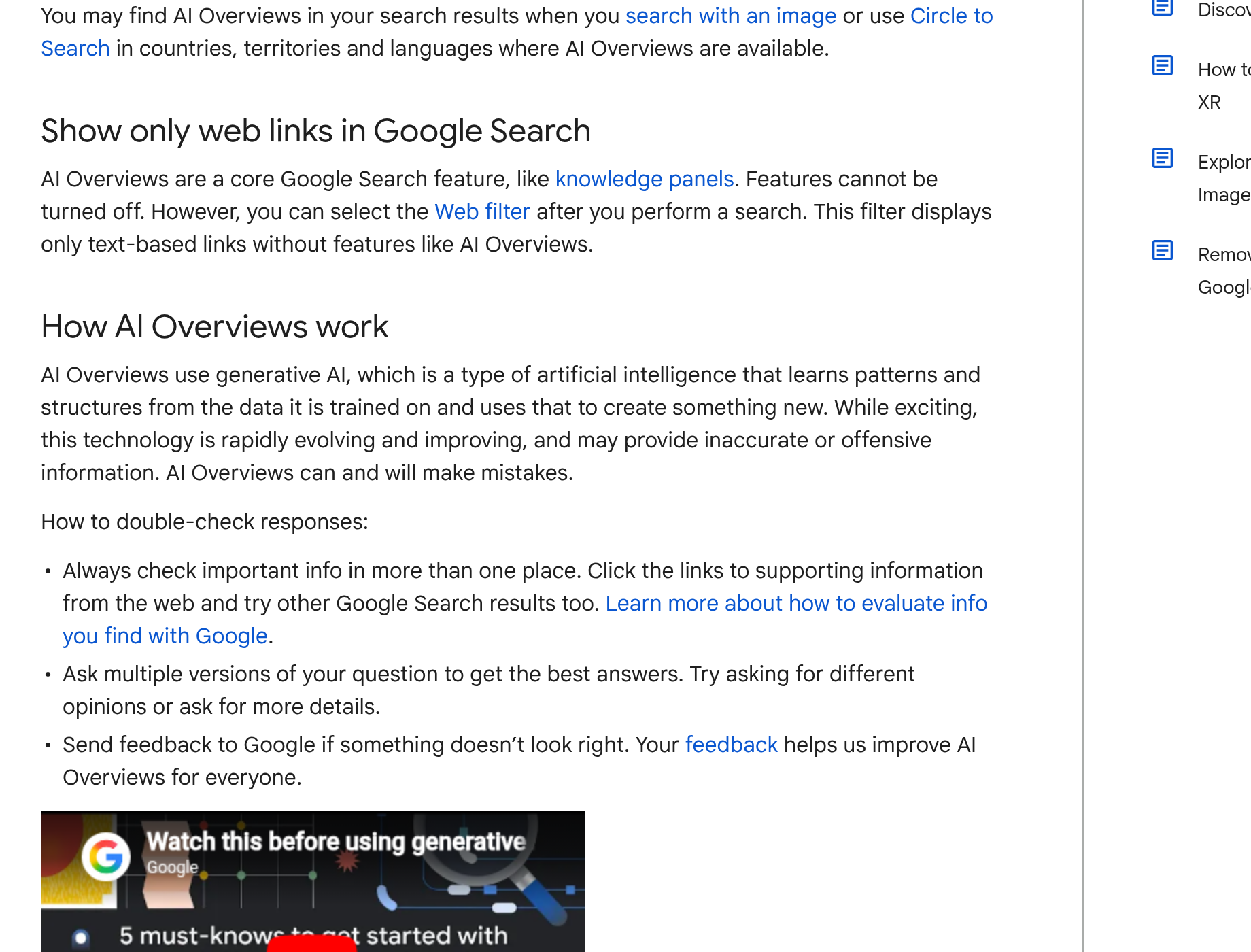
Google says AI Overviews show up when its systems determine that generative AI will be especially helpful, for example when a user wants to understand a topic quickly from a range of sources. That means the feature tends to appear on informational, comparative and research-style queries where summarizing several pages into one answer saves time.
The feature also keeps the classic web open. Google states that AI Overviews include links to supporting information from the web, and it explicitly tells users to double-check important claims by clicking those links and reviewing additional search results. That alone is a useful signal for publishers: source pages still matter because the generated answer is supposed to point back to the open web.
When does Google show AI Overviews?
Google doesn't publish a simple trigger list, but third-party tracking gives a clear picture of the scale. According to Semrush's AI Overviews tracker, the feature appears on roughly 12.95% of U.S. search queries. That share has also shifted over time: informational queries made up about 89% of AI Overview triggers in October 2024, but that figure dropped to around 57% by October 2025 as Google expanded the feature to more query types, including comparison and task-based searches.
Google's March 5, 2025 update adds one more clue. The company said its Gemini model upgrade helps AI Overviews show more often on harder questions, especially coding, advanced math and multimodal queries. That doesn't mean every query gets an overview. Google also says there are cases where it'll fall back to standard web results when it doesn't have high confidence in helpfulness or quality, and you can follow product experiments in Search Labs, more on that in Generative AI and SEO.
SEO Title Generator: eight title tag variations, sized for the SERP and intent-matched. Free, no signup.
How do AI Overviews affect search traffic?
AI Overviews reduce organic click-through rates. Pages appearing alongside an AI Overview see CTRs around 8%, compared to roughly 15% when no AI Overview is present on the same SERP, according to Semrush CTR data. That's a meaningful gap for any publisher tracking query-level performance.
The screen dominance numbers explain why. When an AI Overview appears, it occupies roughly 42% of visible screen space on desktop and around 48% on mobile, according to WordStream's analysis. That's the dominant above-the-fold element on an affected results page, which pushes organic listings further down before users even scroll.
Google's own counterpoint is worth noting. The company says that clicks from search results pages with AI Overviews tend to be higher quality, meaning users who do click are more likely to spend time on the site. That doesn't guarantee better traffic for every publisher, but it does shift the measurement question from raw click volume to visit quality. For SEO teams, the practical implication is that CTR alone isn't the right signal to track on queries where AI Overviews appear regularly. Engagement metrics alongside CTR give a more complete picture.
How are AI Overviews different from featured snippets and AI Mode?
These three surfaces overlap in Search, but they don't do the same job. The easiest way to think about them is by source handling, follow-up depth and user control.
| Feature | What it does | Source pattern | Follow-up depth | Best mental model |
|---|---|---|---|---|
| AI Overviews | Generates a summary inside Search and links to supporting pages | Usually synthesizes multiple sources | Moderate. Users can expand and continue | Search answer layer |
| Featured snippets | Extracts one short answer from one source | Usually one cited source | Low | Quote-style answer box |
| AI Mode | Opens a deeper conversational search experience | Pulls from Search systems and web sources | High. Built for back-and-forth exploration | Search-native AI conversation |
Featured snippets are still simpler. They usually quote or adapt a short answer from a single page. AI Overviews are broader because they summarize across sources and keep a list of supporting links in the result.
AI Mode goes further. In Google's March 5, 2025 announcement, the company positioned AI Mode as the deeper follow-up experience for complex, multi-part questions. Google says AI Mode is particularly useful for comparisons, reasoning-heavy tasks and exploratory searches that would otherwise take several separate queries.
For content planning, the distinction matters. A page that can win a featured snippet by giving one crisp sentence isn't automatically the best page for AI Overviews. AI Overviews need a page that can supply clear extractive answers, but also enough context, credibility and support to deserve inclusion in a multi-source summary.
How can you appear in AI Overviews?
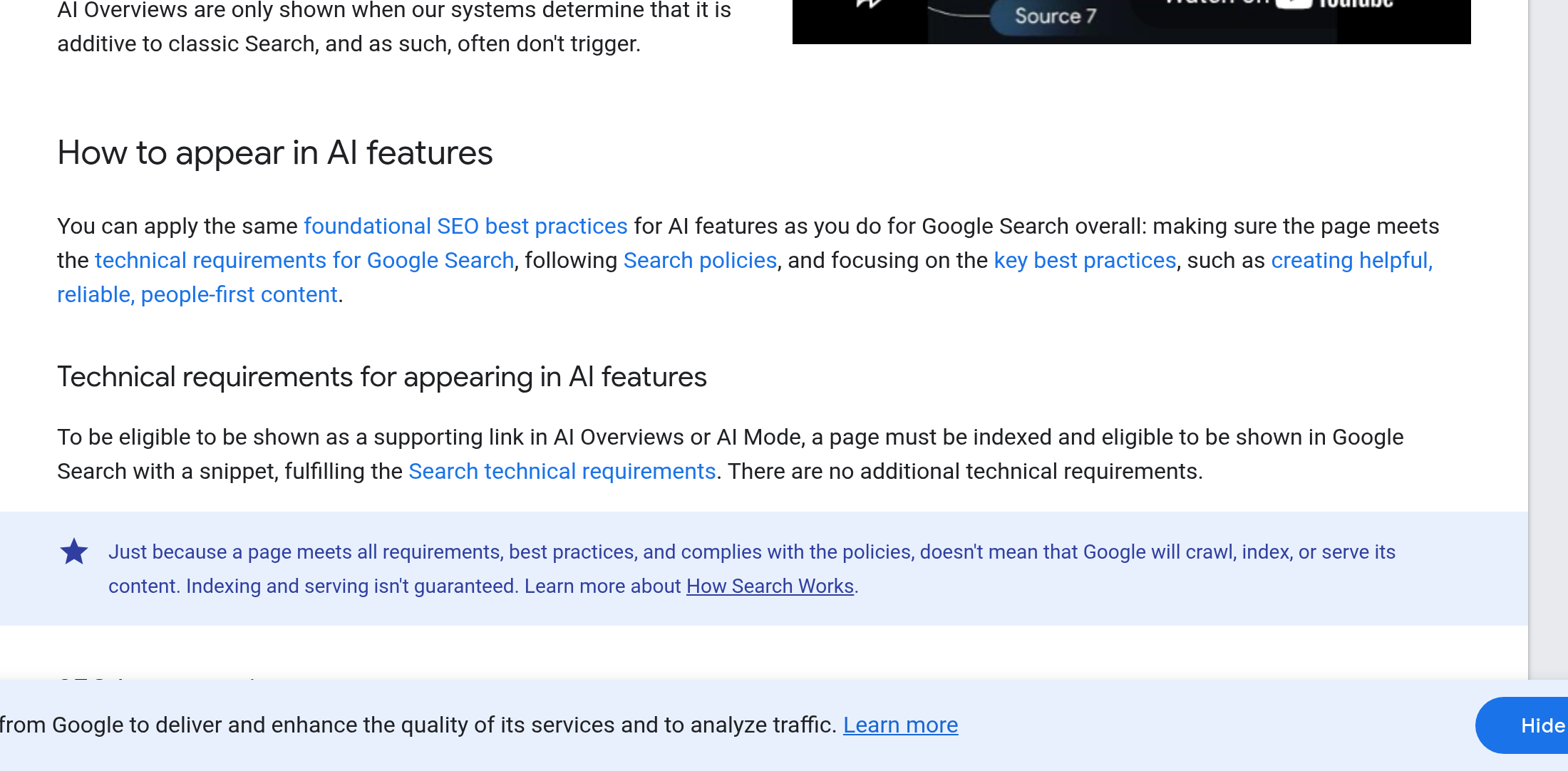
Google's publisher guidance is refreshingly plain. On Google Search Central, the company says you should apply the same foundational SEO best practices for AI features as you do for Google Search overall. That means there's no special AI-Overview markup requirement to unlock.
Google is even more specific in the technical section. To be eligible as a supporting link in AI Overviews or AI Mode, a page must be indexed and eligible to appear in Google Search with a snippet. Google says there are no additional technical requirements beyond the normal Search technical requirements.
What SEO work still matters?
The work that already mattered still matters here:
- Publish helpful, reliable, people-first content.
- Make sure important pages are crawlable and indexable.
- Follow Google's Search policies.
- Use strong headings and answer-first paragraphs so your page is easy to extract and cite.
- Keep useful supporting detail below the direct answer so the page remains worth the click.
The bigger shift is editorial, not technical. AI Overviews reward pages that make the answer easy to identify. If your strongest information is buried under brand filler, overlong intros or vague headings, you're making extraction harder than it needs to be.
How do you measure visibility?
Google says pages that appear in AI features are included in overall Search traffic inside Search Console. Specifically, they're reported in the Performance report under the Web search type.
That doesn't give search teams a neat "AI Overview impressions" column in every workflow, so measurement needs some judgment. The better approach is to watch page-level and query-level movement together:
- track impressions, clicks and CTR for pages that target AI-Overview-heavy questions
- watch whether comparison and explainer queries are shifting even when rankings look stable
- compare Search Console trends with engagement data in analytics to see whether the clicks you do get are stronger
Google itself says that clicks from search results pages with AI Overviews tend to be higher quality, meaning users are more likely to spend more time on the site. That doesn't guarantee better traffic for every publisher, but it's a strong reason to measure visit quality, not just raw click volume.
How do you control your content in AI Overviews?
Publishers who don't want their content used as a source in AI Overviews have limited options. Adding User-agent: Google-Extended and Disallow: / to your robots.txt file stops that content from training future Gemini models, but it does not keep your pages out of AI Overviews, which draw on the same crawling and indexing as regular Search. There's currently no token that keeps a page in Search while excluding it from AI Overviews specifically; blocking Googlebot itself would remove the page from AI Overviews, but it would also remove it from organic search results entirely.
The second option is controlling what Google can show as a snippet from your pages. The nosnippet meta tag prevents any text excerpt from appearing in Search, which also removes the page from AI Overview eligibility since a snippet is required. For more targeted control, data-nosnippet lets you exclude specific sections of a page rather than the whole thing, and max-snippet caps how much text Google can use. These are standard Search preview controls, not AI-specific settings.
Using noindex prevents Google from indexing the page at all, which removes it from Search entirely including AI Overviews. That's a more drastic step and only makes sense when you don't want a page in Search at all, not just in AI-generated answers.
What do AI Overviews mean for SEO teams?
AI Overviews raise the value of answer-first content, source trust and structural clarity. They don't kill classic SEO ranking factors, but they punish pages that rely on weak introductions, generic section labels and thin supporting evidence.
For most teams, the next move isn't "optimize for AI" as a separate channel. It's to tighten the pages that already target informational demand:
- make the first sentence under each main heading answer the heading directly
- separate comparisons cleanly instead of blending several concepts into one paragraph
- cite or link the official source when the topic is controlled by one platform, like Google Search
- keep one layer of deeper explanation below the direct answer so users still have a reason to click through
That's also where this topic connects to broader answer engine optimization. AI Overviews are one of the most visible retrieval surfaces inside Google, but the pages that show up there are usually the pages that already communicate their value clearly to both users and search systems.
FAQ about AI Overviews
Can you turn AI Overviews off?
No, AI Overviews are a core Google Search feature and can't be switched off globally. Users can use the Web filter to see link-only results for a search.
How often do AI Overviews appear?
According to Semrush's AI Overviews tracker, the feature appears on roughly 12.95% of U.S. search queries as of late 2025. That's a meaningful share of search volume, and the trigger rate has been expanding as Google adds more query types beyond informational searches.
Are AI Overviews accurate?
They're useful, but Google says they can make mistakes. Important claims should be checked against the supporting links and other search results.
Do AI Overviews replace featured snippets?
No, featured snippets still exist and still handle some direct-answer queries. AI Overviews are broader because they summarize across sources and support deeper exploration.
Should SEOs optimize differently for AI Overviews?
SEOs shouldn't treat AI Overviews as a separate technical platform. The smarter move is to improve extractive clarity, source trust, crawlability and page usefulness so the same content can work in both classic Search and AI-generated result layers.