
How-to · 7 steps
Content Planning: How to Build a Plan Your Team Will Actually Use

Content planning is the tactical process of deciding what content to create, who it is for, when it publishes and how you will measure it. A working content plan links goals, audience, formats, a content calendar and metrics, and building one takes seven steps, from setting objectives to measuring results and adjusting the plan.
- Set objectives tied to a business outcome and define your audience by their questions
- Brainstorm ideas from keyword research and sales conversations, then prioritize by business impact
- Build a content calendar with real publish dates and room for reactive pieces
- Write a content brief for every piece and assign one owner with stage deadlines
- Plan promotion channels and paid support before each piece publishes
- Measure results against your committed metrics and adjust topics, formats or cadence
Key takeaways: A content plan turns your content strategy into scheduled, produced work. That is different from a content calendar, which is just the schedule, and different from a content strategy, which is the vision behind it. Five components hold a plan together: goals, audience, formats, a calendar and metrics. Building one takes roughly seven steps.
Most teams do not fail at content marketing because they lack ideas. They fail because nobody turns those ideas into a plan with owners, deadlines, and a way to check whether any of it worked. Content planning closes that gap.
What Is Content Planning?
Content planning is the tactical process of deciding what content to create, who it is for, when it publishes, and how you will measure whether it worked. A content plan documents five things: your goals, your target audience, the formats and channels you will use, a calendar that sequences the work, and the metrics you will track. It sits between a broad content strategy and the actual act of publishing.
It is not writing content. It is not scheduling posts either. Content planning is the decision-making step that happens before both, and that is why a content operation built on one runs predictably instead of reacting to whatever comes up that week.
Content Planning vs. Content Strategy vs. Content Calendar
These three terms get used interchangeably. That causes real confusion for teams trying to set up a content operation, because they describe three separate layers of the same system rather than three names for one thing.
Content strategy sits on top. It is the overall vision, business goals, and audience positioning that content is supposed to serve, and it answers one question: why are we creating content, and for whom? Content planning is the middle layer, the tactical process of deciding what topics, formats, and resources will deliver on that strategy. It answers what will we make and how will we know it worked. The content calendar sits at the bottom. It is the scheduling artifact that records publish dates, owners, and status for each piece, answering only when something goes live and who owns it.
| Layer | Purpose | Typical owner | Output |
|---|---|---|---|
| Content strategy | Sets the vision, business goals and audience focus for all content | Marketing lead or head of content | A strategy document or one-pager with goals and positioning |
| Content planning | Translates strategy into topics, formats, resourcing and measurement | Content manager or editorial lead | A content plan covering goals, audience, formats, calendar and metrics |
| Content calendar | Schedules and tracks individual pieces of content | Content coordinator or individual contributor | A calendar or board showing dates, owners and status |
Build a calendar without a plan behind it, and you get a schedule full of dates with no clear reason any of them matter. Build a strategy without a plan, and you get a vision nobody has translated into produced work. All three layers need to exist, and they need to stay connected to each other.
Why Content Planning Matters
Content planning is not paperwork for its own sake. Teams that plan consistently see real benefits over teams that publish reactively.
- It improves production efficiency. When topics, formats, and deadlines are decided in advance, teams can batch similar work and reuse research across pieces instead of scrambling to figure out what to publish today.
- It reduces risk and last-minute pressure. A plan surfaces content gaps weeks ahead, not the day before something is due.
- It connects day-to-day content work to business goals. Without a plan, individual pieces drift toward whatever is easiest to produce. With one, every piece traces back to an objective.
- It makes performance review possible. You cannot tell whether content is working if nobody defined "working" before it published. Planning forces that definition up front.
The Core Components of a Content Plan
A complete content plan has five components. Skip one, and the plan usually falls apart quietly rather than all at once.
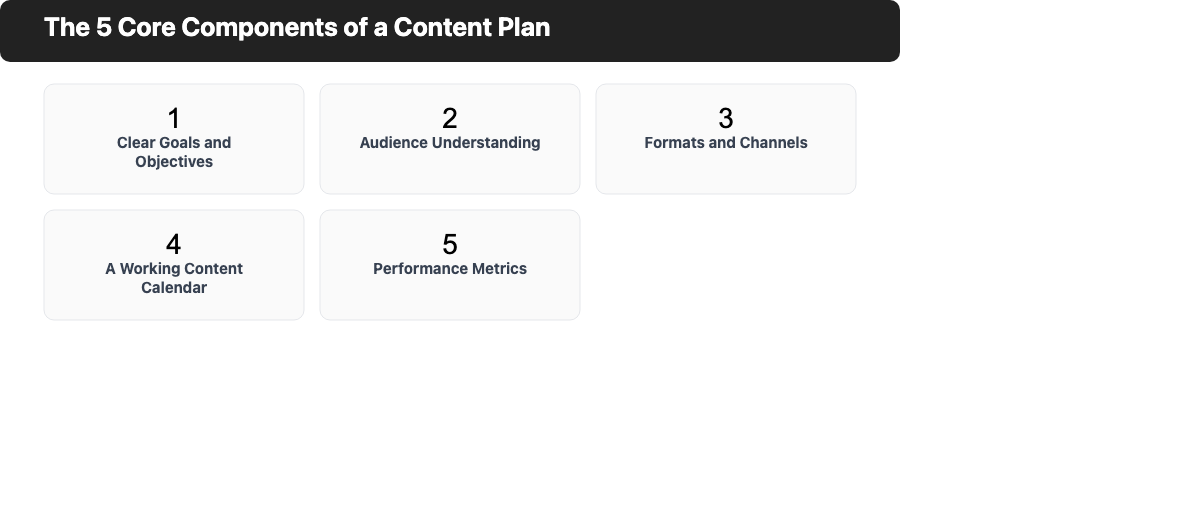
Clear Goals and Objectives
Set objectives that connect directly to a business or marketing goal. Not "get more engagement." Something specific enough to later confirm you hit it: grow organic sessions to a page category by a target percentage, generate a set number of qualified leads from gated content, or build topical authority in a defined subject area within a set timeframe.
Audience Understanding
Effective planning depends on knowing who you are creating for beyond basic demographics. Understand the questions your audience is actually asking. Understand where they are in the buying journey when they encounter your content, and which format they prefer to consume it in. Skip this step, and a plan tends to produce content that is technically correct but never resonates.
Formats and Channels
Not every idea belongs everywhere. Some work best as long-form articles, others as short social posts, video walkthroughs, or downloadable templates. Map each idea to the format and channel where it is most likely to get seen, rather than defaulting to one format for everything.
A Working Content Calendar
This is where the plan becomes executable. It records publish dates, who owns each production stage, current status, and any promotion tied to it. A calendar without a plan behind it is just a list of dates. A plan without a calendar in front of it never gets produced at all.
Performance Metrics
Decide before you publish, not after, how you will measure success. Depending on the goal, that could mean page views, time on page, social shares, email signups, sales inquiries, or search rankings. Commit to metrics in advance, and the measurement step at the end of the process actually becomes possible.
How to Create a Content Plan in 7 Steps
Building a content plan follows a repeatable process from setting objectives through measuring results and adjusting course.
- Set objectives and define your audience
- Brainstorm and prioritize content ideas
- Build your content calendar
- Write a content brief for every piece
- Assign ownership and production deadlines
- Plan promotion and distribution
- Measure results and adjust the plan
Step 1: Set Objectives and Define Your Audience
Write down what this content effort should achieve and who it serves. Tie the objective to a real business outcome. Describe the audience by the questions they ask and the stage of the buying journey they are in, not just job title or age range. Everything later in the process gets measured against this step.
Step 2: Brainstorm and Prioritize Content Ideas
Pull ideas from keyword research, competitor gaps, support questions, sales conversations and subject-matter experts inside your organization. Once the list exists, prioritize by topic relevance, audience segment, buyer-journey stage and expected business impact. Do not try to produce all of it at once.
Step 3: Build Your Content Calendar
Turn the prioritized list into a calendar with real publish dates. Sequence related pieces so they build on each other rather than publishing in a random order. Leave room for timely, reactive content next to the planned, evergreen pieces.
Step 4: Write a Content Brief for Every Piece
Most content plans skip this step, and it is where quality control actually lives. A brief translates the plan into instructions someone can execute without guesswork. A useful one covers:
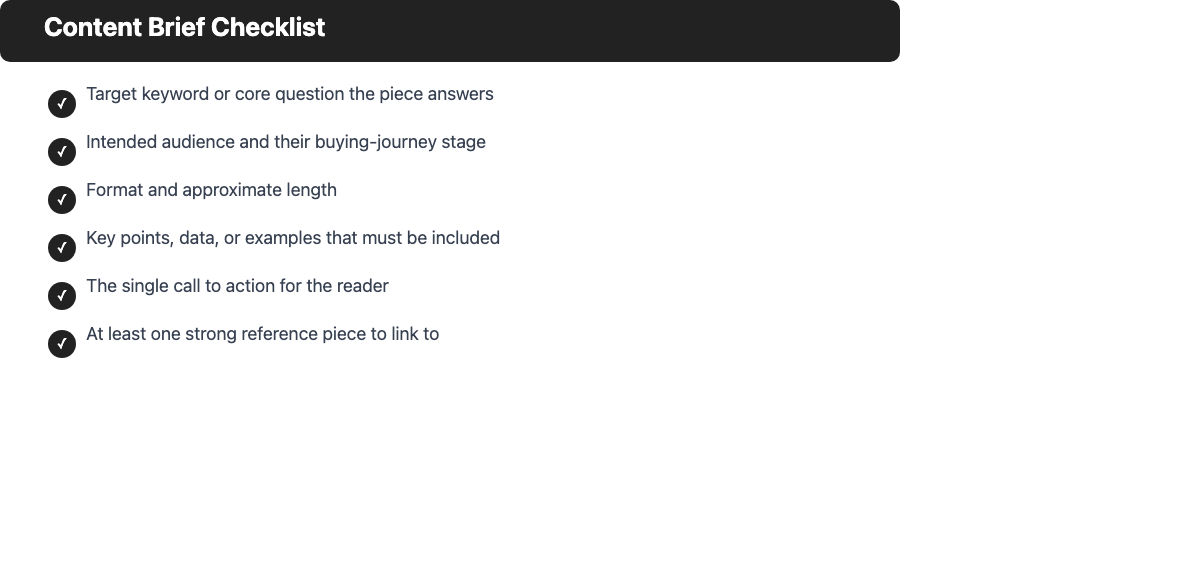
- the target keyword or core question the piece answers
- the intended audience and their buying-journey stage
- the format and approximate length
- key points, data, or examples that must be included
- the single call to action for the reader
- at least one strong reference piece to link to
Skip this step, and a calendar full of dates still produces inconsistent, off-brief content.
Step 5: Assign Ownership and Production Deadlines
Give every piece one clearly accountable owner and deadlines for each stage: draft, edit, design, final approval. Ambiguous ownership is one of the most common reasons planned content quietly slips or never gets made.
Step 6: Plan Promotion and Distribution
Decide how a piece gets promoted as part of the plan, not as an afterthought once it publishes. Identify which channels will carry it, whether it needs paid support, and how it connects to whatever else is going out around the same time.
Step 7: Measure Results and Adjust the Plan
Review performance against the metrics you committed to, on a regular cadence rather than once a quarter. Use what you learn to adjust future topics, formats or cadence. A content plan is a living document. It is not a file you close once the content goes live.
Content Planning Tools Worth Considering
You do not need one specific named product to plan content well. Most teams still benefit from tools across three categories.
- Calendar and scheduling tools keep publish dates, owners and status visible to the whole team, whether that is a dedicated content calendar, a project board, or a shared spreadsheet for smaller teams.
- Collaboration tools let writers, designers and reviewers work on the same brief and draft without version-control chaos.
- Analytics tools connect published content back to the metrics defined in the plan, so the measurement step relies on real data instead of a guess.
Fit matters more than feature count. A simple shared calendar your team actually opens beats a full platform nobody logs into.
Blog Outline Generator: headings, key points and FAQ candidates for your topic. Free, no signup.
Common Content Planning Mistakes to Avoid
- Inconsistent publishing with no clear strategy behind it. Irregular timing and quality swings erode trust faster than one missed deadline ever will.
- Ignoring audience feedback and engagement signals. Comments and questions are free research. A plan that never uses them stops improving.
- Failing to adapt to shifting trends and platform changes. A quarter-long plan with zero flexibility looks stale by the time it publishes.
- Neglecting performance data. Collecting analytics and never acting on them is nearly as unproductive as tracking nothing at all.
- Prioritizing quantity over value. Publishing faster than you can maintain quality erodes audience trust quickly.
- Treating the plan as too rigid to adjust. A good plan reserves slots for timely, reactive content specifically so planning and responsiveness never compete. It should flex around real opportunities, not block them.
Frequently Asked Questions
Is a content plan the same as a content calendar?
No. A content plan specifies what content gets created (the topics, keywords and formats) and how you will create, distribute and measure it. A content calendar only maps when and where each of those pieces goes live. The full comparison in the table above breaks down purpose, owner and output for the content strategy, content plan and content calendar layers side by side.
How often should a content plan be updated?
Check it against your metrics on a regular cadence. Monthly works for fast-moving channels; quarterly is enough for longer-form content. Adjust topics or formats based on what the data actually shows.
Do I need a rigid plan, or is it better to post reactively?
Both. Reserve room in the calendar for timely content next to the planned pieces, so the plan never forces you to ignore a genuine, timely opportunity.
What is the most commonly skipped step in content planning?
Writing a content brief for each piece. Skip it, and a calendar full of dates still produces inconsistent, off-target content.