Tool list · 8 tools
Best AI Detector: 8 Tools Compared for Accuracy, Price, and Use Case (2026)

An AI detector estimates the probability that a piece of text was generated by a large language model rather than written by a human. The guide compares eight widely used tools, including Originality.ai, GPTZero, Winston AI and Pangram, on accuracy, price and use case, because independent testers keep finding real accuracy gaps between vendor claims and results.
If you publish content, grade papers or manage a team of writers, you have probably already asked the same question everyone else is asking: which AI detector can you actually trust? Dozens of tools now claim "99% accuracy," but independent testers who have run 9, 12 and even 30+ detectors side by side keep landing on the same conclusion: accuracy varies a lot by tool, by text length and by how the text was written.
This guide compares eight of the most widely used AI detectors on the market: Originality.ai, GPTZero, Winston AI, Pangram, Copyleaks, Quetext, QuillBot's AI detector and Sapling. You will get an at-a-glance comparison table, an honest look at how accurate these tools really are and a decision guide based on who you are and what you need to check.
What Is an AI Detector and How Does It Work?
An AI detector is a content-detection tool that scans a piece of text and estimates the probability that it was generated by a large language model such as ChatGPT, GPT-5, Gemini, Claude or Llama, rather than written by a human.

Most detectors combine a handful of signals:
- Perplexity: how predictable the word choices are. AI-generated text tends to pick the statistically "safest" next word more often than a human writer does.
- Burstiness: how much sentence length and structure vary. Human writing tends to mix short and long sentences more unevenly than machine-generated text.
- Pattern-matching against known model outputs: many detectors are trained on large samples of text from specific AI models, so they can recognize stylistic fingerprints tied to those models.
None of these signals is a perfect tell on its own, which is exactly why accuracy claims deserve a closer look before you trust a single score.
Best AI Detectors at a Glance (Comparison Table)
Before the full reviews, here is how the eight tools stack up on the factors that matter most: who they are built for, what they claim on accuracy, whether there is a free option and what a typical starting price looks like. Treat every accuracy figure below as vendor-stated unless a specific independent study is named. See the accuracy section further down for the honest version of this conversation, and for more on that, see our best ai search engine guide.
| Tool | Best For | Accuracy Claim (Vendor-Stated) | Free Tier | Starting Price |
|---|---|---|---|---|
| Originality.ai | Content teams and agencies | High accuracy, backed by third-party studies | No free scans, pay-as-you-go credits available | Roughly $30/month for a small-team plan |
| GPTZero | Schools and educators | High accuracy on document-length text | Yes, limited free word count | Free tier available; paid plans for higher volume |
| Winston AI | SEO and content agencies | Claims accuracy in the high-90s% range | Limited free trial | Tiered monthly plans based on word volume |
| Pangram | Publishers and long-form content | Independently benchmarked across dozens of tools | Limited free checks | API and subscription pricing based on volume |
| Copyleaks | Enterprise and API integration | High accuracy across multiple languages | Limited free trial | Custom/enterprise pricing, plus self-serve plans |
| Quetext | All-in-one plagiarism + AI checking | Moderate-to-high, bundled with plagiarism score | Limited free checks | Affordable monthly plans, bundled with plagiarism tool |
| QuillBot AI Detector | Free, occasional use | Vendor-claimed high accuracy on unedited AI text | Yes, generous free tier | Free; premium unlocks other QuillBot tools |
| Sapling | Support and sales team workflows | Built into a broader AI writing-assistant suite | Limited free trial | Team pricing based on seats |
Paragraph Rewriter: three versions side by side, every factual claim preserved. Free, no signup.
1. Originality.ai: Best Overall for Accuracy and Content Teams
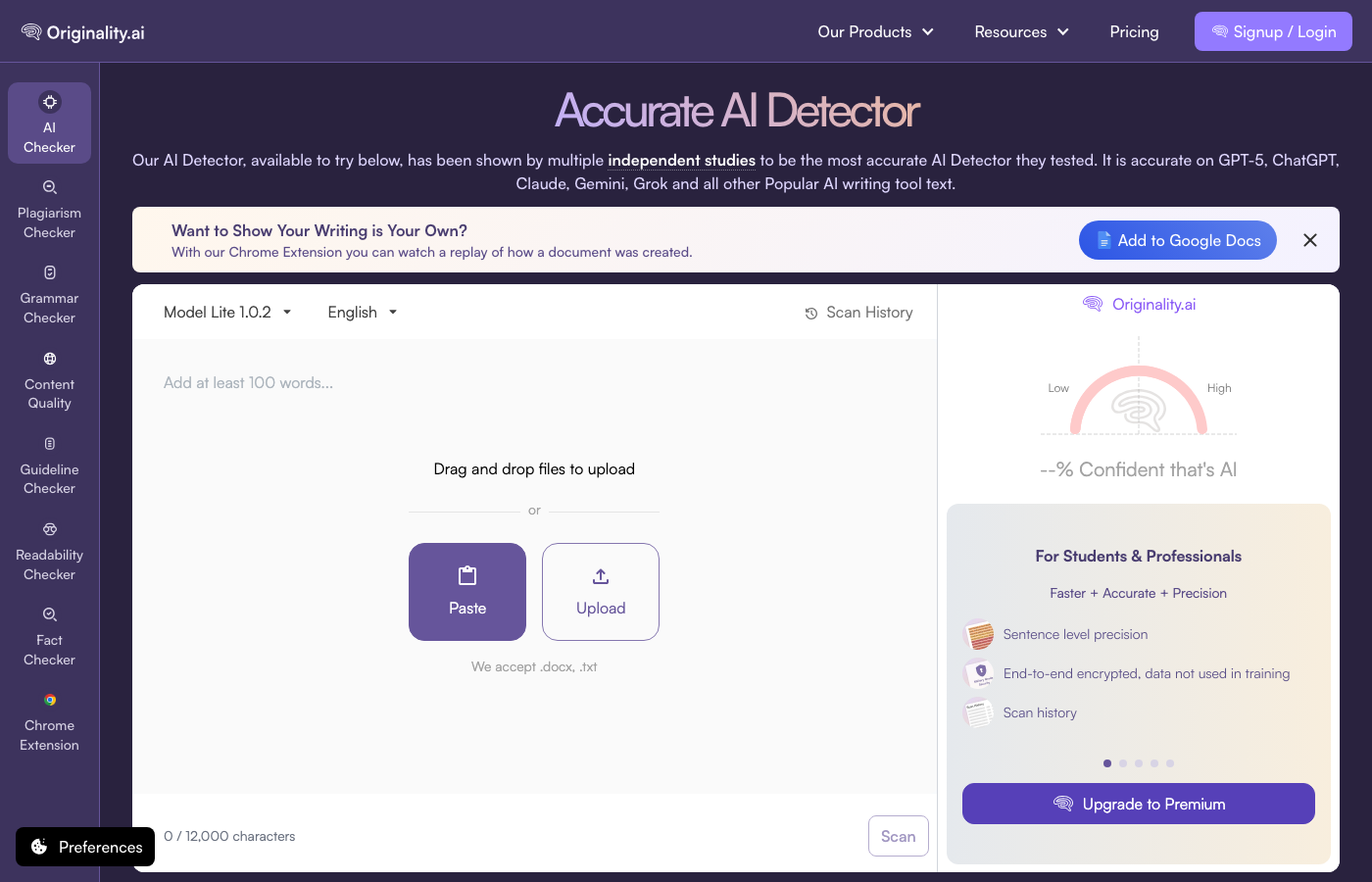
Originality.ai is the strongest all-around pick if you need AI detection bundled with plagiarism checking, fact-checking and readability scoring in one workspace. It is built for marketers, agencies and publishers who need to check content at scale before it goes live.
- Bundles AI detection, plagiarism checking, fact-checking and readability scoring under one credit system
- Offers a Chrome extension that checks any webpage you're viewing for AI-written text
- "Writing Replay" feature lets writers record their drafting process to prove authorship if a piece is ever flagged
- Provides team accounts and API access for agencies scanning content at scale
Originality.ai cites third-party, peer-reviewed accuracy studies rather than only self-reported numbers, which is a meaningful trust signal in a market full of unverified "most accurate" claims. That said, no accuracy claim, including this one, should be treated as a guarantee on every single scan; see the accuracy section below for why.
2. GPTZero: Best for Schools and Educators

GPTZero was one of the first AI detectors built specifically for the classroom and it remains the most widely deployed option in education. By its own account, it is used across thousands of schools and universities worldwide.
- Integrates directly with learning management systems, including Canvas and Google Classroom
- Includes an AI Tutor feature to give students writing feedback instead of just a flag
- Offers a bundled plagiarism scan alongside AI detection
- Publishes a genuinely useful FAQ on its own limitations, including the admission that no AI detector is 100% accurate
That last point matters: GPTZero is one of the few vendors that publicly states results should not be used as the sole basis for academic penalties and that accuracy improves with longer documents rather than short snippets. That kind of transparency is rare in this category and is part of why it remains the default choice for teachers who are not already locked into Turnitin, the older plagiarism-first platform many universities license separately and which has since added its own AI-writing detection to the same assignment workflow.
3. Winston AI: Best for SEO and Content Agencies

Winston AI positions itself squarely at content marketers, SEO teams and agencies that need to verify large volumes of blog content and freelance submissions before publishing.
- Claims accuracy in the high-90s percentage range on its marketing pages
- Includes an image-detection feature in addition to text scanning
- Bundles a plagiarism scanner and writing-feedback tool
- Offers a certification/report format that agencies can share with clients or writers
Agencies tend to like Winston AI because the workflow is built around reviewing many submissions quickly, not just single documents. As with every tool on this list, treat the headline accuracy percentage as a vendor claim rather than an independently audited figure until you check the source study behind it. Unlike Grammarly, which bundles a lighter AI-detection flag inside a broader grammar and style assistant, Winston AI is built around content review as the primary job, not a secondary feature.
4. Pangram: Best for Publishers and Long-Form Content
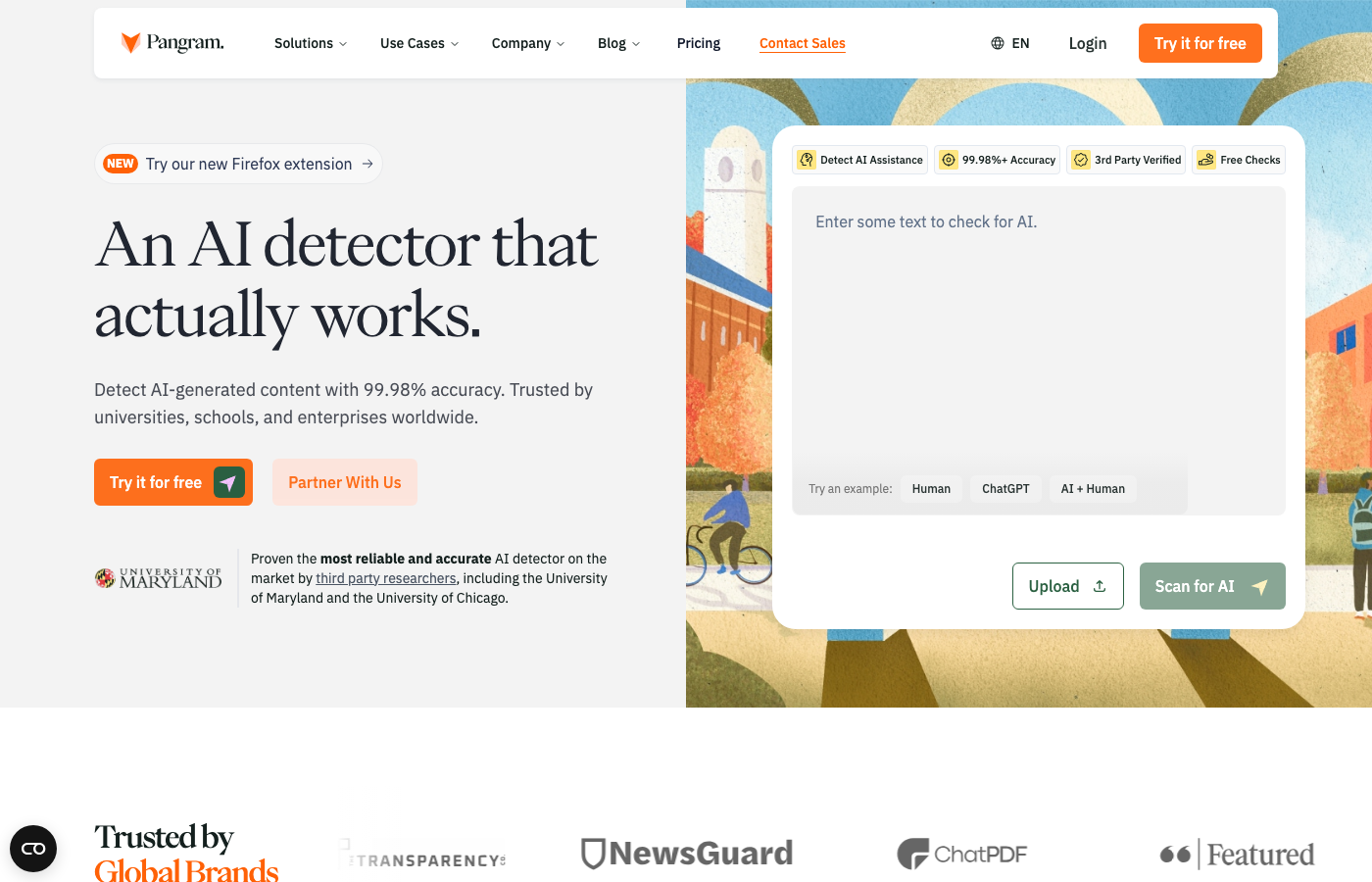
Pangram has built its reputation on methodology rather than marketing copy. Its own public testing compared its detector against roughly 30 other tools, and it consistently shows up as a top performer in third-party and independent reviews across the SERP for this exact topic.
- Designed for scanning long-form editorial content, not just short snippets
- Emphasizes false-positive rate as a core metric, not just raw accuracy
- Offers API access for publishers who want to screen large volumes of submitted content automatically
- Frequently cited by independent reviewers as one of the more reliable options when tested against real human writing samples
If your priority is minimizing the risk of falsely flagging a real writer's work (a genuine concern for publishers working with freelancers), Pangram's public focus on false-positive testing makes it worth shortlisting.
5. Copyleaks: Best for Enterprise and API Integration
Copyleaks is built for organizations that need AI detection at scale: universities, enterprises and platforms that want to embed detection directly into their own products through an API.
- Supports detection across multiple languages, not just English
- Offers LMS integrations for higher-education customers
- Provides an API for companies that want to build AI detection into their own tools or workflows
- Bundles plagiarism detection alongside AI-content scanning
Copyleaks is less of a fit if you just want to paste text into a browser and get a quick answer. It is built for teams and platforms that need detection wired into a larger system.
6. Quetext: Best All-in-One with Plagiarism Checking
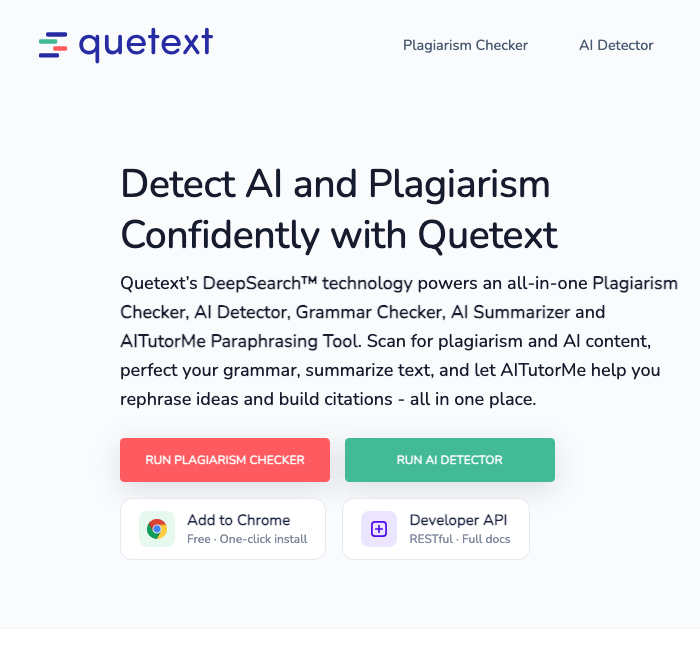
Quetext started as a plagiarism checker and later added AI detection, which makes it a strong pick if you specifically want both checks in one subscription rather than paying for two separate tools.
- Combines plagiarism checking, AI detection and citation assistance in one plan
- Popular with bloggers, teachers and editors who need an all-purpose content-integrity tool
- Simpler interface than more feature-dense competitors like Originality.ai or Copyleaks
- Generally positioned at a lower price point than dedicated enterprise AI-detection suites
If your main use case is catching both plagiarism and AI-generated text without juggling two subscriptions, Quetext's bundled approach is one of the more practical options on this list.
7. QuillBot AI Detector: Best Free Option
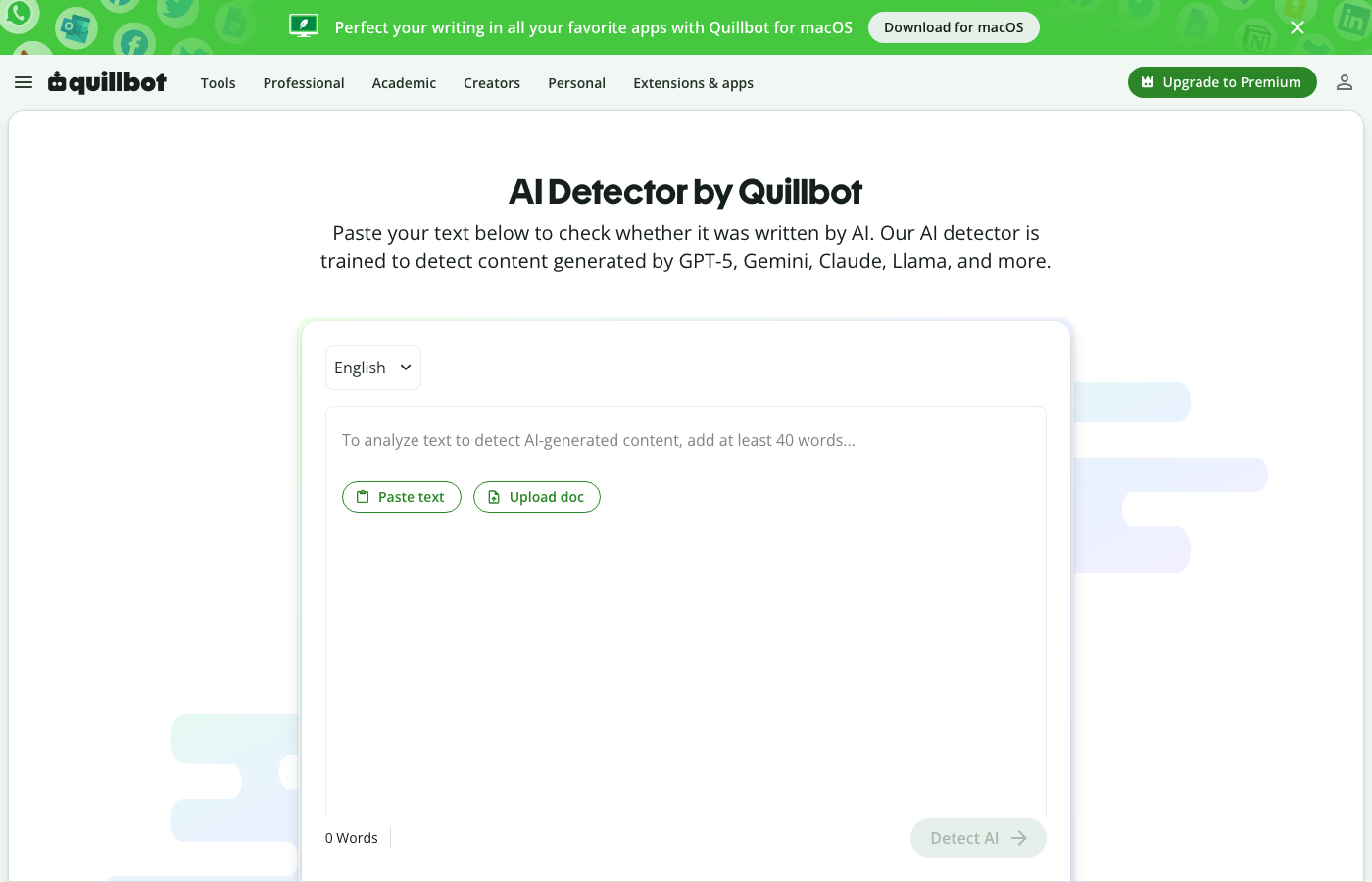
QuillBot is best known as a paraphrasing and grammar tool, but its free AI detector has become a genuinely popular choice for people who just need an occasional, no-cost check.
- Free to use with no account required for basic scans
- Built into the same ecosystem as QuillBot's paraphrasing and grammar-checking tools
- Independent reviewers testing dozens of detectors have repeatedly rated it as one of the more accurate free options for catching unedited AI text
- Premium subscription unlocks QuillBot's broader writing-assistant suite, not just more AI-detector scans
The tradeoff with any free detector, QuillBot included, is that accuracy tends to drop once AI text has been edited, paraphrased or run through a humanizing tool, a limitation covered in more detail below.
8. Sapling: Best for Customer Support and Team Workflows
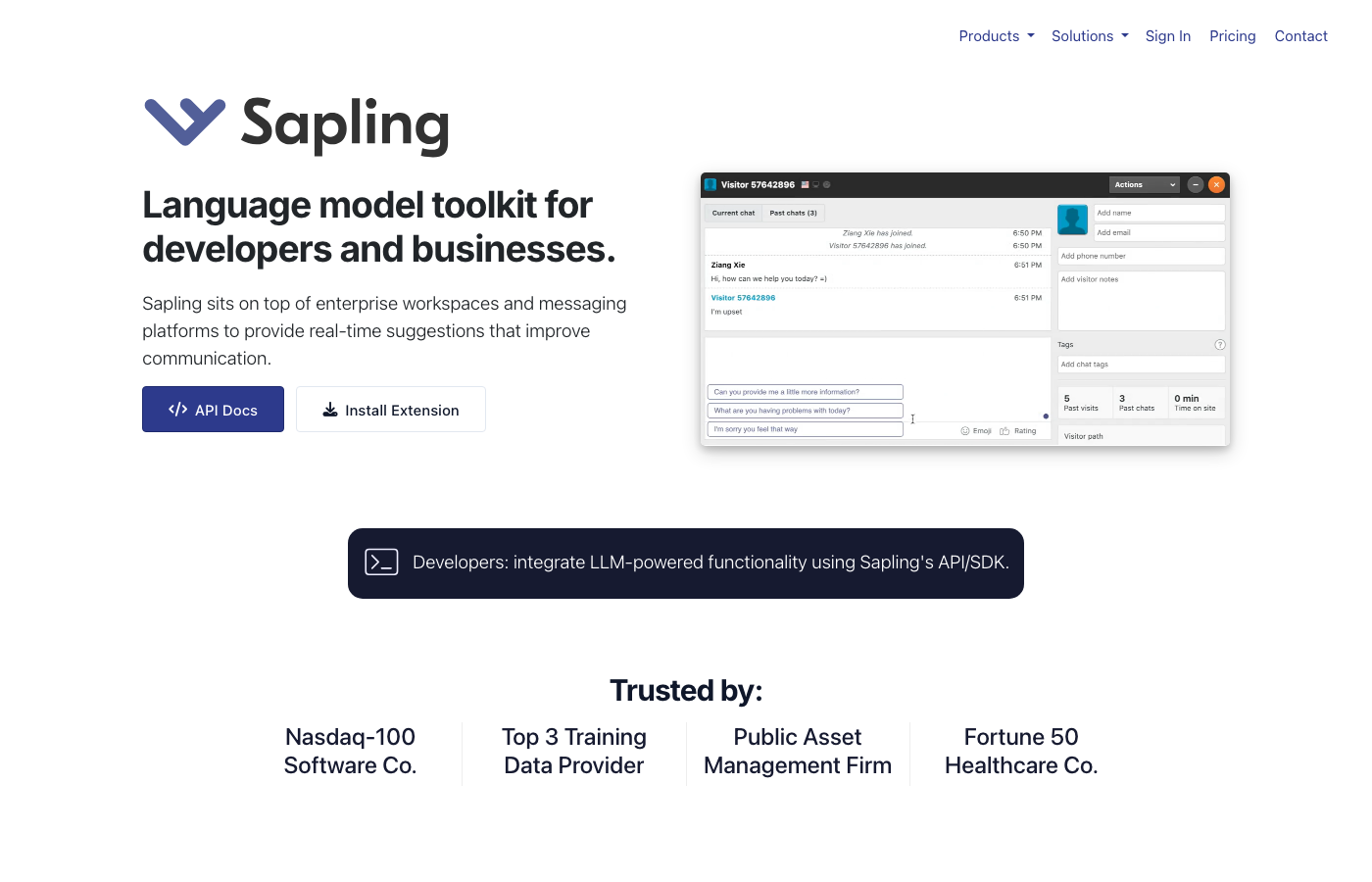
Sapling is primarily an AI writing assistant built for customer support and sales teams, and its AI detection feature is aimed at that same audience rather than at bloggers or students.
- Built into a broader suite of team writing tools (autocomplete, snippets, quality scoring)
- Aimed at support and sales teams checking whether responses were AI-generated versus written by an agent
- Seat-based team pricing rather than per-document credits
- Less relevant if you only need a standalone, one-off AI checker
Sapling is a niche pick on this list, but if your organization already uses it for support-team writing quality, its built-in detection saves you from adding a separate tool just for AI checks.
How Accurate Are AI Detectors, Really?
Here is the honest answer: no AI detector is 100% accurate and any tool that implies otherwise is overselling. Independent testers who have run 9 to 30+ detectors side by side consistently find meaningful gaps between vendor-claimed accuracy and real-world performance, especially once text has been edited, paraphrased or run through a humanizing tool.
Two things matter more than the headline accuracy percentage:
- False positives. A false positive happens when a detector flags genuinely human-written text as AI-generated. This is a well-documented, widely discussed risk in the industry, particularly for shorter texts, unusual writing styles and non-native English writing patterns. A tool with a high raw accuracy score can still carry a meaningful false-positive rate.
- Text length. Detectors are generally more reliable on longer, document-length text than on short snippets or single paragraphs, because there is more pattern data for the model to work with.
Before you trust an AI-detector score for anything consequential, run through this quick check:
- Is the scanned text long enough (ideally several paragraphs) for the tool to have enough signal to work with?
- Does the vendor disclose a false-positive rate or only an accuracy rate?
- Is there an independent, third-party study behind the accuracy claim or is it entirely self-reported?
- Would you be comfortable acting on this score alone or does it need a second tool or human judgment to confirm it?
If you can't answer those questions confidently, treat the result as one data point, not a verdict.
Can AI Detectors Be Fooled or Bypassed?
Yes, to a meaningful degree. Running AI-generated text through a paraphrasing or "humanizing" tool can lower detection accuracy across most detectors, since it disrupts the exact statistical patterns detectors are trained to recognize. However, heavy paraphrasing tends to degrade the writing quality and coherence of the original text, which somewhat undercuts the point of generating it with AI in the first place. Detector vendors are also continuously updating their models to catch known humanizer patterns, so this is a moving target rather than a permanent loophole.
How to Choose the Right AI Detector for Your Situation
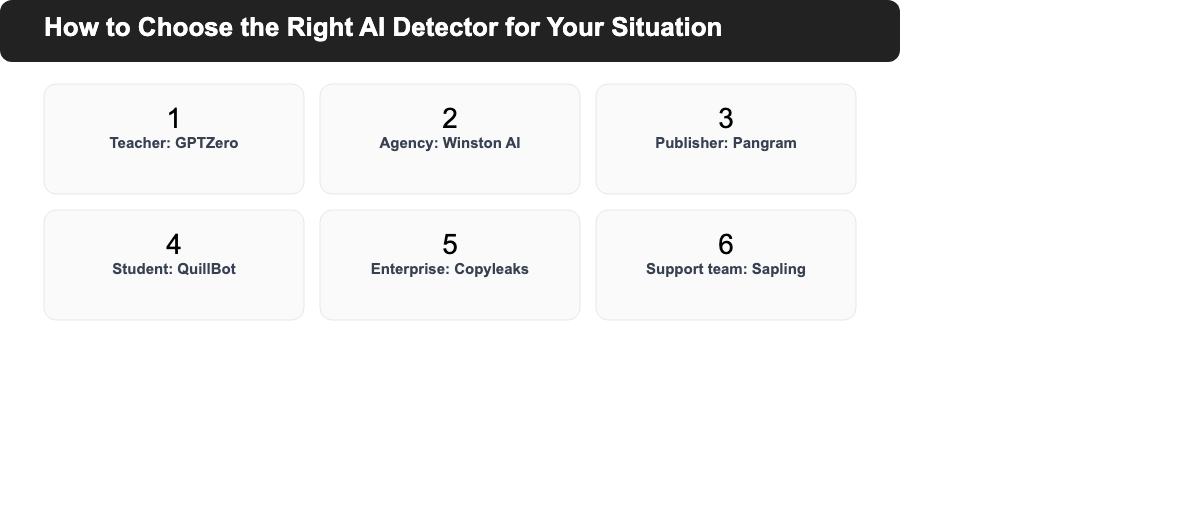
- If you're a teacher or academic institution: start with GPTZero for its LMS integrations and its transparent stance on limitations or Copyleaks if you need multi-language support at an institutional scale.
- If you're a content agency or SEO team: Winston AI or Originality.ai fit agency workflows best, since both are built to check high volumes of freelance and in-house content quickly.
- If you're a publisher working with freelance writers: Pangram's focus on false-positive testing makes it a safer choice for not wrongly flagging real writers.
- If you're a student or individual who just needs an occasional free check: QuillBot's AI detector is the most practical starting point.
- If you're an enterprise or platform that wants to build detection into your own product: Copyleaks' API-first approach is the closest fit.
- If you already use an AI writing assistant for support or sales: Sapling's built-in detection avoids adding another standalone tool.
Frequently Asked Questions
Can AI detectors be fooled or bypassed?
Yes, to some extent. Paraphrasing or "humanizing" AI-generated text can reduce detection accuracy, though it usually comes at the cost of writing quality and detector vendors regularly update their models to catch known humanizer patterns.
Are free AI detectors accurate enough to trust?
Free tools like QuillBot's AI detector can perform well on unedited AI text, but like every detector on this list, accuracy drops on shorter snippets and on text that has been edited or paraphrased. Use a free tool as a first check, not a final verdict.
Do AI detectors work on non-English text?
Coverage varies by tool. Some detectors, including Copyleaks and GPTZero, explicitly support multiple languages, while others are optimized primarily for English. Always check a vendor's stated language support before relying on results for non-English content.
Can AI detectors flag human writing by mistake?
Yes. This is called a false positive and it is one of the most important limitations to understand before trusting any AI-detector score. Shorter texts and certain writing styles are more prone to being flagged incorrectly, which is why longer documents and a second opinion from another tool are both good practice before treating a result as final.