
Glossary
Long-Tail Keywords: What They Are and How to Find Them [2026]

Long-tail keywords are specific search queries with low monthly search volume, usually 3 or more words, that target a narrow audience with a clear search intent. Long-tail keywords face less competition than head terms and convert better because the searcher knows what they want. Ahrefs, Semrush and Google Search Console are the main tools for finding them.
- Named after the search demand curve, where a long tail of low-volume queries follows few head terms
- More than 70% of all search queries fall into the long-tail category, according to BrightEdge
- Short-tail keywords have 1-2 words, 10,000+ monthly searches and broad, unclear intent
- Topical long-tail keywords like how to set up a project in Asana need dedicated pages
Long-tail keywords are specific search queries with low monthly search volume that target a narrow audience. They tend to be 3 or more words, reflect a clear search intent and convert better than broader head terms because the person searching knows what they want.
Most SEO guides treat long-tail keywords as a beginner tactic. They're not. Used well, they're one of the most reliable ways to build consistent organic traffic, even for newer sites competing against established domains.
This guide covers what long-tail keywords are, why they matter, how to find them and a distinction most articles skip: the three types of long-tail keywords and why mixing them up wastes months of effort.
What Are Long-Tail Keywords?
Long-tail keywords are search queries with low monthly search volume and high specificity. They're usually 3 or more words and target a narrower audience than short or mid-tail terms.
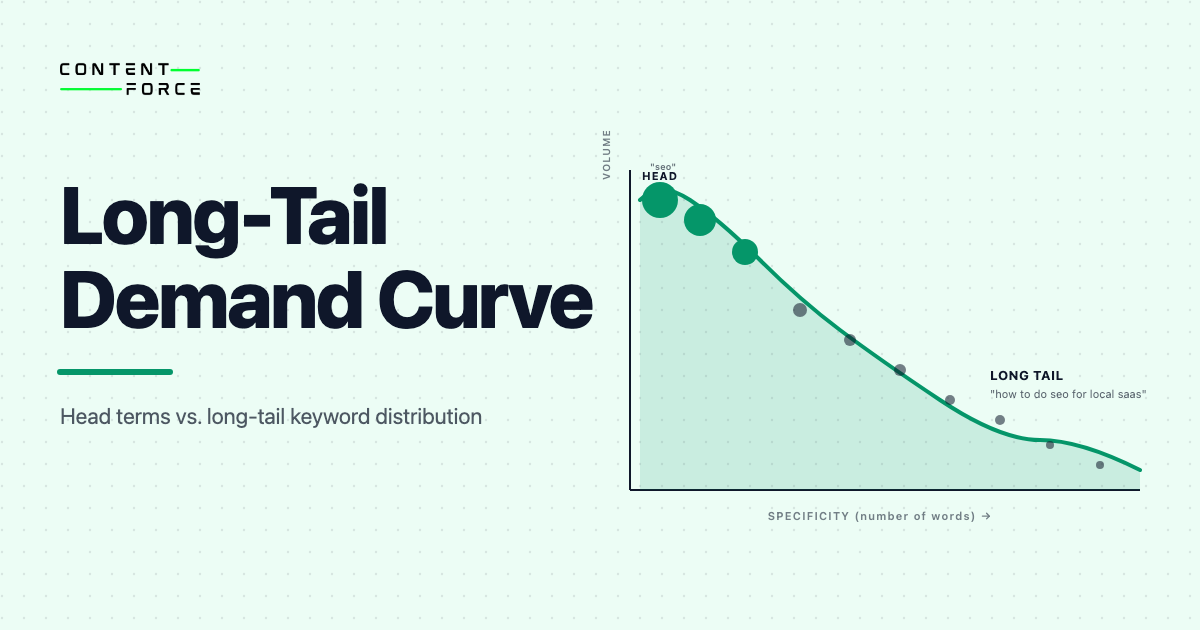
The name comes from the search demand curve, a concept popularized by Chris Anderson in The Long Tail. Plot all keywords by search volume and you'll see it: a small cluster of head terms at the top with massive traffic. Then the curve drops. It stretches far to the right across thousands of low-volume queries. That's the tail.
A head keyword like "running shoes" gets hundreds of thousands of searches per month. A long-tail keyword like "best running shoes for flat feet women" gets a fraction of that. But it attracts someone who's already made most of the decision. That's the trade worth making.
Long-Tail vs. Short-Tail vs. Mid-Tail Keywords
These three tiers behave differently in practice:
| Type | Length | Monthly Volume | Competition | Intent |
|---|---|---|---|---|
| Short-tail (head) | 1-2 words | 10,000+ | Very high | Broad, unclear |
| Mid-tail | 2-3 words | 1,000-10,000 | Moderate | Partially specific |
| Long-tail | 3+ words | Under 1,000 | Low to moderate | Specific, high intent |
Short-tail keywords are expensive to rank for and attract browsers. Mid-tail keywords balance volume with competition. Long-tail keywords are where decision-ready visitors search, and that's where the real opportunity sits.
Why Are They Called "Long-Tail"?
The term refers to the shape of the demand curve, not the length of the query. On the curve, a handful of popular head terms dominate on the left. The curve drops, then extends far to the right as a long "tail" of lower-volume terms. Enormous, actually. Ahrefs puts around 18,000 keywords in its US database above 100,000 monthly searches, against roughly 2.3 billion keywords that get fewer than 10 searches a month. Most real search behavior happens out in that tail, and it keeps growing: Google has reconfirmed that close to 15% of the searches it sees on any given day have never been searched before.
Why Long-Tail Keywords Matter for SEO
Long-tail keywords offer three advantages that head terms flat-out don't: lower competition, higher conversion intent and massive collective volume. A fourth advantage has emerged more recently. Growing visibility in AI-generated search results is now a real factor worth understanding.
They're Easier to Rank For
Big-name, high-authority domains with years of backlinks dominate head keywords. Long-tail keywords face far less competition. Keyword difficulty scores are low, which means even smaller or newer sites can reach the first page with well-structured content. That's not possible for most head terms without a multi-year link-building campaign.
They Attract Visitors with Higher Purchase Intent
Someone searching "software" is browsing. Someone searching "best project management software for freelancers under $20" is close to making a decision. Long-tail searchers know what they want, and that's why they convert at higher rates. It's not a small difference, either. The intent gap between head terms and long-tail terms is one of the most consistent patterns in organic search.
The Collective Volume Adds Up
No single long-tail keyword drives enormous traffic on its own. But more than 70% of all search queries fall into the long-tail category, according to BrightEdge and multiple independent SEO studies. A content strategy built around dozens or hundreds of relevant long-tail terms builds compounding traffic that doesn't require winning competitive head-term battles.
Long-Tail Keywords and AI Search
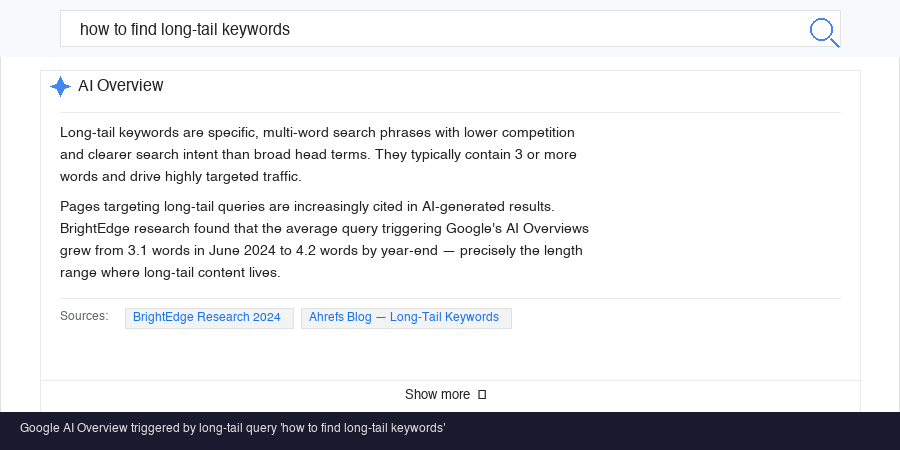
Long-tail keywords have gained new importance as AI-powered search features expand. BrightEdge research from 2024 found that the average query length triggering Google's AI Overviews grew from 3.1 words in June 2024 to 4.2 words by year-end. Longer, conversational queries are exactly what long-tail content addresses, which means pages built around them are well positioned to appear in AI-generated summaries. Without question, this is the trend that makes long-tail strategy more valuable in 2026 than it was five years ago.
SEO Title Generator: eight title tag variations, sized for the SERP and intent-matched. Free, no signup.
How to Find Long-Tail Keywords
The most reliable approach combines a keyword research tool with data you already have in Google Search Console, and supplements both with competitor analysis and forum research. Here's how each method works.
Use a Keyword Research Tool
Tools like Ahrefs and Semrush give you the fastest path to long-tail keywords at scale. Enter a broad seed keyword, then filter the results.
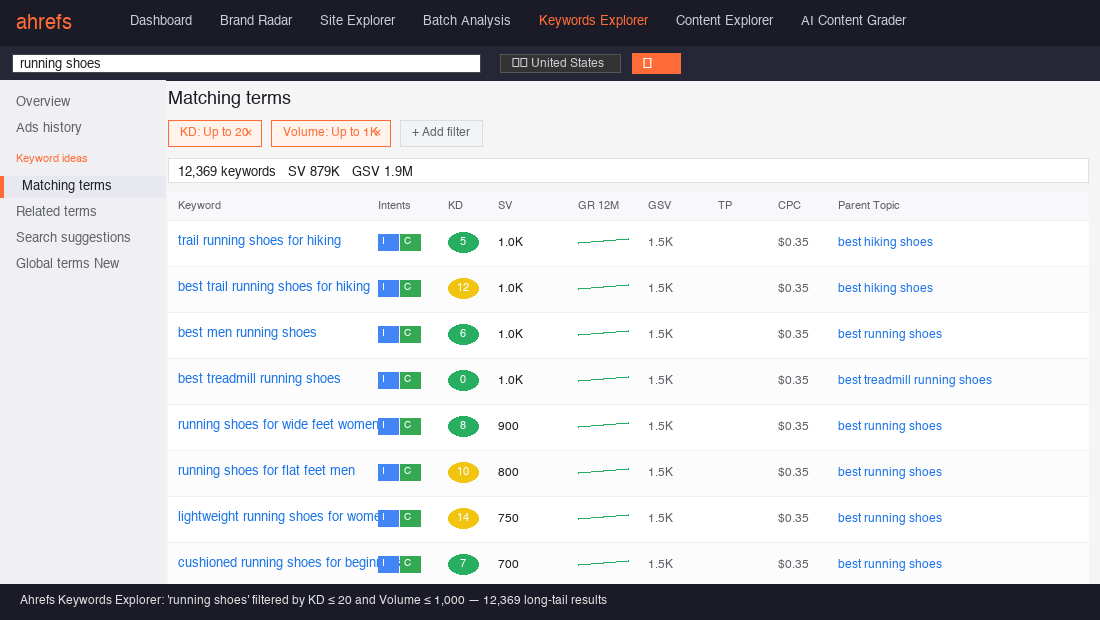
In Ahrefs Keywords Explorer, filter for keyword difficulty below 20 and search volume below 1,000. In Semrush's Keyword Magic Tool, set the word count to 3 or more words and keep keyword difficulty below 30%. Both surface terms that are specific and achievable.
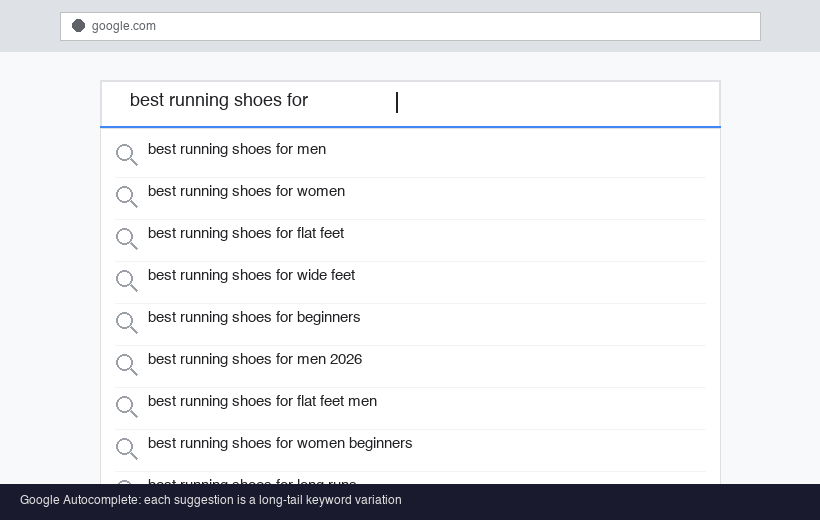
One thing worth knowing: Google Autocomplete shows popular queries, not rare long-tail ones. If you type a keyword into Google and rely on the autocomplete suggestions, you're seeing mid-tail or head terms with high traffic. For true long-tail discovery, a dedicated keyword tool delivers far better results.
Check Google Search Console
Your Search Console performance report already contains long-tail keywords you might not know you're ranking for. Filter queries for more than 100 impressions but fewer than 10 clicks. These are terms where your site appears in results but isn't capturing the traffic, often because the page isn't optimized for that query. They're among the easiest wins available.
Analyze Competitor Keywords
Tools like Ahrefs Site Explorer and Semrush let you enter a competitor's domain and see every keyword they rank for. Sort by difficulty and filter for 3+ word phrases. You'll find long-tail terms your competitors are capturing that you haven't targeted yet. This works well in established niches, where head-term rankings are locked in but long-tail opportunities remain open. You don't need to win the head term to win the niche.
Browse Reddit, Quora and Niche Forums
People on forums phrase questions the way they think, not the way a marketing team writes a headline. Searching your topic on Reddit or Quora surfaces exact long-tail phrases that don't appear in keyword databases because they emerge naturally from real conversations. These work well for finding question-format keywords suited to FAQ sections.
Ask AI Platforms for Ideas
Feed a broad topic into ChatGPT, Gemini or Google AI Mode and ask it for the specific questions people ask about it. AI platforms are good at generating conversational phrasing fast, and that phrasing often matches the full-sentence queries people now type into search. It's not a replacement for a keyword tool. Ask for pain points, ask for question-format variations and ask it to keep phrases at four or more words to stay in long-tail territory.
The catch: these tools don't have real search-volume data. An AI chatbot can suggest a phrase nobody actually searches for. Treat every AI-generated idea as a starting point, then run it back through Ahrefs or Semrush. You'll want to confirm it has real, rankable demand before you write a page around it.
Use Google Autocomplete and People Also Ask (Carefully)
Autocomplete isn't ideal for rare long-tail terms, but it works for finding medium-specificity variations of your main keyword. The "People Also Ask" box is more useful. It surfaces real questions people ask alongside your keyword, and many of those questions are long-tail format. Both work best as a supplement, not as your primary method.
The Three Types of Long-Tail Keywords
This is the distinction most SEO guides skip, and it's the one most likely to affect your results. Not all long-tail keywords are created equal. Some are easy to rank for. Others look long-tail but are just as competitive as head terms, and a third kind barely shows up in a keyword tool at all.
Supporting Long-Tail Keywords
A supporting long-tail keyword's just a variation of a more popular head keyword. It shares the same search intent as the parent topic and can be addressed on the same page.
"Best project management app" is a popular keyword. "Best project management app for small teams" is a supporting long-tail keyword. Both searchers want a tool recommendation. One article targeting the head term will naturally rank for the supporting variation too, because Google recognizes they share intent.
Creating a separate article for the supporting variation is wasted effort. Google won't treat it as a new topic, and it's likely to be ignored or treated as duplicate content.
Topical Long-Tail Keywords
A topical long-tail keyword's got its own distinct search intent. It can't be addressed on the same page as a related head keyword because the user wants something different.
"Project management software" and "how to set up a project in Asana" aren't the same intent. Someone searching for setup instructions needs a tutorial, not a listicle about the best tools. These two pieces of content can't share a page.
Topical long-tail keywords need dedicated pages. They're also the ones that move rankings because each page targets a separate, rankable intent.
Conversational Long-Tail Keywords
A conversational long-tail keyword is a full-sentence or question-style query typed into an AI platform rather than a search box. Think "what's the best way to find long-tail keywords for a brand-new blog with no backlinks" instead of "long-tail keyword tool." These queries don't look anything like a keyword list. They drive query fan-out, where an AI system breaks one prompt into several related sub-questions and pulls in content that answers each one.
Ahrefs reports that over 95% of conversational long-tail keywords show no measurable search volume in a traditional keyword tool, yet people type them constantly. That doesn't mean they don't matter. A page written to answer one clearly, in plain language, can still get pulled into an AI answer even though no keyword tool would ever flag the phrase as worth targeting.
| Supporting Long-Tail | Topical Long-Tail | Conversational Long-Tail | |
|---|---|---|---|
| Example | "best running shoes for women" | "how to break in new running shoes" | "what's the best way to find long-tail keywords for a brand-new blog" |
| Intent | Same as head keyword | Distinct from head keyword | Same intent, phrased as a full question or sentence |
| Best approach | Target on the same page as head term | Create a dedicated page | Answer it directly and completely in the first sentence |
| Ranking difficulty | Similar to parent keyword | Lower | Rarely shows measurable volume in keyword tools |
Chasing supporting long-tail terms with separate articles is a common mistake. It creates thin near-duplicate content and rarely improves rankings. The ones worth targeting independently are topical long-tail keywords, and conversational long-tail keywords are worth answering directly inside existing pages even when no tool shows demand for them.
Long-Tail Keyword Examples
Here's how long-tail keywords look across different types of sites, and it's worth scanning all five rows:
| Head Keyword | Long-Tail Variation | Niche | Intent |
|---|---|---|---|
| running shoes | best running shoes for wide feet men | Ecommerce | Commercial |
| CRM software | CRM software for small real estate teams | SaaS | Commercial |
| coffee shop | best independent coffee shop in Brooklyn | Local | Navigational |
| meditation | how to meditate when you have ADHD | Informational | Informational |
| web hosting | cheapest web hosting for WordPress under $5 per month | Ecommerce | Commercial |
Each of these has a specific audience, lower competition than the head keyword and a user who's closer to taking action.
Frequently Asked Questions
What is a long-tail keyword in simple terms?
A long-tail keyword is a search phrase, usually 3 or more words, that is more specific than a general search term. It has lower search volume but attracts visitors who know what they're looking for, which makes it both easier to rank for and more likely to convert.
Are long-tail keywords still worth targeting in 2026?
Long-tail keywords are more valuable now than they've been in years. AI-generated search results increasingly favor specific, conversational queries, which is exactly what long-tail content addresses. They're also one of the most practical paths to organic traffic for sites that can't yet compete for high-volume head terms.
How many long-tail keywords should I target per page?
One primary keyword per page is the right approach. A well-written page targeting one clear topical long-tail keyword will naturally rank for related supporting variations. The goal is to answer one specific question thoroughly, not to pack in as many variations as possible.
What is the difference between a long-tail and a short-tail keyword?
Short-tail keywords are 1-2 words with broad intent and high search volume. Long-tail keywords are 3+ words with specific intent and lower volume. Short-tail terms attract general browsers. Long-tail terms attract people who've already narrowed down what they want.
Do long-tail keywords help with AI search?
They do, and this connection is getting stronger. AI Overviews pull answers from content that addresses specific questions clearly. Long-tail keywords often match the phrasing of those questions directly, which gives well-structured long-tail content a better chance of being cited. Writing direct, specific answers rather than broad overviews is the single best thing you can do to improve AI search visibility.
What is a conversational long-tail keyword?
A conversational long-tail keyword is a full-sentence or question-style search phrase typed into an AI platform such as ChatGPT, Gemini or Google AI Mode instead of a traditional search box. These queries usually show no measurable volume in keyword tools, but that's not a reason to ignore them. A page that answers one directly and completely can still get pulled into an AI-generated answer.