

Search visibility tells you how much of the available organic traffic for your target keywords you actually capture, compared to everyone else competing for the same searches. It puts your rankings in context instead of reporting them in isolation. One number, many competitors.
This guide covers what search visibility means, how it gets calculated, how classic search visibility differs from AI visibility, what counts as a good score, and the tactics that move the number.
What Is Search Visibility?
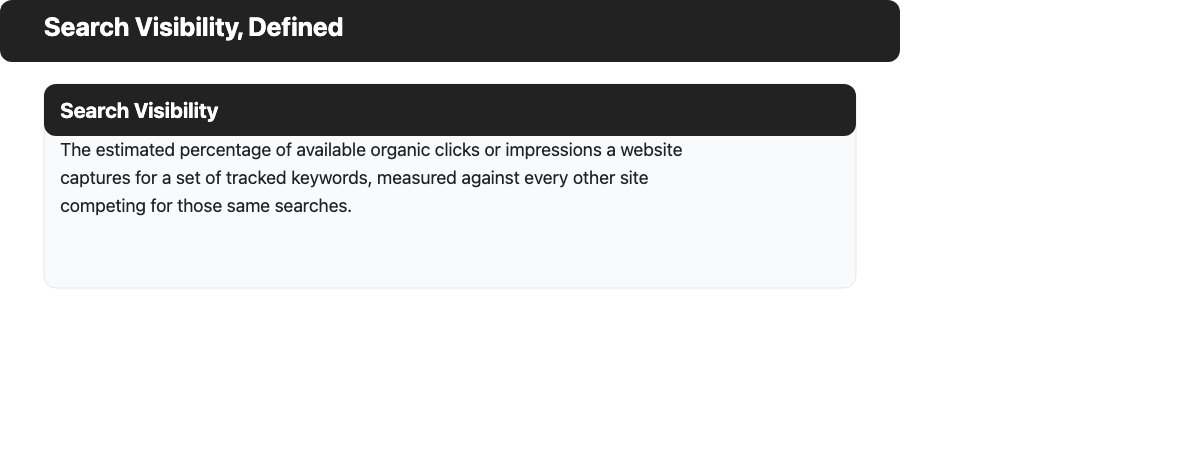
Search visibility is the estimated percentage of available organic clicks or impressions a website captures for a set of tracked keywords, measured against every other site competing for those same searches.
Here is a worked example. A keyword gets 100 searches a month. Your page earns 5 clicks from ranking on that term. Your search visibility for that keyword is 5%. Run that same math across every keyword you track, average it, and you get an overall visibility score for your site.
The two ends of the scale work as useful anchors. A 0% score means no meaningful ranking presence for your tracked keywords, usually outside the top 20 or 30 results. A 100% score would mean owning the top spot for every keyword you track. That almost never happens once you're tracking more than a handful of terms.
How Is Search Visibility Calculated?
Most rank-tracking tools combine two inputs: each keyword's search volume and the click-through rate you can expect at your current ranking position. Multiply volume by expected CTR for every tracked keyword. Sum the results. Express the total as a percentage of the maximum possible clicks across that keyword set.
Position matters more than it might seem. Click-through rate drops sharply as you move down the page: roughly 30% at position 1, 15% at position 2, and 10% at position 3, falling further from there.
Some tools apply an explicit weighting factor by position instead of relying on CTR curves alone. The table below shows one such weighting model. Position 1-3 gets full credit; visibility drops to zero once you fall past the first page.
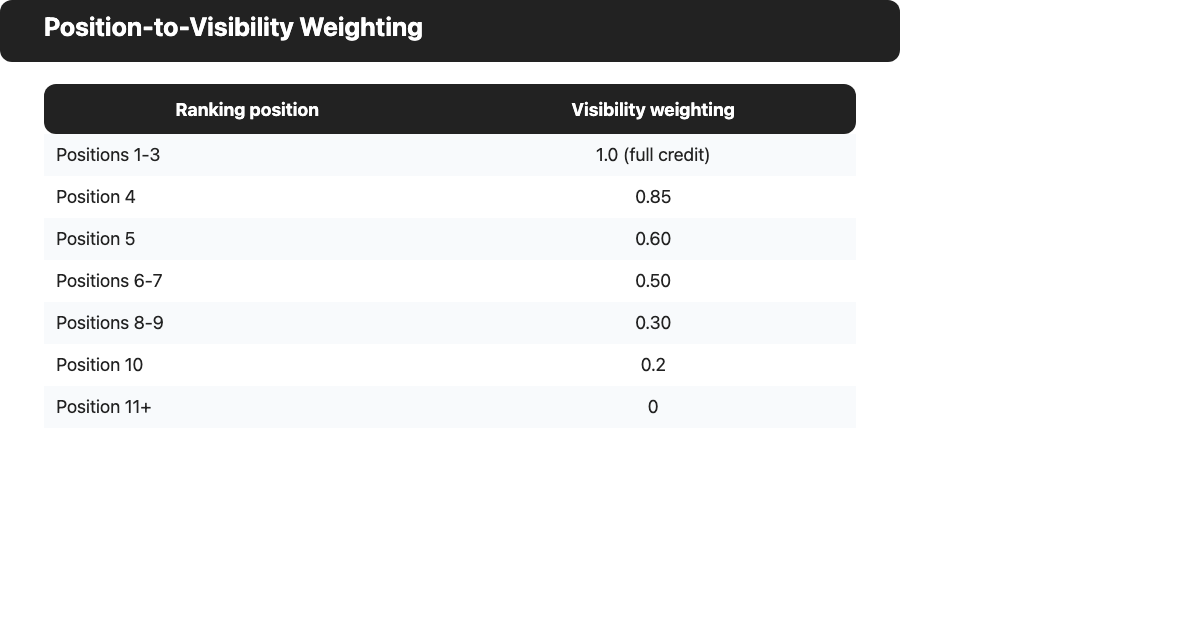
| Ranking position | Visibility weighting |
|---|---|
| Positions 1-3 | 1.0 (full credit) |
| Position 4 | 0.85 |
| Position 5 | 0.60 |
| Positions 6-7 | 0.50 |
| Positions 8-9 | 0.30 |
| Position 10 | 0.2 |
| Position 11+ | 0 |
The practical takeaway: moving from position 6 to position 3 usually does more for your visibility score than moving from position 15 to position 11. The weighting curve is steepest near the top of page one.
Search Visibility vs. AI Visibility
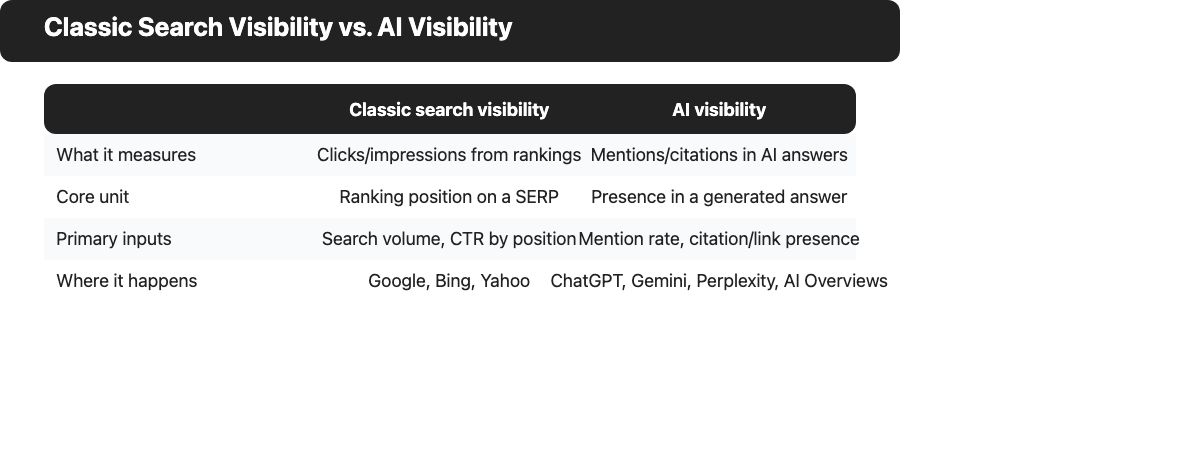
Classic search visibility measures how well your site ranks in traditional organic results on engines like Google, and how many of the available clicks you capture as a result. It's a position-based metric tied to the ten blue links model of search.
AI visibility measures something related but distinct. How often does your brand get mentioned, recommended, or cited when a platform like ChatGPT, Gemini, or Perplexity answers a user's question? There's no ranking position in a conversational AI answer. Instead, AI visibility tracks mention rate, how often you show up across a set of tracked prompts, and citation presence, whether your specific pages get linked as a source.
| Classic search visibility | AI visibility | |
|---|---|---|
| What it measures | Share of clicks/impressions from organic rankings | Share of mentions or citations in AI-generated answers |
| Core unit | Ranking position on a SERP | Presence in a generated answer |
| Primary inputs | Search volume, CTR by position | Mention rate, citation/link presence |
| Where it happens | Google, Bing, Yahoo | ChatGPT, Gemini, Perplexity, AI Overviews |
Neither metric replaces the other. A page can rank well in classic search while rarely getting cited in AI answers. The reverse happens too. More SEO teams now track both side by side instead of treating classic visibility as the whole picture.
What's a Good Search Visibility Score?
There's no single universal benchmark for search visibility. The right number depends on your niche, how many keywords you track, and how competitive your industry is. Even so, a widely cited reference range puts 35-50% as a strong score in competitive industries, and 20-30% as solid for smaller or newer brands with a narrower keyword set.
A rough way to read your own score:
- 0-10%: low visibility. Your site rarely appears for its target keywords.
- 11-30%: a fair-to-good baseline, common for growing sites still building authority.
- 31-50%: a strong position, ranking consistently on page one for most core terms.
- 51% and above: an exceptional score, the kind category leaders post when they dominate their SERPs.
Tracking the trend beats chasing an absolute number. Compare your score against direct competitors instead of an arbitrary industry-wide target. A climb from page two to page one for your core terms counts as real progress, even if the raw score stays well under 50%.
How to Improve Your Search Visibility
Five tactics move the needle most reliably.
- Match search intent precisely. Check what's actually ranking for a keyword today. If the top results are list-style comparisons and your page pitches a single product, visibility stays flat no matter how well the page is optimized otherwise.
- Build backlinks to your strongest pages. Find lower-quality pages that already rank, build something that genuinely beats them, then reach out to the sites linking to the weaker page.
- Strengthen internal linking. Point relevant pages on your own site toward the ones you most want to rank, using descriptive anchor text instead of generic "click here" links.
- Target keywords in the striking-distance range. Terms already ranking in positions 2 through 12 tend to be the fastest wins, since you've already established some relevance and authority for them.
- Optimize for SERP features, not just the blue links. AI Overviews, People Also Ask boxes, and image packs now occupy a large share of results pages. Recent data puts AI Overviews on roughly 14.49% of tracked results, People Also Ask on about 34.53%, and image packs on around 65.53%. Structuring content to be extractable for these features captures visibility you'd otherwise miss, even at a strong ranking position.
Search Visibility FAQ
Can you get 100% search visibility?
Realistically, no. A perfect score would require ranking first for every keyword you track. Most sites track more than one competitive term, which makes 100% effectively unreachable at scale. Treat visibility as a share to grow, not a ceiling to hit.
What's a good search visibility score?
No fixed universal number exists, but 35-50% is a widely cited strong score for competitive niches, while 20-30% works as a solid target for smaller brands. Trend and competitive comparison matter more than the raw percentage on its own.