
Comparison
Semrush vs Moz: Which SEO Tool Is Better in 2026?

Semrush is the stronger all-around SEO tool for agencies and teams, offering a larger keyword database, broader AI search visibility across five surfaces, and deeper competitor research in one subscription. Moz Pro fits solo bloggers and single-site owners instead, with a simpler interface, Domain Authority metric, and plans starting at $49 per month.
- Semrush tracks five AI search surfaces versus four surfaces tracked by Moz Pro.
- Semrush cites a 26 billion plus keyword database against Moz's 1.25 billion keyword suggestions.
- Moz Pro starts at $49 per month, far below Semrush's $139 entry plan.
- Semrush offers a permanent free plan, while Moz Pro offers only a free trial.
As of October 2026
Semrush is the stronger all-around platform: a genuinely larger keyword database, broader AI search visibility tracking, and deeper competitor research, all in one subscription. Moz Pro earns the win on a narrower question, though, cost and simplicity for a single small site, where its core SEO metrics and Domain Authority matter more than extra database depth.
This comparison uses the plans and features listed on each vendor's own site, checked on October 8, 2026, not the retired Semrush plan names and prices that most existing guides are still quoting. If you've also got Ahrefs on your shortlist, see the aside near the end: it's a frequent third name in this debate, even though it isn't the two tools this page weighs head to head.
Semrush vs Moz at a Glance
| Semrush | Moz Pro | |
|---|---|---|
| Entry price (realistic plan) | $139/mo (SEO plan) | $99/mo (Standard plan) |
| Cheapest paid plan overall | $139/mo (no lower paid tier) | $49/mo (Starter, 1 site) |
| Keyword database | 26B+ keywords (vendor-cited) | 1.25B keyword suggestions, 180M ranking keywords |
| AI search visibility | ChatGPT, Perplexity, Gemini, Claude, Google AI Overviews (5 surfaces) | GPT, Gemini, Google AI Mode, Perplexity (4 models) |
| Proprietary authority metric | Authority Score | Domain Authority / Brand Authority |
| Free plan | Yes ($0/mo, limited) | No (paid trial only) |
Semrush wins on raw scale: more keywords, more AI surfaces tracked, and a broader toolkit that extends into paid search, local SEO, and content creation. Moz wins on cost and simplicity instead, especially for a single-site owner who mainly wants keyword research, rank tracking, and the Domain Authority metric without a steeper learning curve.
What Is Semrush?
Semrush is an all-in-one SEO and online-visibility platform used for keyword research, competitor research, site audits, backlink analysis, rank tracking, and, as of 2026, AI search visibility tracking. It's aimed at freelancers, in-house marketers, and agencies who need one subscription covering organic search, AI search, and often paid search and content planning too. Semrush's own positioning clearly leans toward breadth: one login that handles SEO, AI visibility, local search, and reporting together, rather than a narrower, single-purpose tool.
SEO Title Generator: eight title tag variations, sized for the SERP and intent-matched. Free, no signup.
What Is Moz?
Moz Pro is an SEO platform built around a smaller, more focused toolkit: keyword research, rank tracking, site crawling, link analysis, and the Domain Authority metric it made famous. Moz added its own AI and GEO (generative engine optimization) features in 2026, including AI Overviews tracking and AI visibility dashboards. Still, it stays closer to the core SEO workflow than Semrush's broader marketing-suite approach. It's a common choice for solo site owners, small agencies, and anyone who genuinely prefers a simpler interface over a feature-maximalist one.
Semrush vs Moz Pricing (as of October 2026)
Both vendors restructured their plans during 2026. If you've seen a comparison quoting Semrush's old Pro, Guru, and Business tiers at $139.95, $249.95, and $449.95 a month, that lineup has been retired. Here is the current plan ladder for both tools, verified directly on semrush.com and moz.com.
Semrush (SEO + AI Search plans, USD, as of October 2026):
| Semrush Plan | Monthly | Billed annually (per month) | Key limits |
|---|---|---|---|
| Free | $0 | - | 1 demo project, 10 reports/day |
| SEO | $139 | $117.33 | 5 sites, 500 keywords tracked daily, basic keyword research and AI visibility tracking |
| Starter | $199 | ~$165/mo | 5 sites, 500 keywords, 50 AI prompts tracked daily, MCP access |
| Pro+ | $299 | ~$248/mo | 15 sites, 1,500 keywords, historical SEO data, content optimization, 100 AI prompts tracked daily |
| Advanced | $549 | ~$456/mo | 40 sites, 5,000 keywords, share of voice, API access, 200 AI prompts tracked daily |
These SEO + AI Search plans are one slice of Semrush's wider "Semrush One" platform, which also bundles separate content, local-search, and advertising-research toolkits. Semrush's pricing page served this comparison EUR prices by default, not USD. The USD figures above are cross-checked against two independent pricing trackers that read Semrush's US pricing in the first week of October 2026, and the EUR-to-USD ratio across all four tiers is consistent. Still, check semrush.com/pricing for your own local currency before buying, since both the tier names and the prices have already changed once in 2026.
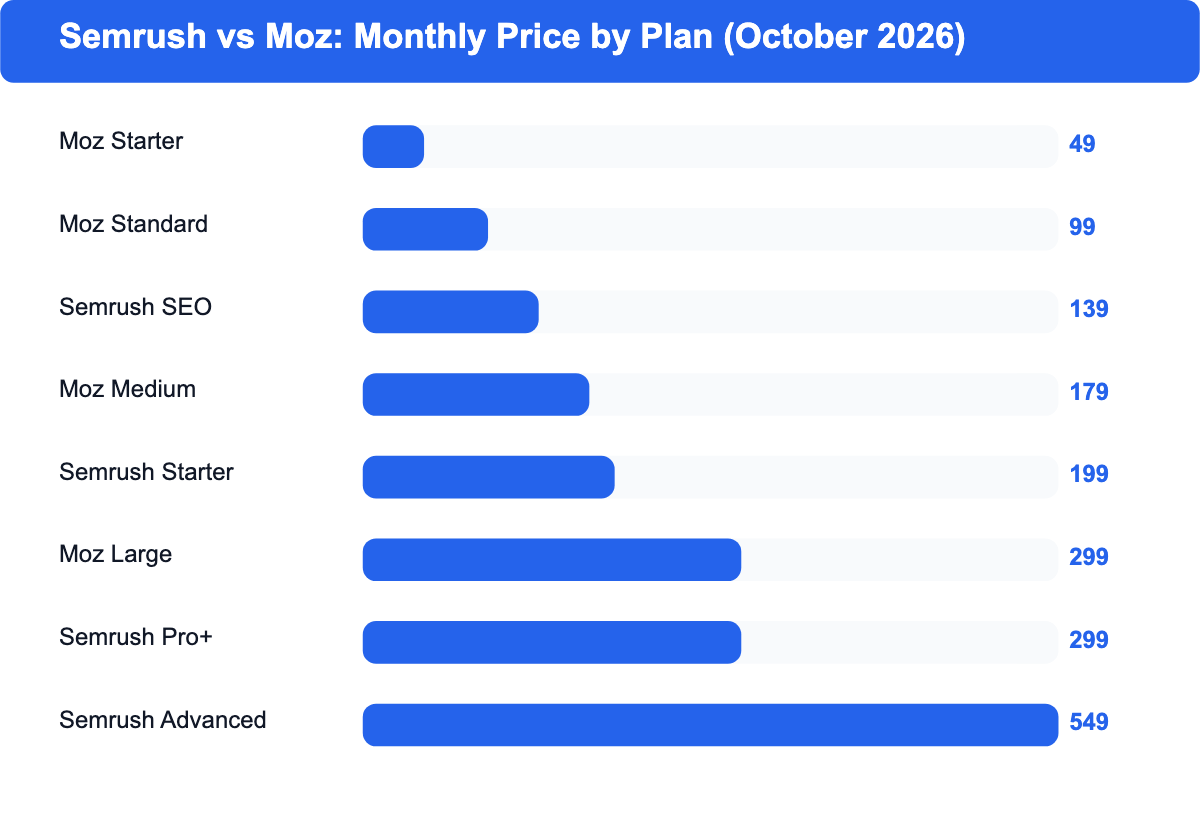
Moz Pro (USD, as of October 2026):
| Moz Plan | Monthly | Billed annually (per month) | Key limits |
|---|---|---|---|
| Starter | $49 | - | 1 site, entry-level, for a single website |
| Standard | $99 | $79 | 1 user, 3 sites, 300 keywords/mo, 400K pages crawled/mo, 3 AI visibility dashboards, 150 tracked prompts |
| Medium | $179 | $143 | 2 users, 10 sites, 1,500 keywords/mo, 2M pages crawled/mo, 6 AI visibility dashboards, 300 tracked prompts |
| Large | $299 | $239 | 3 users, 25 sites, 3,000 keywords/mo, 5M pages crawled/mo, 12 AI visibility dashboards, 600 tracked prompts |
For a one-person operation running a single site, Moz's $49/month Starter plan is clearly the cheapest realistic entry point in this whole comparison. But if you want Moz's AI and GEO features too, the $99/month Standard plan is the more comparable match to Semrush's $139/month SEO plan, not the bare Starter tier.
One seat-pricing detail both vendors bury in the fine print: every current Semrush plan ships with just one user login by default, and extra seats cost more on top, starting around $45/month per added user. Moz's per-seat allowance is more generous out of the box instead, with 2 users on Medium and 3 on Large before you need to add anyone extra.
Semrush vs Moz for Keyword Research
Semrush's own marketing cites a keyword database of more than 26 billion keywords, built through the Keyword Magic Tool. The tool groups suggestions into topic clusters and flags lower-competition "easy win" terms automatically. Moz's Keyword Explorer is smaller and more curated: Moz's own product page lists 1.25 billion keyword suggestions and 180 million ranking keywords tracked.
The database-size gap matters most on niche or long-tail topics. A first-time user, on the other hand, often cares less about raw suggestion volume and more about not drowning in it, which is exactly the trade-off Moz's simpler Keyword Explorer interface is designed around.
- Semrush: Keyword Magic Tool, topic clustering, personalized keyword difficulty based on your own site's authority, search intent labeling
- Moz: Keyword Explorer, Keyword Suggestions by topic, Minimum Domain Authority per SERP, search intent labeling (Moz AI-generated)
Both tools show monthly search volume, a 1-100 keyword difficulty score, and keyword-gap comparisons against competitors. If your niche is broad and mainstream, the practical difference is genuinely small. If you work in a narrow or emerging niche, however, Semrush's larger index is more likely to find keyword ideas Moz simply doesn't have in its index at all.
Semrush vs Moz for Competitor Research and Backlink Analysis
Semrush goes deeper here: both platforms let you enter a competitor's domain and see their authority score, backlink count, and top-ranking keywords, but only Semrush extends that gap analysis into estimated traffic and paid-search data.
Semrush's version goes further into traffic estimation. It shows an approximate monthly traffic figure for a competitor's site and extends gap analysis into paid-search data as well. Moz, by contrast, keeps its competitor research centered on the core SEO signals: Domain Authority comparisons, backlink profiles, and SERP comparisons, without a paid-search layer at all.
- Semrush: Keyword Gap, Backlink Gap, traffic estimation, dedicated link-building tool with automated outreach suggestions, 4-domain gap comparison limit
- Moz: Link Intersect (compares your domain against up to 5 other domains at once, one more than Semrush's 4), Spam Score, Domain Search Theme, Keyword Gap
The practical difference shows up in how far each tool lets you push a single comparison: Semrush caps gap analysis at 4 domains but adds automated outreach on top, while Moz's extra Link Intersect slot and its long-standing Spam Score remain a quick, trusted backlink-quality filter for many SEOs regardless of which platform they actually pay for day to day.
Semrush vs Moz for Site Audits
Both tools crawl your site and return a prioritized list of technical issues: broken links, missing meta tags, duplicate content, crawlability problems, and a 0-100 health or site score you can track over time.
Semrush's Site Audit goes deeper into Core Web Vitals and AI-readiness checks, flagging whether your pages are structured in a way that AI answer engines can parse and cite. It also crawls more pages per month at every tier than Moz's equivalent plan. Moz's crawler, on the other hand, is widely considered the cleaner, less overwhelming interface of the two, and it covers the standard essentials (redirects, duplicate content, broken links, missing tags) without burying them under more advanced reports a smaller site rarely needs.
Neither audit tool replaces a developer for serious technical work. Both are genuinely good at catching the common, high-impact issues that quietly cap a site's rankings: slow pages, broken internal links, and thin or duplicate content.
Domain Authority vs Authority Score
Domain Authority (DA) is Moz's proprietary 1-100 score estimating how likely a site is to rank, based on its backlink profile. It's the metric Moz built its reputation on, and it remains one of the most widely recognized third-party authority scores in SEO, even among people who don't subscribe to Moz Pro at all.
Authority Score is Semrush's equivalent: also a 1-100 score, blending backlink data, organic traffic, and other site-quality signals into one number. Both metrics are directional, not an official Google ranking factor, and the two scores for the same domain are rarely identical, since each vendor weights its own backlink index differently. Neither score should be treated as an absolute number. Use whichever one your toolkit already gives you, and track the trend over time instead of comparing your Authority Score against someone else's Domain Authority.
Semrush vs Moz for AI Search Visibility (GEO)
This is the fastest-moving part of either platform, and it's where most existing Semrush vs Moz comparisons are already out of date. Here's what each vendor's own pricing and feature pages actually show today.

Semrush names five AI surfaces it tracks: ChatGPT, Perplexity, Gemini, Claude, and Google AI Overviews, bundled with AI sentiment tracking (how LLMs describe your brand) and AI visibility reports for any domain, available from its entry SEO plan up.
Moz's version centers on dashboards rather than a flat surface list: 3 AI Visibility Dashboards and 150 tracked prompts on Standard, scaling to 12 dashboards and 600 prompts on Large, refreshed weekly across GPT, Gemini, Google AI Mode, and Perplexity. AI Overviews by keyword and AI-generated content briefs are bundled in from the first paid tier.
- Semrush AI surfaces tracked: ChatGPT, Perplexity, Gemini, Claude, Google AI Overviews (5)
- Moz AI models tracked: GPT, Gemini, Google AI Mode, Perplexity (4)
Semrush covers one more surface (Claude) and frames AI visibility as part of a wider brand-monitoring toolkit alongside AI sentiment tracking. Moz's AI/GEO tools, by contrast, are tightly integrated into its existing keyword and site-audit workflow, with AI Overviews and content briefs available from its first paid tier. If tracking the widest possible set of AI answer engines matters most to you, Semrush currently covers more ground. But if you want AI visibility bundled into an already-simple SEO workflow at a lower price, Moz's implementation is the more accessible option overall.
Which Should You Choose: Semrush or Moz?
- Agencies and teams managing multiple clients: Semrush, mainly for the larger keyword and backlink databases, the wider AI-surface coverage, and the reporting and white-label features built for client work.
- Solo bloggers and single-site owners: Moz Pro's $49/month Starter plan, or the $99/month Standard plan if you want the AI and GEO features too. The simpler interface and lower price genuinely outweigh Semrush's extra database depth for a single site.
- Local businesses: Semrush, since it bundles local-search visibility, listing management, and review tracking alongside its core SEO toolkit. Moz has no equivalent local-SEO product at all.
- Anyone who already trusts Domain Authority as an industry reference point: Moz, since DA remains the most widely recognized third-party authority metric, even outside Moz's own customer base.
Before committing to either, use the free trial, or see our roundup of free Semrush alternatives if budget is the main blocker. Semrush offers a free-forever plan plus a free trial of its paid tiers, and Moz offers a free trial of Moz Pro. Run your own site and one competitor through both tools using your actual target keywords before you decide. The real difference between these two platforms shows up fastest on the specific keywords and competitors you care about, not in a features list like this one.
What about Ahrefs? Semrush, Ahrefs, and Moz are the three names that come up constantly together, including on forums like Reddit, as most SEOs' shortlist of the top 3 SEO tools on the market. Ahrefs tends to sit closest to Semrush on price and depth, with its Starter plan from $29/month and its more comparable Lite plan from $129/month, and it's frequently the first pick among SEOs who want backlink and competitor research specifically rather than Semrush's broader marketing-suite scope. If backlink analysis is your main job, it's worth trialing alongside whichever of Semrush or Moz you shortlist from this comparison, even though a full three-way breakdown is outside the scope of this page (see our Semrush vs Ahrefs comparison for that one).
FAQ
Is Semrush worth the price compared to Moz?
Yes, for agencies and teams: Semrush's $139-$549/month range buys a larger keyword database, wider AI-visibility tracking, and tools beyond core SEO, such as local search, paid search research, and content creation. For a single small site where budget matters more than database depth, though, Moz Pro's $49-$299/month range delivers the core SEO workflow at a noticeably lower monthly cost.
What does Moz SEO do?
Moz Pro is an SEO platform for keyword research, rank tracking, site crawling and technical audits, backlink analysis, and, since 2026, AI and GEO visibility tracking. Its best-known feature is Domain Authority, a 1-100 score used across the SEO industry to estimate a site's ranking strength from its backlink profile.
How expensive is Semrush?
Semrush's current plans, as of October 2026, start at $139/month for the SEO plan and scale up to $199/month (Starter), $299/month (Pro+), and $549/month (Advanced), all billed monthly. Annual billing brings the effective monthly price down on every tier. A limited free plan is also available.
Can I use Semrush or Moz for free?
Semrush has a permanent free plan with limited reports and one demo project, plus a free trial of its paid tiers. Moz Pro doesn't have a permanent free plan, but it does offer a free trial before you're charged anything.
Does Moz track AI search visibility like Semrush does?
Yes. As of 2026, Moz Pro tracks AI visibility across four models (GPT, Gemini, Google AI Mode, and Perplexity) with weekly tracking frequency, starting on its Standard plan. Semrush tracks five surfaces (ChatGPT, Perplexity, Gemini, Claude, and Google AI Overviews) instead, giving it slightly broader AI-surface coverage overall.
Is Moz reliable?
Yes, for what it's built to do. Moz has shipped its Domain Authority metric and core SEO toolkit for two decades, and DA remains one of the most widely cited third-party authority scores in the industry. Its main limitation isn't reliability but scope: a smaller keyword index than Semrush's, and no paid-search or local-search research layer, so it's a dependable tool for core SEO work rather than a complete marketing-suite replacement.