
An SEO content brief (also called an SEO brief or content writing brief) is a document that guides a writer by specifying the primary keyword, search intent, target audience, suggested headings, word count target, brand voice, and technical details for a piece of content. It gives the writer everything they need to produce a strong first draft without back-and-forth with the strategist.
Without a brief, writers guess at search intent, produce off-topic drafts, and require multiple revision cycles to align with what the page needs to rank. Strong content brief creation reduces these costs by front-loading strategy before a single word is written.
What Is an SEO Content Brief?
An SEO content brief is a planning document created by a content strategist or SEO manager before a writer starts work on audience-facing content. It captures the business goal, the target keyword, who the reader is, how the content should be structured, and what technical signals it needs to carry.
The brief acts as a contract between the strategy layer and the execution layer. The strategist communicates what the content needs to achieve and documents the target audience, SEO signals, and content structure. The writer delivers it without needing to reverse-engineer the search results themselves.
The core difference between an SEO brief and a general content brief is specificity around search signals. An SEO brief explicitly maps to a keyword, a search intent, and a ranking goal. A general content brief covers topic, tone, and format, but it does not account for audience search behavior or ranking requirements.
Key elements at a glance:
- Primary keyword and semantic variations
- Search intent (informational, commercial, navigational, transactional)
- Target audience and reader profile
- Suggested headings and content structure
- Recommended word count based on competitor benchmarks
- Brand voice and tone guidelines
- Internal and external link suggestions
- Competitor references for benchmarking
- Meta title and meta description targets
- Call to action
Why You Need an SEO Content Brief
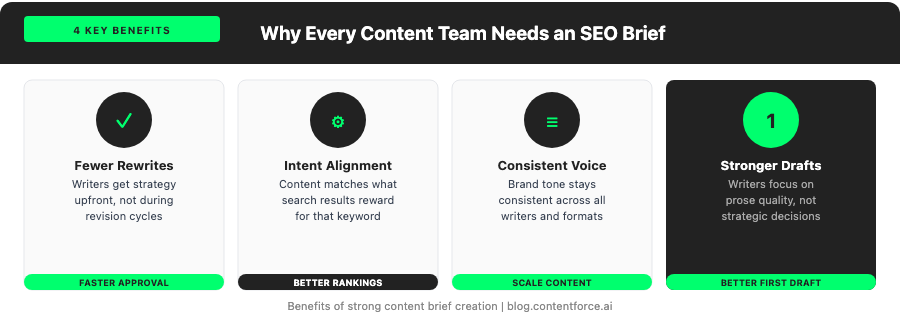
Content briefs are the single most effective quality gate before writing begins. They reduce downstream problems that cost time and budget: rewrites, misaligned drafts, and content that fails to rank despite good prose.
The four primary reasons content teams use briefs:
Fewer Rewrites and Faster Approval
The most common cause of multiple revision cycles is misaligned intent between the strategist and the writer. The strategist has context from the SERP. The writer has none. The brief transfers that context before writing starts, not after the first draft is already off course.
Teams that brief every article consistently report faster review cycles, fewer structural rewrites, and less back-and-forth over what the content is supposed to achieve.
Better Search Intent Alignment
A writer without a brief defaults to the most natural interpretation of a keyword, which is often wrong. If the keyword “content brief template” returns pages offering downloadable templates, a writer who produces a theoretical explanation of briefs has failed the intent test regardless of quality.
The brief pins the intent so writers align to it from sentence one. This is not about keyword density; it is about producing the right type of audience content for the query: the content format the search results reward for that keyword.
Consistent Brand Voice at Scale
When a content team produces dozens of articles per month, voice drift is inevitable without a shared reference point. A brief that includes tone descriptors, off-limits language, and example sentences gives every writer and editor a calibration tool.
This is especially valuable for teams that mix in-house writers with freelancers or AI-generated drafts that require human editing.
Stronger First Drafts from Writers
Writers produce better first drafts when they know the audience, the goal, the structure, and the competitive benchmark before they start. A well-built brief reduces cognitive overhead for the writer and lets them focus on quality prose instead of strategic decisions they are not positioned to make alone.
What to Include in an SEO Content Brief
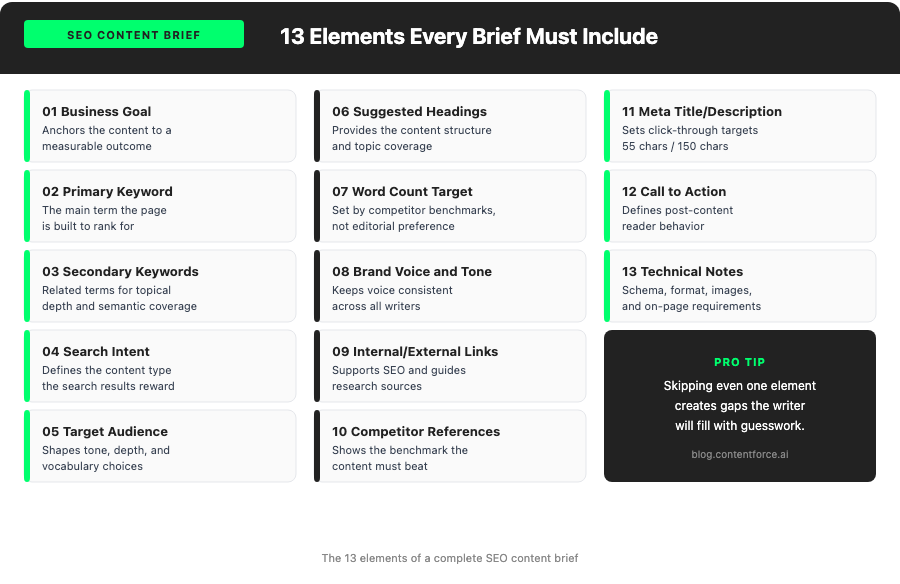
A complete SEO content brief should include 13 core elements. Each one serves a distinct function. Skipping any of them creates gaps that the writer will fill with guesswork.
| Element | Why It Matters |
|---|---|
| Business Goal | Anchors the content to a measurable outcome |
| Primary Keyword | Tells the writer the main ranking target |
| Secondary Keywords | Covers topical depth and semantic variations |
| Search Intent | Defines the type of content the SERP rewards |
| Target Audience | Shapes tone, depth, and vocabulary choices |
| Suggested Headings | Provides the content structure and topic coverage |
| Recommended Word Count | Sets scope based on competitor benchmarks |
| Brand Voice and Tone | Keeps voice consistent across writers |
| Internal and External Links | Supports SEO and guides research sources |
| Competitor References | Shows the benchmark the content must meet or beat |
| Meta Title and Description | Sets the click-through targets |
| Call to Action | Defines the post-content behavior expected of the reader |
| Technical Notes | Captures schema, format, and on-page requirements |
Business Goal
The brief should open with the business goal of the piece: drive trial signups, capture an informational query, support a bottom-funnel purchase decision, or build topical authority. Without a stated goal, writers default to generic coverage, and stakeholders add competing CTAs at the editing stage.
Stating the goal upfront also helps the writer calibrate depth and emphasis. A piece designed to convert readers to a trial will use different proof standards and CTAs than an informational piece designed to build brand awareness.
Primary Keyword
The primary keyword is the main term the page is being built to rank for. It should appear in the title, the first paragraph, and at least one H2. Include the exact match form and note any close variants that should be woven in naturally.
Also specify whether the keyword is head-term, mid-tail, or long-tail so the writer understands the competitive context.
Secondary Keywords
Secondary keywords are closely related terms that broaden topical coverage and satisfy semantic search expectations. They are not just variations of the primary keyword. They include related questions, sub-topic terms, and co-occurring entities the SERP consistently rewards.
List secondary keywords by priority and note where in the article they belong. Do not instruct the writer to force every secondary keyword into the text; instead, flag the top five or six that matter most for coverage.
Search Intent
Search intent specifies what type of result the SERP rewards for the target keyword. The four main categories are informational (the reader wants to learn), commercial investigation (the reader is comparing options), transactional (the reader is ready to act), and navigational (the reader is looking for a specific destination).
Include the intent category and a one-sentence description of what the ideal piece looks like for this intent. If the SERP shows a mixed intent signal (e.g., both how-to guides and product listicles), note which pattern dominates and which the brief is targeting.
Target Audience
Define the reader at the level of specificity needed to write for them. A vague definition like “marketing professionals” produces generic content. A useful definition looks like: “In-house SEO managers at B2B SaaS companies who are scaling content output and need a repeatable brief process for a mixed team of in-house writers and freelancers.”
Include skill level, primary pain point, and what success looks like for that reader after they finish the article.
Suggested Headings and Structure
The suggested heading structure is the most direct editorial input in the brief. It tells the writer what sections to cover, in what order, and at what depth.
Headings should be derived from competitor benchmarking and SERP analysis, not invented from scratch. List them as H2s and H3s. Mark which are required, which are suggested, and which are optional.
Writers should have room to adjust phrasing and sub-points, but the section architecture should be locked before writing starts.
Recommended Word Count
Word count guidance should be anchored in the word counts of the top-ranking pages, not editorial preference. Check the top three to five pages and set a target range that matches or exceeds the competitive midpoint.
Avoid padding targets. If competitors rank at 1,500 words, targeting 3,000 words wastes writer time and produces bloated content. Target the length that matches the search intent and competitive context for that keyword.
Brand Voice and Tone
Brand voice guidelines in a brief can be as simple as a tone descriptor and three example sentences, or as detailed as a full style reference. At minimum, include: formality level, vocabulary register, sentence length preference, and any terms or phrases to avoid.
For teams using freelancers, include examples of strong and weak passages from existing published content so writers can calibrate quickly.
Internal and External Links
Specify at least two to four internal link suggestions by target URL and suggested anchor text. These help the writer support topical authority and give editors a starting point for link placement.
For external links, note the standard for acceptable sources (e.g., primary research, official documentation, recognized publications) and flag any specific studies or pages to include.
Competitor References
List the top three to five ranking URLs for the primary keyword. Note what each one does well and where it falls short. This gives the writer a benchmark and helps them understand where there is room to add value rather than just matching existing coverage.
Mark one or two URLs as the primary structural benchmarks. These are the pages the brief is explicitly designed to beat.
Meta Title and Description
Include a proposed meta title and meta description. Google renders meta titles up to approximately 580 pixels wide, which translates to roughly 50 to 60 characters for standard text. A safe target is 55 characters. Meta descriptions are typically truncated at around 155 to 160 characters on desktop SERPs; targeting 150 characters covers both desktop and mobile rendering.
Writers should not be expected to write these fields; they are SEO decisions that belong in the brief. The meta title should include the primary keyword and a differentiation hook. The meta description should include the primary keyword and a clear value statement that earns the click.
Call to Action
Define what action the reader should take after finishing the content: start a free trial, download a template, book a demo, read a related article. One clear CTA is better than three competing ones.
Also specify where in the article the CTA should appear. A high-intent CTA placed mid-article performs differently than one at the footer. The brief should lock that placement before writing begins.
Technical Notes
Technical notes capture anything that affects production or publishing but does not belong in prose. Common examples include: schema type (FAQ, HowTo, Article), image count and alt text requirements, internal link minimum count, and whether the piece should include a summary table.
How to Create an SEO Content Brief: 6 Steps
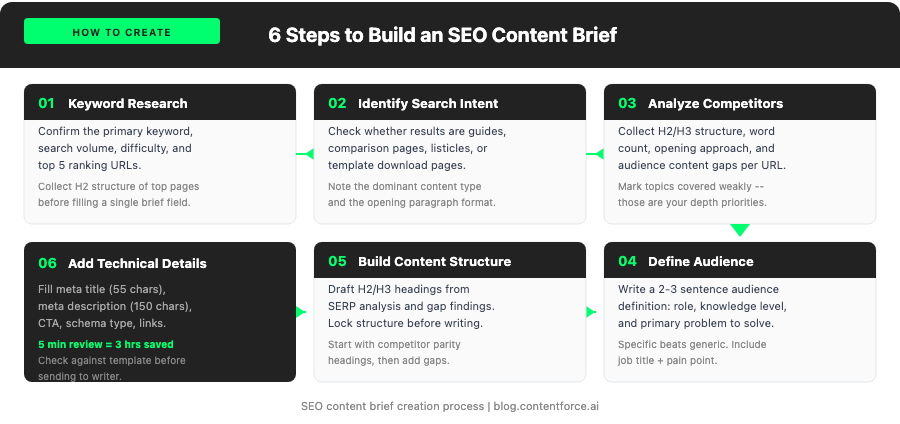
Creating a strong SEO content brief takes 30 to 60 minutes for a standard article when you have a consistent process. The steps below apply whether you are building briefs manually, using a brief template, or using a tool to automate parts of the workflow.
Step 1: Start with Keyword Research
Before writing a single field in your brief, confirm the primary keyword and collect its core data: monthly search volume, keyword difficulty, and current ranking position if you already have content on the topic.
Also collect the top five ranking URLs, their approximate word counts, and their H2 heading structures. This data drives every subsequent decision in the brief.
Identify three to five secondary keywords that are topically related and appear together with the primary keyword in the ranking content.
Step 2: Identify Search Intent
Look at the SERP for the primary keyword. Note the dominant result type: are most pages informational guides, product comparison pages, listicles, or tool landing pages? That pattern is the SERP’s signal for what intent it rewards.
Look at the first paragraph of the top three results. Note what question they answer in the opening sentence. That sentence structure is a template for the brief’s extractive answer target.
If the SERP shows two distinct content types competing (e.g., both how-to guides and template download pages), note which pattern the brief is targeting and why.
Step 3: Analyze the Top-Ranking Competitors
Competitive gap analysis is the highest-value step in content brief creation. Collect the following from the top three to five ranking URLs:
- The H2 and H3 heading structure
- The approximate word count
- The opening paragraph approach (definition-first, problem-first, or anecdote-first)
- Any elements they include that others do not (tables, templates, calculators, step-by-step processes)
- Any topics that multiple competitors cover but handle poorly
Where competitors cover a topic weakly, there is room to build a stronger section that earns better engagement signals. Including this audience content gap analysis in the brief gives writers a clear mandate to go deeper on those topics rather than matching competitor depth.
Step 4: Define Your Target Audience
Write a two to three sentence audience definition that includes: role or job title, knowledge level on the topic, and the primary problem they are trying to solve with this piece of content.
This definition belongs at the top of the brief. It calibrates the writer’s vocabulary choices, assumed knowledge, and depth before they write the first sentence.
Step 5: Build the Content Structure
Using your keyword research, intent analysis, and competitor headings, draft the H2 and H3 structure. This is the most important step in the brief. Every subsequent decision flows from the structure.
Start with the headings that appear across multiple competitors (high parity signal). Add headings that address gaps you identified in step 3 (information gain). Remove headings that appear in competitors but serve low-value or tangential topics.
Lock the structure before writing. The writer should propose heading changes back to the strategist before draft delivery, not during revision.
Step 6: Add Technical and Distribution Details
Complete the brief by filling in: meta title, meta description, CTA placement, schema type, internal link suggestions, minimum external link count, and any image or visual requirements.
Check the brief against a standard template or checklist before sending it to the writer. A brief review takes five minutes and prevents three hours of revision.
SEO Content Brief Template
A brief template gives your team a consistent starting format for every article. The fields below represent a complete brief framework. Adjust field order and optional sections to match your team’s workflow.
Core Fields to Include in Every Brief
| Field | Example Value |
|---|---|
| Primary Keyword | seo content brief |
| Target URL / Slug | /blog/seo-content-brief/ |
| Business Goal | Capture informational query; drive trial signups via mid-article CTA |
| Search Intent | Informational: readers want to understand what an SEO brief is and how to create one |
| Target Audience | SEO managers and content strategists at growing B2B SaaS companies |
| Recommended Word Count | 2,800 to 3,500 words |
| Secondary Keywords | content brief template, what is a content brief, seo brief, content brief checklist |
| Suggested H2s | What Is an SEO Content Brief / Why You Need One / What to Include / How to Create One / Template / Mistakes / FAQ |
| Brand Voice | Professional but practical; no jargon; second-person address; active voice |
| Primary Competitor Benchmark | https://www.semrush.com/blog/seo-content-brief/ |
| Meta Title | SEO Content Brief: What It Is, What to Include, and How to Create One |
| Meta Description | Learn what an SEO content brief is, which 13 elements to include, and how to create one in 6 steps. Includes a free template. |
| CTA | Inline after Step 6: “Build your briefs faster with ContentForce” |
| Internal Links | /blog/keyword-research/, /blog/search-intent/, /blog/content-strategy/ |
| Schema Type | Article + FAQ |
Optional Fields for Larger Teams
For teams with multiple writers, editors, and stakeholders, add:
- Editor notes (flags for fact-checking, legal review, or SME sign-off)
- Publishing date and priority level
- Content cluster assignment and pillar page reference
- SME interview required: yes or no
- Visual requirements (infographic, screenshot, comparison table)
Common SEO Content Brief Mistakes to Avoid
Even well-intentioned briefs fail when they fall into predictable traps. These are the five most common mistakes.
Listing keywords without specifying intent. A keyword list without an intent directive sends the writer into the wrong content type. If the SERP rewards how-to guides but the brief only lists the keyword, the writer may produce a product comparison page. Always include an explicit intent statement.
Vague audience definitions. “Marketing professionals” is not an audience. “In-house content leads at mid-market B2B companies who are building their first brief process” is an audience. The more specific the definition, the faster the writer can calibrate depth and vocabulary.
No business goal stated. Without a goal, writers default to covering the topic generically. The brief should state whether the article is designed to convert, educate, rank for a specific query, or support a topical authority strategy.
Structural suggestions that ignore SERP patterns. Headings invented from editorial preference rather than SERP analysis produce content that does not map to what the algorithm rewards. Every H2 in the brief should have a basis in either competitor structure or a clear information-gain rationale.
Treating the brief as a creative brief. An SEO content brief is not a creative brief. It is an operational document designed to align search signals, writer execution, and business goals. Adding mood descriptors, brand color references, or campaign concepts dilutes the brief’s usefulness for SEO content work.
How AI Tools Can Streamline Your Content Brief Process
AI tools have made SEO brief creation significantly faster. The research-heavy parts (SERP review, heading extraction, keyword clustering) can now be automated or semi-automated in minutes.
Tasks AI handles well in content brief creation:
- Extracting heading structures from multiple competitor URLs
- Clustering secondary keywords by subtopic and intent group
- Generating a first-draft heading structure from keyword and intent inputs
- Drafting meta title and description variants for editorial review
- Flagging audience content gaps based on heading inventory analysis
Tasks that still require human judgment:
- Setting the business goal for the piece
- Defining the target audience at the level of specificity that drives strong content
- Choosing which information-gain angles are worth pursuing vs which add noise
- Approving or modifying the suggested heading structure before it goes to a writer
AI-powered platforms like ContentForce automate the competitor analysis, secondary keyword clustering, and heading structure steps of the SEO brief process. You input the primary keyword; the system outputs a structured brief draft with competitor benchmarks pre-populated. The strategist reviews and approves the structure, then the brief goes to the writer.
Manual content brief creation typically takes 45 to 90 minutes per article. With AI assistance, the research and structure steps compress to under 15 minutes, reducing the strategist’s role to review and refinement rather than raw data collection. For teams producing 20 or more articles per month, that difference adds up to dozens of hours saved.
Frequently Asked Questions About SEO Content Briefs
What is the difference between a content brief and a creative brief?
A content brief specifies the SEO signals, audience definition, and content structure for a piece of written content. A creative brief is used for broader marketing deliverables like ad campaigns, brand visuals, or video productions. Content briefs are narrower in scope and more technically focused on search performance. Creative briefs address brand storytelling, visual identity, and campaign messaging.
How long should an SEO content brief be?
Most SEO content briefs run between one and three pages when formatted in a document. The brief should be comprehensive enough to prevent misalignment, but concise enough that a writer can read it in under ten minutes. Briefs that run to six or more pages often contain editorial commentary that belongs in a style guide, not a per-article brief.
Who is responsible for creating the content brief?
The content brief is typically created by the SEO strategist or content manager, not the writer. The brief requires SERP analysis, keyword research, and competitive benchmarking that a writer focused on execution is not positioned to do efficiently. In smaller teams, the same person may perform both functions, but the strategic research should be done before the writing begins.
How often should you update a content brief template?
Review your standard brief template every three to six months. SERP features, intent patterns, and algorithm preferences shift over time. The template fields themselves rarely need major changes, but the guidance notes and examples within the template should reflect current best practices.
Can you use the same brief for multiple articles?
No. A brief is specific to a keyword, URL, and search intent. Two articles on related topics will have different intent patterns, competitor benchmarks, and word count targets. Using the same brief for multiple articles produces generic content that does not align to the specific SERP requirements of each keyword. A template saves time by giving you a consistent starting structure; a brief is always customized per article.