Guide
AI SEO Agents: What They Automate End to End

AI SEO agents automate research, planning, drafting, on-page and technical fixes, internal linking and reporting, using live data from tools such as Google Search Console. A person still approves anything that goes live. Publishing, redirects, code deployments and strategy should stay with a human, while agents suggest and draft.
- Choose one clearly defined workflow, such as a weekly list of pages that lost clicks
- Write down the human process: where the data comes from, what you check and the output
- Connect verified data sources, such as Search Console exports or an official connector
- Save the process as a reusable skill instead of a long prompt
- Test with several real inputs and compare the agent's answer with your own
- Deploy at approval level 1 or 2, then review the output weekly
An AI SEO agent is software that carries out a multi-step SEO task on its own, using live data from tools such as Google Search Console, and then reports back or waits for your approval. Agents can run research, audits, internal link suggestions and reporting from start to finish, but publishing, redirects and strategy should stay with a person.
Below you'll find the stages an agent can run, the tasks that need a person, what each tool type costs and a checklist for choosing. Prices come from vendor pages checked in October 2026.
What is an AI SEO agent?
An AI SEO agent is a workflow that an AI model runs against live SEO data, so it can pick the next step, finish the task and hand you the result. Semrush describes it as "a fully or partly automatic workflow" built into an AI tool for one specific process. Ahrefs puts it more bluntly: the agent is software that does the SEO work instead of only describing it.
Three kinds of tools get mixed up under this label. What sets them apart is who decides the next step and where the data comes from, so it's worth keeping them straight.
| Type | What it does | Who decides the next step |
|---|---|---|
| Single-task tool (a rank tracker, a crawler) | Collects data for one job and shows a report | You |
| General chatbot | Answers from its training data and whatever you paste in | You |
| AI SEO agent | Connects to live sources, chains several steps and returns a finished output | The agent, within the limits you set |
That's the line a chatbot crosses once it can read your Search Console data, run a crawl or open a pull request without you copying anything in. The more steps it runs unattended, the more you'll need to decide what it can touch.
What do AI SEO agents automate from research to reporting?
AI SEO agents automate research, planning, drafting, on-page and technical fixes, internal linking and reporting, but a person still approves anything that goes live. The table shows each stage, the data an agent needs and the point where a human has to step in. We call that last column the human gate, and it's the part most vendor pages skip.
| Stage | What the agent does | Input data | Human gate |
|---|---|---|---|
| Research | Expands seed topics, clusters keywords, pulls the top-ranking pages | Keyword database, SERP data | Pick which clusters fit the business |
| Planning | Turns clusters into briefs and a refresh list | Search Console, existing posts | Approve the priorities and the brief |
| Drafting | Writes a first draft or a rewrite against the brief | Brief, verified facts | Fact-check and edit before it goes anywhere |
| On-page and technical fixes | Finds broken links, missing titles and schema gaps, then proposes the change | Crawl data, CMS access | Review the change before deployment |
| Internal linking | Maps link opportunities and suggests anchor text | Sitemap, page content | Accept or reject each link |
| Monitoring and reporting | Tracks rankings and clicks, flags declining pages, writes the report | Search Console, rank data | Decide what to do about the findings |
Each stage has concrete work behind it. Keyword research is the most common starting point: an agent can expand seed topics into keyword lists, cluster them and score them, which is the same job covered in our guide to keyword clustering. Reporting is the easiest stage to hand over, because the agent only reads data and writes a summary, so there's nothing it can break.
Technical work sits in the middle, and it's where mistakes get expensive. Ahrefs describes agents that run a crawl, compare it with the last one and post a severity-ranked digest, and agents that propose code fixes and open pull requests. The agent finds and drafts. A person clearly has to merge.
Which SEO tasks should stay with a human?
Publishing, redirects, code deployments, brand claims and strategy should stay behind human approval, while agents suggest and draft. Semrush gives the same advice: keep high-impact actions such as publishing, redirects and code deployments behind human approval.
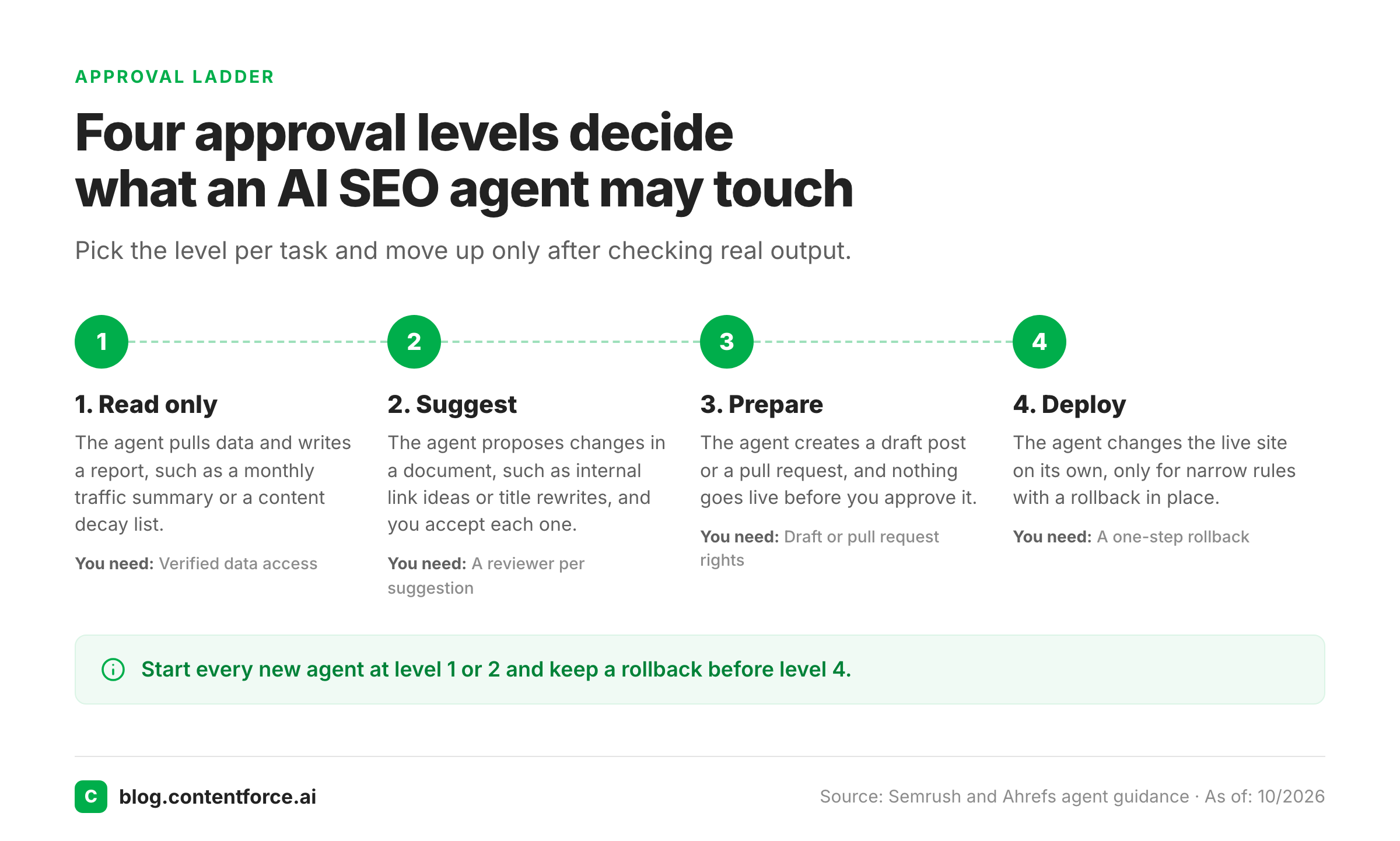
An approval ladder makes this concrete. Pick the level for each task, not for the agent as a whole.
| Level | The agent may | Example task | Who approves |
|---|---|---|---|
| 1. Read only | Pull data and write a report | Monthly traffic report, content decay list | Nobody, you just read it |
| 2. Suggest | Propose changes in a document | Internal link ideas, title rewrites | You, per suggestion |
| 3. Prepare | Create a draft post or a pull request | Refresh of an old article | You, before anything goes live |
| 4. Deploy | Change the live site on its own | Bulk title and schema updates | You, once per rule, with a rollback |
Start every new agent at level 1 or 2, and don't skip ahead. Move a task up a level only after you've checked its output on a few dozen real pages. Level 4 does make sense for narrow, repeatable changes such as adding missing alt text. It doesn't make sense for anything that carries a claim, a price or a legal statement.
Some work shouldn't ever move up the ladder. Semrush says one-off tasks, tasks that need editorial judgment or brand-risk assessment and workflows that change on every run aren't a good fit for an agent. Choosing which topics to cover, deciding what your brand can truthfully claim and handling a migration are the clearest examples, and they're all jobs where one wrong call is hard to undo.
What types of AI SEO agent tools exist and what do they cost?
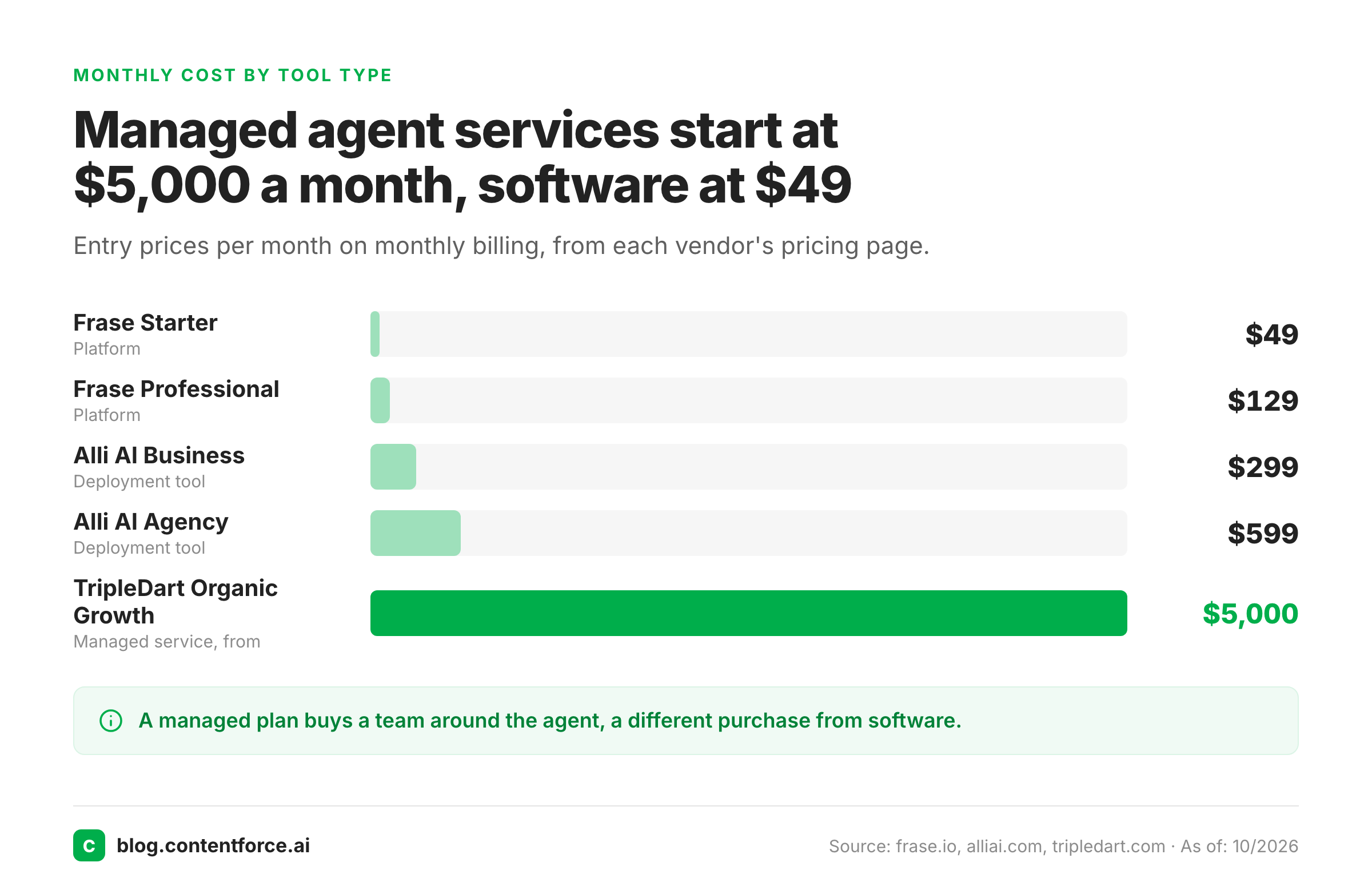
Costs run from usage-based API units to $299 to $599 per month for deployment tools such as Alli AI and from $5,000 per month for managed agent services. The right type depends on how much of the work you want to build yourself. Prices were checked on each vendor's pricing page in October 2026.
| Type | Example | Typical cost (USD) | Data access | Main limit |
|---|---|---|---|---|
| Chatbot plus MCP connector | Claude or ChatGPT with the Semrush or Ahrefs MCP | Chatbot plan plus data units | A subset of the tool's data | You supply the instructions and the guardrails |
| Agent inside an SEO platform | Frase | Platform subscription ($49 to $299 per month at Frase) | The vendor's own data | Tied to one provider's data and logic |
| Deployment tool | Alli AI | $299 to $599 per month | Your live site | Changes go live, so rollback matters |
| Managed service | TripleDart | From $5,000 per month | Whatever the agency connects | Pay for people, not just software |
The first row has the lowest entry cost, and it's where most teams should begin. Semrush's help center says plans such as Semrush One Starter and SEO Classic Pro include 50,000 MCP API units, that MCP calls draw the same units as direct API requests and that higher tiers need an extra units package. Ahrefs adds that connectors expose only a subset of a tool's data, so an agent built on one can't see everything the web app shows, and you'll hit that ceiling sooner than you'd expect.
Platform agents add convenience at the price of lock-in. Frase lists $49, $129 and $299 per month on monthly billing for its Starter, Professional and Scale plans, with limits on seats, sites and articles. Its own comparison pages rank Frase first, so weigh any "best agent" claim from a vendor accordingly.
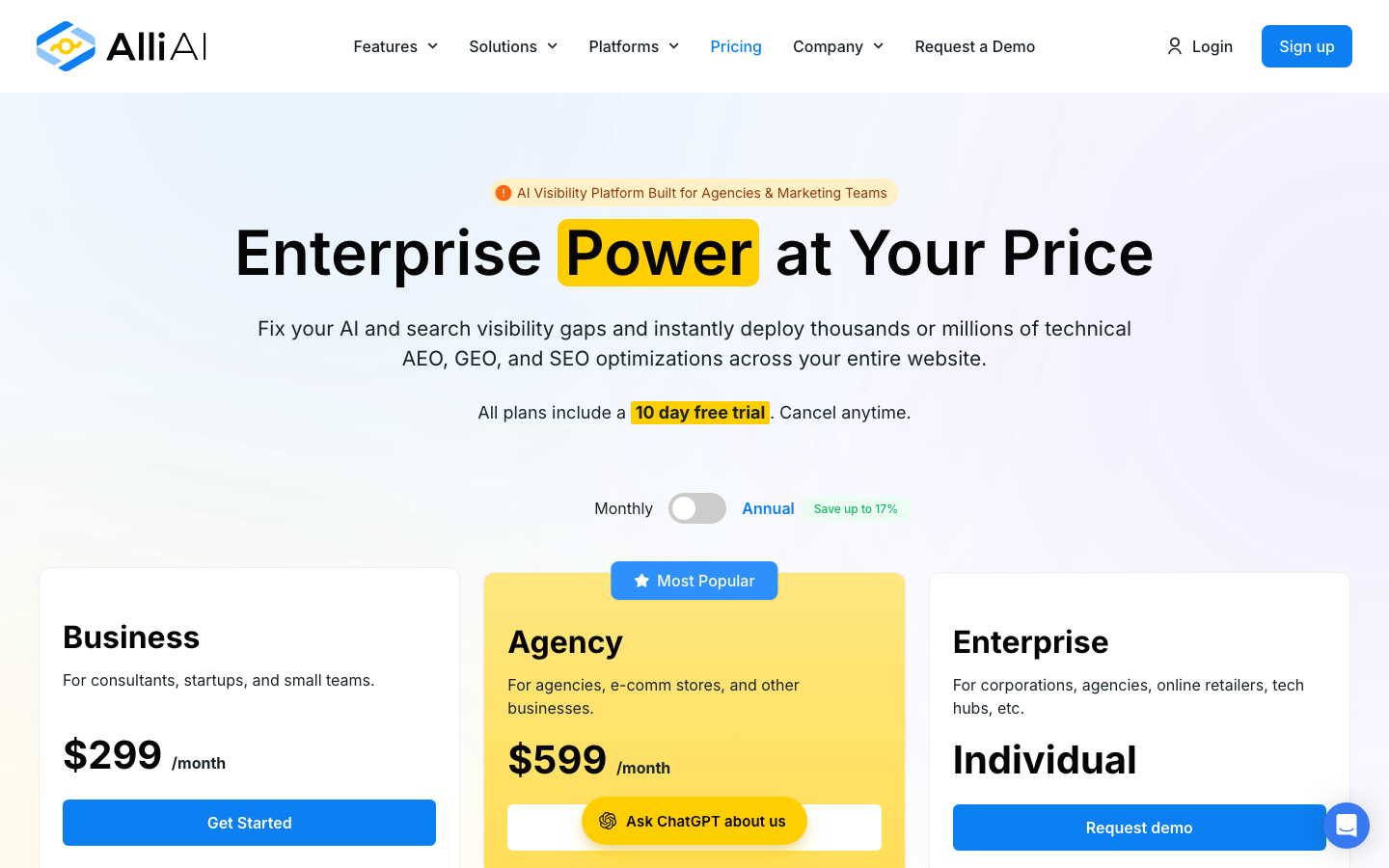
Deployment tools are the only type that edits your live site for you. Alli AI charges $299 per month for Business (5 sites, 500 keywords, 1,250 pages) and $599 per month for Agency (15 sites, 2,000 keywords, 5,000 pages). Annual billing brings those down to $249 and $499. Every plan includes a 10-day free trial.
Managed services sit at the top. TripleDart lists its Organic Growth plan from $5,000 per month, with up to 30 content assets and 5,000 tracked prompts, and an editor approves each piece before publishing. That price buys a team around the agent, and it's a different purchase from software.
For a wider look at ranking and writing software, see our comparison of AI SEO tools.
SEO Title Generator: eight title tag variations, sized for the SERP and intent-matched. Free, no signup.
How do you build a simple AI SEO agent?
You build a simple AI SEO agent by choosing one workflow, writing down how a person does it, connecting verified data, turning that process into reusable instructions and testing the output before anyone relies on it. Ahrefs and Semrush describe the same path, and Semrush breaks it into nine steps. Six are plenty for a first agent, and you'll rarely need more.
- Choose one clearly defined workflow, such as a weekly list of pages that lost clicks.
- Write down the human process: where the data comes from, what you check and what the output looks like.
- Connect verified data sources. Search Console exports or an official connector work. Pasted guesses don't.
- Turn the process document into instructions and save them as a reusable skill instead of a long prompt, because long prompts bloat the context and degrade the output.
- Test with several real inputs and compare the agent's answer with your own. Ahrefs warns that agents can invent API parameters that don't exist unless you give them the real documentation.
- Deploy at approval level 1 or 2, then review the output weekly and tighten the instructions.
Keep the first agent small, because you're learning how it fails. A weekly decay report teaches you more about the failure modes than a full content pipeline does, and a mistake in a report costs you five minutes, not a ranking.
What are the risks of AI SEO agents?
The main risks of AI SEO agents are wrong output from unverified data, costly mistakes on live sites, runaway token and API costs and mass-produced pages that fall under Google's spam policy. Each one has a simple counter, and you've already seen most of them on the approval ladder.
- Wrong output. Agents can hallucinate, so you'll want to feed them verified data and make them show their sources. A reviewer shouldn't have to guess why a keyword or a heading was suggested.
- Damage to a live site. A flawed schema change or an over-optimized page can hurt rankings. The fix is to limit write access and keep a rollback for every deployed change, so a bad run isn't permanent.
- Cost. Each test run, each user and each long prompt uses tokens or API units. Limit who can run the agent and set a budget before you roll it out.
- Data exposure. Check what the connected tools do with your inputs before you upload client data, because you can't take it back afterward.
- Scaled content. Google's spam policy on scaled content abuse applies no matter how the content is created. Using generative AI to mass-produce pages that add nothing for users is one of its listed examples.
The last point decides how you use a drafting agent. One researched article that a person edits is fine, and it's the safe way to work. Hundreds of near-identical pages generated from a keyword list are the pattern the policy describes. Our guide on generative AI and SEO covers what changes in search when AI content is everywhere.
How do you choose an AI SEO agent?
You choose an AI SEO agent by the task you want to hand over and the approval level it needs, then you check six things before you pay. The answers decide whether a tool fits your workflow or only demos well, and they're quick to get from a vendor.
- Data access. Which sources does it read, and does it see your Search Console data or only public data?
- Write access. Can it change your site, or only propose changes? If it can deploy, who approves and how?
- Rollback. Can you undo a deployed change in one step?
- Logs. Can you export what it did, with sources, so a reviewer can check it?
- Cost per run. Is pricing per seat, per page, per keyword or per token, and what does a normal month use?
- Exit. Can you take your prompts, reports and history with you if you leave?
Run a two-week trial on one site section before you commit, since you can't judge an agent from a landing page. Alli AI's 10-day trial won't cover two weeks, but it's enough for a first test, and most chatbot plans make the rest cheap. Judge the tool on the weekly decay report or the internal link list it produces, not on its demo.
FAQ about AI SEO agents
Are AI SEO agents allowed by Google?
Google doesn't ban AI-assisted content, and it's the policy against scaled content abuse that matters here, because it applies whether people, automation or AI made the pages. Pages that add real value for users are fine. Mass-produced pages that don't are, of course, a problem.
Can an AI SEO agent replace an SEO specialist?
An agent can take over repeatable work such as clustering, audits and reports, but it can't decide strategy or judge brand risk. Semrush lists tasks that need editorial judgment as a poor fit for agents.
What is MCP in SEO?
MCP is a connector standard that lets a chatbot or agent read data from a tool such as Semrush or Ahrefs. Ahrefs notes that these connectors expose only a subset of a tool's data.
Is there a free AI SEO agent?
You can build a basic one for the price of a chatbot plan and a free Search Console export. Most ready-made agents are paid, although some, such as Alli AI, offer a free trial (10 days at the time of writing), and you'll find the build route in the section above.
Do AI SEO agents help with AI search?
Some AI SEO agents help with AI search. Tools such as Frase score content for generative engine optimization (GEO), and agencies like TripleDart track citations in AI answers. Our guide to GEO explains what that work involves.
Can AI SEO agents hurt my rankings?
Yes, an AI SEO agent can hurt your rankings if it deploys a flawed change to a live site or publishes thin pages at scale. Google's spam policy treats mass-produced pages that add nothing for users as scaled content abuse, so keep a person between the agent and the publish button.
Does Google penalize AI SEO agent content?
Google penalizes unhelpful, mass-produced pages, not the tool that made them. Its scaled content abuse policy applies whether people, automation or AI created the content, so one reviewed article is safe and hundreds of near-identical pages aren't.
What features should an AI SEO agent have?
An AI SEO agent should read live data from Google Search Console or a crawler, show the sources behind each suggestion, keep a log of every action and let you set an approval level per task. A rollback for deployed changes matters most if the agent can edit your site.
Is an AI SEO agent cheaper than an SEO agency?
An AI SEO agent costs far less than a managed service, but it covers less. Alli AI starts at $299 per month on Business, while TripleDart lists its managed Organic Growth plan from $5,000 per month, and the agency price includes strategy, an editor and a dedicated strategist.
How long until an AI SEO agent shows results?
Reporting and audit agents save time in the first week, and you'll see that right away. Ranking effects from technical fixes or refreshed content take weeks, and the agent doesn't change how fast Google recrawls and re-evaluates a page. Don't judge it on rankings in the first month.