
Tool list · 11 tools
11 Best AI Visibility Tools in 2026 (Tested and Compared)
Track your brand in ChatGPT, Perplexity and Google AI Overviews. Honest comparison of 12 AI visibility tools with pricing, LLM coverage and who each one is for.

An AI visibility tool tracks how a brand appears in answers from large language models such as ChatGPT, Perplexity and Google AI Overviews, recording whether the brand is mentioned and cited as a source. Semrush covers the widest range of LLMs for enterprise teams, Profound focuses on dedicated AI search tracking, and Peec AI suits agencies managing multiple clients.
- From
- €85/mo
Price from the vendor's pricing page, checked Oct 22, 2026.
Your brand might rank on page one of Google and still be invisible in ChatGPT, Perplexity and Google AI Overviews. When someone asks an AI search engine for the best tool in your category, it either names you or it does not. Unlike traditional SEO, you cannot check your position in a rank tracker. Not every AI search engine sources and cites answers the same way; see how the major ones compare on citation accuracy before deciding which one to prioritize.
AI visibility tools fill that gap. They send prompts to large language models, record whether your brand appears in the answers and show you how that changes over time. Some also track competitors, flag inaccurate descriptions and help you see which sources the AI pulls from.
This guide covers the 11 best options in 2026. Each entry includes verified pricing, LLM coverage and a verdict on who it suits.
What is an AI visibility tool?
An AI visibility tool tracks how your brand appears in answers from large language models and AI search engines. Instead of monitoring your position on a search results page, you monitor whether AI platforms mention your brand, how they describe it and whether your content is cited as a source.
These tools go by several names: LLM visibility platforms, AI monitoring tools, answer engine optimization (AEO) trackers. The core function is the same: measure your brand's presence in AI-generated answers, including from widely used assistants like Claude, ChatGPT and Gemini.
How does AI visibility tracking work?
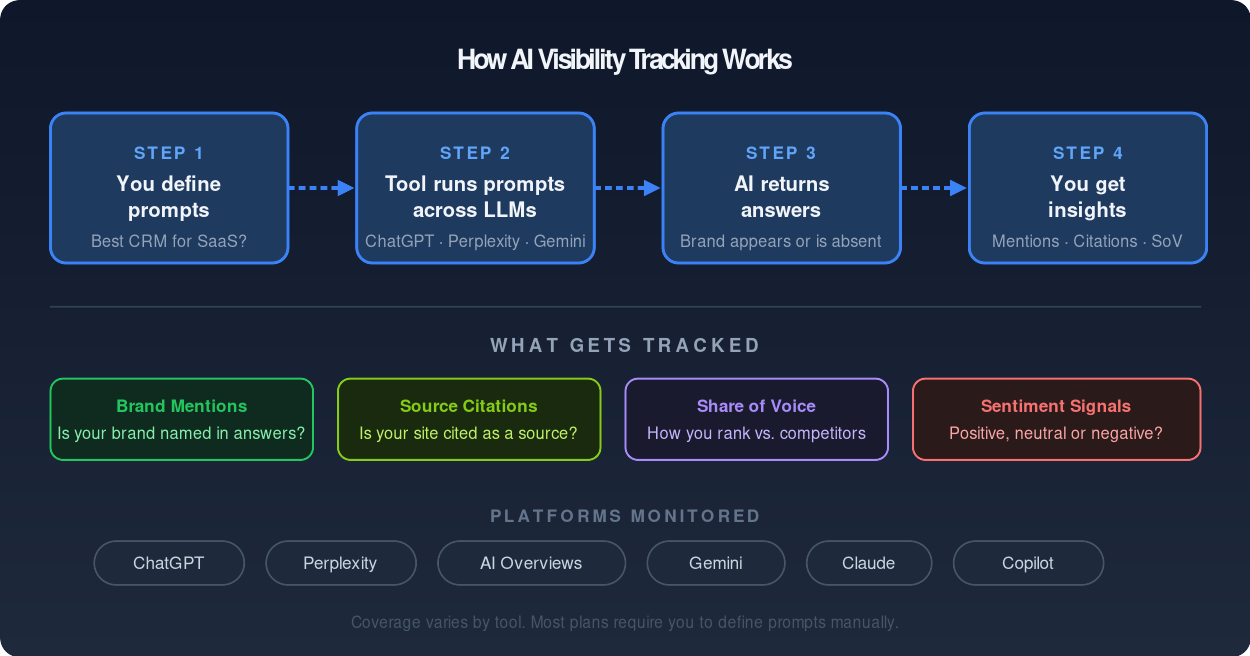
You give the tool a list of prompts, such as "what are the best project management tools for agencies" or "which CRM should a SaaS startup use." The platform runs those prompts across AI engines like ChatGPT, Perplexity, Google AI Overviews and Gemini, then records whether your brand appeared, in what position and whether your site was cited as a source.
Most tools require you to define those prompts manually. A few suggest prompts based on your website or topic categories, which surfaces queries you might miss on your own.
The main limitation: you only get data on what you track. Unlike Google, where discovery tools surface thousands of queries you rank for, LLM tracking is bounded by the prompts you set up.
What to look for in an AI visibility tool
For a deeper comparison of how these criteria actually differ tool by tool, see our guide to what GEO tools measure and how they differ, more on that in Semrush vs Moz.
- LLM coverage. ChatGPT and Perplexity are the baseline. Tools that also cover Google AI Overviews, Gemini, Claude and Microsoft Copilot give you a more complete picture. Check this before signing up, since many tools only cover two or three engines.
- Prompt limits and discovery. Every plan caps the number of prompts you can track. More important than the limit is whether the tool finds relevant prompts for you. Manual-only tools put the full burden on you.
- Competitive benchmarking. Looking at your own mentions in isolation is not useful. Share of voice, meaning how your brand compares to specific competitors across the same prompts, is the more valuable view.
- Sentiment and accuracy. A small number of tools flag when AI describes your brand with wrong pricing, misattributed features or confused positioning. This matters when prospects arrive from AI answers with bad information in their heads.
- Reporting. If you share data with clients or stakeholders, check for PDF exports, shareable links and clean dashboards. Unlimited seats is a real advantage for agency billing.
- Update pace. This market moves fast. A tool that shipped nothing new in six months is falling behind. Check the changelog before committing.
- Data-collection methodology. Some tools query LLM APIs directly. Others simulate real user sessions in a browser, which can surface different results since API responses do not always match what a person sees in the ChatGPT or Perplexity interface. Ask a vendor which method they use before trusting the numbers.
- Security and compliance. If your company requires SSO or SOC2 compliance for any tool that touches brand data, check this before you evaluate features. It usually only appears on enterprise tiers, and not every vendor publishes it upfront.
Outline, title, intro, conclusion, FAQ, rewriter and summarizer, each on its own page. No signup.
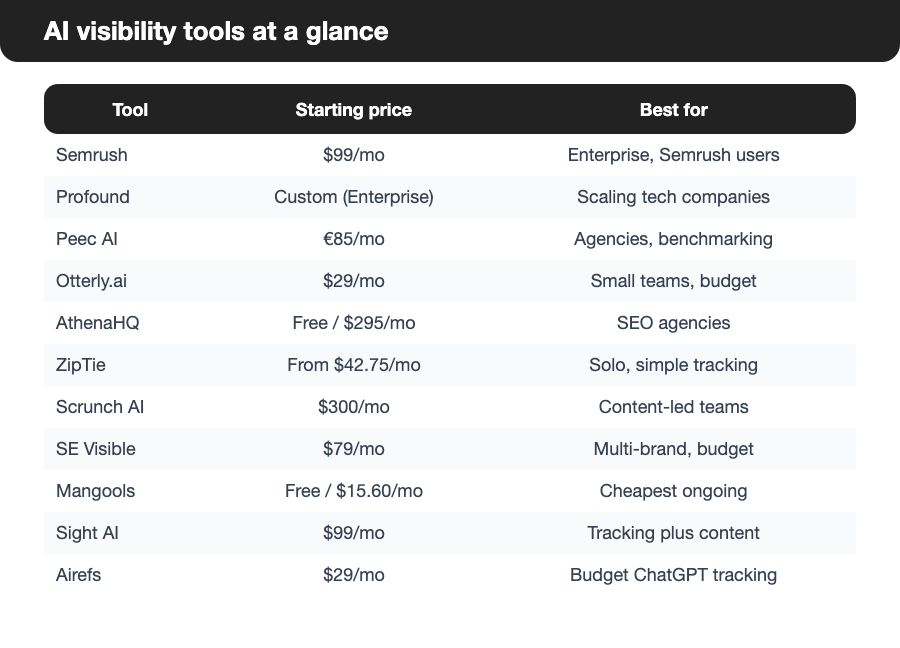
AI visibility tools at a glance
| Tool | Starting price | Free trial | LLMs covered | Best for |
|---|---|---|---|---|
| Semrush | $99/month | No | 7+ (ChatGPT, Gemini, Claude, Grok, Perplexity, Deepseek, Google AI Overviews) | Enterprise, existing Semrush users |
| Profound | Custom (Enterprise) | Yes (7 days) | 3 on trial, up to 9 on Enterprise | Scaling tech companies |
| Peec AI | €85/month | 7 days | 3 core + modular add-ons | Agencies, competitive tracking |
| Otterly.ai | $29/month | 7 days | ChatGPT, AI Overviews, Perplexity, Copilot (+ add-ons) | Small teams, budget-conscious |
| AthenaHQ | Free / $295/month | Free plan | Up to 9 AI models on paid tiers | SEO agencies, unlimited seats |
| ZipTie | from $42.75/month (usage-based) | Yes (7 days) | ChatGPT, Perplexity, Google AI Overviews | Solo operators, simple tracking |
| Scrunch AI | $300/month | No | ChatGPT, Claude, Gemini, Perplexity, Google AI Mode, AI Overviews, Meta | Content-led teams |
| SE Visible | $79/month | No | ChatGPT, Gemini, Perplexity, AI Overviews, AI Mode + more | Multi-brand on a budget |
| Mangools AI Search Watcher | Free / $15.60/month | Free plan | ChatGPT, Gemini, Claude, Mistral, Llama, Google AI Overviews, Grok | Cheapest ongoing tracker, free plan available |
| Sight AI | $99/month | 7 days | ChatGPT, Claude, Grok, Gemini, Perplexity | Tracking plus content production |
| Airefs | $29/month ($24 billed yearly) | 7 days | ChatGPT, Google AI Overview (add-on) | Low-cost ChatGPT tracking with content |
1. Semrush: Best for enterprise AI visibility
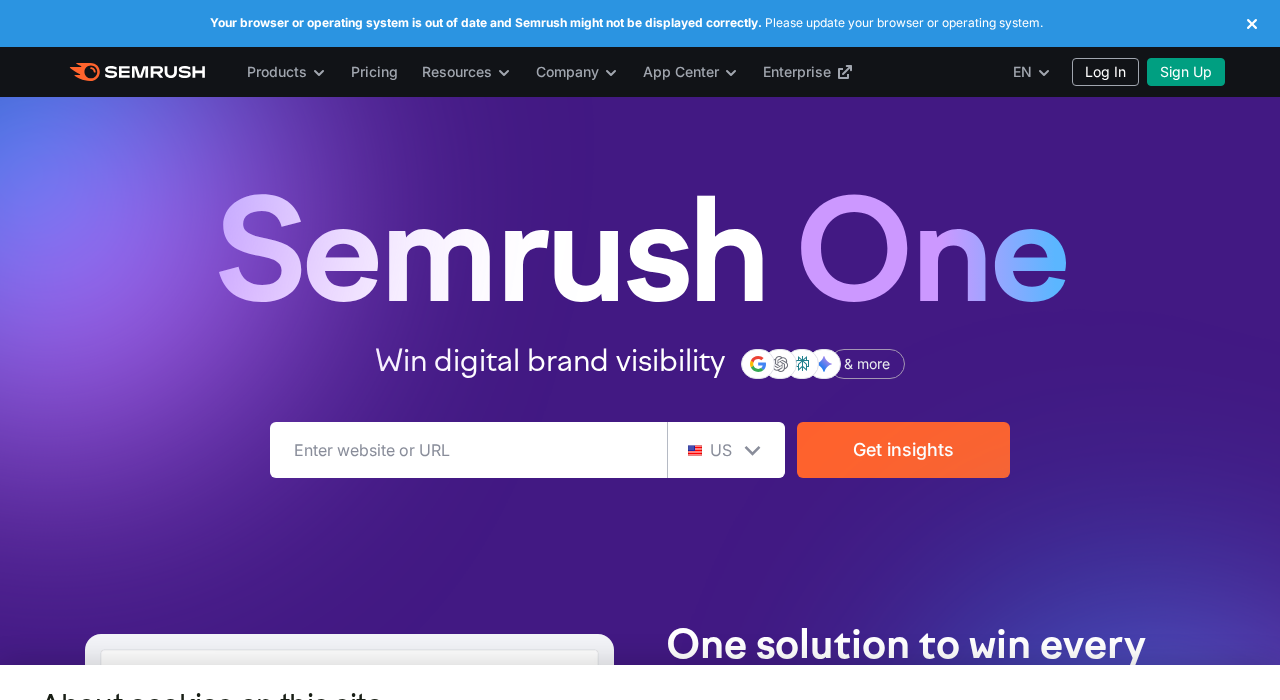
If you use Semrush for SEO and want to add AI visibility tracking, this is the natural fit. The AI Visibility Toolkit covers seven or more LLMs (ChatGPT, Google AI Overviews, Gemini, Claude, Grok, Perplexity and Deepseek), more than any other tool on this list. The competitive layer is strong: define your prompts, see brand mentions broken down by LLM, view the source domains driving those citations and compare against competitors with share of voice data.
For teams outside the Semrush ecosystem, the price is harder to justify against standalone tools. But if you want the widest LLM coverage and the deepest SEO integration in one platform, nothing else comes close.
Pricing
AI Visibility Toolkit from $99/month per domain. Semrush One (SEO and AI Toolkit) from $199/month. Enterprise pricing on request.
LLMs covered
ChatGPT, Google AI Overviews, Gemini, Claude, Grok, Perplexity, Deepseek. Worth a look: the standalone article on chatgpt alternative.
Strengths
- Widest LLM coverage of any tool reviewed
- Quote-level sentiment scoring and share of voice tracking
- Deep integration with Semrush SEO and content workflows
Limitations
- Expensive for teams that only need AI visibility, not the full SEO suite
- Extra charges for additional users on most plans
- No AI crawler visibility analysis at time of writing
2. Profound: Best for dedicated AI search tracking

Profound launched in 2024 and raised a $180 million Series D in September 2026. It focuses on AI search visibility only, and that focus shows. The Conversation Explorer maps topic-level AI search demand rather than just brand mentions. Prompt discovery is automated. The optimization workspace gives you a place to act on findings rather than just review them.
Profound restructured its pricing since our last review: it now offers a free 7-day trial (tracking ChatGPT, Gemini and Google AI Overviews) instead of a paid entry tier. Full platform coverage, up to nine answer engines, requires the custom-priced Enterprise plan. For a company that treats AI search as a core channel, that is the tier to budget for. If the Enterprise-only pricing is the sticking point, our guide to alternatives to Profound compares nine tools with public prices.
Pricing
Trial free for 7 days (50 prompts daily, ChatGPT, Gemini and Google AI Overviews, unlimited seats). Enterprise custom pricing (up to 9 answer engines, SSO/SAML, SOC 2, unlimited seats).
LLMs covered
Trial: ChatGPT, Gemini and Google AI Overviews. Enterprise: up to 9 platforms, adding Perplexity, Google AI Mode, Microsoft Copilot, DeepSeek, Claude and Exa Search.
Strengths
- Automated prompt discovery finds queries you would not track manually
- Conversation Explorer maps topic-level demand beyond brand mentions
- Enterprise tier adds SSO/SAML and SOC2 compliance for security-conscious buyers
Limitations
- The 7-day trial only tracks ChatGPT, Gemini and Google AI Overviews: broader platform coverage needs the custom-priced Enterprise plan
- No self-serve paid tier: after the trial, Enterprise pricing requires a sales demo
- Infrastructure not at Semrush scale
3. Peec AI: Best for agencies
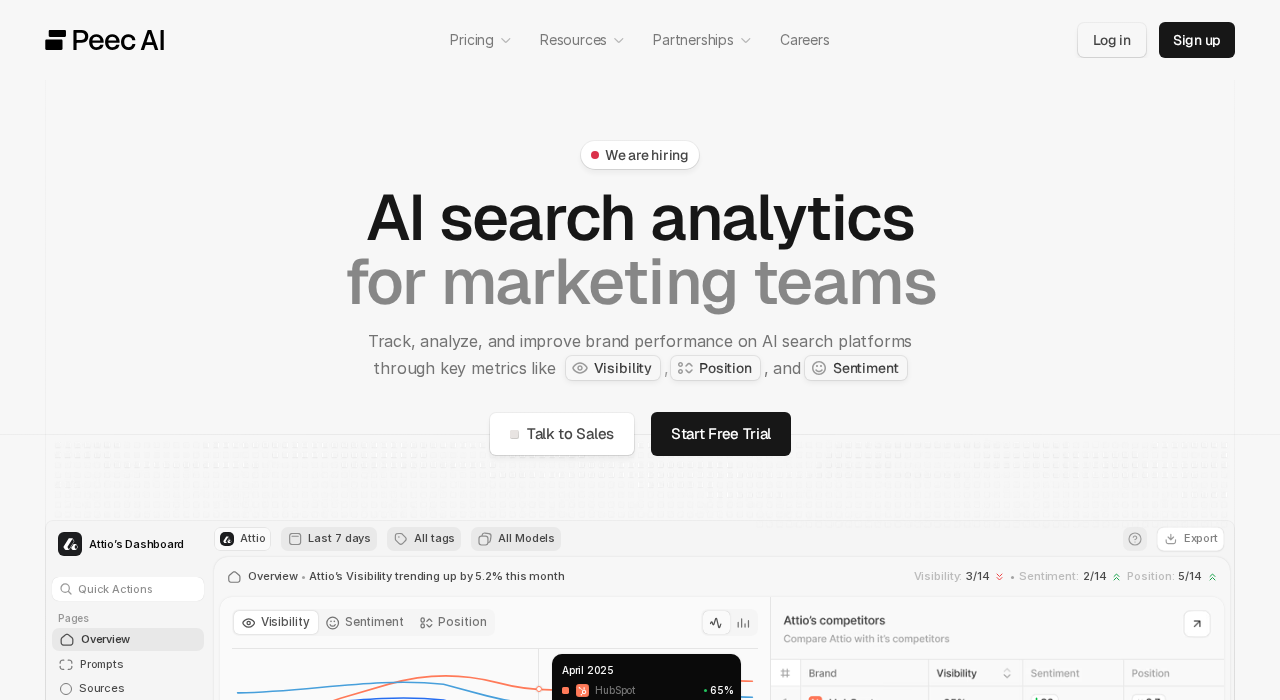
Peec AI launched in 2025 with €5.2 million in seed funding. It is built for agencies managing multiple clients. The competitive benchmarking is strong: you can track up to five competitors at once, see relative mention frequency and share of voice by category and export clean PDF reports for client use.
The modular pricing works in your favour. Every plan includes three models of your choice, for example ChatGPT, Google AI Overviews and Gemini. You can then add more models, including Perplexity, as paid add-ons from €25/month per extra model rather than upgrading your base tier.
Pricing
Starter €85/month (50 prompts, 1 project). Pro €205/month (150 prompts, 2 projects). Advanced €425/month (350 prompts, 5 projects, multi-country tracking, Looker Studio integration). Enterprise is custom-priced. Annual billing is cheaper, and extra models are billed separately as add-ons. Prices as shown on peec.ai/pricing in October 2026.
LLMs covered
Three models of your choice on every plan, from ChatGPT, Google AI Mode, Google AI Overviews, Microsoft Copilot, Gemini and Naver AI. Perplexity and further models as add-ons; Enterprise covers up to 13 models.
Strengths
- Best competitive benchmarking at this price point
- Country-specific tracking with multi-language support
- PDF and CSV export for client-facing reports
Limitations
- Works best for established brands AI already knows, with limited signal for new products
- 7-day trial, no credit card required
- Full LLM coverage costs extra on top of the base plan
4. Otterly.ai: Best entry-level option
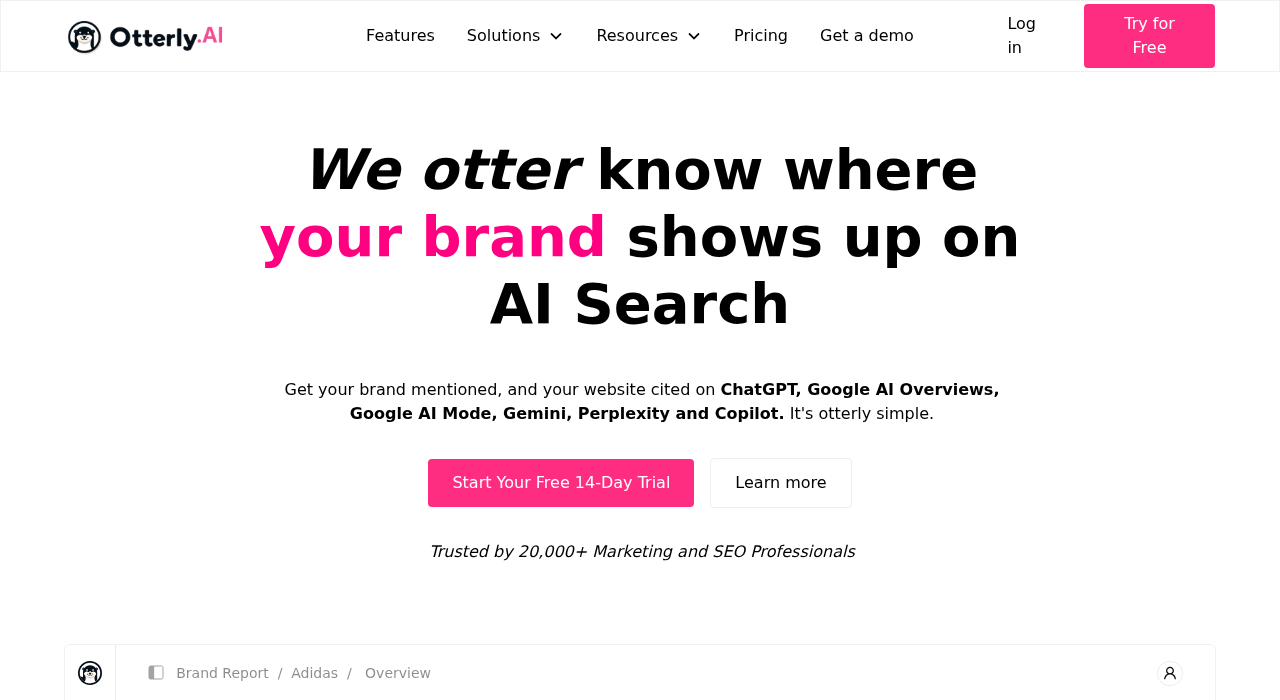
At $29/month, Otterly.ai is the cheapest paid AI visibility tracker on this list. Setup takes under 10 minutes. The dashboard shows total mentions, which prompts triggered them, citation status and basic sentiment across ChatGPT, Google AI Overviews, Perplexity and Microsoft Copilot on the base plan, with Claude, Gemini and Google AI Mode available as paid add-ons. Otterly has since added prompt research and competitive benchmarking, so it is no longer just a read on whether you are showing up.
For teams that want to answer one question (does AI mention us?) without committing to a bigger platform, this is the right starting point. The 7-day trial (50 prompts) requires no credit card.
Pricing
Lite $29/month (1 workspace, 15 prompts). Standard $189/month (unlimited workspaces, 100 prompts) is Otterly's most popular tier. Premium $489/month (unlimited workspaces, 400 prompts). Billed yearly, that comes to $25, $160 and $422 per month. Claude, Google AI Mode and Gemini cost extra as add-ons on every tier. 7-day trial with 50 prompts, no card required.
LLMs covered
ChatGPT, Google AI Overviews, Perplexity, Microsoft Copilot on every base plan. Claude, Google AI Mode and Gemini are paid add-ons.
Strengths
- Lowest paid entry price of any tool reviewed
- Fast setup with no learning curve
- 7-day trial without a credit card
Limitations
- Lite is limited to 1 workspace and 3 recommendations per week
- 15 prompts on the Lite plan is tight for most brands; Claude, Gemini and AI Mode cost extra even on paid tiers
- Extra prompts cost $99 per 100 on Standard and Premium
5. AthenaHQ: Best for SEO agencies
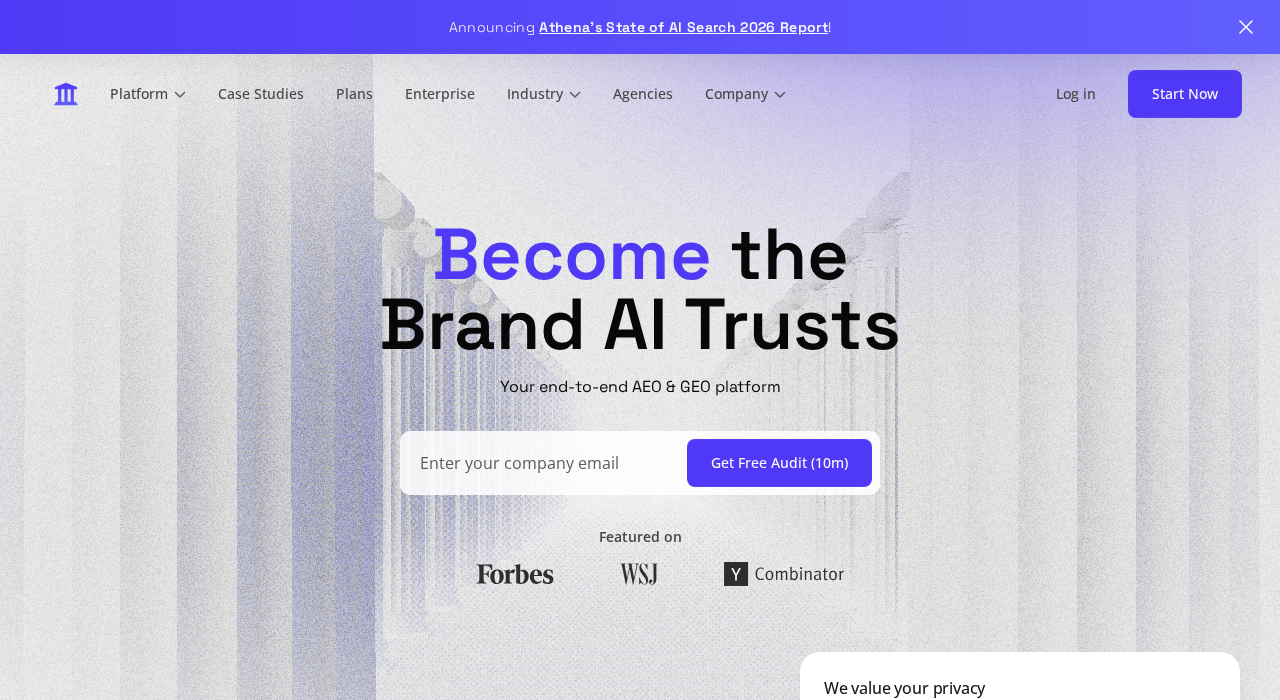
AthenaHQ tracks how your brand appears in AI results and connects that to traffic and conversions. The main advantage for agencies is unlimited seats across all plans, including the free tier, so you do not pay extra per team member, which keeps costs predictable when you manage multiple client contacts.
AthenaHQ now offers a genuine free Essential plan (300 credits, covering ChatGPT, Perplexity, Google AI Overviews, Gemini and Claude), a change since our last review. The paid Starter plan adds broader model coverage and a content optimization agent.
Pricing
Essential free ($25 credit, 300 credits total, unlimited members). Starter $295/month (3,600 credits, visibility across 9 AI models). Enterprise custom with unlimited credits and SSO/OIDC.
LLMs covered
Essential: ChatGPT, Perplexity, Google AI Overviews, Gemini, Claude. Starter and above: up to 9 AI models.
Strengths
- Unlimited seats on every plan, including the free tier
- Genuine free Essential plan with 300 credits and full unlimited-member access
- Content optimization agent included from the Starter tier up
Limitations
- $295/month Starter is a high jump from the free tier
- Credit-based billing is hard to forecast before you know your usage
- Full 9-model list on Starter not itemized publicly
6. ZipTie: Best for simplicity
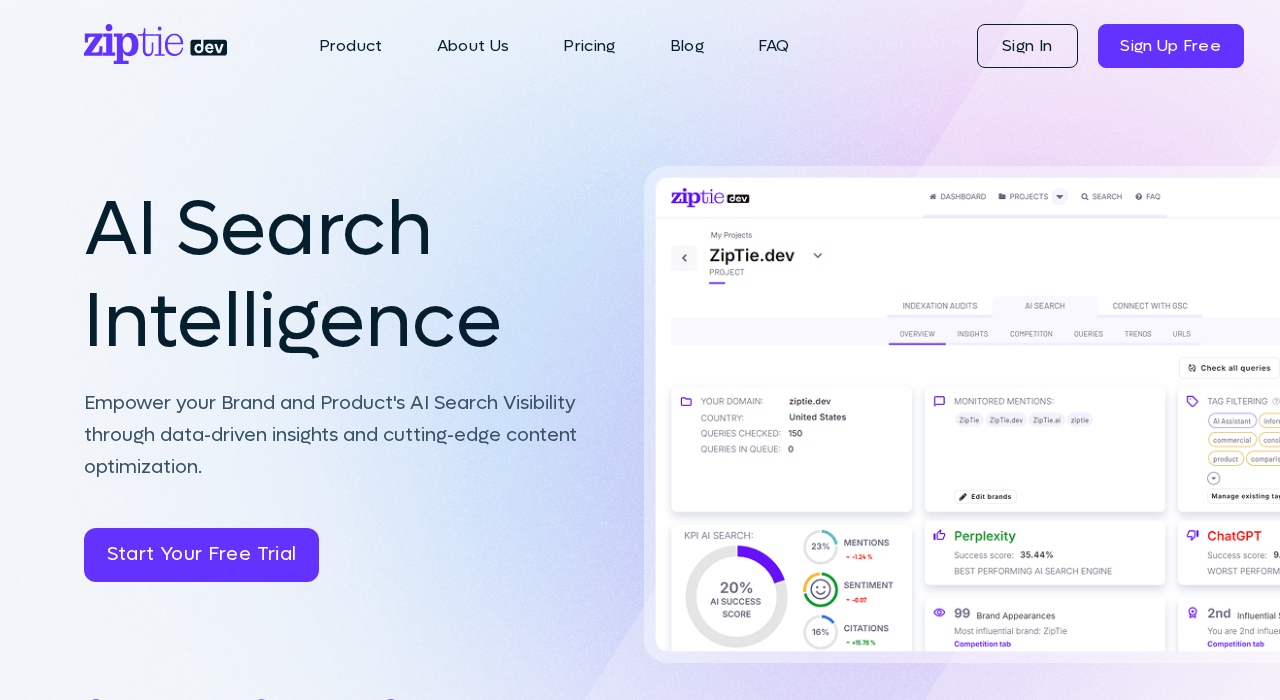
ZipTie reduces AI visibility tracking to the basics. Add your brand, enter a few prompts and get citation data and mention counts across ChatGPT, Perplexity and Google AI Overviews. No sales process, no onboarding call. The AI Success Score gives you a top-level read at a glance.
For solo operators or small teams that need to know whether they show up, ZipTie works without friction. There is also a free 7-day trial with 25 daily prompts, no card required, if you want to test it before paying.
Pricing
7-day trial free (25 daily prompts, no card required). Starter from $42.75/month, usage-based on prompts and AI engines tracked. Professional from $659.59/month. Enterprise from $3,137.09/month. Annual billing saves up to 20%.
LLMs covered
ChatGPT, Perplexity, Google AI Overviews.
Strengths
- Simplest setup and interface of any tool reviewed
- Citation data and mention counts in one view
- Free 7-day trial before you commit to a paid plan
Limitations
- Three LLMs only: no Claude, Gemini or Copilot
- No competitive benchmarking or sentiment analysis
- Not built for multi-brand or agency workflows
7. Scrunch AI: Best for content-led teams
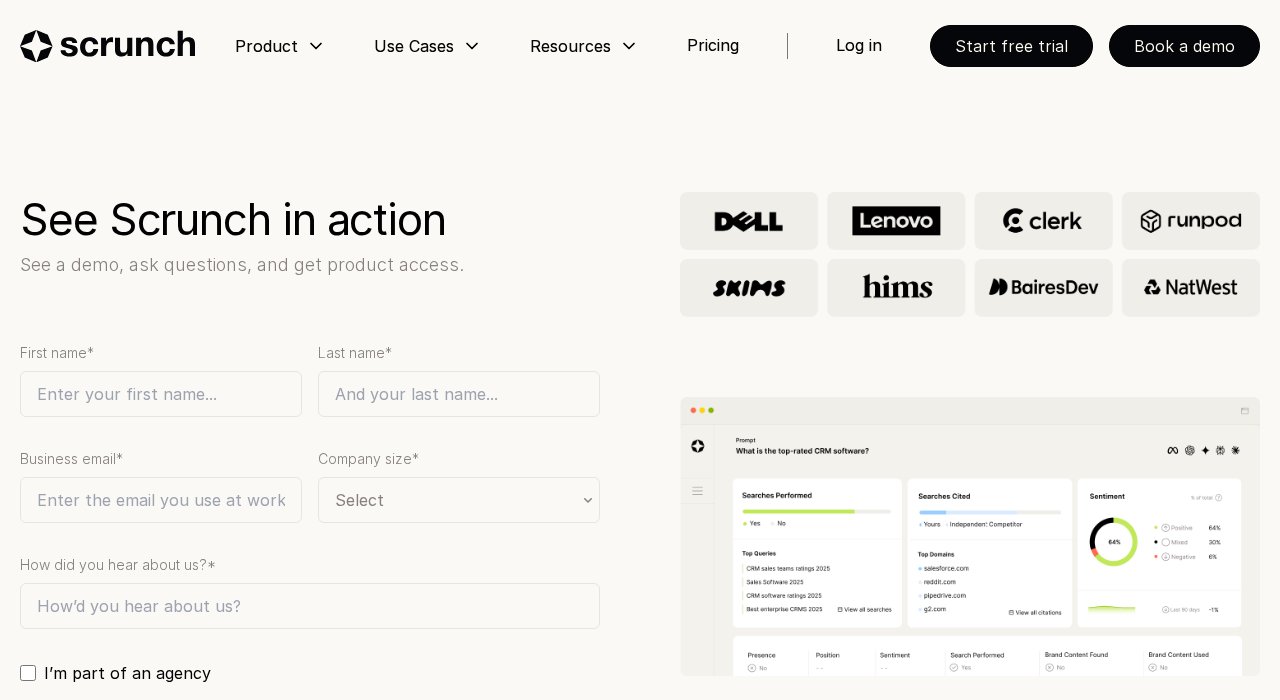
Most AI visibility tools stop at measurement. Scrunch AI adds an optimization layer: the Insights feature analyzes how your content is referenced by AI engines and recommends changes to improve your presence. For teams that publish at volume and want to connect content decisions to AI visibility, that distinction is relevant. Coverage is broader than it looks at a glance: Scrunch tracks 7 platforms on every tier, not just the 3 most tools lead with.
The platform also includes an Enterprise Data API and dedicated GTM support on its top tier. At $300/month entry, Scrunch suits teams with an active publishing operation rather than early-stage testing.
Pricing
Starter $300/month, or $250/month billed annually (350 custom prompts, 1,000 industry prompts, 3 personas, 5 page audits, 3 user licenses). Growth $500/month, or $417/month billed annually (700 custom prompts, 2,500 industry prompts, 5 personas, 10 page audits, 5 user licenses). Enterprise custom (SAML/OIDC, Enterprise Data API, dedicated GTM team).
LLMs covered
ChatGPT, Claude, Gemini, Perplexity, Google AI Mode, AI Overviews, Meta: 7 platforms on every tier including Starter.
Strengths
- Widest LLM coverage of any tool in this list outside Semrush: 7 platforms on the entry tier
- Content optimization recommendations built into the platform
- Monitoring and improvement in one workflow
Limitations
- High starting price relative to prompt volume on the Starter tier
- Enterprise tier requires a custom quote, slow for teams that want to self-serve
8. SE Visible: Best for multi-brand tracking on a budget
SE Visible is part of SE Ranking and tracks AI mentions, citations and sentiment across ChatGPT, Gemini, Perplexity, Google AI Overviews and AI Mode, with more engines added as they emerge. The entry plan at $79/month supports three brands, which makes it one of the better-value options for managing multiple properties without paying per brand.
It fits teams already using SE Ranking who want to extend into AI visibility without adding a separate tool. If you are not in that ecosystem, the limited integrations outside it are a real constraint.
Pricing
From $79/month (150 prompts, 3 brands). No dedicated agency plan.
LLMs covered
ChatGPT, Gemini, Perplexity, Google AI Overviews, Google AI Mode, plus emerging search experiences as SE Ranking adds them.
Strengths
- Three brands on the entry plan, good value for multi-brand use
- Named engine coverage now includes both AI Overviews and AI Mode, not just a generic "AI search" bucket
- Clean integration with SE Ranking SEO data
Limitations
- Still fewer named engines than Semrush or Scrunch AI at this price point
- Limited integrations outside SE Ranking
- No agency plan with client workspace features
9. Mangools AI Search Watcher: Best free starting point
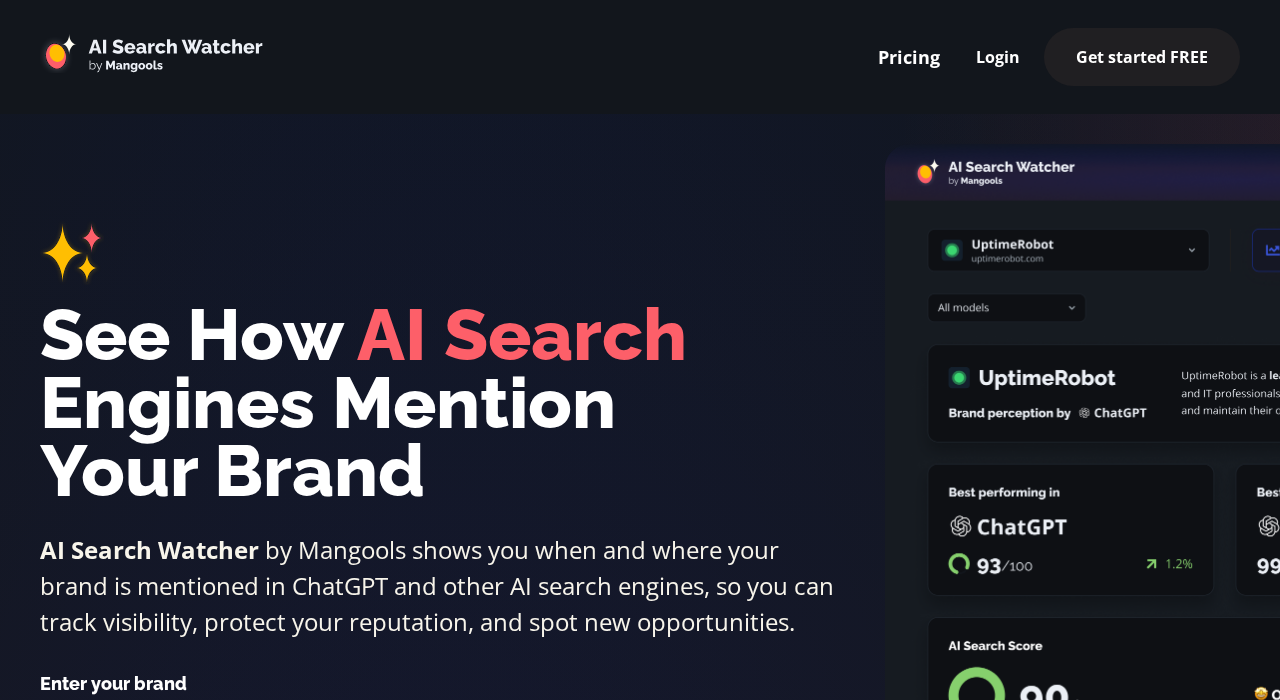
Mangools built its name on affordable SEO tools and the AI Search Watcher follows the same pattern. The free plan tracks five prompts, and coverage has grown since our last review, now spanning seven AI systems: ChatGPT, Google AI Overviews, Gemini, Claude, Grok, Mistral and Llama, no credit card required. Setup takes about 30 seconds. Each checkup runs prompts multiple times to reduce the noise from LLM response variability.
The paid plan starts at $15.60/month billed annually, which makes it the cheapest ongoing tracker on this list. For teams that want more than a one-off snapshot but are not ready for a $29+ commitment, it is a solid first step.
Pricing
Free (5 prompts). Pro from $15.60/month billed annually. 48-hour money-back guarantee on paid plans.
LLMs covered
ChatGPT, Google AI Overviews, Gemini, Claude, Grok, Mistral, Llama: 7 systems, up from 5 at our last review.
Strengths
- Free plan with no credit card: five prompts across seven LLMs, including Google AI Overviews and Grok
- Cheapest paid ongoing tracker at $15.60/month
- Runs each prompt multiple times for more reliable results
Limitations
- Five prompts on the free plan is very limited for most brands
- No competitive benchmarking or share of voice tracking
- Part of the Mangools ecosystem, less focused than dedicated AI visibility platforms
10. Sight AI: Best for tracking plus content production
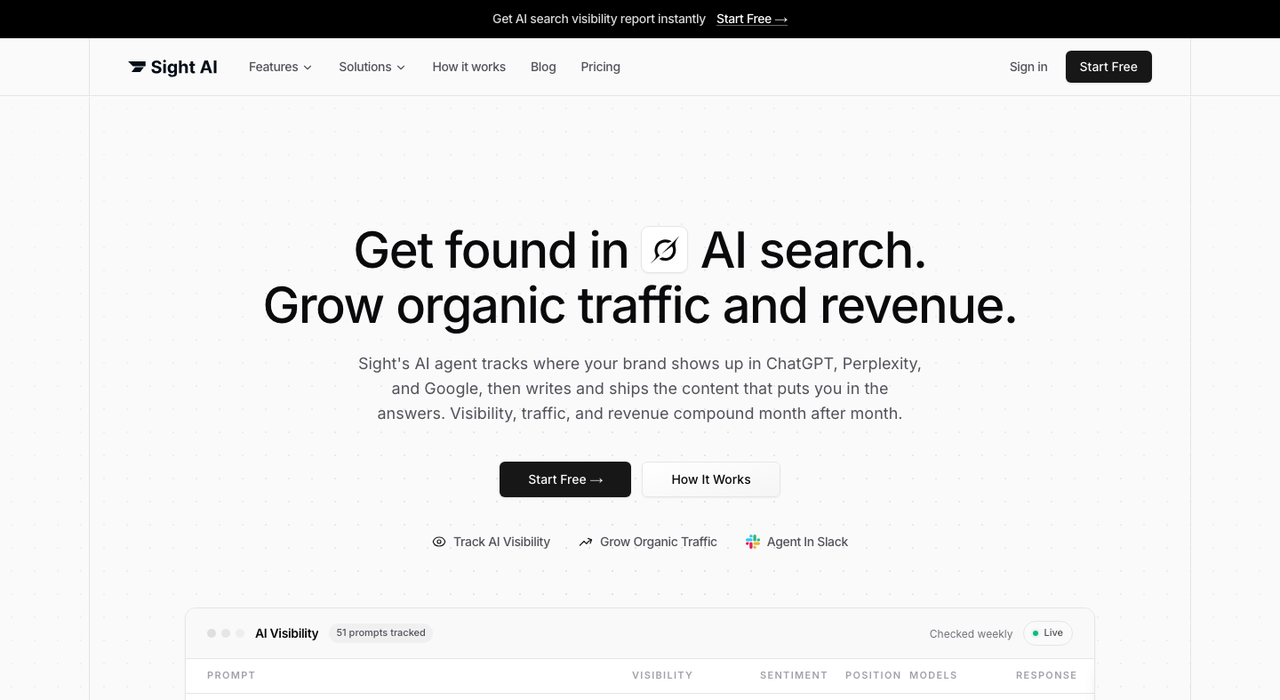
Sight AI combines AI visibility tracking with an AI agent that writes and publishes content. It tracks where your brand shows up in ChatGPT, Claude, Grok, Gemini and Perplexity, shows the full responses and follows mentions, citations, position and sentiment for each prompt. Alongside that, it pulls keyword positions from Google Search Console and flags opportunities such as content gaps, pages that need a refresh and prompts where competitors get mentioned and you do not.
What sets it apart from most tools on this list is what happens after the report. Its writing agents draft long-form articles, publish them to WordPress, Webflow, HubSpot, Framer, Wix or Shopify and submit the new URL to Google and Bing via IndexNow. A Slack integration posts alerts and runs tasks once you approve them. That makes it a fit for lean teams that want tracking and content production in one place. If you only need a tracker, you are paying for a content engine you will not use.
Pricing
Pro from $99/month (5,000 AI credits, 1 site, 1 seat), with larger credit sizes available. Enterprise from $2,500/month. Extra sites cost $59/month, extra seats $29/month, and annual billing saves 20%. 7-day free trial with 1,500 credits, card required.
LLMs covered
ChatGPT, Claude, Grok, Gemini and Perplexity on every plan.
Strengths
- Five AI engines on every plan, including Claude and Grok
- Turns visibility gaps into published articles, with CMS connectors and IndexNow submission built in
- Slack agent for alerts and approvals, so the team does not have to live in another dashboard
Limitations
- Credit-based pricing makes costs harder to predict: a full all-platform visibility check uses about 31 credits and an AI article about 100, drawn from the same pool
- Tracked prompt limits per plan are not listed on the pricing page
- Google AI Overviews and AI Mode are not among the named tracking engines
- Large jump from Pro to Enterprise at $2,500/month
11. Airefs: Best low-cost ChatGPT tracker with content
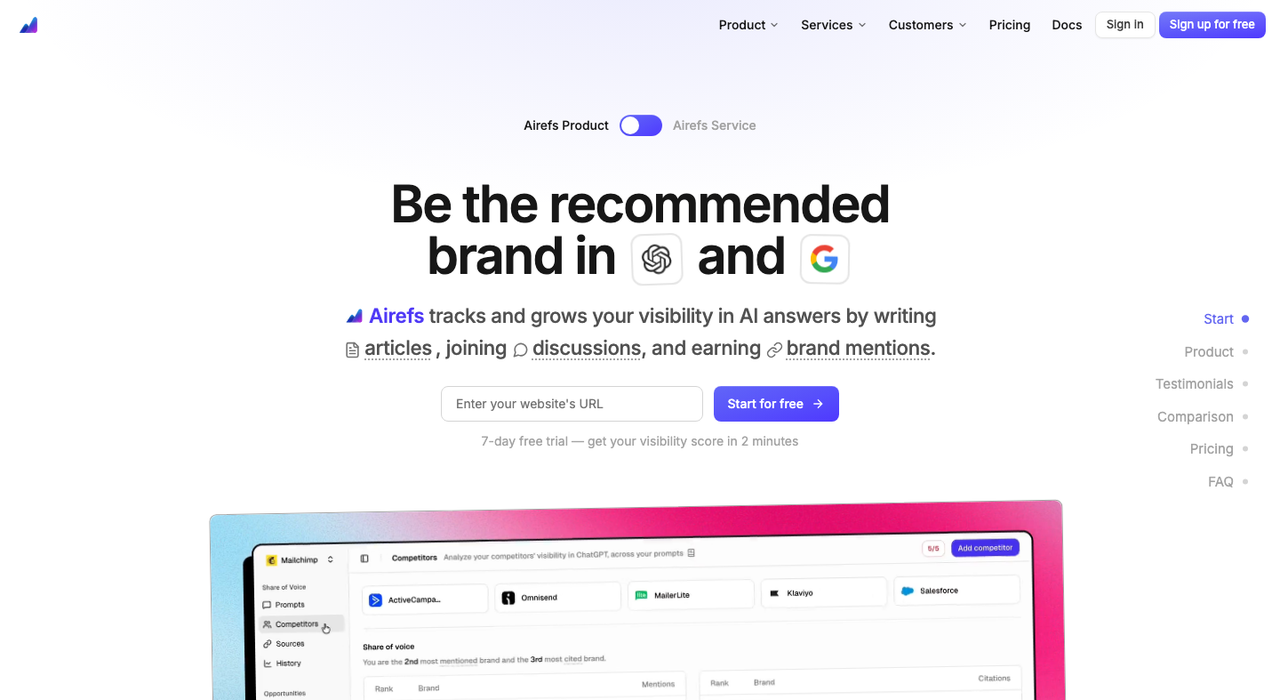
Airefs tracks how often your brand appears in ChatGPT and Google AI Overview answers, compares your share of voice against up to 20 competitors and shows which URLs shape those answers. Next to prompt tracking, it logs which AI crawlers read your pages and measures visitor clicks coming from ChatGPT, Perplexity, Google AI Overview and other AI search answers.
Like Sight AI, it goes beyond dashboards. It writes AEO articles, surfaces Reddit, Quora and LinkedIn discussions worth joining and finds third-party articles in your category for outreach. Pro and Expert include a read-only MCP server, so you can query your data from Claude, ChatGPT or Cursor. The trade-off is narrow prompt coverage: only ChatGPT is included by default, Google AI Overview costs extra, and Claude, Gemini and Perplexity show up in the crawler and traffic analytics, not in prompt tracking.
Pricing
Lite $29/month or $24/month billed yearly (1 domain, 25 prompts, 1 article/month). Pro $59/month or $49/month yearly (3 domains, 60 prompts, 3 articles). Expert $99/month or $83/month yearly (unlimited domains, 150 prompts, 6 articles, dedicated AEO strategist). Google AI Overview tracking adds $10 to $30/month depending on the plan. Extra articles cost $7 each. Fully managed service from $300/month. 7-day free trial.
LLMs covered
Prompt tracking: ChatGPT, plus Google AI Overview as a paid add-on. Crawler and traffic analytics: ChatGPT, Claude, Gemini, Perplexity and other AI search engines.
Strengths
- Low entry price that already includes one AI-optimized article per month
- AI crawler and AI referral traffic analytics alongside prompt tracking
- Read-only MCP server on Pro and Expert for querying your data from AI assistants
Limitations
- Prompt tracking covers only ChatGPT and Google AI Overview, and the latter costs extra
- Lite refreshes answers every other day and keeps just 7 days of history
- No prompt tracking for Claude, Gemini or Perplexity
Other AI visibility tools worth knowing about
The 11 tools above cover most buyers, but a few adjacent options come up often enough to name.
Similarweb tracks AI referral traffic and topic themes alongside its existing SEO data, which makes it a fit if you already use Similarweb and want side-by-side SEO and GEO tracking in one dashboard rather than a dedicated AI visibility tool. Pricing is quote-based.
Ahrefs added an AI visibility add-on to its platform, priced around $199/month on top of a paid Ahrefs plan. It covers Google AI Overviews, AI Mode, ChatGPT, Perplexity, Gemini and Copilot, and its main strength is brand benchmarking against competitors using the same Ahrefs data you may already track for SEO.
Clearscope, better known as a content-optimization tool, tracks brand mentions across ChatGPT, Gemini and Perplexity starting around $129/month. It suits content teams who want AI visibility folded into an existing content-scoring workflow rather than a standalone tracker.
HubSpot AEO starts at $45/month for the standalone AEO tool (25 prompts/day), with bundles available from $800/month with Marketing Hub Professional. It tracks AI visibility performance across ChatGPT, Gemini, and Perplexity, and stands out through its native CRM integration, allowing marketers to use CRM customer data to discover the prompts their target audiences are most likely to use on AI search engines. Users can also filter prompts by ideal customer profiles and buyer journey stages to fine-tune prompt discovery, making it a strong option for teams looking to embed AEO into their existing marketing workflows.
None of these four made the Top 11 above because each is either a bolt-on to a broader platform rather than a dedicated AI visibility tool, or appeared in only one of the sources reviewed for this guide. Each is worth a look if you already use the parent platform, but not a first stop if you are starting from zero.
Hall, which appeared in earlier versions of this guide, is no longer included. In July 2026 it was acquired by Tracksuit, and its former site now lists no plans or pricing and only points to a Tracksuit waitlist. Check again once Tracksuit publishes its own AI visibility product.
How to choose an AI visibility tool
Starting for free: Mangools AI Search Watcher or AthenaHQ. Mangools covers seven LLMs on the free plan with five prompts and is the better option if you want ongoing tracking from day one. AthenaHQ offers a free Essential plan with 300 credits and unlimited members.
Small team or solo operator: Otterly.ai at $29/month gets you basic tracking fast. ZipTie from $42.75/month, usage-based, adds a slightly stronger dashboard and citation tracking.
Agency: Peec AI for competitive benchmarking and multi-country reporting. AthenaHQ if unlimited seats and a GA4 integration matter more for your workflow.
Scaling tech company: Profound. The Conversation Explorer and automated prompt discovery are stronger than what competitors offer at this level, but budget for the custom-priced Enterprise plan if you need more than the trial's three engines, since only a free 7-day trial is available before that.
Enterprise with existing SEO tooling: Semrush AI Visibility Toolkit covers the most LLMs and connects to Semrush SEO data. Scrunch AI is the alternative if content optimization alongside tracking is a priority.
How to track AI traffic in Google Analytics 4
Before investing in a paid tool, check how much traffic you already receive from AI platforms. GA4 lets you filter referral traffic by source to isolate sessions from ChatGPT, Perplexity and similar engines.
This shows whether people click through from AI to your site, but it does not tell you whether AI mentions you in answers. Still, it is a useful free baseline.
- Go to Acquisition → Traffic acquisition
- Click Add filter
- Select Session source / medium as the dimension
- Set Match Type to matches regex
- Paste:
(.*gpt.*|.*chatgpt.*|.*openai.*|.*perplexity.*|.*gemini.*google.*|.*bard.*|.*claude.*) - Switch the primary dimension to Session source / medium
- Add Page path as a secondary dimension to see which pages get the most AI referral traffic
Save it as a report and check monthly. As AI referrals grow, the numbers tell you whether your pages are being cited in practice.
FAQ
What is AI visibility?
AI visibility is about whether AI engines mention your brand when users ask relevant questions. Tools like ChatGPT, Perplexity and Google AI Overviews generate answers from their training data and indexed sources, and your brand either appears in those answers or it does not.
Is AI visibility the same as SEO?
No, they measure different things. SEO is about where your pages rank. AI visibility is about whether AI engines mention your brand when generating answers. You can rank first on Google and still not appear in the AI Overview sitting above that result.
Does ranking on Google improve AI visibility?
It helps, but it is not enough on its own. Many LLMs use Google's index as a source, so well-ranking pages have a better chance of being cited. AI engines also factor in how clearly your pages describe your brand and how well-known your entity is across the web, so strong rankings are just one piece of it.
Which AI platforms do these tools track?
Most tools start with ChatGPT, Perplexity and Google AI Overviews. Gemini, Copilot, Claude, Grok and DeepSeek are available on higher tiers or as paid add-ons. Semrush covers the most platforms out of the box. Peec AI lets you add engines one by one so you only pay for what you use.
What is the cheapest AI visibility tool?
Mangools and AthenaHQ both have free plans. Mangools tracks five prompts across seven LLMs without a credit card. AthenaHQ's free Essential plan includes 300 credits. If you want a paid plan, Mangools starts at $15.60/month and Otterly.ai at $29/month.