

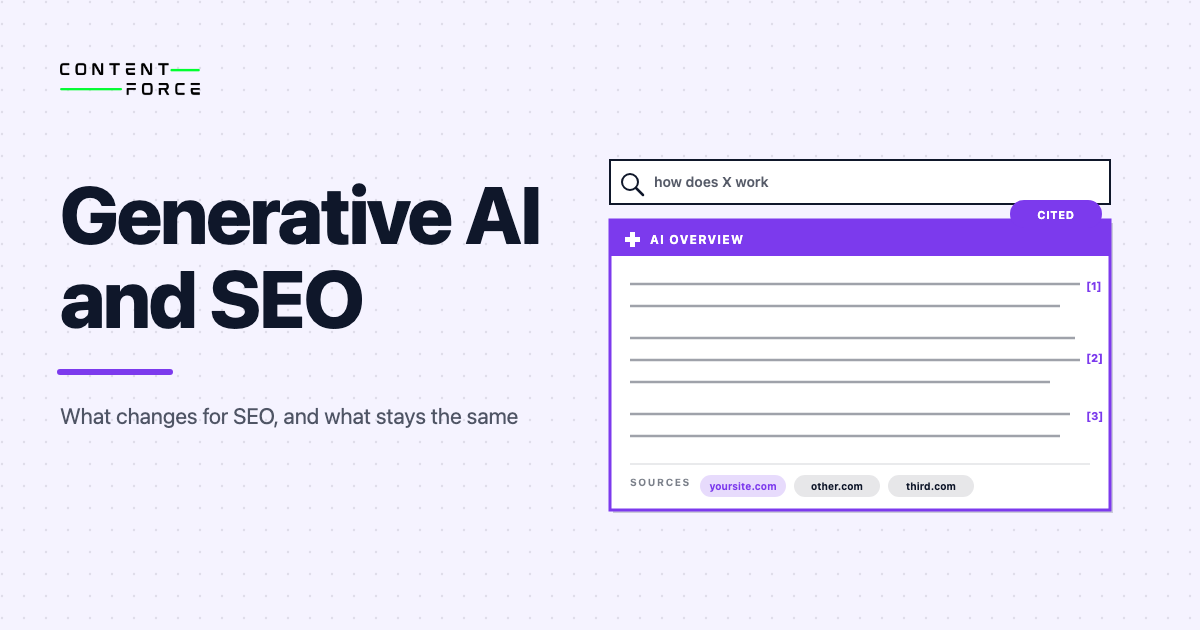
Yes, SEO is still relevant for generative AI. That answer comes straight from Google itself: its AI-powered search features are built on the same core Search ranking and quality systems that traditional results have always used. Google’s own developer guide explains that these features rely on retrieval-augmented generation (RAG) and a technique called query fan-out. Both pull answers from the existing search index, not from some separate, parallel system. If a page isn’t technically sound enough to rank in traditional search, it won’t appear in an AI-generated answer either.
That single fact reframes the whole “generative AI seo” question. The practice isn’t being replaced. It’s clearly being extended, with a new layer of visibility, citation, and measurement sitting on top of the SEO fundamentals that already existed. This guide separates what genuinely changes from what stays exactly the same, so a content or SEO team can prioritize effort correctly instead of chasing every new acronym that shows up online.
GEO, AEO, AIO, LLMO: What These Terms Actually Mean
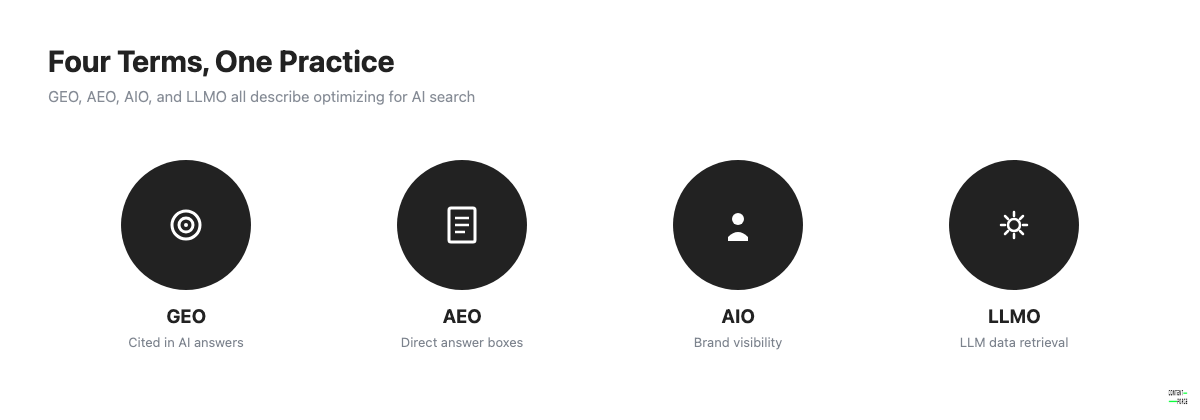
Search around this topic for five minutes and four overlapping labels show up: GEO, AEO, AIO, and LLMO. There’s no agreed academic definition for any of them yet, and usage still varies by vendor and publication, per Wikipedia’s own terminology entry. Here’s what each one usually means, and who uses it.
| Term | What it usually means | Who uses this framing |
|---|---|---|
| GEO (Generative Engine Optimization) | Optimizing content so it gets cited or referenced inside AI-generated answers, across engines like Google’s AI features, ChatGPT, and Perplexity | Most common umbrella term in vendor blogs and courses |
| AEO (Answer Engine Optimization) | Structuring content to directly answer a specific question, aimed at featured snippets and AI answer boxes | Bing’s own materials, plus SEO tool vendors |
| AIO (AI Optimization) | Building broader brand visibility and consistent positioning so a brand gets mentioned inside AI answers, not just cited as a source | Brand and reputation-focused marketers |
| LLMO (Large Language Model Optimization) | A narrower technical framing focused on how a page is represented in the data an LLM retrieves or was trained on | Technical SEO practitioners |
Google’s own position, stated directly in its developer guide, is that this is “still SEO.” The underlying work of building crawlable, well-structured, genuinely useful content hasn’t changed just because a new label got attached to it. Independent analysts take a similar view. Forrester Research has described GEO and its siblings as terms that are significantly, but not fundamentally, different from SEO, and has cautioned marketers against treating them as a wholesale replacement discipline.
The practical takeaway isn’t to pick a winning acronym. A reader or a prospect might arrive at this exact question from any of these four directions. Make sure the underlying practice covers all of them, because the tactics behind each term overlap far more than the branding suggests.
What Changes for SEO Under Generative AI
Three things shift in how visibility actually gets earned, even though the foundation stays the same.
The first is the win condition itself. Historically, success meant earning a click on a blue link. Zero-click searches, where a reader gets their answer without visiting any site, have grown sharply as AI Overviews and conversational search have expanded. Now, a meaningful share of visibility happens when a brand or a page gets cited inside an AI-generated answer, sometimes without the reader ever clicking through. That makes unlinked brand mentions, not just backlinks, a signal worth actively pursuing, since AI systems can cite or reference a source without a hyperlink attached.
The second is content specificity. Semrush’s own analysis of generative engine optimization found that pages containing direct quotes and concrete statistics showed roughly 30 to 40 percent higher visibility in AI-generated responses than pages without them, in the sample Semrush reviewed. Vague, generic paragraphs are easy to skip past. A competitor’s page that states a number, cites a source, or quotes an expert directly wins that comparison. That’s consistent with what Google’s guide calls “non-commodity content”: material that reflects real, first-hand expertise rather than a rewritten summary of what already exists elsewhere.
The third is technical delivery. Content that depends entirely on client-side JavaScript to render is a genuine risk. A retrieval system that cannot render a page the way a browser does may simply never see the words at all. Server-side rendering, or at least a reliably crawlable HTML fallback, has become more important, not less, in an AI-search environment. Freshness matters more too. AI systems appear to favor recently updated, verifiably current information over content that hasn’t been touched in years, since a stale answer is a bad answer to serve a user.
None of this requires reinventing content strategy from scratch. It requires being more specific, more current, and more crawlable than before, which is a sharper version of good SEO, not a different discipline. Teams already running solid technical SEO foundations have the shortest path to AI-era visibility.
What Stays the Same
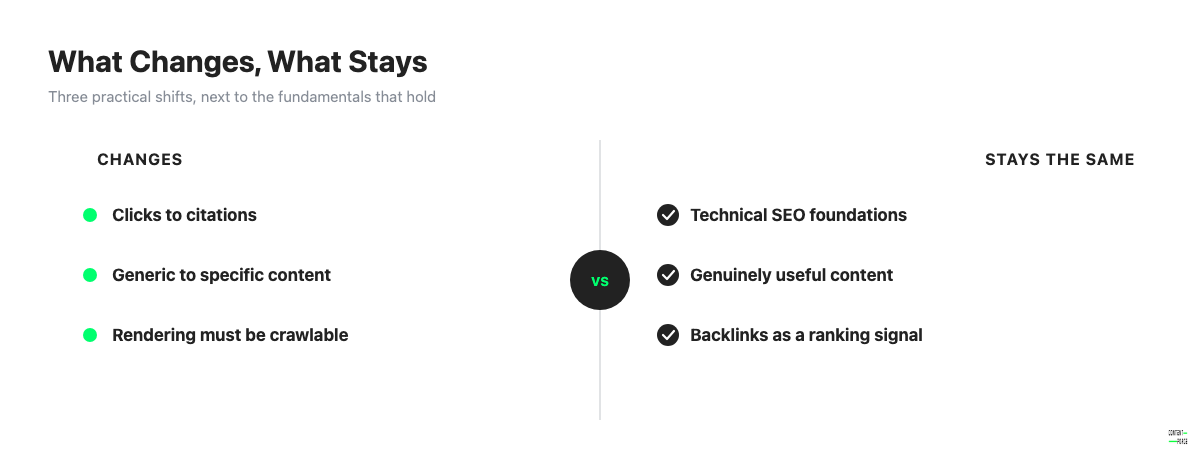
The foundation underneath all of this hasn’t moved, and frankly, that’s the most important sentence in this guide. Technical SEO, genuinely useful content, and links still drive visibility in both traditional results and AI-generated ones, because AI features are built on the same ranking and quality systems, not a separate stack.
Backlinks specifically remain relevant for a reason that’s easy to miss. AI search platforms still rely on traditional search engine indexes to discover and evaluate URLs in the first place, and those indexes still use backlinks as a ranking signal. A citation inside an AI answer doesn’t bypass the index. It depends on it, and that dependency isn’t going away.
Google’s guide also directly corrects several tactics that have circulated as supposed “AI SEO hacks.” Being clear about what doesn’t work is admittedly as useful as knowing what does.
5 Things You Don’t Need to Do for AI Search
- Publishing an llms.txt file. Google has stated this file has no effect on how its systems crawl or use a site’s content.
- Chunking content into artificial fragments. Writing clear, direct answers for a human reader works better than manually breaking a page into algorithm-sized pieces.
- Writing in a special “AI-only” style. Modern models handle natural language, synonyms, and normal human phrasing without needing a stripped-down or robotic tone.
- Buying or seeding inauthentic mentions. A brand name repeated across low-quality, disconnected sources doesn’t carry the same weight as a genuine, contextual citation.
- Adding structured data purely for AI visibility. Structured data still helps with rich results in traditional search, but it isn’t a requirement for appearing in an AI-generated answer.
How Do You Measure AI Search Visibility?
Two free, first-party tools cover most of what a team genuinely needs, and both are worth checking before reaching for a paid platform.
Google Search Console has a dedicated Generative AI performance report. It shows how a site’s content is surfacing inside Google’s AI-powered search features, separate from standard organic performance. Bing Webmaster Tools has a comparable AI Performance report, tracking visibility inside Microsoft’s own AI-driven search surfaces. Neither platform shares its full internal ranking logic with third-party tools, so these first-party reports are the closest thing to ground truth currently available, and they’re free.
Beyond that, third-party AI-visibility platforms track a broader set of metrics: AI share of voice, brand mention frequency, and which specific sources get cited across a set of tracked prompts. These are genuinely useful for competitive benchmarking and for monitoring sentiment. They sit on top of the two free first-party reports rather than replacing them. A small team can get real signal from Search Console and Bing Webmaster Tools alone before paying for anything additional. For a broader view of the tools available at every budget, see this site’s own roundup of AI SEO tools and its dedicated look at AI visibility platforms.
What Comes Next: Agentic Search and Beyond
One further shift is still early enough that it belongs in an outlook section rather than a core strategy. Google’s own guide describes emerging “agentic experiences,” where autonomous AI agents complete tasks on a person’s behalf, such as comparing product specifications or booking a reservation, sometimes by accessing a website directly rather than through a search results page. Google references emerging protocols like the Universal Commerce Protocol as part of preparing sites for this kind of agent traffic.
This is clearly worth watching, but it’s not worth building an entire strategy around today. The practical implication for now runs through this whole guide: a site that’s technically clean, genuinely well-structured, and easy for a machine to parse correctly is already better positioned for whatever agentic search becomes next. That’s true without needing a separate, speculative optimization effort in the meantime. For readers who want to go deeper on any single piece of this puzzle, this site’s guides on GEO versus SEO, LLM SEO, AI visibility, and answer engine optimization each cover one term from the table above in full depth.
Frequently Asked Questions
Can ChatGPT do SEO?
ChatGPT can assist with several SEO tasks: brainstorming and clustering keywords, drafting outlines and meta descriptions, generating structured-data snippets, and writing basic technical fixes like robots.txt rules. What it can’t do is the ranking-affecting technical or on-site work itself, since it doesn’t crawl the live web or execute changes on a site. That’s also a distinct question from AI search visibility, or GEO, which is about whether a page gets cited inside an AI-generated answer, not whether AI helped write it.
Is SEO still worth it in 2026?
Yes. Google’s own AI-powered search features are built on the same core ranking and quality systems as traditional search. The fundamentals that drive traditional rankings, crawlability, content quality, and backlinks, continue to drive AI-era visibility as well.
Do I need a “generative AI SEO” certification to do this work?
No, you don’t need a specific certification. Courses on generative engine optimization can be a useful primer on vocabulary and concepts, but the underlying skill set is the same technical and content SEO expertise that already existed, applied with the sharper specificity that AI-generated answers reward.
What is the single biggest mistake teams make with generative AI and SEO?
Treating GEO as a replacement discipline instead of an extension of existing SEO work. The teams that get the best results keep investing in technical SEO, expert-led content, and genuine backlinks, while adding AI-specific measurement on top, rather than diverting effort away from the fundamentals toward speculative “AI-only” tactics.

1 thought on “Generative AI and SEO: What Changes and What Does Not”