Tool list · 9 tools
Best AI CRM: 9 Tools Compared by Price and AI Features

The best AI CRM for most small and mid-sized teams is HubSpot Sales Hub, because its AI agents and notetaker come with the paid plans. Salesforce Sales Cloud fits large sales organizations, Zoho CRM is the best value, Attio suits startups and folk fits agencies that prospect on LinkedIn.
As of October 2026
- From
- $7/mo
- From
- $25/mo
Price from the vendor's pricing page, checked Oct 29, 2026.
The best AI CRM for most small and mid-sized teams is HubSpot Sales Hub, because its AI agents and notetaker come with the paid plans and the free tools let you start without a contract. Salesforce Sales Cloud is the pick for large sales organizations that want AI agents across a complex setup, Zoho CRM is the best value if budget matters most, and Attio suits startups that want a flexible, AI-native data model. If you're an agency or a founder who prospects on LinkedIn, you'll want to look at folk.
Every CRM now claims to have AI. That's true on paper, but it doesn't tell you much. The real differences are what the AI does on its own, which plan unlocks it and how the vendor bills for it. Some include AI in every seat, others meter it through credits, and some sell it as an add-on on top of the seat price.
How a CRM bills for AI decides your real cost more often than the headline price does, and it's easy to miss.
What is an AI CRM?
An AI CRM is customer relationship management software that uses machine learning and large language models to do parts of the sales work that reps used to do by hand. It still stores contacts, companies and deals like any CRM, so you're not giving up the basics. The difference is that it doesn't just store them. It also fills in records, scores leads, summarizes calls and emails, predicts which deals will close and, in newer tools, runs AI agents that take actions on their own.
A traditional CRM is a database your team has to keep up to date. An AI CRM, by contrast, tries to update itself from email, calendar and call data, then tells reps what to do next. In practice most products sit somewhere between the two, so it's worth checking which AI features are real and included before you compare prices.
What AI features actually matter in a CRM?
Five AI features do most of the useful work in a sales CRM, while the rest is often marketing, and they're the ones you'll want to check on every shortlist:
- Automatic data capture and enrichment: the CRM logs emails and meetings and fills company size, industry or job title without manual entry.
- Lead and deal scoring: the CRM predicts which leads will convert and which deals are likely to close, so reps focus on the right ones.
- Call and meeting intelligence: AI records, transcribes and summarizes calls and meetings and turns them into notes and next steps.
- Writing help: drafts for emails, follow-ups and sequences based on the record and past conversations.
- AI agents: software that acts on your behalf, for example researching prospects, updating fields or following up with leads based on rules you set.
Data capture and scoring save the most time for small teams. They're the boring features, and they're the ones that pay off.
Agents are different, though. They matter more once you have enough clean data and volume for them to act on.
How do AI CRMs charge for AI?
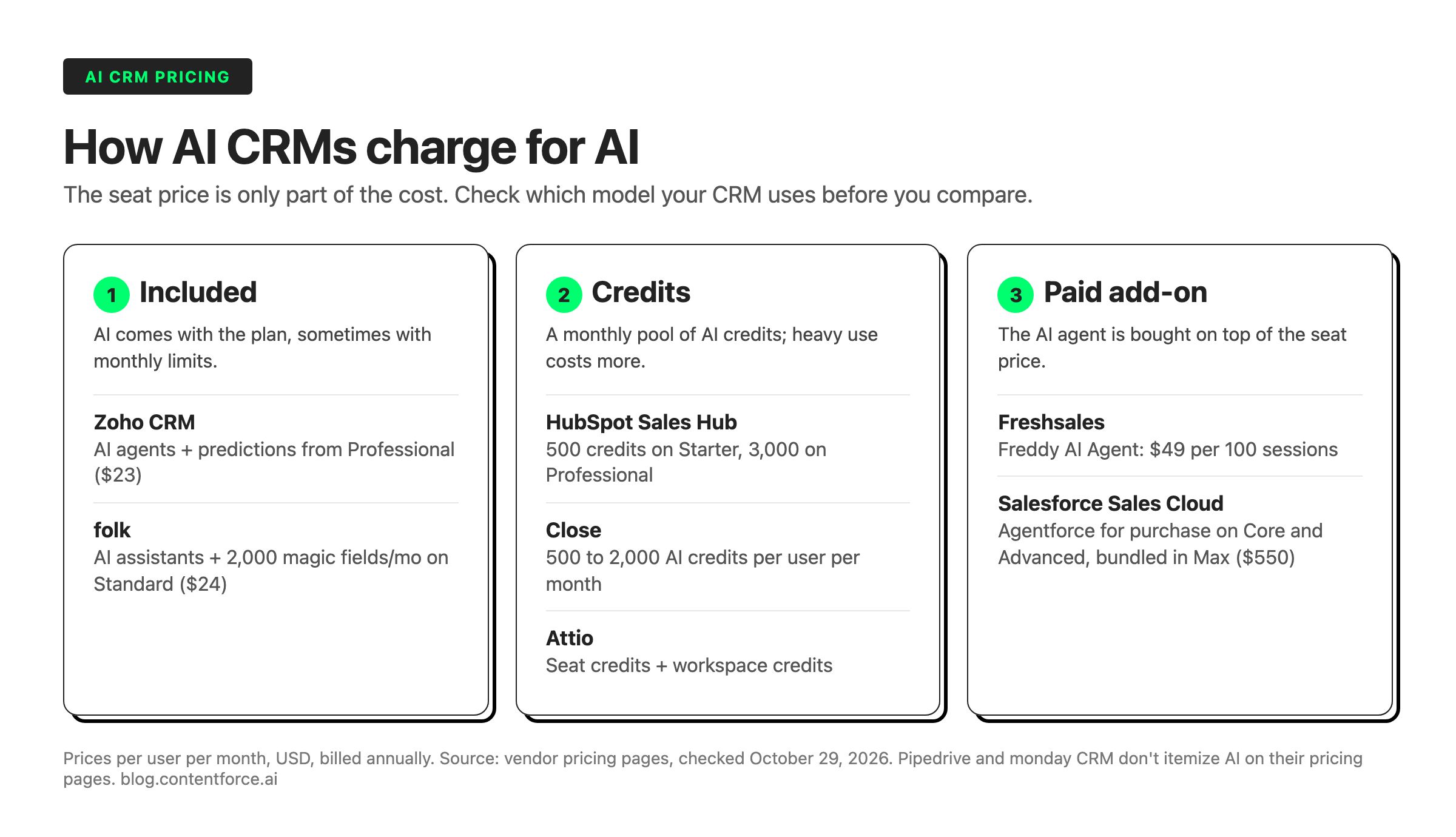
AI CRMs charge for AI in three ways, and you'll want to know which one a tool uses before you compare price tags:
- Included in the seat price: the AI features come with the plan. Zoho lists its AI agents and predictive intelligence as plan features from Professional, and folk includes AI assistants and magic fields from its Standard plan with monthly limits.
- Credits: each plan includes a monthly pool of AI credits and heavy use costs more. HubSpot includes 500 HubSpot Credits in Sales Hub Starter and 3,000 in Professional, Close gives 500 to 2,000 AI credits per user per month depending on the plan, and Attio uses seat and workspace credits.
- Paid add-ons: the AI agent is a separate purchase. Freshsales sells its Freddy AI Agent at $49 per 100 sessions, and Salesforce lists most Agentforce sales agents as "available for purchase" on Core and Advanced and only bundles them in its top Max edition.
Credit-based tools are cheap for light AI use. However, they can get expensive for teams that run agents all day. Add-on pricing makes the AI cost visible, but it's easy to forget when you budget.
The 9 best AI CRMs compared
We read every price and AI feature below on the vendor's own pricing or product pages on October 29, 2026. Prices are per user per month in US dollars, billed annually unless noted. Vendors change plans often and some show local currencies by region, which we've noted where it applies, so treat the numbers as a snapshot and check the pricing page before you buy. We'll update them when we spot changes.
The ranking weighs how useful the built-in AI is for day-to-day selling, how clearly the vendor prices it and how well the CRM fits the team size it targets. It's an editorial comparison based on vendor documentation, not a hands-on lab test.
We didn't use review-site ratings, because we couldn't verify them.
| CRM | Best for | Free plan | Paid plans from | Main AI features | How AI is billed |
|---|---|---|---|---|---|
| HubSpot Sales Hub | Small and mid-sized teams | Free tools | $7 per seat (Starter, annual) | Breeze agents, prospecting agent, notetaker | HubSpot Credits per plan |
| Salesforce Sales Cloud | Large sales organizations | Free Suite | $25 (Starter Suite) | Agentforce agents | Add-on below Max, bundled in Max |
| Zoho CRM | Budget-conscious teams | Yes, up to 3 users | $14 (Standard) | Zia, AI agents, predictive intelligence | Included from Professional |
| Attio | Startups with custom data needs | Yes, up to 3 seats | $35 (Plus) | Ask Attio, call intelligence | Seat and workspace credits |
| Pipedrive | Pipeline-focused sales teams | No | $14 (Lite) | AI Sales Assistant, win probability | Not itemized on pricing page |
| folk | Agencies and relationship-led teams | No (14-day trial) | $24 (Standard) | AI assistants, magic fields | Included, monthly limits per plan |
| Freshsales | Startups on a tight budget | No (21-day trial) | $9 (Growth) | Freddy AI | Freddy AI Agent add-on |
| Close | Inside sales and calling teams | No | $9 (Solo) | Chloe AI sales agent | AI credits per user |
| monday CRM | Teams already on monday.com | No | $12 (Basic) | Lead sourcing, meeting prep and calling agents | Not itemized on pricing page |
1. HubSpot Sales Hub: Best AI CRM for small and mid-sized teams
HubSpot Sales Hub is the easiest way to get an AI CRM running without a large setup project. The free CRM tools cover contacts, deals and a pipeline, so you don't pay anything to start, and the paid Sales Hub plans add HubSpot's Breeze AI features on top. For a team that wants AI help with prospecting, meeting notes and follow-ups without hiring a CRM admin, it's honestly the safest starting point.
Pricing: Sales Hub Starter started at $7 per seat per month on annual billing when we checked, or $20 per seat on monthly billing. Professional starts at $90 per seat per month billed annually ($100 monthly) and Enterprise at $150 per seat. HubSpot charges a one-time onboarding fee on Professional ($1,500) and Enterprise ($3,500). The Starter price looked promotional on the day we checked, so confirm it before you plan a budget around it. It won't necessarily last.
AI features: Starter includes 500 HubSpot Credits a month, the Agent Builder, a prospecting agent and a notetaker for meetings. Professional raises the pool to 3,000 credits and adds forecasting and deal progression features, which HubSpot labels beta.
Strengths: You get a free entry point, a large app marketplace and AI that sits inside the same records your marketing and service teams use. The credit model keeps light AI use cheap.
Limitations: Costs climb quickly from Starter to Professional, though, and heavy AI use eats into the credit pool. Onboarding fees on the higher plans add to year-one cost.
2. Salesforce Sales Cloud: Best AI CRM for large sales organizations
Salesforce Sales Cloud is the most configurable CRM on this list and the one built for large, multi-team sales organizations. Its AI layer, Agentforce, runs agents for lead nurturing, pipeline management and sales actions inside Salesforce data.
Pricing: Salesforce offers a Free Suite, a Starter Suite at $25 per user per month (billed monthly or annually) and a Pro Suite at $100 billed annually. Sales Cloud editions start with Core at $195, Advanced at $395 and Max at $550 per user per month, all billed annually.
AI features: Starter Suite uses AI to sync emails, events and contacts automatically. The pricing table lists Agentforce for Sales, Lead Nurture and Pipeline Management as available for purchase on Core and Advanced. Max, which Salesforce says includes its full suite of AI, adds Agentforce for Sales and Agentforce Coworker plus 2.75 million Flex Credits per org per year.
Strengths: It's got unmatched customization, a huge partner ecosystem and AI agents that can work across sales, service and data in one platform.
Limitations: The full AI suite only comes bundled in the most expensive edition, while every other tier needs add-ons. That's a big jump. Most teams need an admin or a partner to set it up well, and that isn't cheap.
3. Zoho CRM: Best value AI CRM
Zoho CRM packs more AI into a low price than any other full CRM here. Its AI assistant, Zia, handles predictions, recommendations and data enrichment, and the Professional plan adds AI agents that run tasks for you.
Pricing: Zoho CRM is free for up to 3 users. Paid plans start at $14 per user per month (Standard), $23 (Professional) and $40 (Enterprise), with monthly or annual billing and no long-term contract.
AI features: Standard includes data enrichment and sales forecasting, but you won't get AI agents yet. Professional adds AI agents and predictive intelligence that estimates how likely a lead is to convert, a deal to close or a customer to churn. Enterprise adds what Zoho calls extended AI capabilities, with insights, predictions and recommendations from Zia.
Strengths: You're getting strong AI for the price, built-in calling from Standard and a large set of connected Zoho apps if you'll need invoicing or support tools later.
Limitations: The interface is dense, however, and the number of options can slow down setup. The most useful AI predictions start on Professional, not on the cheapest plan.
4. Attio: Best AI-native CRM for startups
Attio is a newer CRM built around a flexible data model, so you can track deals, investors, partners or users in one workspace and shape objects to your process. It calls itself an AI-first CRM, with Ask Attio for analysis and call intelligence for meetings.
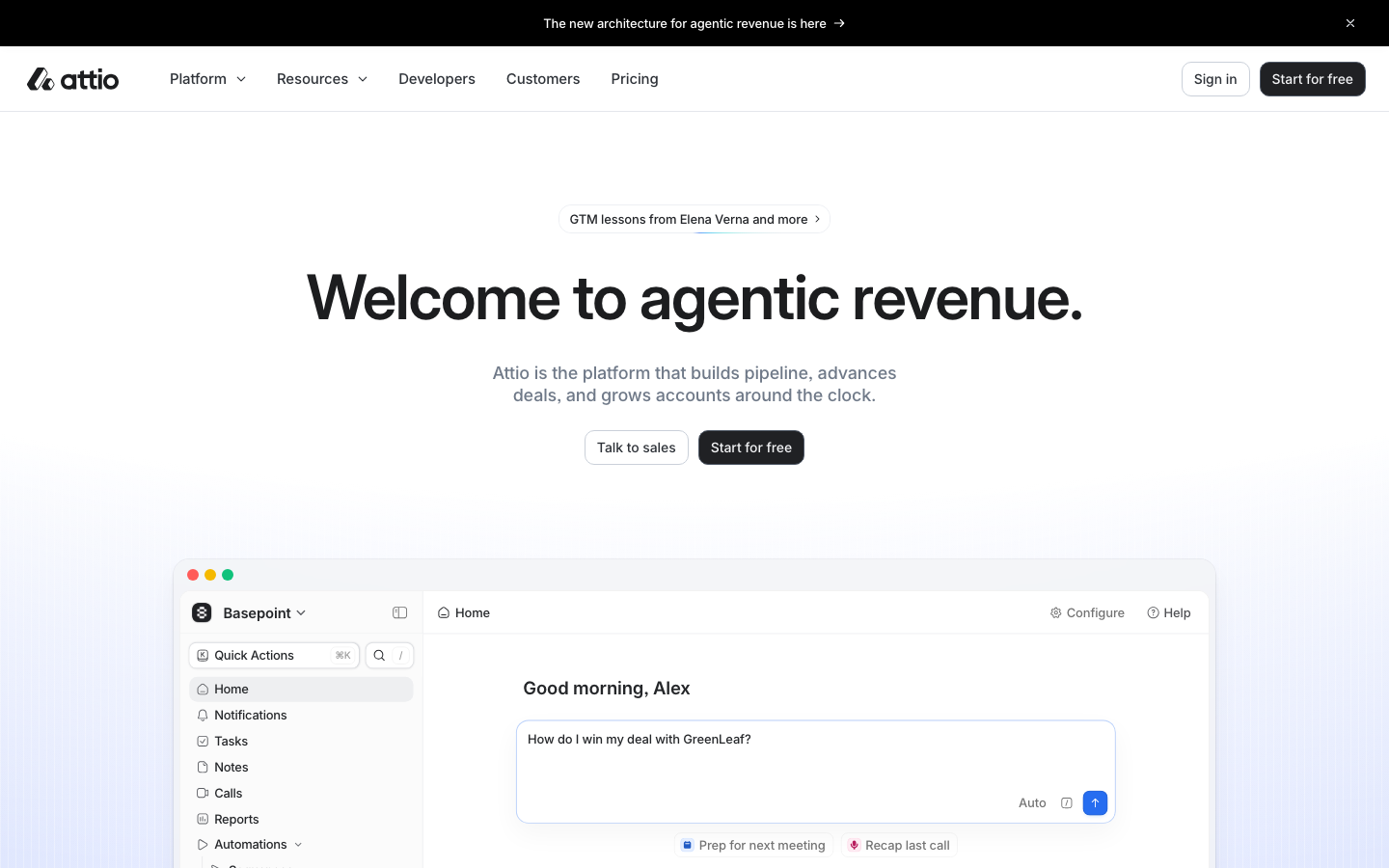
Pricing: Attio has a Free plan for up to 3 seats. Plus costs $35 per user per month billed annually ($44 monthly) for up to 10 seats, Pro costs $79 billed annually ($99 monthly), and Enterprise is priced on request. Attio's site showed euro prices when we opened it from Europe and dollar prices from the US.
AI features: Ask Attio lets you analyze and create with AI across your CRM data. Pro adds call intelligence to record and analyze meetings, plus sequences. AI use is measured in seat credits and workspace credits, and you can buy more workspace credits.
Strengths: A modern interface, real-time contact syncing and automatic enrichment even on the Free plan. Yet the data model isn't limited to classic sales pipelines.
Limitations: Call intelligence and sequences sit on the Pro plan, which isn't cheap: it costs more than many full CRMs. If you want a classic, ready-made sales setup, you'll find the flexibility takes more planning.
5. Pipedrive: Best AI CRM for pipeline-focused sales teams
Pipedrive is built around a visual deal pipeline, and its AI focuses on keeping deals moving. The AI Sales Assistant surfaces patterns in your sales data, answers questions about deals and team performance and suggests next steps.
Pricing: Pipedrive's four plans cost $14, $39, $59 and $79 per seat per month billed annually. There isn't a free plan.
AI features: The Sales Assistant gives AI summaries of deals, recent changes and linked deals, and AI notifications predict a deal's win probability and recommend the next best action. You can also prompt the assistant to analyze team performance.
Strengths: It's really one of the easiest CRMs to learn, with AI that stays close to the pipeline view reps already use every day. You won't need training to get value from it.
Limitations: There's no free plan, and the AI is focused on deals rather than agents that act on their own. Marketing features are thinner than in HubSpot or Zoho.
6. folk: Best AI CRM for agencies and relationship-led teams
folk is a lightweight AI CRM for small sales teams, agencies, founders and anyone who sells through relationships rather than a high-volume pipeline. Contacts come in from LinkedIn and Sales Navigator through the folkX Chrome extension, and email, calendar and WhatsApp sync keep every conversation on the record. AI assistants then research contacts, fill fields and suggest follow-ups, so you aren't copying data by hand.
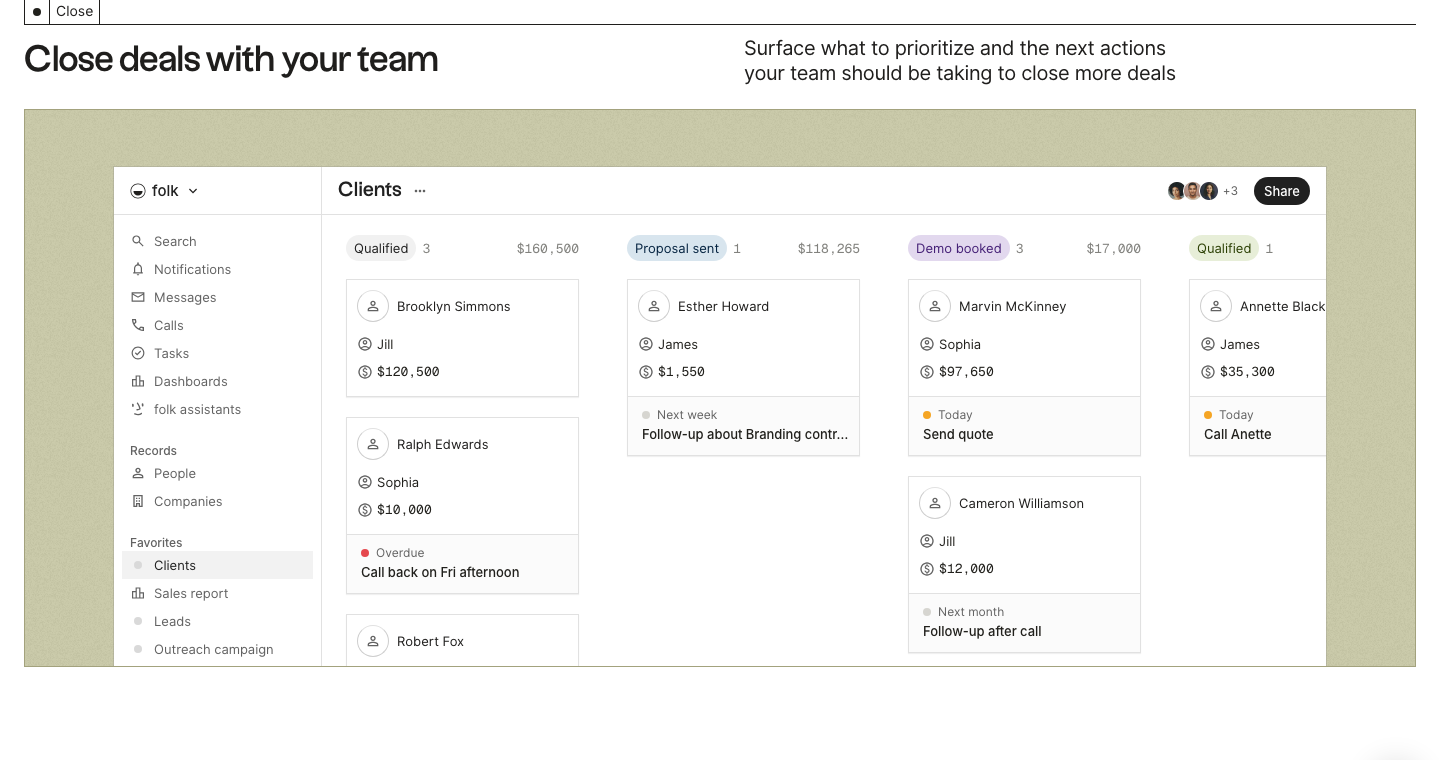
Pricing: folk's Standard plan costs $24 per member per month billed annually ($30 monthly), Premium costs $48 billed annually ($60 monthly) and Enterprise starts at $80 billed annually ($100 monthly). Every new workspace gets a 14-day free trial with premium features and no credit card.
AI features: Standard already includes AI assistants and magic fields, which fill CRM columns with AI. The pricing table lists 2,000 magic field uses a month on Standard and 5,000 on Premium, 200 Research Assistant runs a month on both, and a Workflow Assistant with 1,500 or 10,000 runs. A Follow-up Assistant and a Recap Assistant round out the AI set.
Strengths: AI that comes with the entry plan, a fast LinkedIn workflow and a simple interface that doesn't need a CRM admin. folk's privacy policy says personal data is hosted on Amazon Web Services in Ireland, which helps European teams with GDPR reviews.
Limitations: Email sequences, custom objects for deals and dashboards start on Premium. There's no free plan beyond the trial, and folk is too light for large teams with complex approval processes.
7. Freshsales: Best low-cost AI CRM for startups
Freshsales by Freshworks offers one of the lowest entry prices for a full sales CRM with AI. Freddy AI is Freshworks' AI layer across its products, and the Freddy AI Agent can be added to any plan.
Pricing: Growth costs $9 per user per month, Pro $39 and Enterprise $59, all billed annually. You can try the full CRM free for 21 days.
AI features: Freshsales sells the Freddy AI Agent as an add-on at $49 per 100 sessions on every plan, so the AI agent cost depends on how much you use it. You won't pay for sessions you don't run.
Strengths: It's got a low starting price, a built-in phone and a familiar interface for teams that already use Freshdesk or other Freshworks tools.
Limitations: The AI agent costs extra on top of the seat price, so budget for sessions if you're planning to use it heavily. No free plan after the trial.
8. Close: Best AI CRM for inside sales and calling
Close is a CRM built for teams that sell by phone, email and SMS from one place. Its AI sales agent, Chloe, works across those channels, and the higher plans add a power dialer and workflows.
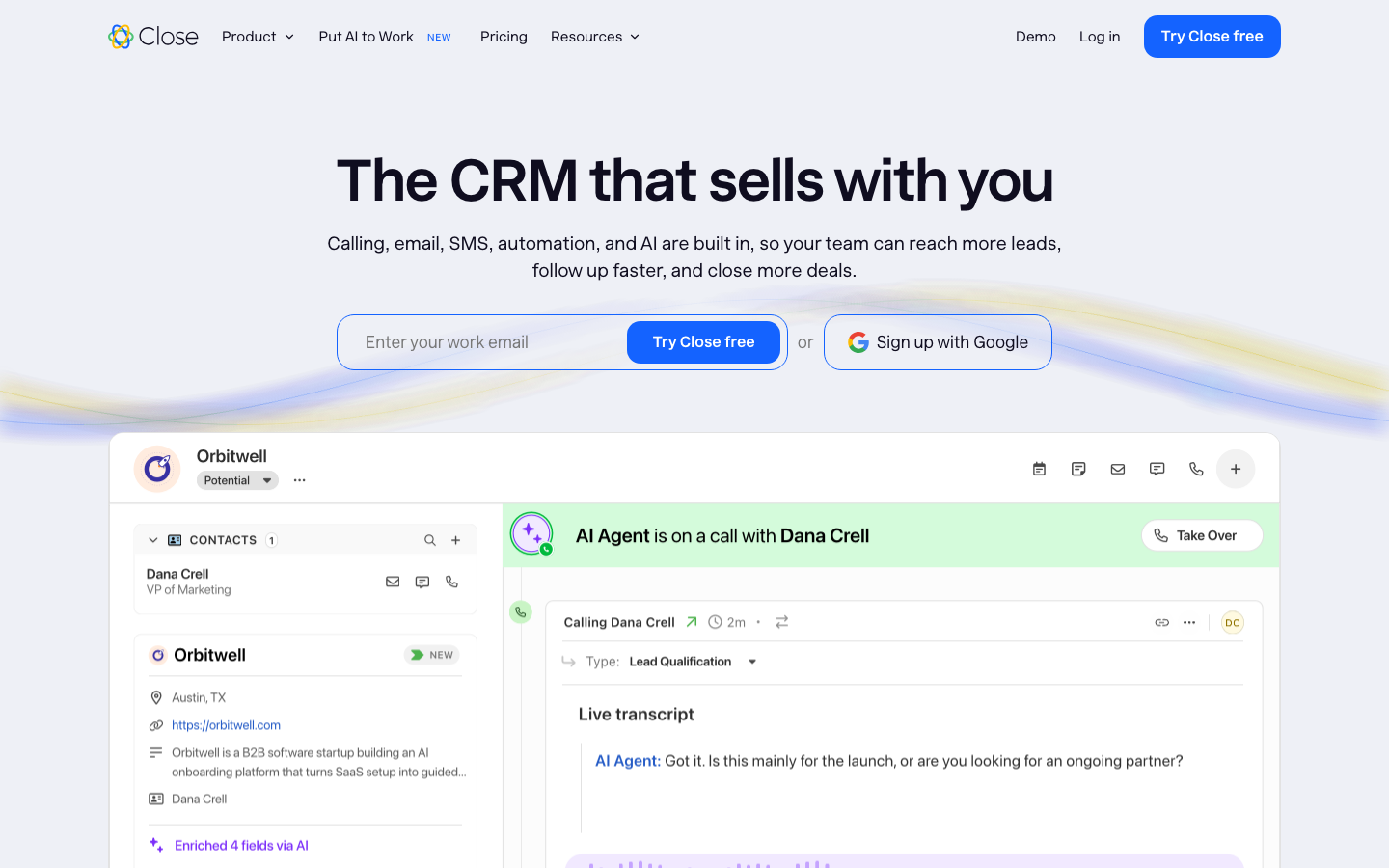
Pricing: Solo costs $9 per user per month billed annually ($19 monthly) and is limited to one user. Essentials costs $35 ($49 monthly), Growth $99 ($109 monthly) and Scale $139 ($149 monthly).
AI features: Every plan includes AI credits for Chloe and the other AI features: 500 per user per month on Solo, 1,000 on Essentials, 1,500 on Growth and 2,000 on Scale. Growth adds Chloe inside workflows and the power dialer, which you'll want for outbound calling.
Strengths: Calling, email and SMS are built in instead of bolted on, which makes Close strong for inside sales teams that live on the phone. It's the one we'd pick for a calling-heavy team.
Limitations: Workflows and the power dialer start on Growth at $99 per user, and the Solo plan only works for one person.
9. monday CRM: Best AI CRM for teams already on monday.com
monday CRM brings sales pipelines into the monday.com work platform, which makes it a good fit when sales and delivery teams already plan their work there. monday now markets it as an AI CRM with a set of ready-made AI agents, and you can build your own agents with a plain-language prompt.
Pricing: Basic costs $12 per seat per month billed annually ($18 monthly), Standard $17 ($25 monthly) and Pro $28 ($41 monthly).
AI features: monday lists a Lead Sourcing Agent that finds, enriches and scores new leads daily against your ideal customer profile, a Meeting Prep Agent, a Calling Agent, a Pipeline Monitor Agent and custom agents. monday says calls, emails and meetings auto-populate the right CRM fields, and that agents handle call prep, meeting notes and follow-ups. The pricing page doesn't itemize which agents come with which plan, so check that with sales before you buy.
Strengths: You'll get very flexible boards, strong automations and an easy handover from sales to project delivery, plus an agent lineup that's broader than most mid-priced CRMs.
Limitations: It's less sales-specific than Pipedrive or Close, and if you only need a CRM, you'll pay for work-management features you won't use. Agent availability per plan isn't clear from the pricing page.
Outline, title, intro, conclusion, FAQ, rewriter and summarizer, each on its own page. No signup.
Which AI CRM fits your team?
The right AI CRM depends on team size, how you sell and how much setup you can handle. Use this table as a shortcut, then check the limits in each entry above. It's a starting point, not a verdict.
| If you are... | Start with | Why |
|---|---|---|
| A small team that wants AI without a contract | HubSpot Sales Hub | Free tools, AI credits on paid plans |
| A large sales organization with admins | Salesforce Sales Cloud | Agentforce across a fully customizable platform |
| A team that needs the most AI per dollar | Zoho CRM | AI agents and predictions from $23 |
| A startup with non-standard data | Attio | Flexible objects and AI-native design |
| A pipeline-driven sales team | Pipedrive | AI win-probability and next steps in the pipeline |
| An agency or founder who sells through LinkedIn | folk | AI assistants on the entry plan, LinkedIn capture |
| A startup on a tight budget | Freshsales | $9 entry price, AI agent pay-as-you-go |
| An inside sales team that calls a lot | Close | Calling and the Chloe agent built in |
| A team already on monday.com | monday CRM | Sales and delivery in one workspace |
Team size changes the answer more than features do. Still, features aren't irrelevant. Under 10 users, choose the tool your team will actually keep updated, because AI can't score or summarize data that never makes it into the CRM. Between 10 and 50 users, though, look at how AI is billed, since credits and add-ons scale with every seat. Above 50 users, admin control, permissions and integrations matter more than any single AI feature.
That's where Salesforce and HubSpot Enterprise earn their price.
How to roll out an AI CRM without bad data
An AI CRM is only as good as the data it learns from.
Most failed rollouts don't fail because the AI is weak. They fail because duplicate contacts, empty fields and deals with no activity give the AI nothing reliable to work with.
So don't start with agents.
Roll it out in this order:
- Clean and import your data first. Remove duplicates, merge companies and fix missing emails before the import. Most CRMs on this list, including folk and Zoho, support CSV import and export.
- Connect email and calendar on day one. Automatic activity capture is the AI feature that saves the most time, and it only works once inboxes are synced.
- Turn on scoring and summaries before agents. Let the AI predict and summarize for a few weeks so your team can see whether it's worth trusting.
- Add AI agents for one narrow job. Start with a single task such as follow-up reminders or prospect research, measure it, then expand.
- Review AI usage monthly. Check credit or session use against your plan so credit pools and add-ons won't surprise you on the invoice.
Before you sign, run through this checklist. It'll take ten minutes and it's cheaper than a bad contract:
- Which AI features are included in the plan you'd buy, and which are add-ons?
- How does the vendor meter AI (credits, sessions or included)?
- Does the free plan or trial include the AI features you want to test?
- Where is your customer data hosted, and is there a data processing agreement?
- Can you export all your data if you switch later?
If you also run cold email from your CRM, pair it with one of the best email deliverability tools so your messages reach the inbox. For AI tools beyond sales, see our guide to the best AI tools.
Frequently asked questions
What is the best AI CRM?
The best AI CRM for most small and mid-sized teams is HubSpot Sales Hub, because it combines free CRM tools with AI agents, a prospecting agent and a meeting notetaker on its paid plans. Salesforce Sales Cloud is better for large organizations, whereas Zoho CRM gives the most AI for the money, and folk is the best fit for agencies and relationship-led teams.
Is there a free AI CRM?
Yes, several AI CRMs have free plans. Zoho CRM is free for up to 3 users, Attio's Free plan covers up to 3 seats with automatic enrichment, HubSpot offers free CRM tools and Salesforce has a Free Suite. The free plans usually don't include the stronger AI features, such as agents, predictions or call intelligence, which start on paid tiers.
How much does an AI CRM cost?
Most AI CRMs on this list cost between $9 and $100 per user per month for the plans small and mid-sized teams buy. Freshsales and Close start at $9 billed annually, Zoho at $14, folk at $24 and Attio at $35. Enterprise editions cost far more, with Salesforce Max at $550 per user per month. Credits, AI add-ons and onboarding fees can add to the seat price, so don't compare seat prices alone.
Can AI build or replace a CRM?
AI can't replace a CRM, although it can do much of the manual work inside one. AI features log emails and meetings, enrich records, score leads, summarize calls and draft follow-ups. You'll still need a CRM as the system of record that stores customer data and the history of every deal.
What is HubSpot AI?
HubSpot AI, branded Breeze, is the set of AI features built into HubSpot's products. In Sales Hub it includes an Agent Builder, a prospecting agent and a meeting notetaker, and it runs on HubSpot Credits that come with each paid plan: 500 a month on Starter and 3,000 on Professional.
Which AI CRM is best for small businesses?
For small businesses, HubSpot Sales Hub and Zoho CRM are the strongest all-round choices, because both offer free entry points and add AI features as you grow. Small teams that sell through relationships and LinkedIn should look at folk, which includes AI assistants on its entry plan, and teams that mostly sell by phone should look at Close.