
Review
Ahrefs Review 2026: Honest Verdict After 12 Months

Ahrefs is worth the price in 2026 for agencies and in-house teams that need the deepest backlink and keyword data and can accept its per-seat, no-trial pricing model starting at $129 a month for Lite. Skip it if you run one small site or want to try before you pay.
- A deep, self-crawled backlink index most competitors get benchmarked against
- MCP Server access included on every paid tier for AI assistants
- Real field Core Web Vitals data in Site Audit, not simulations
- No free trial on any paid plan
- Per-seat and per-project add-on costs escalate fast for agencies
- Daily rank tracking costs extra instead of coming standard
- Good fit for
- agencies and in-house teams that need deep backlink and competitive research
- Not a fit for
- single-site hobbyists or teams that want to try before paying
- Starting price
- $129 per month for the Lite plan
- Free trial
- None on any paid plan
As of September 2026
Ahrefs is one of the most recognizable names in SEO software. It is also one of the most argued-about. Search for "ahrefs review" and you will find agencies complaining about per-seat pricing, a Trustpilot score that looks nothing like its G2 rating, and three or four competitors pitching themselves as the "real" alternative. This review pulls those threads together: what Ahrefs does well, what it costs in 2026 once every add-on is counted, how it stacks up against Semrush, Moz and SE Ranking, and who should buy it.
Quick Verdict: Is Ahrefs Worth It in 2026?
Yes, with a condition. Ahrefs earns its price if you need the deepest backlink and keyword data available and can absorb its per-seat, no-trial pricing model. Skip it if you run one small site, want to try before you pay, or lead a team large enough that seat and project add-ons quietly double the sticker price.
Plans start at $129 a month for Lite. No paid tier offers a free trial. On third-party review platforms, Ahrefs holds a 4.5 out of 5 on G2 across 667 reviews and a 4.7 out of 5 on Capterra across 578 reviews, both tracking its reputation among working SEOs. Its 2.0 out of 5 on Trustpilot, based on 319 reviews, tells a different story: billing and support complaints, not data-quality complaints. The reviews section further down explains why that gap exists.
- Best for: agencies and in-house teams doing heavy backlink analysis, competitive research or content-gap work
- Not ideal for: single-site hobbyists, anyone who wants to trial before paying, or teams that need many seats on a mid-tier plan
- Standout strength: Site Explorer's backlink index, the tool most competitors get benchmarked against
- Standout weakness: no free trial, and a real monthly cost for multi-person teams that runs well past the advertised price
What Is Ahrefs and Who It's Built For
Dmytro Gerasymenko founded Ahrefs in 2010. The company is headquartered in Singapore. It started as a backlink checker and grew into a full SEO platform covering keyword research, rank tracking, site auditing, content research and, as of 2026, AI-search-visibility tracking through a feature called Brand Radar. Unlike most of its category, Ahrefs stayed bootstrapped. It grew without outside venture funding. That matters because it explains the product strategy: no aggressive freemium funnel, no investor-driven push toward a free trial, and steady reinvestment into its own web crawler instead of licensing backlink data from a third party.
Ahrefs serves three overlapping groups in practice. Solo consultants and freelancers use it mainly for client audits and keyword research on the Lite plan. In-house marketing teams use Standard or Advanced to manage a handful of owned properties and run recurring rank tracking. Agencies push the platform hardest, running many client projects at once. That is exactly where the per-seat and per-project limits described later in this review start to bite.
Ahrefs Features Tested: Every Core Tool Explained
Every plan opens the same core toolset. The difference between tiers is volume: projects, tracked keywords, crawl credits, not which tools you can open. Here is what each one does.
Site Explorer and Backlink Analysis
Site Explorer is still the reason most people buy Ahrefs. Enter any domain or URL and you get its backlink profile, referring domains, organic keyword rankings and estimated traffic, all pulled from Ahrefs' own crawl rather than a licensed third-party dataset. The Backlinks and Broken Backlinks reports let you filter by follow/nofollow status, anchor text and first-seen date, which matters for link-building prospecting and disavow work alike.
As a live example pulled through Ahrefs' own API while researching this review, ahrefs.com's own domain carries a Domain Rating of 91.0 out of 100 and an Ahrefs Rank of 618 globally. That gives useful context for how the tool scores an established, heavily-linked-to site against a newer domain. Independent testing elsewhere tells a more cautious story. Style Factory Productions ran a 9-domain backlink-count comparison against Moz and Semrush and found Ahrefs reporting fewer total backlinks than both rivals on most domains tested. A smaller raw count is not automatically worse data; crawl frequency, deduplication rules and recrawl priority all affect the number differently across vendors. Still, the three tools are not interchangeable for absolute link-count reporting.
Keywords Explorer
Keywords Explorer covers search volume, keyword difficulty, click-through-rate estimates and a "traffic potential" metric: an estimate of the total traffic the top-ranking page for a keyword receives across every term it ranks for, not just the one you searched. Volume and difficulty data cover most major search engines, not only Google. The keyword-idea reports (Matching terms, Related terms, Also rank for) build topical clusters well, not just one-off keyword lists.
A live pull from Keywords Explorer for "ahrefs review" itself, US search volume, returns 2,800 monthly searches, a difficulty score of just 16 out of 100, a cost-per-click of $1.80, and a traffic potential of 350. Low competition despite the volume. That traffic-potential number means the current top-ranking page for this exact term pulls an estimated 350 monthly visits across every keyword it ranks for, not just this one. The gap between 2,800 searches and 350 traffic potential shows what the metric actually measures: how much of that demand a single ranking page really captures.
Rank Tracker
Rank Tracker monitors ranking positions by keyword, device and location, down to city level in supported countries. It tracks your own domain alongside a list of competitors in the same project, so gains and losses show up in context. The catch: daily-frequency tracking is not included by default on the lower tiers. It is sold as a separate add-on for $100 to $250 a month depending on plan, so budget-tier users are stuck with weekly updates unless they pay extra, a detail Ahrefs does not put front and center on its pricing page. Weekly tracking is fine for agencies reporting to clients on a weekly cadence. For teams watching volatile SERPs during an active campaign or an algorithm-update recovery, the daily add-on is close to a necessity.
Site Audit
Site Audit crawls a site for technical SEO issues. It reports both field data, real Core Web Vitals pulled from Chrome User Experience data, and lab data, a real step up from tools that only offer a Lighthouse-style simulation. The issue list groups problems by severity and category: performance, HTML tags, content quality, internal linking. Each issue links to an explanation of why it matters and how to fix it, which makes the report usable for someone who did not run the crawl themselves. Crawl volume is capped by the "crawl credits" figure on each plan, from 100,000 on Lite up to 1,500,000 on Advanced. Large sites can burn through a monthly allowance faster than expected on a full re-crawl schedule instead of an incremental one. A mid-size site of a few thousand pages can eat a meaningful share of a Lite plan's monthly credits in one full crawl. Worth checking before scheduling recurring full audits on the entry tier.
Content Explorer and Alerts
Content Explorer searches a database of published web content by topic. It is useful for finding link-building targets, guest-post outreach angles, or content gaps competitors have already covered, and it is locked to Standard and above. Ahrefs Alerts sends notifications for new or lost backlinks and keyword ranking changes, a lightweight monitoring layer that is easy to set up and easy to ignore once inbox fatigue sets in. Ahrefs also runs a public help center at help.ahrefs.com with a documented breakdown of what each metric measures, worth bookmarking for anyone new to terms like "traffic potential" or "crawl credits."
Outline, title, intro, conclusion, FAQ, rewriter and summarizer, each on its own page. No signup.
Ahrefs Pricing in 2026: Every Plan and Add-On
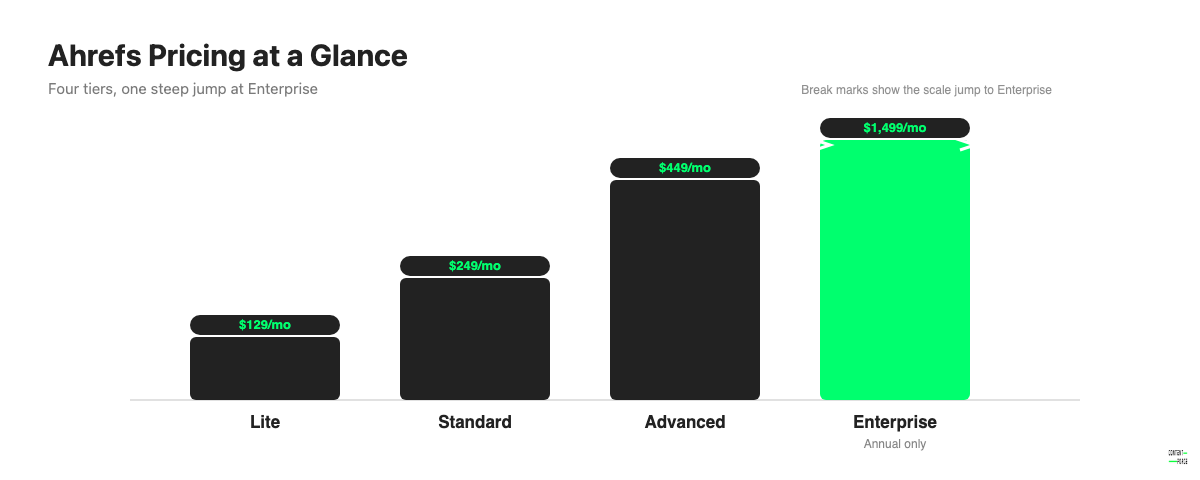
Ahrefs runs four core paid tiers plus a cheaper Starter option and a free tool. No paid plan offers a trial, the single biggest objection every competitor in this review's benchmark set raises. The figures below come straight from ahrefs.com's official pricing page, not a third-party summary.
| Plan | Monthly price | Projects | Tracked keywords | Crawl credits | Included users |
|---|---|---|---|---|---|
| Starter | $29/mo | Limited | Limited | Limited | 1 |
| Lite | $129/mo | 5 | 750 | 100,000 | 1 |
| Standard | $249/mo | 20 | 2,000 | 500,000 | 1 |
| Advanced | $449/mo | 50 | 5,000 | 1,500,000 | 1 |
| Enterprise | $1,499/mo (annual only) | 50+ | 5,000+ | Personalized | 1+ |
Every tier, Lite included, now bundles Site Explorer, Keywords Explorer, Site Audit, Rank Tracker, Web Analytics, API access, an MCP Server for connecting Ahrefs data to Claude, ChatGPT or other LLM tools, and Report Builder. Content Explorer, Portfolios and Batch Analysis stay gated to Standard and above. Enterprise adds uncapped API usage, SSO and unlimited historical data on top of Advanced's limits.
Add-ons are where the sticker price stops telling the full story:
- Extra user seats: $40/mo on Lite, $60/mo on Standard, $80/mo on Advanced, $100/mo on Enterprise, per additional seat
- Content Kit (AI Content Helper, Grader, Inventory): from $99/mo
- Report Builder scaling: $99/mo for expanded report and widget limits
- Brand Radar AI, the AI-search-visibility tracker: from $199/mo
- Daily Rank Tracker upgrade: $100 to $250/mo depending on plan
- Project Boost Pro at $20 per project a month; Project Boost Max at $200 per project a month
- Standalone API tiers outside a normal plan: $500, $2,000 or $10,000 a month depending on volume
Annual billing knocks roughly 17% off every tier. That is the closest thing Ahrefs offers to a discount, since there is no trial and no refund for unused months once you commit to an annual plan. For a deeper breakdown of every plan and add-on, see our full Ahrefs pricing guide.
What Ahrefs Actually Costs by Team Size
The advertised price covers one seat on one project tier. Add real usage and the total shifts fast. Here is what three common team sizes pay per month, using Standard as the working example since it is the most common tier for teams past a single freelancer.
| Team size | Base plan | Extra seats | Add-ons commonly needed | Realistic monthly total |
|---|---|---|---|---|
| Solo consultant, 1 client | Lite | $0 | None | $129/mo |
| Small in-house team, 3 users | Standard | 2 extra seats x $60 = $120 | None | $369/mo |
| 10-client agency | Advanced | 4 extra seats x $80 = $320 | Daily Rank Tracker ~$150, Project Boost for overflow clients ~$100 | ~$1,019/mo |
The jump between advertised and realistic cost is largest for agencies, exactly the group Ahrefs markets to hardest. A 10-client agency running daily rank tracking with a few seats past the included one lands closer to $1,000 a month than the $449 Advanced sticker price, before any standalone API usage.
Ahrefs vs Semrush vs Moz vs SE Ranking: Full Comparison Table
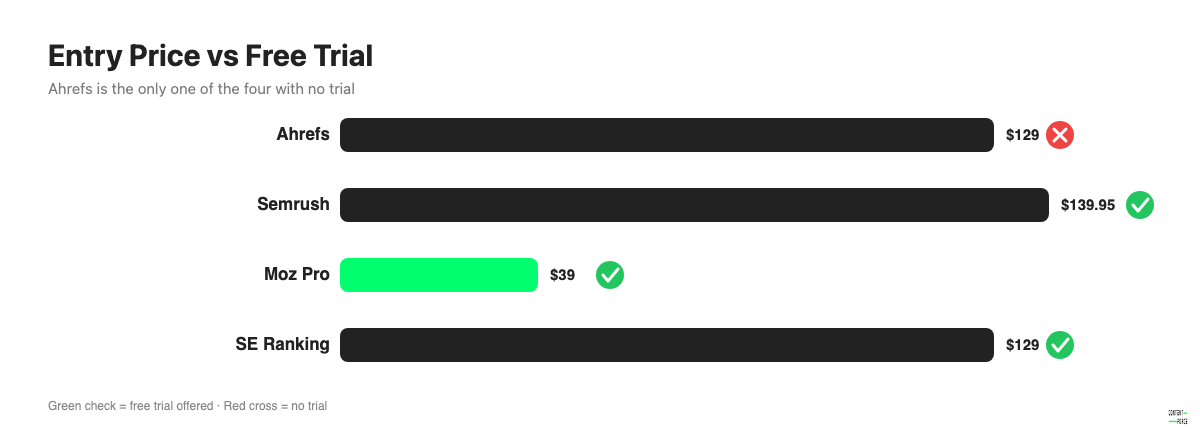
Ahrefs is not the only serious option. The SERP for "ahrefs review" makes clear that most buyers compare at least one alternative before deciding. Here is how four commonly-compared competitors line up on the factors that actually change a buying decision.
| Tool | Entry price | Free trial | AI-search-visibility feature | Standout strength |
|---|---|---|---|---|
| Ahrefs | $129/mo (Lite) | None | Brand Radar, from $199/mo add-on; base MCP access included | Backlink index depth, MCP/LLM integration |
| Semrush | $139.95/mo (Pro+) | 7 days, up to 14 via some partner offers | AI visibility tracking bundled into higher tiers | Broadest all-in-one feature set: PPC, social, content |
| Moz Pro | $39/mo (Starter) | 7 days | Limited next to Ahrefs and Semrush | Lowest entry price, simpler learning curve |
| SE Ranking | $129/mo (Core) | 14 days, no credit card required | AI search tracking as a paid add-on | Strong value at the Growth tier, transparent white-label option |
Ahrefs and Semrush sit closest in price and depth. The real difference is scope, not data quality. Semrush bundles content marketing, PPC research and social tools Ahrefs does not attempt to match, while Ahrefs keeps a narrower, more backlink-and-keyword-focused product. Teams that only care about backlinks and organic keyword research tend to prefer Ahrefs' tighter interface. Teams that need to justify one tool budget across SEO, paid search and content lean toward Semrush, partly because its trial makes that internal pitch easier before anyone commits.
Moz sits at the budget end of this group but trails both on feature depth once you compare Site Audit and Keywords Explorer directly. Its strength is approachability. A simpler interface and a lower learning curve make it a reasonable starting point for someone new to SEO tooling, at the cost of the granularity power users expect from Ahrefs or Semrush. See our full Ahrefs vs Moz comparison for the complete pricing and authority-metric breakdown.
SE Ranking beats Ahrefs on trial policy, 14 days with no card required against zero, and is the most upfront of the four about add-on costs. That transparency is the exact complaint Ahrefs draws most often. Its backlink and keyword database runs smaller than Ahrefs' or Semrush's, a gap that shows up mainly on larger, more established sites where crawl history and index size matter more.
Ahrefs Brand Radar and AI Search Visibility, Explained
Brand Radar is Ahrefs' answer to the shift toward AI-generated answers in ChatGPT, Perplexity and Google's AI Overviews. It tracks how often a brand or domain gets mentioned or cited across a database of more than 271 million tracked AI prompts, a rough equivalent to "share of voice" for AI answers instead of classic SERP rankings.
The base MCP Server lets Claude, ChatGPT and other LLM tools query Ahrefs data directly. It ships on every paid tier starting at Lite, a forward-looking inclusion most competitors have not matched yet. In practice, a connected AI assistant can pull live domain-rating, keyword-volume or backlink data straight from Ahrefs' index during a conversation, no manual export required. That is the same live-data connection used to source the ahrefs.com domain-rating and keyword-volume figures cited earlier in this review.
Full Brand Radar reporting sits behind its own add-on starting at $199 a month, separate from the base plan price. It tracks brand and domain mentions across AI-generated answers rather than traditional blue-link rankings. For teams already worried about AI-search visibility, that add-on is a real extra cost on top of an already expensive base plan. It is also one of the more complete implementations of the category on the market right now, ahead of where Semrush and SE Ranking's equivalent features stood at the time of writing. Rankability, Rankmax and Style Factory Productions, the three highest-ranking review pages for this exact query, name Brand Radar but never test it. That leaves one of Ahrefs' newest, most actively marketed features under-covered across the entire current conversation.
What's New in Ahrefs for 2026
The most visible shift in Ahrefs' product this year: a move from "backlink and keyword tool" to "SEO plus AI-search-visibility platform." Brand Radar, the MCP Server and Web Analytics now sit as standard parts of the core plan lineup rather than bolted-on side products; every tier, including Lite, carries MCP access by default. Web Analytics, a lighter first-party analytics layer, lets Ahrefs users see on-site traffic behavior without leaving the platform, a capability absent from earlier plan generations.
The entry-level plan does more than it used to. The headline monthly price has not dropped to match, and the newest capability, full Brand Radar reporting, still sits behind its own separate add-on rather than folding into the base price. Anyone comparing Ahrefs against an older review published before 2026 should re-check the plan feature list. MCP Server access and baseline Brand Radar visibility were not standard inclusions in prior pricing generations.
Ahrefs Reviews: What G2, Capterra, and Trustpilot Users Say
Third-party ratings for Ahrefs split sharply depending on where you look. The split is informative once you know what each platform's reviewer base looks like.
- G2: 4.5 out of 5 across 667 reviews, weighted toward working SEOs and marketers rating the product's actual data and workflow
- Capterra: 4.7 out of 5 across 578 reviews, a similar professional-user base to G2
- Trustpilot: 2.0 out of 5 across 319 reviews, weighted more heavily toward billing, cancellation and support complaints than data-quality complaints
The gap is not really about whether the data is good. G2 and Capterra reviewers, mostly people actively using the product day to day, rate it well. The recurring praise across both platforms centers on backlink and keyword data accuracy and the depth of the reporting once you know how to use it. Trustpilot skews toward people who had a bad support or billing experience and went looking for a place to leave a public complaint, a known pattern across SaaS review platforms generally, not unique to Ahrefs. The visible complaint themes there lean toward pricing and support, not data quality. Read the Trustpilot score as a support-and-billing signal, not a data-quality signal, and weigh it against the more usage-focused G2 and Capterra numbers.
Pros and Cons of Ahrefs
Reasons to use Ahrefs
- A deep, self-crawled backlink index that most competitors get benchmarked against
- MCP Server access included on every paid tier for connecting to AI assistants
- Real field Core Web Vitals data in Site Audit, not just lab simulations
- Keyword-idea and content-gap discovery tools that go beyond basic volume lookups
Reasons to think twice
- No free trial on any paid plan
- Per-seat and per-project add-on costs escalate fast for agencies
- Daily rank tracking costs extra instead of coming standard
- A Trustpilot score that reflects real, recurring billing and support friction
Ahrefs Alternatives Worth Considering
- Semrush: best if you want one platform covering SEO, PPC, content and social research together, and can use its 7-to-14-day trial window before committing. See also our free Semrush alternatives roundup if budget decides.
- Moz Pro: best for smaller budgets or teams newer to SEO who want a simpler interface and a lower entry price, at the cost of shallower backlink and audit depth
- SE Ranking: best if trial access and transparent add-on pricing matter more than the single deepest backlink index, with a genuine free trial and no credit card required
- Ahrefs Free / Ahrefs Starter: worth trying first if you are not sure you need a full paid tier. Ahrefs Free gives limited access to core data at no cost; Starter at $29 a month covers basic search and competitor-spying before you commit to Lite.
Who Should (and Shouldn't) Buy Ahrefs
Ahrefs is the right call for agencies and in-house teams that live in backlink and competitive research daily, and for anyone who wants AI-assistant access to SEO data through the MCP Server without a separate integration to build. It is worth it for beginners only if they are serious about learning SEO as a profession; the interface assumes some baseline familiarity with concepts like keyword difficulty and referring domains.
- Solo consultants: Lite is usually enough, and $129 a month is straightforward to pass on to a single retained client
- In-house marketing teams: Standard fits most teams managing a handful of owned properties, though extra seats add up past 2-3 direct users
- Agencies: Advanced or Enterprise, budgeted around the realistic add-on-inclusive total, not the sticker price
- Beginners learning SEO seriously: worth the investment once fundamentals are in place; Ahrefs Free is a reasonable starting point before that
- Casual or single-site users: better served by Ahrefs Free, Starter, or a cheaper competitor until real multi-project needs appear
Skip it if you manage a single small site and only need occasional keyword checks. Ahrefs Free, Starter, or a cheaper competitor like Moz's entry tier covers that need without Lite's $129-a-month commitment. It is also a harder sell for larger agencies unless you have already budgeted the realistic, add-on-inclusive monthly total, not the advertised base price.
Ahrefs Review FAQ
Does Ahrefs offer a free trial?
No. As of 2026, Ahrefs offers no free trial on any paid plan. The closest option is Ahrefs Free, a limited free tier, or the $29-a-month Starter plan for basic use cases.
Is Ahrefs good for beginners?
It can be, though it was not built specifically for beginners. The interface assumes familiarity with core SEO concepts: keyword difficulty, referring domains, crawl credits. Beginners serious about learning SEO as a profession get real value from it. Casual or one-off users will probably find Ahrefs Free enough.
How does Ahrefs compare to Semrush?
They sit close in price, and both offer deep backlink and keyword data. Semrush covers more ground overall (PPC, content marketing, social tools) and offers a free trial. Ahrefs stays more focused on backlink and keyword depth and includes MCP/AI-assistant access on every tier, with no trial period.
Can I cancel Ahrefs anytime?
Monthly plans cancel anytime and will not renew past the current billing period. Annual plans carry no refund for unused months after cancellation, so canceling mid-term does not return a prorated refund.
Does Ahrefs data update in real time?
No tool in this category updates every metric in real time. Ahrefs' backlink index recrawls on its own schedule based on a site's crawl priority. Rank Tracker defaults to weekly position updates unless you buy the Daily Rank Tracker add-on ($100 to $250 a month depending on plan). Site Audit crawl frequency depends on how the project is configured and how many crawl credits remain for the month.
Is Ahrefs worth it for a single small website?
Usually not, at Lite's $129-a-month price point. A single small site rarely needs 750 tracked keywords or 100,000 monthly crawl credits. Ahrefs Free or the $29-a-month Starter plan covers basic competitor-spying and keyword lookups without the larger commitment. Lite starts to make sense once you manage more than one property or take on regular client work.