
Ahrefs wins on raw data scale and Moz wins on price, but the real question behind this search is narrower than “which tool is better.” It’s whether Ahrefs’ Domain Rating and Moz’s Domain Authority can actually be trusted, since both tools build their entire pitch around a single proprietary score. A 2023 peer-reviewed study found both metrics hold up far better than their different methodologies would suggest, correlating at a Spearman’s rho above 0.9 across more than 3,000 domains. That finding, not a feature checklist, is the real answer to this comparison.
Ahrefs vs Moz at a Glance
Ahrefs is the larger, more expensive platform built around a bigger backlink and keyword index. Moz is the cheaper, more approachable platform built around its Domain Authority metric and a simpler workflow. Neither tool’s score is objectively more accurate than the other’s. They measure different things with different data, and an independent study found their authority scores agree closely despite that.
| Ahrefs | Moz Pro | |
|---|---|---|
| Cheapest full plan (USD per month) | 129 (108 annual) | 99 (79 annual) |
| Backlink index | 493 billion pages, 209 million domains | Not publicly disclosed at a current, verifiable figure |
| Keyword database | 28.7 billion keywords (2.7 billion US) | 1.25 billion keyword suggestions, 180 million ranking keywords |
| Authority metric | Domain Rating (DR), 0 to 100 | Domain Authority (DA), 1 to 100 |
| Best fit | Agencies and in-house teams that need the largest possible data set | Small businesses and solo marketers who want core SEO metrics without the learning curve |
Choose Ahrefs if the size and freshness of the backlink index matters more than price. Choose Moz if a lower entry cost and a simpler interface matter more than having the largest index on the market.
What Ahrefs and Moz Actually Do
Ahrefs and Moz each bundle keyword research, backlink analysis, rank tracking, and site auditing into one subscription, but they built those tools around different starting points.
What Ahrefs Does
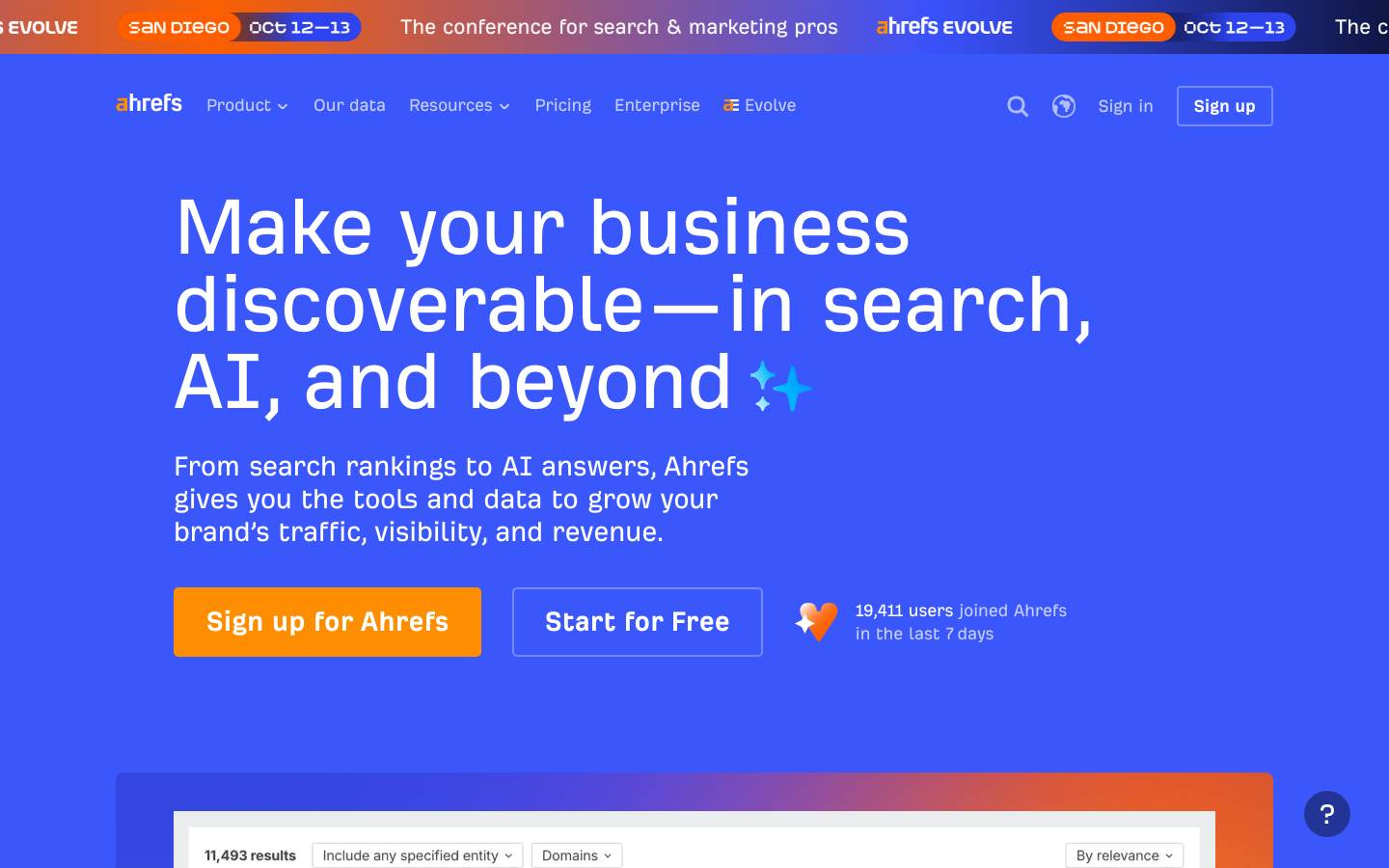
Ahrefs started as a backlink index and still leads with it. Site Explorer (backlink and traffic data for any domain), Keywords Explorer (keyword volume and difficulty), Rank Tracker, Content Explorer, and Site Audit all sit on top of the same crawl data, and Ahrefs markets itself as running “the second most active web crawler after Google.” That crawler is also how Ahrefs builds its newer AI-tracking features, including Brand Radar, which checks how brands appear across AI search results and prompts.
What Moz Does
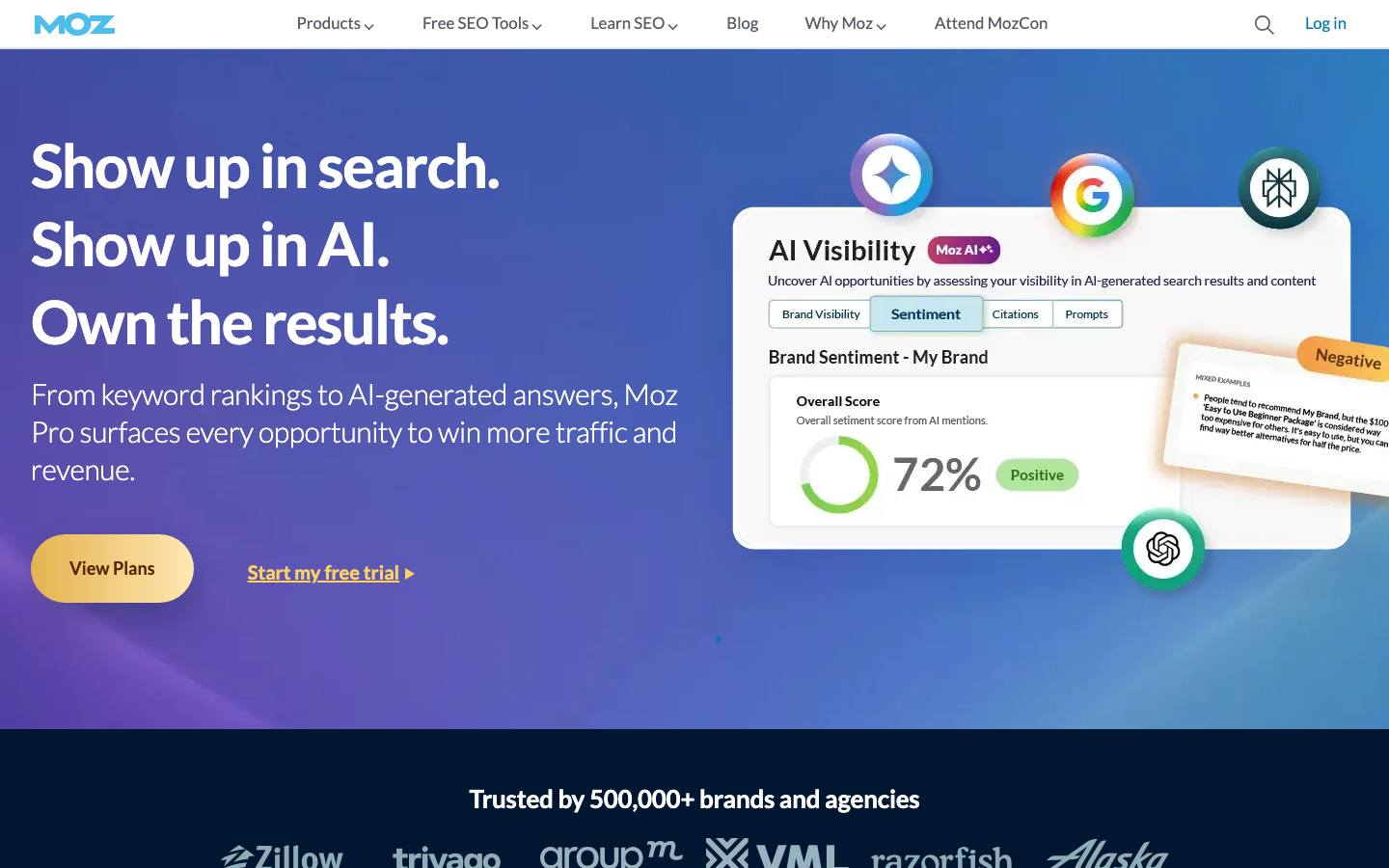
Moz built its reputation on Domain Authority and a friendlier learning curve. Link Explorer (backlink lookup), Keyword Explorer, Campaigns (ongoing site tracking), On-Page Grader, and the MozBar browser extension cover the same core SEO workflow as Ahrefs, with a smaller index behind them and a lower starting price. Moz Pro has also added AI visibility tracking across GPT, Gemini, Google AI Mode, and Perplexity, matching the direction every major SEO platform has taken in 2026.
Rank Tracking and Reporting
Ahrefs and Moz track rankings on a weekly cycle by default, so neither has a meaningful speed edge out of the box. Ahrefs’ Rank Tracker refreshes tracked keywords weekly on every plan, and daily tracking is only available through the separate Project Boost Max add-on. Moz Pro’s Campaigns update rankings and crawl data weekly too, while social mentions and traffic data inside the same campaign refresh daily. For reporting, Ahrefs centralizes dashboards through its Report Builder add-on (50 reports, 500 widgets, scheduling), while Moz bundles scheduled and branded reports directly into its Medium and Large tiers at no extra cost, which matters for agencies that resell white-labeled reports to clients.
Domain Rating vs Domain Authority: Which Metric Holds Up?
Domain Rating and Domain Authority measure the same general idea (how strong a site’s link profile is relative to others) but calculate it from different indexes using different formulas, so the raw numbers are never directly comparable between the two tools. What a 2023 peer-reviewed study found, however, is that despite those different formulas, the two scores rank sites in almost the same order.
How Ahrefs Calculates Domain Rating
Domain Rating is Ahrefs’ proprietary score for the “backlink popularity” of a site, built from its own crawl of 493 billion pages across 209 million domains. Ahrefs says that index refreshes every 15 minutes, and that’s clearly faster than most competitors disclose for their own crawl cycles. DR runs on a 0 to 100 scale and it reflects the strength of a site’s backlink profile specifically, not its overall ranking potential.
How Moz Calculates Domain Authority
Domain Authority is Moz’s score for how likely a site is to rank in search results compared to competitors, built with a machine learning model trained on Moz’s own Link Explorer index. Moz describes DA as factoring in “dozens of” link-based signals, with the quality and quantity of backlinks weighing most heavily. The score runs on a 1 to 100 scale and Moz is explicit that it’s not a Google ranking factor, only a comparative benchmark.
What an Independent Study Found
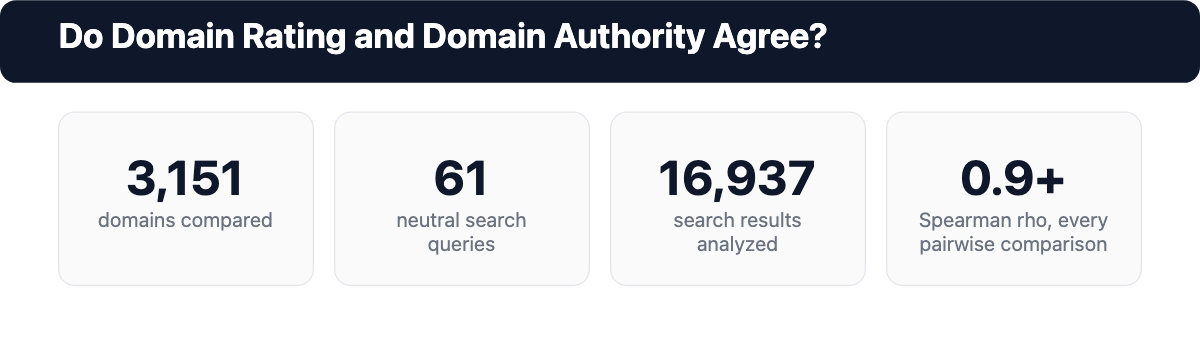
Domain Rating and Domain Authority were put to a direct test in a 2023 paper published in Profesional de la Información (DOI: 10.3145/epi.2023.jul.03), written by three Spanish researchers: Reyes-Lillo, Morales-Vargas, and Rovira. They pulled 16,937 search results from 61 neutral queries, reducing that to a sample of 3,151 unique domains, then compared each domain’s Moz Domain Authority, Semrush Authority Score, and Ahrefs Domain Rating using Spearman’s correlation coefficient. Every pairwise comparison came back above 0.9, and the global correlation across all three tools was also 0.9. In plain terms, even though Ahrefs and Moz build their scores from different indexes and different formulas, they don’t disagree much about which domains rank higher. Neither metric is “more accurate” in isolation, but both hold up, without question, as reliable relative-strength signals, which is the real answer behind this search.
Which Metric to Trust for Which Job
- Comparing two competitors you already know by name: trust Domain Rating. Ahrefs’ larger, faster-refreshed index gives DR an edge for head-to-head comparisons between specific domains.
- Running a quick sanity check on an unfamiliar vendor, guest post site, or link-building pitch: Domain Authority works fine here. The correlation study shows DA tracks relative authority just as reliably as DR for this kind of fast screening.
- Making a go/no-go decision on a single number: don’t. Both companies and the independent research agree these are comparative scores, not absolute measures of quality or a Google ranking factor.
- Reporting authority trends over time on your own site: pick one tool and stay consistent. Since DA and DR use different scales and indexes, switching between them mid-campaign will look like a ranking change that never actually happened.
Keyword Research: Database Size and Depth
Ahrefs runs a larger keyword database than Moz by a wide margin, but Moz’s numbers are still large enough for most small-business keyword research needs.
| Ahrefs | Moz Pro | |
|---|---|---|
| Total keyword database | 28.7 billion (filtered from 110 billion discovered) | 1.25 billion keyword suggestions |
| US-specific keywords | 2.7 billion | Included in the 1.25 billion total, not broken out separately |
| Ranking keywords tracked | Varies by plan tier | 180 million |
| Locations covered | 217 | 170 Google search engines |
Both tools report monthly search volume, keyword difficulty, and search intent, and both now layer AI-prompt or AI-visibility tracking on top of traditional keyword volume. The practical difference shows up on long-tail and international queries, where Ahrefs’ larger discovered-keyword pool (110 billion before filtering) surfaces more low-volume variations than Moz’s smaller index.
Site Audits and Technical SEO
Ahrefs and Moz both crawl your own site for technical issues, but they meter that crawling differently, and that’s something that matters once a site grows past a few thousand pages. For a deeper look at dedicated crawlers, see our comparison of the best technical SEO tools.
Ahrefs uses a shared “crawl credit” system: 100,000 credits per month on Lite, 500,000 on Standard, and 1,500,000 on Advanced, with those same credits also covering API calls and some reporting features. Moz meters site audits in pages crawled per week instead, separate from its keyword or backlink query limits: 400,000 pages per month on Standard, 2 million on Medium, and 5 million on Large. Neither model’s strictly better. A single large site with few projects fits Ahrefs’ credit pool well, while an agency running many small client sites may find Moz’s flat crawl allowance easier to plan around, since it isn’t shared with keyword-tracking usage the way Ahrefs’ credits are.
Ahrefs vs Moz Pricing
Moz is cheaper at every comparable tier, and Ahrefs’ starting price is roughly 30 percent higher than Moz’s equivalent plan as of October 2026. Prices below are current list prices and can change without notice, so verify on each vendor’s own pricing page before buying.
| Plan | Monthly price (USD) | Annual price (USD per month) | Tracked keywords (per mo) | Projects or sites (count) | Crawl allowance | Users included |
|---|---|---|---|---|---|---|
| Ahrefs Starter | 29 | n/a | n/a (search tool only) | n/a | n/a | 1 |
| Ahrefs Lite | 129 | 108 | 750 | 5 | 100,000 credits | 1 |
| Ahrefs Standard | 249 | n/a | 2,000 | 20 | 500,000 credits | 1 |
| Ahrefs Advanced | 449 | n/a | 5,000 | 50 | 1,500,000 credits | 1 |
| Ahrefs Enterprise | ~1,249 (annual contract, ~$14,990/yr) | n/a | custom | custom | custom | 3+ |
| Moz Starter | 49 | n/a | n/a | 1 | n/a | 1 |
| Moz Standard | 99 | 79 | 300 | 3 | 400,000 pages | 1 |
| Moz Medium | 179 | 143 | 1,500 | 10 | 2,000,000 pages | 2 |
| Moz Large | 299 | 239 | 3,000 | 25 | 5,000,000 pages | 3 |
Ahrefs Plans and Prices
Ahrefs’ cheapest full platform plan, Lite, costs $129 a month or $108 a month billed annually, a 17 percent discount. The jump to Standard ($249/mo) and Advanced ($449/mo) mainly buys more projects, more tracked keywords, and a larger crawl-credit pool rather than new feature categories. Ahrefs also sells a $29/mo Starter plan that covers search and competitor research only, without full site tracking, and a custom Enterprise tier that requires an annual commitment and starts well above $1,000 a month.
Moz Pro Plans and Prices
Moz Pro’s Standard plan starts at $99 a month, or $79 a month billed annually, and is built for small businesses running a handful of sites. Medium, at $179 a month ($143 annually), is Moz’s own “most popular” tier and roughly doubles the tracked-keyword and crawl allowance while adding a second user seat. A $49/mo Starter plan covers a single site for marketers who only need the basics. Every paid Moz Pro tier now bundles AI visibility tracking across ChatGPT, Gemini, Google AI Mode, and Perplexity at no extra cost, a feature Ahrefs sells separately through its Brand Radar add-on starting around $179/mo.
Which Metric (and Tool) Should You Trust?
The honest answer is that both tools’ authority scores are reliable for what they’re actually designed to do: ranking sites relative to each other, not producing an absolute quality grade. Pick your tool based on budget and data depth instead of chasing the “more accurate” score, since the independent research clearly shows there isn’t one.
- If the backlink index size and refresh speed matter most to your workflow, Ahrefs’ larger, 15-minute-refreshed index is the stronger pick, even at the higher price.
- If budget is the deciding factor and you mainly need DA for quick vendor or guest-post screening, Moz’s $99/mo Standard plan delivers a metric that the research shows tracks just as reliably as Ahrefs’ DR for that purpose. Readers on a tighter budget still can also check our roundup of free Ahrefs alternatives before committing to either paid plan.
- If you manage many small client sites, Moz’s flat page-crawl allowance is easier to budget than Ahrefs’ shared credit pool.
- If you need the largest possible keyword and backlink data set for competitive research, Ahrefs’ 28.7 billion keyword database and 493 billion page index are simply larger than anything Moz currently publishes.
Ahrefs vs Moz FAQ
Is Ahrefs worth the money?
Ahrefs is worth the money for agencies and in-house teams that need the largest available backlink and keyword index, since its data depth is hard to match at any price. For a solo marketer or small business tracking a handful of keywords, Moz’s cheaper tiers cover the same core workflow for less, and the authority-score correlation study shows you aren’t giving up measurement reliability by choosing the lower-priced tool. Our full Ahrefs review covers the rest of the platform in more depth if pricing is not the only factor.
Who are Ahrefs’ main competitors?
Ahrefs’ main competitors are Moz, Semrush, and SE Ranking, all of which bundle keyword research, backlink analysis, rank tracking, and site auditing into a single subscription. Moz is the closest comparison on price and simplicity, while Semrush competes more directly with Ahrefs on data scale and feature breadth.
Can I use Ahrefs and Moz together?
Yes, running both tools side by side is common among agencies that want Ahrefs’ larger backlink index alongside Moz’s Domain Authority for client reporting, since many clients already recognize the DA score by name. The 2023 reliability study’s useful here too: because DA and DR correlate so closely, using both doesn’t produce conflicting signals, just two different scales measuring the same underlying authority.
Is Moz good enough for beginners?
Moz is good enough for beginners, and its simpler interface and lower starting price make it an easier first SEO tool than Ahrefs for someone without prior experience. The tradeoff is a smaller keyword and backlink index, and that’s something that matters more once a site grows past the scale a $99/mo plan is built to track.

2 thoughts on “Ahrefs vs Moz: Which Metrics Hold Up?”