
Review
Moz Review: Is It Still Worth It?

Moz Pro is worth it in 2026 for small-to-midsize in-house teams and consultants who want one easy SEO dashboard with AI-visibility tracking built in, but not the best fit for teams that need the deepest backlink index or built-in PPC data.
- Bundles AI Overviews by Keyword, AI Visibility Dashboards and AI Content Briefs into every paid plan
- One dashboard covers keyword research, rank tracking, backlink analysis and site audits
- Clear four-tier pricing from $49 to $299 per month, plus a custom Enterprise plan
- Smaller backlink index than Ahrefs or Semrush
- Keyword tracking caps out at 3,000 per month even on the Large plan
- Pricing page does not state the free trial's exact day count
- Good fit for
- in-house marketers and single-site consultants who want an easy, all-in-one SEO and AI-visibility dashboard
- Not a fit for
- teams that need the deepest backlink index, built-in PPC data or keyword tracking beyond 3,000 terms a month
- Starting price
- $49/month (Starter)
- Most popular plan
- Medium, $179/month ($143/month billed yearly)
- AI models tracked
- ChatGPT, Gemini, Google AI Mode and Perplexity
As of October 2026
Moz Pro now costs between $49 and $299 per month across four public tiers, plus a custom Enterprise plan, and every paid tier bundles AI-search tracking (AI Overviews, AI visibility dashboards and AI content briefs) alongside the classic keyword, link and site-crawl tools. That combination is the real story of Moz in 2026: it's no longer just a Domain Authority dashboard, it's trying to be the easy on-ramp into both traditional SEO and AI search visibility. Whether that's worth paying for depends on how much you already use a bigger suite like Semrush or Ahrefs, and how seriously you take Moz's own AI-visibility numbers.
What Is Moz?
Moz is a search-engine-optimization platform built around Moz Pro, the keyword research, rank tracking, backlink and site-audit suite most people mean when they say "Moz." The company has been publishing SEO research and tools since 2004, and it popularized Domain Authority as a shorthand for a site's relative link strength. Moz was acquired by iContact, an email-marketing company owned by J2 Global, in 2021; J2 Global later renamed itself Ziff Davis, and Moz now sits inside Ziff Davis's martech portfolio alongside other digital brands. Moz hasn't announced a new sale or spin-off since then.
Moz's Background
Moz grew out of SEOmoz, a blog and toolset built by Rand Fishkin, and turned Domain Authority, Page Authority and later Spam Score into reference points the whole SEO industry still quotes, even competitors that disagree with the methodology. That history is why Moz Pro still gets treated as a default starting point for people new to SEO software, even in a market now crowded with Semrush, Ahrefs and a wave of AI-visibility-only tools.
Who Moz Is Built For
Moz is built for small-to-midsize in-house marketing teams, solo consultants and smaller agencies who want one dashboard instead of five separate tools. It's less aimed at enterprise teams running six-figure paid search budgets or agencies that need a massive backlink index, which is where Semrush and Ahrefs tend to pull ahead.
Moz Pro's Core SEO Tools
Moz Pro's four core tools are Keyword Explorer, Link Explorer, Site Crawl and Rank Tracker inside Campaigns, backed by the MozBar browser extension and the Domain Authority/Page Authority/Spam Score metrics that Moz is best known for.
Keyword Explorer and Keyword Research
Keyword Explorer returns search volume, a 0-100 difficulty score, organic CTR potential and a blended "Priority Score" meant to combine all three into one ranking signal. Every plan also now layers on "AI Overviews by Keyword," which shows whether a given keyword currently triggers a Google AI Overview, plus keyword-suggestion features powered by Moz's newer AI layer. If Keyword Explorer's tracked-keyword cap feels tight, pair it with a free keyword research tool for overflow research. Priority Score weights volume, difficulty and CTR into a single 0-100 number, which is genuinely useful for triaging a long keyword list quickly, though it still rewards a second look at difficulty alone before you commit content-production time to a term.
Link Explorer and Backlink Analysis
Link Explorer shows linking domains, anchor-text distribution, top-linked pages and newly discovered or lost links, with Domain Authority attached to every linking root domain so you can eyeball link quality quickly. Moz's link index is smaller than Ahrefs' or Semrush's, though, so if backlink-gap analysis is your main job, budget for cross-checking a second tool or adding a dedicated rank-tracking tool alongside it. The tool still earns its keep for quick link-quality checks: you can paste in a competitor's URL and see its strongest linking domains, nofollow ratio and anchor-text pattern in one screen, which is enough for a fast prospecting pass even if it is not the deepest index on the market.
Site Crawl and Technical SEO
Site Crawl flags broken links, duplicate content, missing title tags and meta descriptions, redirect chains and other on-page issues, with monthly crawl limits that scale from 400,000 pages on Standard to 5 million on Large. It's a solid technical-SEO baseline, though JavaScript-heavy sites are better served by a crawler built specifically for rendered-page audits. On-demand re-crawls (10 per month on Medium, 25 on Large) let you confirm a fix landed without waiting for the next scheduled crawl, which matters when you are working through a long issue list against a deadline.
Domain Authority, Page Authority and Spam Score
Domain Authority (DA) and Page Authority (PA) are both 0-100 predictive scores modeling how likely a domain or page is to rank, based on Moz's own link graph. Spam Score is a similar predictive flag for spam-like link patterns. None of the three is a Google ranking factor, and Google has flat-out said it doesn't use Moz's metrics directly; treat all three as a directional, Moz-specific yardstick for comparing your own site's trajectory over time, not an absolute measure of quality.
MozBar
MozBar Premium, included with every paid Moz Pro plan, is a Chrome extension that overlays DA/PA, on-page elements and link data directly on any page you are browsing, which is useful for a fast competitor spot-check without opening the full dashboard.
SEO Title Generator: eight title tag variations, sized for the SERP and intent-matched. Free, no signup.
Moz's AI Search and GEO Features
Every paid Moz Pro plan now includes AI Overview tracking, AI visibility dashboards and AI content briefs, which is the clearest sign Moz has repositioned itself around AI search rather than treating it as an add-on.
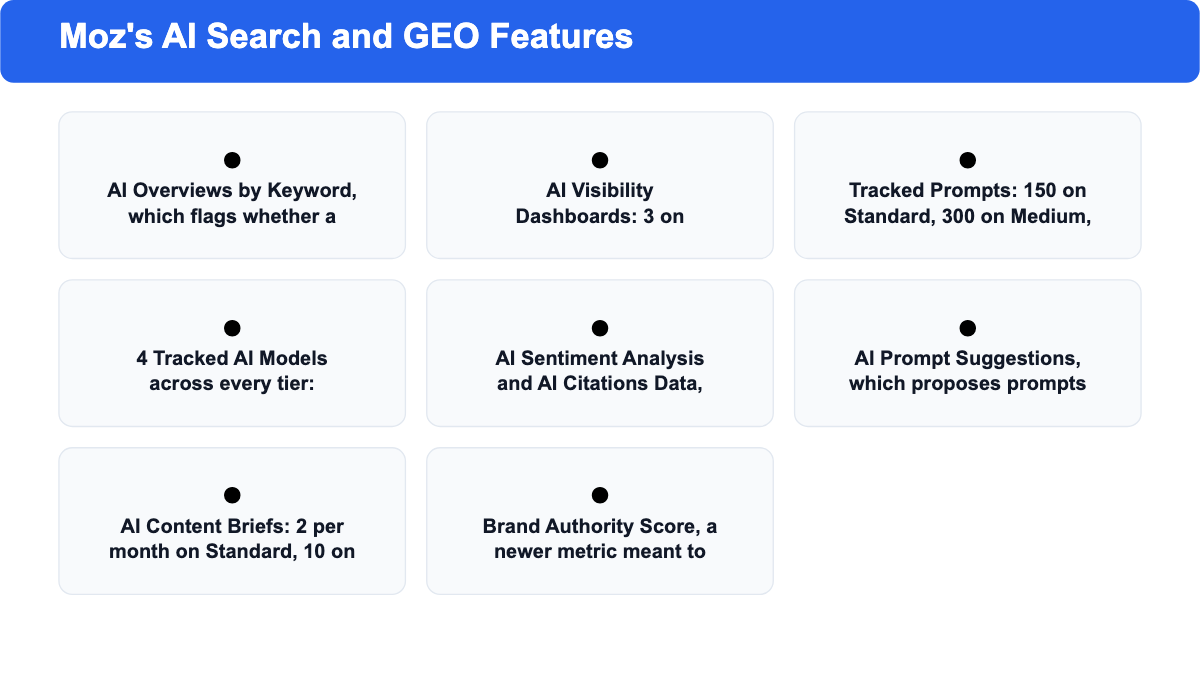
- AI Overviews by Keyword, which flags whether a tracked keyword currently surfaces a Google AI Overview
- AI Visibility Dashboards: 3 on Standard, 6 on Medium, 12 on Large, with extra dashboards available at $20/month each
- Tracked Prompts: 150 on Standard, 300 on Medium, 600 on Large, refreshed on a weekly tracking cadence, with extra prompts at $50 per 100
- 4 Tracked AI Models across every tier: ChatGPT, Gemini, Google AI Mode and Perplexity
- AI Sentiment Analysis and AI Citations Data, showing how and where AI answers mention your brand
- AI Prompt Suggestions, which proposes prompts worth tracking based on your existing keyword set
- AI Content Briefs: 2 per month on Standard, 10 on Medium, 50 on Large
- Brand Authority Score, a newer metric meant to extend the Domain Authority idea into how AI systems represent a brand
No major third-party Moz review currently gives this bundle more than a passing mention. That's without question the single biggest thing most 2024- and 2025-era "is Moz worth it" write-ups are missing in 2026.
Moz Pricing 2026: Plans and What You Actually Pay
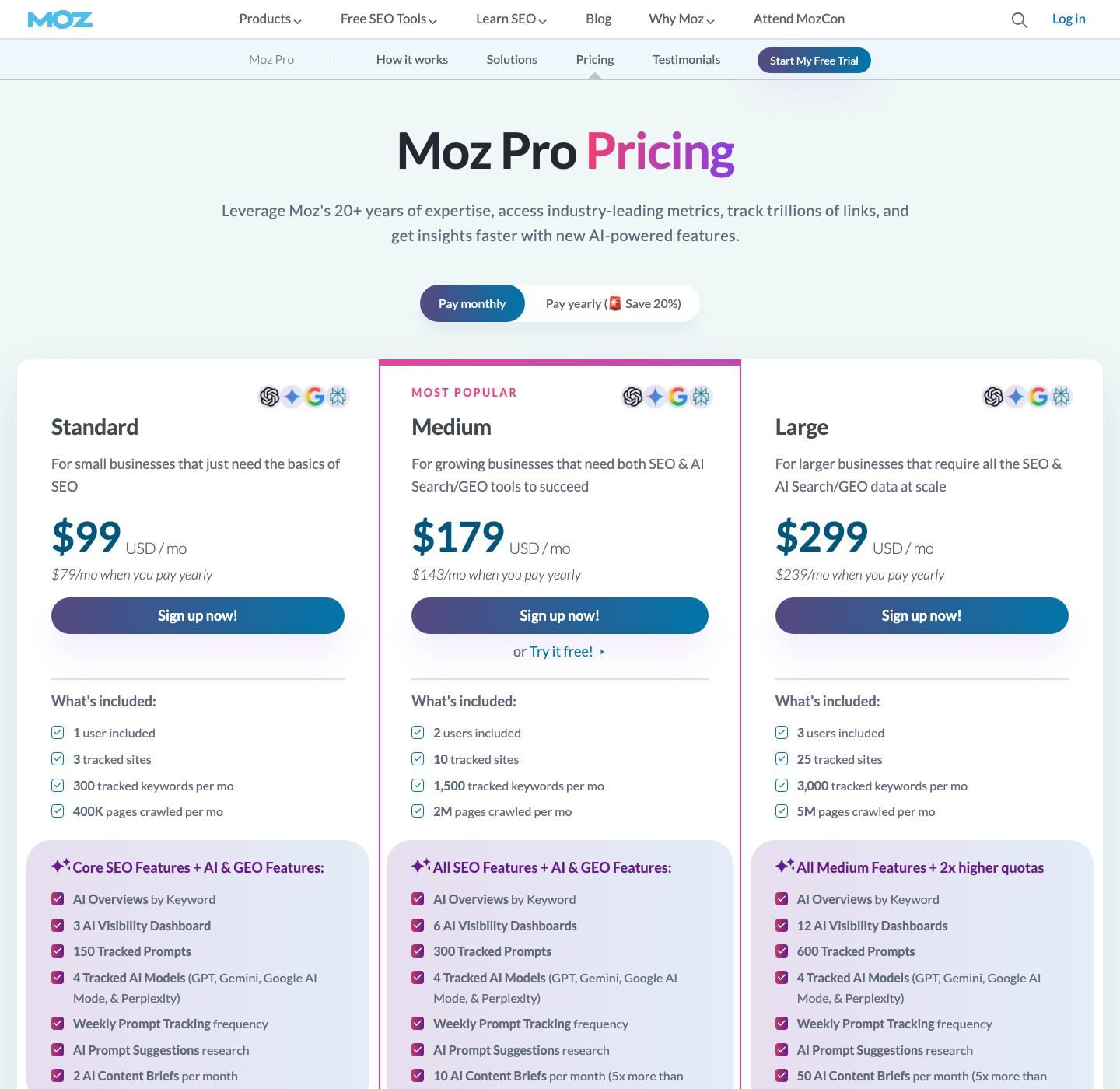
Moz Pro costs $49 to $299 per month across four tiers, plus a custom Enterprise plan, with roughly a 20% discount for paying annually.
Moz Pro Plans and Prices
Each paid tier adds more users, tracked sites and crawl volume on top of the last one.
| Moz Pro plan | Monthly price (USD) | Annual price (USD) | Users | Tracked sites | Keywords tracked/mo | Pages crawled/mo |
|---|---|---|---|---|---|---|
| Moz Pro Starter | $49 | n/a (entry tier, single site) | 1 | 1 | 50 | n/a |
| Moz Pro Standard | $99 | $79 | 1 | 3 | 300 | 400,000 |
| Moz Pro Medium (Most Popular) | $179 | $143 | 2 | 10 | 1,500 | 2,000,000 |
| Moz Pro Large | $299 | $239 | 3 | 25 | 3,000 | 5,000,000 |
| Moz Pro Enterprise | Custom | Custom | Custom | Custom | Custom | Custom |
Figures are Moz's own published plan limits as of this review, but Moz updates pricing and quotas periodically, so treat the table as a snapshot rather than a permanent price list.
Free Trial Terms
Moz advertises a free trial directly on its pricing page, but the page itself doesn't state an exact day count. Independent sources consistently report a 7-day trial on paid plans that requires a credit card and bills you automatically if you don't cancel before it ends; a few older sources mention a 30-day trial that appears to have been discontinued. Confirm the current terms at signup rather than relying on an outdated blog post.
Moz Pro vs STAT vs Moz Local vs Moz API: What's the Difference?
Moz Pro is the core SEO toolkit; STAT is a separate, higher-volume enterprise rank tracker; Moz Local manages local business listings and reputation; and Moz API licenses Moz's underlying data for custom integrations.
- Moz Pro: the all-in-one SEO dashboard covered throughout this review (Keyword Explorer, Link Explorer, Site Crawl, Rank Tracker, AI visibility tools).
- STAT: a dedicated large-scale rank-tracking platform for agencies and enterprises tracking far more keywords than Moz Pro's own tiers allow; pricing starts at $360/month for 3,000 weekly prompts and daily keyword tracking.
- Moz Local: manages business listings, local search visibility and review/reputation monitoring, sold separately from Moz Pro.
- Moz API: a developer-facing product for pulling Moz's link and authority data into your own tools, billed separately from Moz Pro.
Mixing these up is an easy mistake: a Moz Pro subscription alone doesn't include STAT-level rank tracking volume or Moz Local's listings management.
Getting Started With Moz Pro
Start by creating a Campaign, add your tracked keywords, then run your first Site Crawl before touching anything else.
- Create a Campaign for your site and set your target location and search engine.
- Add the keywords you actually want to rank for, not just your highest-volume terms, since every plan has a hard monthly keyword cap.
- Run Site Crawl first and fix the highest-impact technical issues (broken links, missing tags, duplicate content) before chasing new keywords; a site with unresolved crawl errors wastes the keyword data you collect next.
- Use Keyword Explorer to find realistic, winnable terms using the Priority Score rather than volume alone.
- Check your AI Visibility Dashboard and Tracked Prompts if AI-search visibility matters for your brand, since this quota is shared across your whole plan.
Who Should Use Moz (and Who Should Look Elsewhere)
Small-to-midsize in-house teams and single-site consultants who want an easier, all-in-one SEO workflow without stitching together several specialist tools should use Moz Pro.
- Good fit: in-house marketers managing one to a handful of sites, consultants who need a client-friendly dashboard for client reporting, teams that want AI-visibility tracking bundled in rather than bought as a separate product, and anyone who values a gentle learning curve over raw feature depth.
- Look elsewhere if: you need the deepest possible backlink index, built-in PPC/ad-data research, or you are tracking tens of thousands of keywords, since Moz Pro's own tiers cap out at 3,000 keywords/month before you need STAT or a different platform entirely.
Moz Alternatives: When to Choose Semrush or Ahrefs Instead
Choose Semrush if you also need PPC research and broader competitive intelligence in the same subscription, or pick Ahrefs instead if backlink-index depth is your top priority. Both are more expensive at comparable tiers, but both go deeper on the single thing they are known for than Moz Pro does. For a closer side-by-side, see our Semrush vs Moz and Ahrefs vs Moz comparisons. If your SEO work is mostly keyword tracking and basic technical audits, and you want AI-search visibility bundled in rather than a separate purchase, Moz Pro remains the simpler, cheaper starting point.
Final Verdict: Is Moz Worth It in 2026?
Moz is worth it in 2026 if you want one easy-to-use platform for core SEO plus a built-in AI-visibility layer, and you are not running a backlink-first or PPC-heavy workflow. It's flat-out not worth it if you need Ahrefs-level backlink depth, Semrush-level paid-search data, or you're tracking more keywords than even the Large plan's 3,000-per-month cap allows. For a single-site consultant or a small in-house team, the Medium plan's $143-$179/month price point for 10 tracked sites, 1,500 keywords and a real AI-visibility dashboard is a reasonable, if not cheap, starting point.
Frequently Asked Questions
Who Bought Moz?
iContact, an email-marketing company owned by J2 Global, bought Moz in 2021. J2 Global later renamed itself Ziff Davis, and Moz now operates as part of Ziff Davis's martech portfolio.
What Is Moz Pro Used For?
Moz Pro is used for keyword research, rank tracking, backlink analysis and technical site audits, now combined with AI-search visibility tracking across ChatGPT, Gemini, Google AI Mode and Perplexity.
What Is the Best SEO Monitoring Tool?
There isn't a single best SEO monitoring tool for every team. Moz Pro suits teams that want an easy, all-in-one dashboard with AI-visibility tracking bundled in, while Semrush and Ahrefs suit teams that need deeper PPC data or backlink-index depth respectively.
What Is a Moz Score?
"Moz score" usually refers to Domain Authority, a 0-100 predictive metric estimating how likely a domain is to rank in search results based on Moz's own link data. It isn't a Google ranking factor; Page Authority and Spam Score are similar predictive metrics for individual pages and spam risk, period.
Does Moz Pro Have a Free Plan?
No, Moz Pro doesn't have a permanent free plan; the cheapest option is the $49/month Starter tier, plus the time-limited free trial on paid plans. Moz does offer separate free tools outside Moz Pro, including MozBar's basic Domain Authority lookup and a limited Domain SEO Analysis tool capped at a few searches a day.
Is Moz Pro Good for Local SEO?
Moz Pro itself is not built for local SEO; local listings management, citation tracking and map-pack monitoring live in Moz Local, a separate product sold outside the Moz Pro tiers covered in this review. If local search is your main focus, budget for Moz Local on top of (or instead of) a Moz Pro plan.