
Tool list · 25 tools
25 AI Marketing Tools Compared [2026]

AI marketing tools use artificial intelligence to automate campaigns, analyze customer data, and personalize outreach at a scale no human team can match, and this guide compares 25 options including Jasper AI, Surfer SEO, and Brand24 across content, SEO, chat, advertising, and analytics. Pricing and positioning below are checked directly against each vendor's own 2026 pricing page.
- From
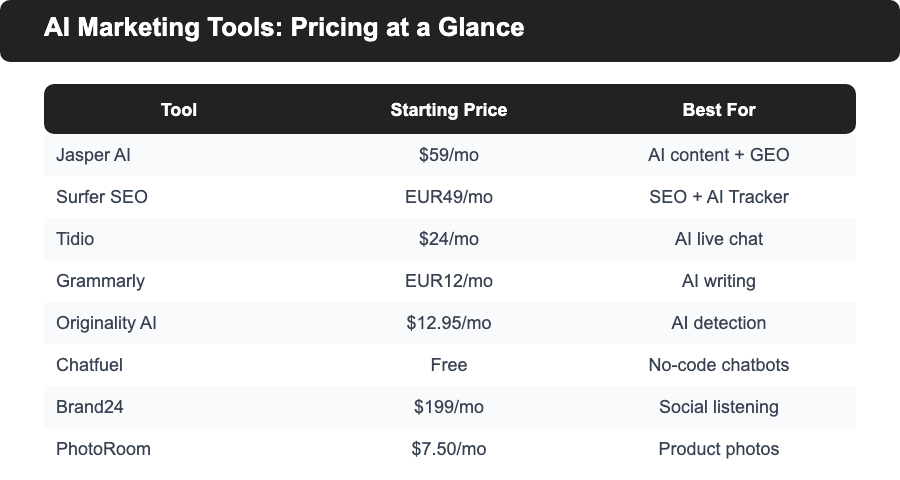
- $59/mo
Price from the vendor's pricing page, checked Sep 28, 2026.
AI marketing tools use artificial intelligence to automate campaigns, analyze customer data, and personalize outreach at a scale no human team can match on its own. This guide reviews 25 AI marketing tools across content creation, SEO, customer chat, advertising, email, and analytics. Options range from Jasper AI for marketing content to Surfer SEO for search optimization to Brand24 for brand monitoring. Every listing below reflects each vendor's current 2026 pricing and positioning, checked directly against their own pricing pages rather than repeated from older reviews.
The hardest part of choosing an AI marketing tool usually isn't finding options. It's cutting through hundreds of overlapping products to find the few that actually fit your workflow. This guide is organized by function so you can jump to the category you need and compare pricing side by side. It also flags how each tool's positioning has shifted as the market moves toward AI search visibility alongside traditional marketing automation.
What are AI marketing tools and AI advertising tools?
AI marketing tools and AI advertising tools are software platforms that use artificial intelligence, including machine learning and generative AI, to automate marketing and advertising tasks that would otherwise take significant manual effort. These tools handle jobs like writing content, analyzing customer data, and personalizing outreach so marketers can focus on strategy instead of repetitive execution.
AI marketing platforms commonly automate email campaigns, social posts, and customer segmentation, cutting the time it takes to launch a campaign. They analyze consumer behavior to shape content and build more personalized experiences at scale.
AI advertising tools improve ad placement and targeting using first-party and behavioral data, and increasingly generate the ad creative itself, images, copy, and variants tailored to a given audience segment.
Using these tools well means your team makes more data-driven decisions with less manual busywork, which is why adoption keeps climbing across marketing departments of every size.
What are the benefits of using AI marketing tools?
The core benefits of AI marketing software are better data analysis, more personalized customer experiences, faster support, tighter campaign optimization, and real time and cost savings.
- Improved Data Analysis: AI surfaces patterns across large volumes of customer data that would take a human analyst far longer to find manually.
- Personalized Customer Experiences: Personalization driven by real customer data tends to lift satisfaction and conversion compared with generic messaging.
- Better Customer Support: AI chat agents now handle a large share of routine support conversations around the clock, escalating only the harder cases to humans.
- Efficient Campaign Optimization: Better targeting and continuous performance analysis improve results without constant manual tuning.
- Cost and Time Savings: Automating repetitive tasks frees your team to spend more time on strategy and creative work.
Headline Generator: 10 headlines across 4U, AIDA, PAS and curiosity frameworks. Free, no signup.
Which AI marketing tools should you know about?
To keep up in digital marketing, it helps to know the AI tools that are actually shaping campaigns, strategy, and reporting right now. Here are the 25 covered in this guide:
- Jasper AI: Best for AI-assisted marketing content and staying visible in AI search.
- Notion AI: Best for writing and organizing work inside Notion.
- Surfer SEO: Best for on-page SEO and AI-search content optimization.
- Tidio: Best for AI-powered live chat and customer support.
- Brandwell (formerly Content at Scale): Best for intent-driven go-to-market content at scale.
- Originality AI: Best for AI content detection and plagiarism checks.
- Writer: Best for enterprise teams building brand-consistent AI agents.
- Undetectable AI: Best for humanizing AI-generated drafts.
- Fullstory: Best for AI-powered behavioral analytics.
- Zapier: Best for connecting your marketing stack with AI-driven automation.
- Userbot.ai: Best for orchestrating multi-agent customer conversations.
- Hemingway App: Best for clear, readable copy.
- Chatfuel: Best for no-code AI chatbot building.
- Grammarly: Best for AI-assisted writing and editing across your team.
- Albert.ai: Best for autonomous paid-media optimization.
- Headlime: Best for AI-generated landing page and ad copy.
- Browse AI: Best for no-code web scraping and competitor monitoring.
- Algolia: Best for AI-powered site search and commerce discovery.
- PhotoRoom: Best for AI product photo editing.
- Reply.io's AI Sales Email Assistant: Best for AI-assisted sales outreach.
- Brand24: Best for social listening and brand mention tracking.
- Influencity: Best for influencer discovery and campaign management.
- MarketMuse: Best for AI content planning and topic modeling.
- Mailmodo: Best for interactive, app-like email campaigns.
- Amplitude: Best for always-on marketing analytics and AI brand visibility tracking.
Using the right mix of these tools can meaningfully improve both the efficiency and the results of your marketing program.
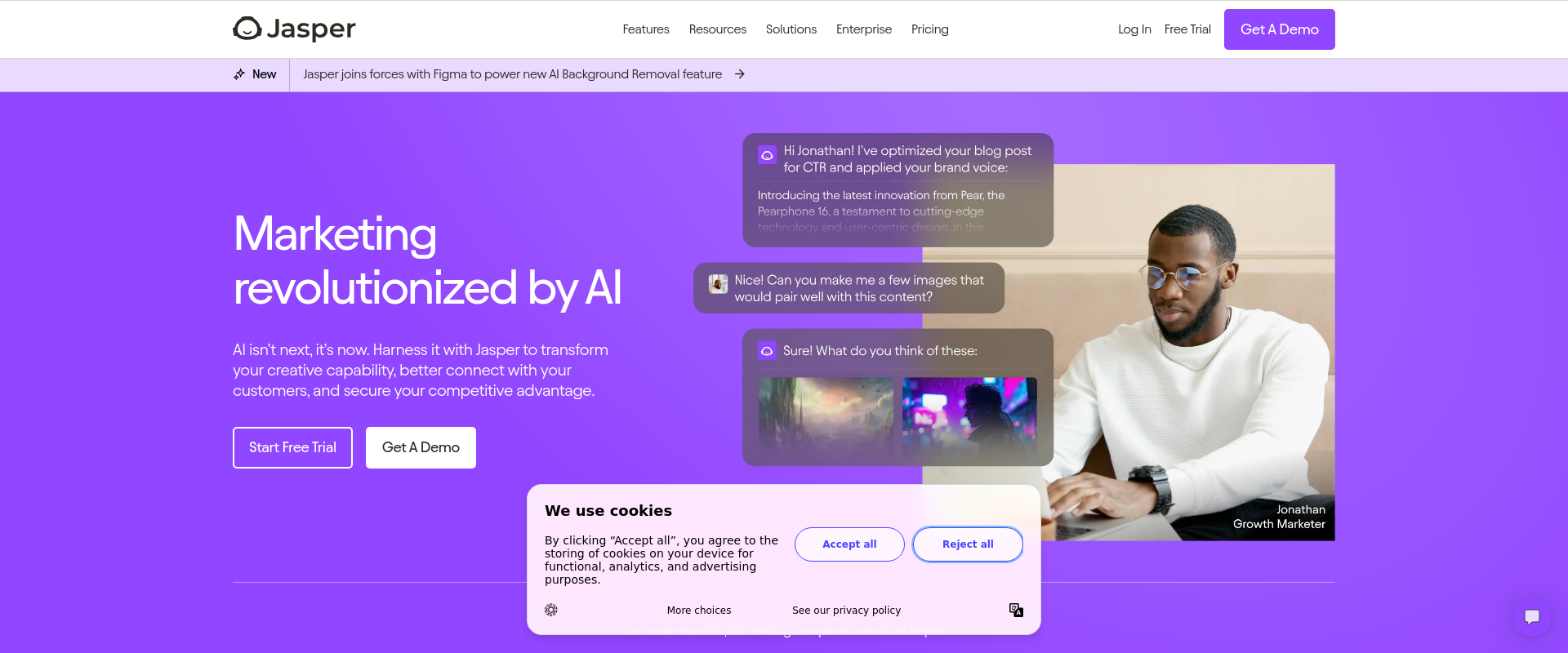
1. Jasper AI
Jasper AI has moved beyond generic AI copywriting into what it now calls an "agent workspace" for marketing teams, built around 100+ specialized AI agents and repeatable content pipelines. Its Jasper IQ layer keeps brand voice and guidelines consistent across every output, and Jasper now markets itself directly on getting brands cited by ChatGPT, Gemini, and other AI answer engines, not just ranked in Google.
Pricing:
- Pro: $59/month billed annually, or $69/month billed monthly
- Business: custom pricing, contact sales
- 7-day free trial
Main Features:
- 100+ purpose-built AI agents for SEO, GEO, campaigns, email, and social
- Content Pipelines that move work from idea to launch without manual handoffs
- Jasper IQ context hub for brand voice, style guides, and audience profiles
- Built-in GEO and AI-optimization features to improve visibility in AI answer engines
- LLM-agnostic architecture with enterprise-grade security
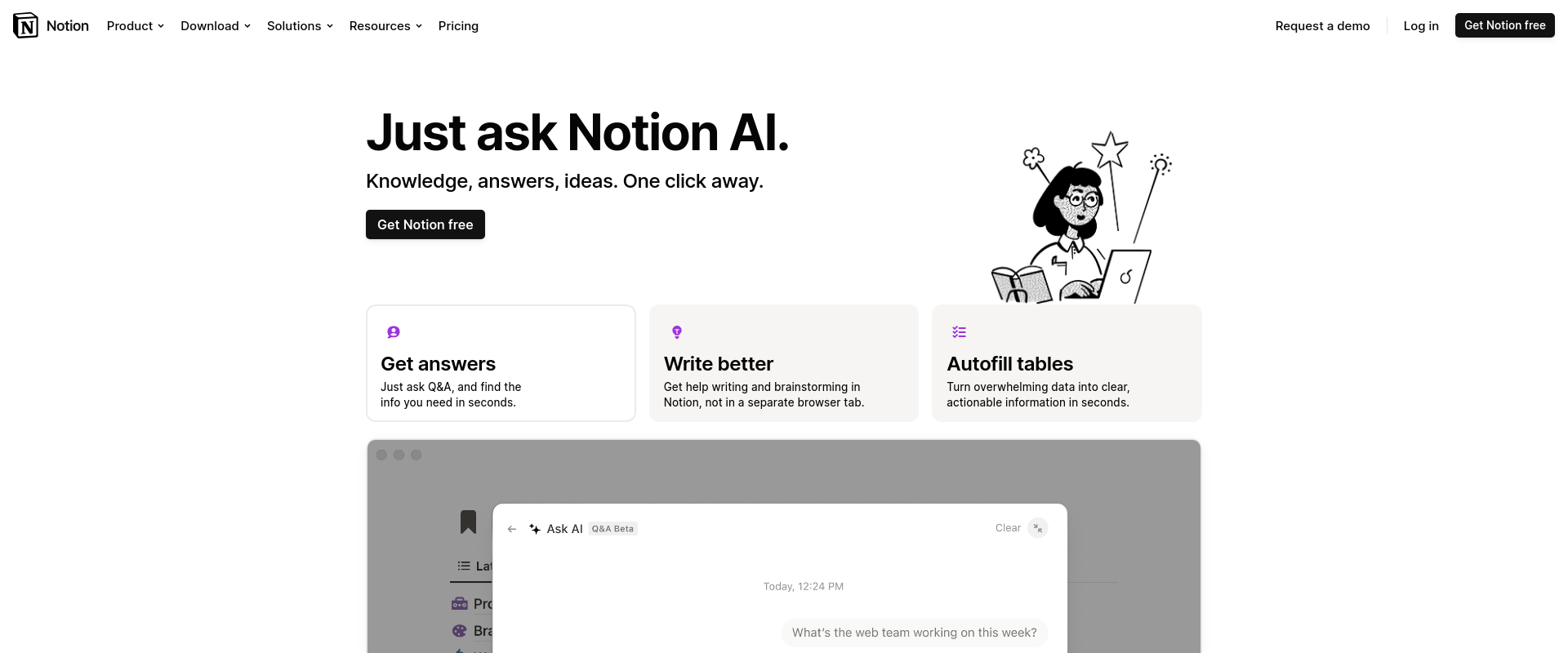
2. Notion AI
Notion AI is the AI layer built into Notion's workspace, positioned as "the AI workspace for work that matters." You can ask questions in plain English, draft and summarize content, and now hand off multi-step work to Notion Agent, a newer autonomous-task feature for Business and Enterprise plans.
Pricing:
- Free: EUR0, limited AI usage
- Plus: EUR9.50/month billed annually
- Business: EUR19.50/month billed annually, includes Notion Agent
- Enterprise: custom pricing
- Pay-as-you-go Custom Agents available at $10 per 1,000 Notion credits
Main Features:
- Finds information quickly across your entire workspace
- Drafts, edits, summarizes, and rewrites text on request
- Notion Agent handles multi-step tasks autonomously on Business and Enterprise plans
- Auto-fills tables and extracts data from linked databases
- Enterprise-grade data controls with optional AI-training opt-out
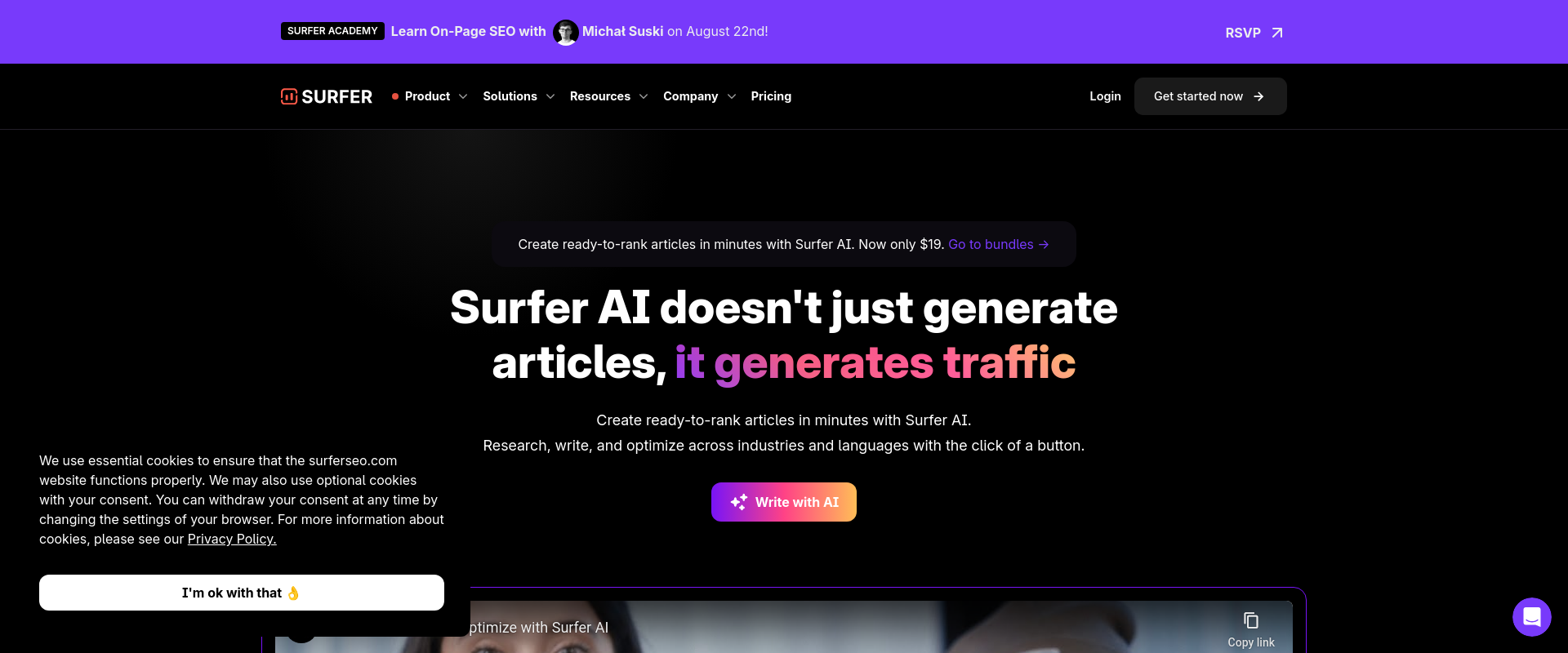
3. Surfer SEO
Surfer SEO has repositioned from a pure content-optimization tool into what it now calls an "AI search and content intelligence platform," adding visibility tracking across Google AI Overviews, ChatGPT, Gemini, Claude, and Perplexity on top of its original content editor.
Pricing:
- Discovery: EUR49/month
- Standard: EUR99/month
- Pro: EUR182/month
- Peace of Mind: EUR299/month
- Enterprise: custom pricing
Main Features:
- Content Editor for on-page keyword use and readability scoring
- AI Tracker monitoring brand mentions and citations across AI models
- Keyword research and competitor-based content outlines
- Content Audit Tool and SERP Analyzer
- Multi-language support and a built-in plagiarism checker
4. Tidio
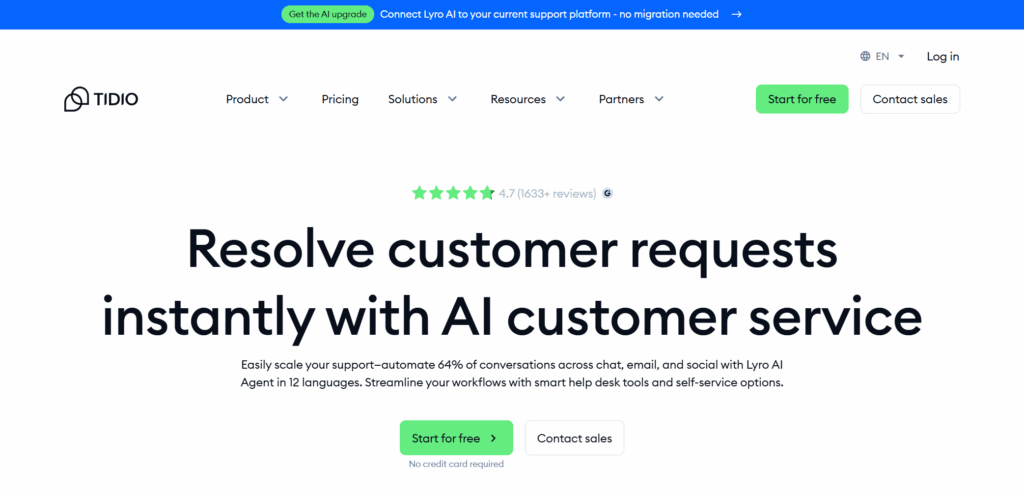
Tidio combines live chat, chatbots, and automation into one customer support platform. Its positioning now centers on the Lyro AI Agent, which the company says resolves up to 67% of customer problems automatically, a shift from Tidio's earlier "live chat plus bots" framing toward autonomous AI support.
Pricing:
- Free: $0, 50 conversations/month
- Starter: $24.17/month, 100 conversations/month
- Growth: from $49.17/month, 250+ conversations/month
- Plus: from $300/month
- Premium: custom pricing
- Lyro AI Agent and Flows are separate add-ons starting at $32.50/month and $24.17/month
Main Features:
- Lyro AI Agent automates responses to common inquiries
- Real-time live chat widget across channels
- Visual automation builder for custom workflows
- Multi-channel inbox for email, social, and messaging apps
- Analytics on conversation metrics and satisfaction rates
Tidio is also underpowered for its price point, which is why many users look at Tidio alternatives instead.
5. Brandwell (formerly Content at Scale)
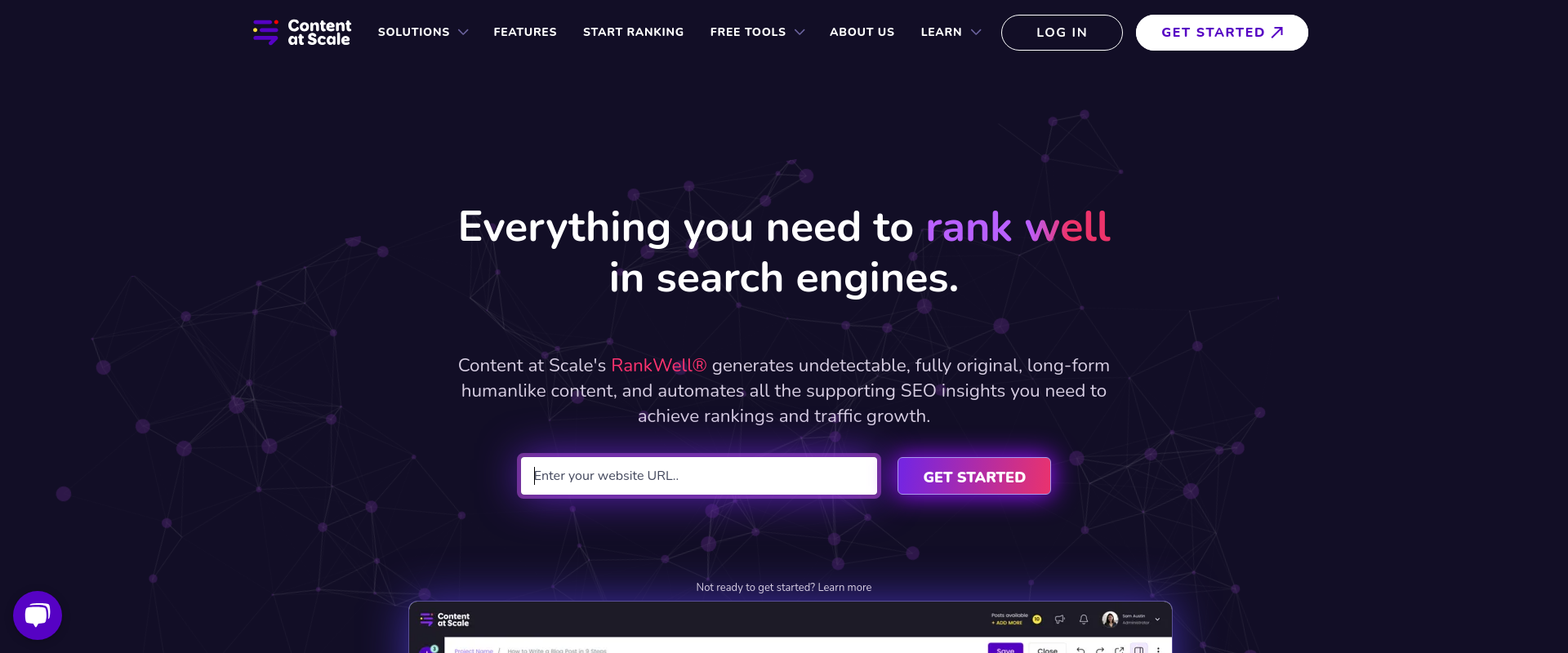
Content at Scale rebranded to Brandwell in August 2024, and the shift is more than a name change. Brandwell now positions itself as an intent-led go-to-market platform, built around TrafficID anonymous-visitor identification and account-based routing, with its original RankWell content-writing engine folded in as one module rather than the core product.
Pricing:
- No public self-serve pricing is currently listed; Brandwell requires a custom quote based on market coverage, lead volume, and enrichment needs
Main Features:
- TrafficID identifies anonymous website visitors for outreach
- Account-based marketing routing for sales and marketing alignment
- RankWell AI content engine still available as a module for SEO-focused long-form writing
- Automated SEO metadata and keyword handling in WordPress
- Built for teams that want intent data and content generation in one platform
6. Originality AI
Originality AI checks whether content was written by AI or a human, and has broadened into a wider "Publish with Integrity" toolkit covering plagiarism, readability, and basic fact-checking, not just detection.
Pricing:
- Pro: $12.95/month billed annually, or $14.95/month billed monthly, 2,000 credits/month, 30-day scan history
- Enterprise: $136.58/month billed annually, or $179/month billed monthly, 15,000 credits/month, 365-day history, API access
Main Features:
- AI detection alongside paraphrase and plagiarism checks
- Readability and basic SEO content checks
- Paste, file upload, or URL scanning
- Detailed originality reports with scan history
- API access and a free Chrome extension
7. Writer
Writer has moved well past simple grammar assistance into an enterprise AI platform for building AI agents, powered by its own Palmyra models and a "WRITER Agent" product for repeatable, brand-consistent workflows.
Pricing:
- Starter: $39/user/month, or $29/user/month billed annually, capped at 5 Pro seats
- Enterprise: custom pricing
- Usage-based API pricing available separately (Palmyra X5 and WRITER Agent tokens)
Main Features:
- WRITER Agent for building repeatable, brand-safe AI workflows
- Proprietary Palmyra language models tuned for enterprise writing
- Real-time collaboration and shared style guides
- Brand-voice consistency controls across large teams
- Templates, guidelines, and multi-language support
8. Undetectable AI
Undetectable AI rewrites AI-generated text to read as more human and pairs that with its own AI-content detector, positioning unchanged from prior cycles as a combined "AI Humanizer and Detector."
Pricing:
- Basic: $5/month billed annually ($60/year), 10,000 words/month
- Pro: $9.50/month billed annually ($114/year), 20,000 words/month
- Premium: $15.75/month billed annually ($189/year), 35,000 words/month
- Enterprise: $21.25/month billed annually, 50,000 words/month
- All paid tiers include unlimited detection checks
Main Features:
- Humanizes AI-generated content for a more natural style
- Built-in AI detection with unlimited checks on paid plans
- No signup required for a quick free test
- Watermark protection on humanized output
- Aimed at marketers, SEO teams, and freelance writers
9. Fullstory
Fullstory has shifted from a general behavioral-analytics tool into what it now calls an "Intelligent Digital Experience Platform," anchored by a new AI insights layer called StoryAI that turns raw behavioral data into trustworthy, actionable findings.
Pricing:
- Free tier: up to 30,000 sessions/month, 12-month data retention
- Business, Advanced, and Enterprise tiers: custom quotes, contact sales for pricing and a demo
Main Features:
- StoryAI layer that surfaces trustworthy behavioral insights automatically
- Session capture across thousands of user events
- Guides and surveys for in-product feedback
- Fraud-signal detection in real time
- Analytics aimed at lifting conversion and reducing churn
10. Zapier
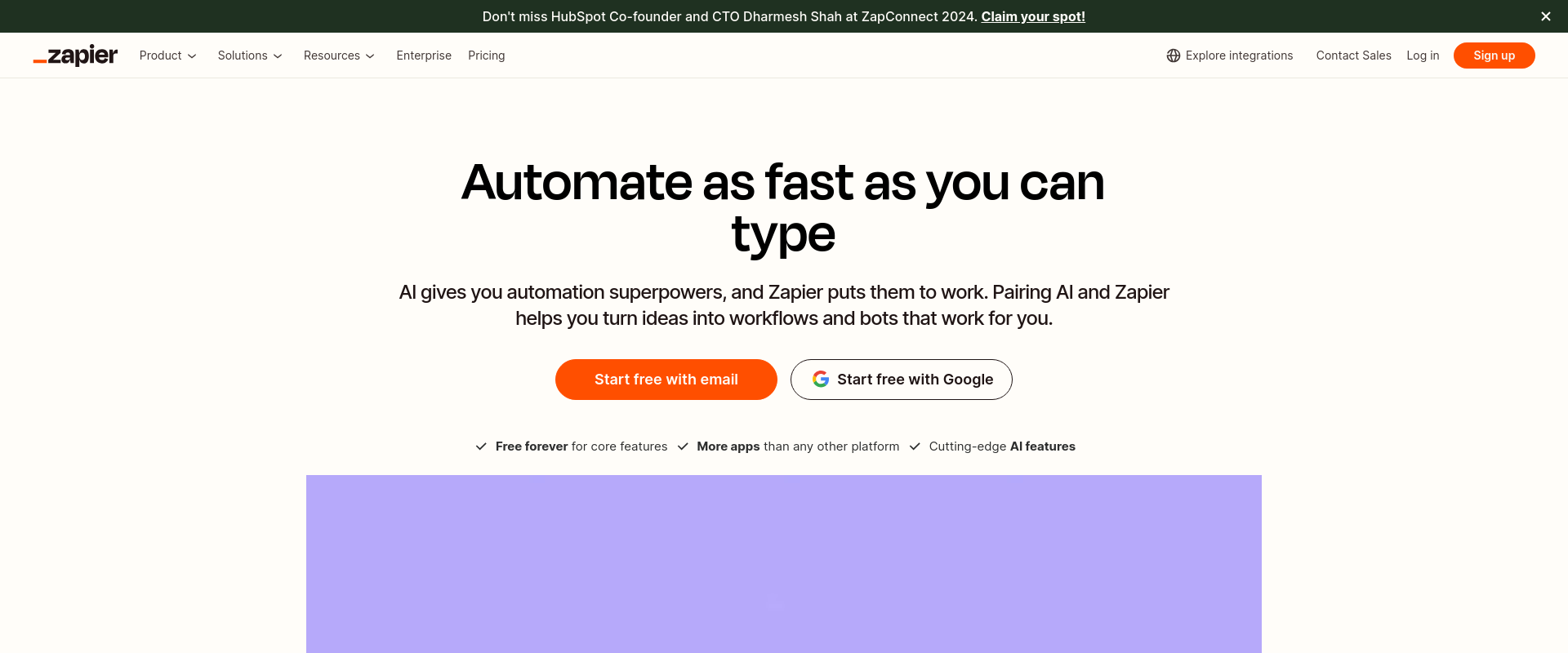
Zapier connects thousands of apps so marketing teams can automate handoffs between tools without writing code. Its positioning has expanded from plain workflow automation to what it now calls "AI orchestration," with two newer standalone products, Zapier Agents and Zapier Chatbots, sitting alongside its classic Zap-based automation.
Pricing:
- Core plans: Free $0, Professional from $19.99/month, Team from $69/month, Enterprise custom
- Zapier Agents: free tier, Pro at $400/year, Enterprise custom
- Zapier Chatbots: free tier, Pro at $160/year, Advanced at $800/year, custom on contact
Main Features:
- Connects thousands of marketing, CRM, and productivity apps
- Zapier Agents build and run autonomous AI workflows without code
- Zapier Chatbots deploy AI chat agents trained on your own data
- Multi-step Zaps with conditional logic and filters
- Broad no-code integration library across marketing tech stacks
11. Userbot.ai
Userbot.ai, an Italian AI company, started as a chat-automation tool but now positions itself as a full AI agent orchestration platform, letting teams build, coordinate, and govern a whole roster of AI agents rather than a single chatbot. It's used across healthcare, finance, retail, and public-sector customer interactions.
Pricing:
- No public self-serve pricing; Userbot.ai uses a demo-gated, custom B2B pricing model
Main Features:
- Multi-agent orchestration across customer touchpoints
- Automatic handoff to a human operator when a query can't be resolved
- Continuous learning from ongoing conversations
- Integrations with CRM and marketing systems
- Real-time analytics on agent and conversation performance
12. Hemingway App
The Hemingway App remains focused on readability, its core positioning hasn't changed, but it now layers an optional AI proofreader on top of the classic scoring engine.
Pricing:
- Free web editor
- Hemingway Editor Classic (desktop, no AI features): $19.99 one-time
- Hemingway Editor Plus (AI proofreader, credit-based): from roughly $8.33 to $12.50/month depending on plan and word volume
Main Features:
- Readability scoring matched to grade level
- Highlights overly complex sentences and passive voice
- AI proofreading on the Plus subscription tier
- Word count and reading-time estimates
- Offline desktop access with the Classic purchase
13. Chatfuel
Chatfuel lets teams build no-code chatbots for sales and support, now marketed under the tagline "Your AI Coworker is ready," reflecting a shift toward agentic language even though the underlying product is still chatbot and automation focused.
Pricing:
- Chatfuel Light: free, no card required
- AI PRO: $49/month, with a discount available on annual billing
- Free trial available on paid tiers
Main Features:
- No-code chatbot builder
- ChatGPT-powered responses for more natural conversations
- CRM and marketing-tool integrations
- Support for major messaging platforms including WhatsApp
- Pre-built templates for faster setup
14. Grammarly
Grammarly has grown from a grammar checker into a broader AI writing assistant, now positioned around the tagline "Great Writing Starts With a Plan" and used by more than 40 million people and 50,000-plus organizations.
Pricing:
- Free: EUR0, basic error and tone detection
- Pro: EUR12/month, full-sentence rewrites, tone adjustment, plagiarism check, 2,000 AI prompts/month
- Enterprise: custom pricing, includes proactive AI and admin controls
Main Features:
- Grammar, tone, and style suggestions across your team's writing
- Full-sentence AI rewrites on paid plans
- Built-in plagiarism checking
- Monthly AI-prompt allowance for drafting and editing
- Enterprise controls including data-loss prevention and custom roles
15. Albert.ai
Albert.ai (now owned by Zoomd Technologies, acquired in March 2022) automates paid-media planning, building, optimizing, and reporting across roughly 90% of the biddable ad universe, including Google, Bing, Meta, TikTok, and YouTube.
Pricing:
- No public self-serve pricing; enterprise/demo-based, contact sales
Main Features:
- 24/7 autonomous optimization across paid-media channels
- Real-time audience-based budget allocation
- Automated keyword and audience-segment discovery
- Creative optimization using live campaign performance
- Significant reduction in manual campaign-management time
16. Headlime
Headlime is an AI copywriting tool for landing pages and ad copy, still active as its own branded product under the tagline "Write better marketing copy faster with AI." Exact current plan pricing isn't published in detail on its own site, so confirm specifics before budgeting.
Pricing:
- Free version available
- Paid plans available, check headlime.com for current tiers and pricing
Main Features:
- AI copy generation for landing pages and ad creative
- Multi-language support including English, French, and Spanish
- Over 1,700 professional copy templates
- Drag-and-drop page editor
- Collaboration tools for managing copy across a team
17. Browse AI
Browse AI is a no-code web scraper that turns any website into a live spreadsheet or API, widely used for competitor pricing checks and market research without writing scraping code.
Pricing:
- Free: $0, 50 credits, 2 monitored sites, 3 users
- Personal: $19/month billed annually ($48/month monthly), 2,000 credits, 5 sites
- Professional: $69/month billed annually ($87/month monthly), 5,000 to 30,000 credits, 10 sites
- Premium: from $500/month, 600,000+ credits/year, custom
Main Features:
- 250+ prebuilt "robots" for common scraping tasks
- No-code training for custom scraping jobs
- 7,000+ integrations for piping scraped data into other tools
- Scheduled monitoring for competitor pricing and launches
- Turns any site into a live spreadsheet or API endpoint
18. Algolia
Algolia powers fast, relevant site search and has expanded its positioning from plain "search" toward what it calls an agentic intelligence layer for commerce discovery, adding AI ranking, recommendations, and personalization on top of its core search API.
Pricing:
- Build: free, 10,000 search requests/month, 1M records, 10,000 AI recommendation requests/month
- Grow: pay-as-you-go, first 10,000 requests free then $0.50 per 1,000
- Grow Plus: adds AI ranking and personalization, $1.75 per 1,000 requests after the free tier
- Elevate: custom enterprise pricing, annual contract
Main Features:
- Handles over 1.7 trillion searches yearly at scale
- 99.999% uptime SLA on higher tiers
- AI-driven ranking and personalization on Grow Plus and above
- Fast API setup with customizable UI components
- Integrates with platforms like Shopify and Salesforce
19. PhotoRoom
PhotoRoom is an AI tool for editing product images, purpose-built for e-commerce sellers who need fast, consistent listing photos. It has added an AI video generator and 4K export on higher tiers since its earlier background-removal-only positioning.
Pricing:
- Free basic plan
- Pro: $7.50/month billed annually
- Max: $20.99/month, adds AI video generation
- Ultra: from $82.50/month, scales with batch volume up to $990/month for high-volume export
- Enterprise: custom pricing, 200,000+ images/year
Main Features:
- AI background removal and retouching
- AI-generated shadows and scene backgrounds
- Bulk editing for large product catalogs
- AI video generation on Max plan and above
- Team collaboration features
20. Reply.io's AI Sales Email Assistant
Reply.io's AI Sales Email Assistant writes, improves, and follows up on sales emails, now sitting alongside Reply.io's newer AI SDR product, Jason, which handles fuller outbound sequences autonomously.
Pricing:
- Email Volume: $49/user/month billed annually, 1,000 active contacts
- Multichannel: $89/user/month billed annually
- Agency: $166/month, annual billing only
- AI SDR (Jason) add-on: from $500/month
- Pricing figures above are approximate; confirm exact current tiers on reply.io/pricing before purchase
Main Features:
- Drafts emails from summaries or bullet points
- Improves grammar, tone, and clarity in existing drafts
- Generates context-aware follow-up emails
- Jason AI SDR add-on runs fuller outbound sequences
- Integrates directly into existing sales sequences
21. Brand24
Brand24 tracks brand mentions across social media, blogs, news, and forums, now marketed as an "AI Social Listening Tool." Its Enterprise tier has added a genuinely new AI Visibility module that tracks brand exposure across major AI platforms like ChatGPT and Gemini, alongside its core mention-tracking product.
Pricing:
- Individual: $199/month billed annually ($249/month monthly)
- Team: $299/month billed annually ($349/month monthly)
- Pro: $399/month billed annually ($499/month monthly)
- Business: $599/month billed annually ($699/month monthly)
- Enterprise: from $1,499/month, includes the AI Visibility module
Main Features:
- Tracks mentions from more than 25 million sources instantly
- Sentiment analysis across every mention
- AI Visibility module tracking brand exposure across AI platforms (Enterprise tier)
- Anomaly detection for spikes in negative sentiment
- Competitor tracking and topic analysis
22. Influencity
Influencity uses AI to help brands discover genuine influencers and manage campaigns end to end across TikTok, Instagram, YouTube, and Twitch. Its pricing page no longer lists exact figures, tiers are now differentiated by usage limits behind a demo request.
Pricing:
- No public list prices; a 7-day free trial is available on all plans, contact sales for a quote
Main Features:
- Creator discovery across multiple platforms and industries
- Real-time influencer profile insights
- Influencer relationship management and task tracking
- Campaign automation and Shopify integration for seeding
- ROI reporting across campaigns
23. MarketMuse
MarketMuse uses AI to plan and audit content, linking keyword research to content performance under the tagline "Create the content that counts." Pricing tiers are now demo-gated rather than listed publicly.
Pricing:
- Free: 1 user, 10 queries/month
- Optimize, Research, and Strategy tiers: book a demo for current pricing
- Optimize includes 100 tracked topics and 5 briefs/month; Research includes 1,000 topics, 10 briefs/month, and 3 users; Strategy includes 10,000 topics, 20 briefs/month, and 5 users
Main Features:
- Automated content audits
- Content briefs and topic clusters based on real gap analysis
- Competitive content analysis and SERP X-Ray
- MarketMuse Inventory for tracking content performance
- Personalized topic and keyword recommendations
24. Mailmodo
Mailmodo is an AI email marketing platform for interactive, app-like emails where subscribers can fill forms, book meetings, or shop without leaving their inbox.
Pricing:
- Free: 10,000 email sends/month, basic templates and analytics
- Starter: $39/month
- Pro: $79/month, adds automation, integrations, and AI personalization
- Custom/Enterprise: tailored pricing
Main Features:
- Interactive in-email forms, carts, and surveys
- AI-optimized subject lines and send-time targeting
- Automation workflows for drip and triggered campaigns
- Integrates with HubSpot, Salesforce, Shopify, and Zapier
- Deliverability tooling and support
25. Amplitude
Amplitude is an AI marketing analytics platform that monitors customer data continuously, surfaces insights automatically, and syncs audiences to marketing channels in real time, covering behavioral analysis, session replay, experimentation, and AI-powered brand visibility tracking in one product.
Pricing:
- Starter: free, up to 10K MTUs or 2M events/month
- Plus: starts free and scales with usage up to 70M events, requires a credit card
- Growth: custom pricing, contact sales
- Enterprise: custom pricing, contact sales
Main Features:
- AI Agents that autonomously sense, analyze, and act on data issues
- AI Visibility feature revealing how LLMs mention your brand
- Session replay connecting behavior directly to metrics
- Web and feature experimentation across the customer journey
- Predictive audiences synced to ad platforms in real time
AI visibility and GEO: the newest category in AI marketing tools
AI visibility, sometimes called generative engine optimization or GEO, is the practice of tracking and improving how often a brand gets cited by AI answer engines like ChatGPT, Gemini, and Perplexity, the same way SEO tracks visibility in Google. Several tools in this guide already build this in rather than treating it as a separate product:
- Jasper AI markets a dedicated GEO and AI-optimization layer alongside its content agents, built around getting brands "cited by AI, the new front door of search."
- Surfer SEO's AI Tracker monitors brand mentions and citations across AI models on top of its classic content-optimization scoring.
- Brand24's Enterprise-tier AI Visibility module tracks brand exposure specifically across AI platforms, extending its existing social-listening product.
- Dedicated AI-visibility platforms like Semrush's AI Visibility toolkit are also emerging as a standalone software category worth watching if brand mentions in AI answers become a bigger part of your traffic mix.
If your team already uses Jasper, Surfer SEO, or Brand24, check whether your current plan includes these AI-visibility features before adding a separate, dedicated GEO tool.
How can AI marketing tools improve your marketing strategy?
AI marketing tools improve strategy by strengthening data analysis, automating repetitive tasks, and optimizing content, all of which lead to more meaningful customer experiences and better results. SaaS teams now add AI-built product tours to that mix, and our list of the best interactive demo software shows which tools draft, personalize and track them.
- Data insights from AI help you understand customers better, leading to sharper marketing strategies.
- Automating tasks frees up time for planning, reduces errors, and increases output.
- Personalization improves as AI uses customer data to tailor experiences to individual preferences.
- AI supports content creation by generating ideas and improving SEO, making content production faster.
- Automated customer interactions, like instant replies, tend to raise satisfaction.
How do AI marketing tools integrate with your existing marketing stack?
AI marketing tools connect to your existing marketing stack through a few straightforward steps.
- Start with setup: connect the AI tool to your existing digital marketing systems.
- Build API connections so data moves smoothly between the AI platform and your systems.
- Confirm data synchronization, so your data stays accurate and updates in real time.
- Customize the tool's configuration to fit your specific marketing needs.
- Rely on ongoing vendor support to resolve integration issues and improve performance over time.
What are the ethical considerations of using AI marketing tools?
Ethical considerations matter a great deal when using AI marketing tools.
- Privacy: Protect user information and get permission before collecting it. Always ask before saving personal details.
- Transparency: Be clear about how AI shapes marketing decisions and uses customer information.
- Bias: Audit systems regularly to make sure AI tools don't favor one group over another.
- Manipulation: Use AI carefully. Don't use it to pressure customers into choices they wouldn't otherwise make.
- Opt-out options: Give people a real choice to stop using AI-driven features if they want to.
- Accountability: Own the outcomes of using AI, and be ready to explain and fix its mistakes.
- Impact on jobs: AI should support your team, not replace it outright.
- Societal impact: Make sure AI-driven marketing doesn't reinforce harmful stereotypes.
- Misinformation: Fact-check AI-generated claims before publishing them.
- Environmental sustainability: Consider the environmental footprint of the AI systems you rely on.
- Regulatory frameworks: Support policies that protect users, and give them a say in how AI is used.
How do AI marketing tools use data to make decisions?
AI marketing tools gather and analyze customer data to improve targeting and personalization. They collect behavioral and preference data, then use algorithms to segment audiences, personalize content, and optimize campaigns.
By analyzing past purchases and browsing habits, these tools can predict future buying patterns and suggest more targeted campaigns to increase sales.
What role does machine learning play in AI marketing tools?
Machine learning is core to how AI marketing tools work. It powers the data analysis behind better insights, stronger personalization, and more effective results, letting teams simplify repetitive work, predict trends, and tailor content at scale.
How can I measure the success of AI marketing tools in my campaigns?
To measure how well AI marketing tools perform in your campaigns, start by identifying key metrics like conversion rate, customer acquisition cost, and return on investment. Track those metrics with your analytics tools, then compare results from before and after adopting AI to confirm real impact.
FAQ
Can I use multiple AI marketing tools together?
Yes. Many teams combine several AI marketing tools to cover different parts of their workflow. Just confirm the tools integrate cleanly with each other so you don't end up with duplicated automation or conflicting data.
Is it expensive to implement AI marketing tools?
Cost varies widely depending on the size of your team and which tools you choose, from free tiers to enterprise contracts running into the thousands per month. Most vendors offer free trials or entry tiers, so you can test fit before committing to a paid plan.
Are AI marketing tools suitable for small businesses?
Yes, most of the tools in this guide offer free or low-cost entry tiers built for smaller teams. They can automate routine tasks, personalize content, and surface customer insights without a large budget, and most scale up as your business grows.
How do I choose the right AI marketing tool for my needs?
Start by defining your goals and the specific bottleneck you're trying to solve, whether that's content volume, lead generation, or customer support. Then shortlist tools that fit that use case, check how well they integrate with your existing stack, and weigh pricing against expected ROI. Test your shortlist with free trials before committing long-term, and make sure the tool can still fit your needs as your strategy evolves.