
Glossary
What Is Generative AI? Meaning, How It Works and Examples

Generative AI is a branch of artificial intelligence that creates new text, images, audio, video and code by learning statistical patterns from training data, instead of just classifying or retrieving content that already exists. ChatGPT, Claude and Midjourney are generative AI tools that rely on foundation models trained on massive datasets to produce that content.
- Foundation models train on massive datasets, then generate new content by sampling learned patterns from a prompt
- Generative AI speeds up drafting, coding and design, and gives small teams access to specialist-level expertise
- Agentic AI extends generative AI by breaking a goal into steps and acting with limited human oversight
- ChatGPT, Claude, Midjourney and GitHub Copilot are widely used generative AI tools for text, images and code
Generative AI (often abbreviated as GenAI) is a branch of artificial intelligence that uses machine learning models to create new content from patterns learned during training, instead of just classifying or retrieving what already exists. A search engine hands you a link to a page someone already wrote; a generative AI tool composes something new in response to your prompt.
That's the one-line version. There's a lot more worth knowing underneath it.
The term covers everyday tools such as ChatGPT and Claude for text, Midjourney and Stable Diffusion for images, and GitHub Copilot for code. It reached mainstream awareness in November 2022 when OpenAI released ChatGPT, and by 2026 the same underlying technology also powers a newer category, agentic AI, covered further down this page.
What is generative AI?
Generative AI is a type of artificial intelligence that generates new content rather than simply analysing or categorising existing data. It uses machine learning models, particularly large neural networks, trained on massive datasets to learn the statistical patterns of language, images, audio and code.
Once trained, a generative AI model can produce new examples that follow those patterns. Give it a writing prompt, a description for an image, or a code task, and it'll produce something new based on what it learned from millions of data points.
The "generative" in the name refers to this ability to create. That's the key difference from discriminative AI, which learns to distinguish between categories but doesn't produce new content.
Modern generative AI relies on large foundation models: general-purpose neural networks pretrained on billions of data points, then adapted to specific tasks. The current flagship models behind ChatGPT, Claude and Google Gemini are all foundation models, and each vendor ships new versions frequently. They're the infrastructure most GenAI products are built on.
How is generative AI different from traditional AI?
Traditional AI classifies or predicts based on existing data. Generative AI creates new data by learning patterns from what it was trained on.
A spam filter is traditional AI: it reads an email and decides whether it's spam or not. A fraud detection system is traditional AI: it flags transactions that look suspicious. Both systems learn to recognise patterns, but they don't create anything new.
Generative AI does something fundamentally different. It learns the structure of language, images or audio and produces new content that follows that structure. A grammar checker is traditional AI. A writing assistant that drafts entire paragraphs for you is generative AI. The distinction isn't subtle; it's outright different in kind, not degree.
It's a different job, not just a better version of the old one.
One useful framing: a search engine retrieves existing pages that match your query. A generative AI system synthesises a new answer from patterns learned across millions of sources. You're not getting a link to what already exists; you're getting something freshly composed.
| Approach | Primary task | Output | Training objective | Examples |
|---|---|---|---|---|
| Traditional AI | Classify, predict or retrieve | Label, score or result | Minimise classification error | Spam filters, recommenders, OCR |
| Generative AI | Create new content | Text, image, video, audio, code | Learn data distribution and generate samples | ChatGPT, Midjourney, GitHub Copilot |
How does generative AI work?
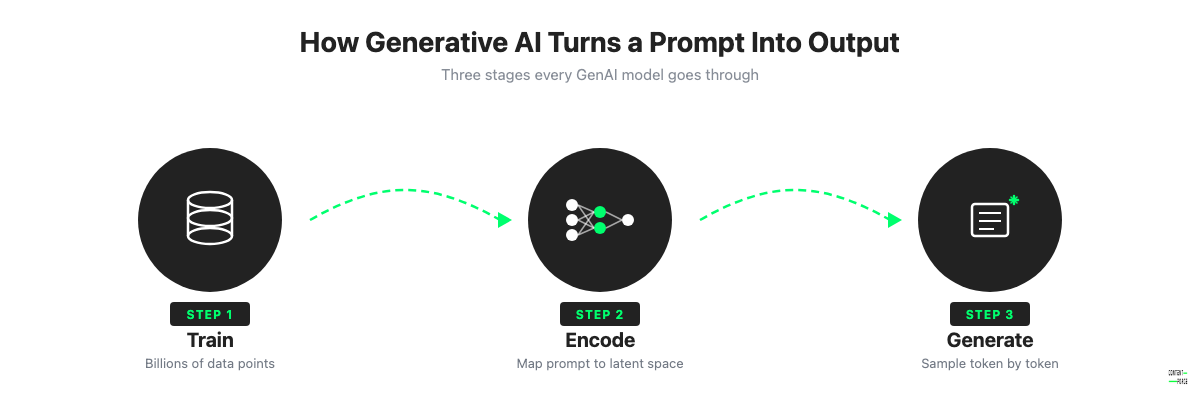
GenAI models train on massive datasets, learning to recognise patterns across billions of data points. When prompted, the model maps the input through an encoder to an internal representation, then a decoder generates new content by sampling from that learned space.
Foundation models and training
The foundation of most modern generative AI is a large model pretrained on broad data. During training, the model's exposed to vast amounts of text, images or other data and learns to predict what comes next: the next word in a sentence, the next pixel in an image patch, the next token in a code snippet.
This training process, called self-supervised learning, requires no human labelling. The model learns from the structure of the data itself. It's a self-organising process, and the result's a model with billions of parameters that encode an enormous amount of knowledge about language, images and the relationships between concepts.
From prompt to output
When you interact with a generative AI tool, you provide a prompt. The model encodes it into an internal numerical representation called a latent space. The decoder then generates a response by sampling tokens or pixels from the probability distribution it's learned.
For text models (large language models, or LLMs), the decoder generates one token at a time, each time picking the most probable next token given the context so far. That's why LLMs sometimes sound fluent but get facts wrong. For image models, diffusion models add random noise during training and learn to reverse that process, turning noise back into a coherent image that matches a text description.
Output quality depends on the size of the model, the quality and diversity of the training data, and how well the model's been fine-tuned for the specific task.
More parameters and cleaner data generally mean better output. It's not a strict rule, but it holds often enough to matter.
Staying current with retrieval augmented generation
A model only knows what it saw during training. That creates a hard cutoff date. Retrieval augmented generation (RAG) works around that: it pairs a generative model with a searchable external knowledge base, so the model retrieves current, specific information at query time instead of relying only on what it memorised during training. That's why a RAG-grounded tool can cite a source or reflect information newer than its training cutoff, while a model without RAG can't.
Types of generative AI models
Generative AI isn't a single technology. It covers five main model architectures, each suited to different tasks.
| Model type | Core mechanism | Best for | Examples |
|---|---|---|---|
| Transformer / LLM | Self-attention on token sequences | Text, code, conversation | ChatGPT, Claude, Gemini |
| Diffusion model | Iterative denoising from random noise | Photorealistic images and video | Stable Diffusion, Midjourney, OpenAI's in-ChatGPT image generation |
| Generative adversarial network (GAN) | Generator vs. discriminator in competition | Synthetic faces, data augmentation | StyleGAN, Pix2Pix |
| Variational autoencoder (VAE) | Encoder-decoder with probabilistic latent space | Image interpolation, audio | Used in image generation pipelines |
| Multimodal model | Combines text, image and audio inputs | Cross-modal tasks | Current flagship models from OpenAI, Google and Anthropic |
Transformers and large language models (LLMs) are the dominant architecture for text. The transformer, introduced in 2017, uses self-attention to weigh which parts of the input are most relevant when generating each token. The current generation of models behind ChatGPT, Claude and Gemini are all LLMs built on this architecture.
Diffusion models have become the standard for image generation. They learn to reverse a noise-addition process, progressively refining random noise into a coherent image that matches a text prompt. Stable Diffusion and Midjourney both use diffusion.
Generative adversarial networks (GANs), introduced by Ian Goodfellow in 2014, pit two networks against each other: a generator produces realistic fake data while a discriminator tries to detect the generated samples. This adversarial dynamic produces sharp, realistic outputs.
Variational autoencoders (VAEs) encode data into a compact probabilistic latent space, enabling smooth interpolation between examples and efficient sampling.
Multimodal models can accept and generate multiple content types, including text, images and audio, within a single model. They're the direction most frontier AI systems are heading.
What can generative AI create?
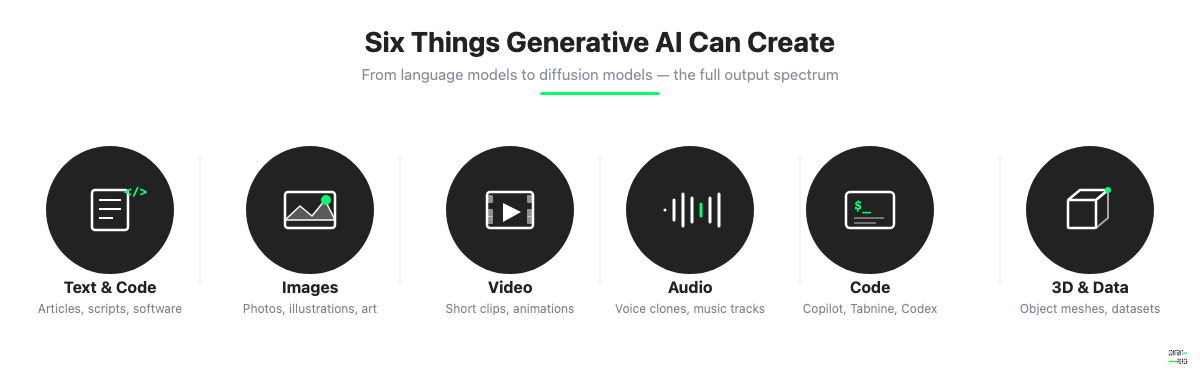
Generative AI can create text and code, images, video, audio and 3D models.
- Text and code: Language models write articles, emails, marketing copy, reports, scripts and software code. GitHub Copilot autocompletes entire code blocks; ChatGPT can draft a blog post or explain a codebase.
- Images: Image generators like Midjourney and Stable Diffusion, plus OpenAI's in-ChatGPT image generation, produce photorealistic photos, illustrations and artwork from text prompts in seconds.
- Video: Text-to-video models like Runway generate short video clips from a text description. This area's advancing quickly and quality's improving at a fast pace; OpenAI folded its own video generation (formerly the standalone Sora app) directly into ChatGPT in 2026.
- Audio and music: Models like ElevenLabs clone voices and generate realistic speech from text. Music generators compose original tracks in specified styles.
- Code: Tools like GitHub Copilot, CodeWhisperer and Tabnine suggest, complete and generate code, reducing time spent on boilerplate.
- 3D models and structured data: Emerging models generate 3D object meshes and structured data formats, with applications in product design and scientific research.
Generative AI examples: tools in use today
The most widely used generative AI tools include ChatGPT and Claude (text), Midjourney and Stable Diffusion (images), GitHub Copilot (code) and Runway (video).
| Tool | Category | Made by | Primary use |
|---|---|---|---|
| ChatGPT | Text / conversation | OpenAI | Chat, writing, analysis, coding |
| Claude | Text / conversation | Anthropic | Writing, analysis, summarisation |
| Google Gemini | Text / multimodal | Chat, search, productivity | |
| Midjourney | Image generation | Midjourney Inc. | High-quality artistic image generation |
| Stable Diffusion | Image generation | Stability AI | Open-source image generation |
| GitHub Copilot | Code generation | GitHub / Microsoft | AI pair programmer |
| Runway | Video generation | Runway | Text-to-video generation |
| ElevenLabs | Audio / voice | ElevenLabs | Voice cloning and text-to-speech |
These are the tools that have seen the broadest real-world adoption as of 2026. New models ship frequently, older ones get folded into bigger products or discontinued (OpenAI retired the standalone DALL-E 3 and Sora apps in 2026 in favour of image and video generation built directly into ChatGPT), and capabilities in video and audio keep improving at a fast clip.
Article Summarizer: a TL;DR, 3 to 7 key points and concrete takeaways. Free, no signup.
Use cases for generative AI
Generative AI is used for content creation, software development, customer service, healthcare research, financial services and education.
Content marketing and SEO: Content teams use generative AI to draft blog posts, ad copy, social media content, product descriptions and email campaigns. Tools like ChatGPT and Claude cut first-draft time significantly. SEO teams use them to generate content briefs, meta descriptions and heading structures. For marketing and content operations, it's become a standard workflow tool, not an experiment.
Software development: Developers use Copilot, CodeWhisperer and similar tools to autocomplete code, generate unit tests, document functions and debug. Productivity gains in coding tasks are among the most consistently documented benefits of generative AI adoption. It's not just faster; it's a different way of working.
Customer service: Businesses deploy generative AI-powered chatbots to handle inbound queries, answer product questions and route complex issues to human agents. They generate contextual responses rather than following rigid decision trees, which means they can handle questions the original developers didn't anticipate.
Healthcare: Generative AI accelerates drug discovery by generating synthetic protein sequences and predicting molecular structures. It also creates synthetic patient data for research that avoids privacy issues with real records. That's valuable when working with sensitive medical data.
Financial services: Banks use generative AI for fraud detection, personalised financial advice, document summarisation and regulatory reporting. McKinsey estimates generative AI could add $200-340 billion in annual value to the banking sector through productivity and efficiency gains.
Education: Teachers use generative AI to create quizzes, study guides and personalised learning materials. Students use it for research assistance, essay outlining and concept explanations, which has also created debates about academic integrity.
Generative AI and agentic AI
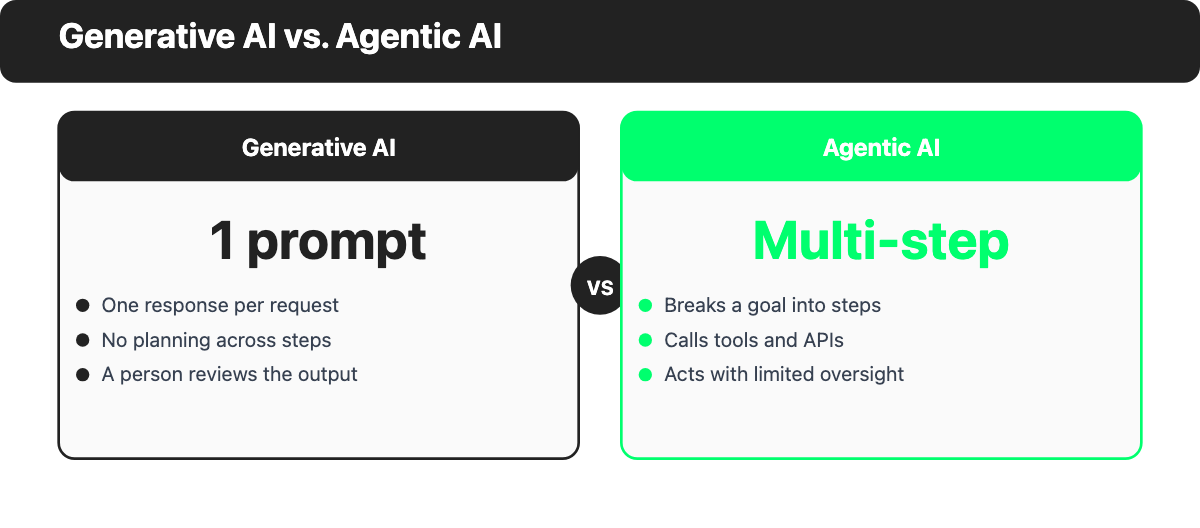
Agentic AI extends generative AI with planning, tool use and multi-step autonomy. Instead of producing one response to one prompt, an agent breaks a goal into steps, calls tools or APIs, and carries out the task with limited human oversight.
The two terms get used interchangeably, but they don't solve the same problem. Generative AI answers a request: write this email, generate this image, summarise this document. Agentic AI pursues a goal across several steps without a human approving each one.
Here's what that looks like in practice: research a topic across multiple sources, write the draft, check it against a style guide, and file it, all from a single instruction.
Coding agents are the clearest current example. Anthropic's Claude Code plans a multi-step coding task, edits files, runs tests and iterates on the result rather than just suggesting a snippet. OpenAI's folded its earlier standalone browser-automation product, Operator, into ChatGPT as an "agent mode" that can browse the web, fill in forms and run code toward a goal with limited supervision. Both are generative AI under the hood; what makes them agentic is the planning and tool-use loop wrapped around the model.
Benefits of generative AI
Generative AI offers four main benefits: speed, scalability, broader access to expertise and cost reduction.
Speed: Tasks that once took hours, like writing a first draft, generating product visuals or coding a function, now take seconds or minutes. For content teams, that's a meaningful multiplier on output without proportional headcount growth. Scalability follows directly from that speed: generative AI can produce hundreds of content variations at a fraction of the cost of human production, and that's what makes personalisation at scale achievable for the first time. A single marketer can brief, generate and review more variants in an afternoon than a small team could hand-write in a week. None of that replaces judgment about which variant is actually good, but it changes how many attempts you can afford to make before you need that judgment.
Broader access to expertise: A small team can now produce research summaries, legal document drafts, data analysis or code with a depth that previously required specialist hires. That's genuinely new.
That shift changes hiring plans, not just workflows.
Cost reduction: By automating repetitive creative and analytical tasks, generative AI reduces the cost per unit of output. Goldman Sachs projected in 2023 that generative AI could increase global GDP by up to 7% (roughly $7 trillion) over ten years through productivity gains; it's a projection made early in the technology's rollout, not a confirmed outcome.
Limitations and risks of generative AI
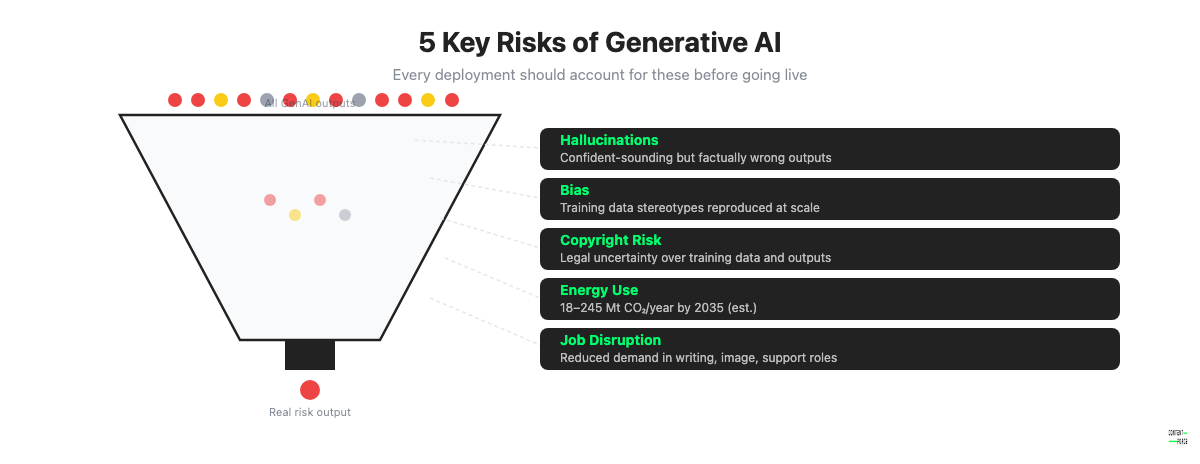
The key limitations include hallucinations, training data bias, a lack of explainability, copyright and legal risks, and significant energy demand.
Hallucinations: Generative AI models can produce confident-sounding statements that are factually wrong. That's called hallucination, and it's a serious problem. Air Canada found this out the hard way: in November 2022, its support chatbot gave a passenger incorrect information about the airline's bereavement-fare policy, and in February 2024 Canada's British Columbia Civil Resolution Tribunal ruled Air Canada liable and ordered it to pay compensation. The legal risk's real, not theoretical.
Bias: If the training data underrepresents certain groups or reflects historical biases, the model will reproduce those biases. That's not a hypothetical. Image generators have shown a flat-out tendency to produce predominantly white, male figures for roles like "CEO." Language models can reinforce stereotypes embedded in text data, and they'll keep doing so unless the training data is corrected.
Lack of explainability: Generative AI models are often described as "black boxes" because their internal decision process isn't fully interpretable, even to the teams that built them. That matters most in regulated or high-stakes settings, like lending or hiring, where an organisation needs to explain why a model produced a given output, and often can't.
Copyright and legal uncertainty: There are major lawsuits underway over whether training on copyrighted content constitutes infringement, including Getty Images v. Stability AI and The New York Times v. OpenAI. The legal landscape isn't settled and varies by jurisdiction.
Energy and resource demand: Training and running large models requires substantial data-center computing power, electricity and water, and that demand keeps growing as models and their user bases scale. Published estimates of the exact future carbon footprint vary widely by methodology and time horizon, so it's worth treating any single precise number with caution. The direction isn't in dispute.
Job market uncertainty: Some roles in writing, image production and customer support are seeing reduced demand. The net employment effect's still contested. A 2025 U.S. study found no discernible labour market disruption yet, while Chinese video game illustrators reported sharp job losses in 2023 after image AI adoption accelerated.
Frequently asked questions about generative AI
What is generative AI in simple terms?
Generative AI is software that creates new content, like text, images or code, by learning patterns from huge amounts of existing data and producing something new when given a prompt. It's essentially a very capable autocomplete that's read most of the internet.
What is the difference between AI and generative AI?
Artificial intelligence is the broad field of systems that perform tasks requiring human-like intelligence. Generative AI's a specific type focused on creating new content, rather than just classifying inputs or making predictions. All generative AI is AI, but not all AI's generative.
Is ChatGPT a generative AI?
ChatGPT is a generative AI. It's a large language model built by OpenAI that generates text responses based on patterns learned from a vast training dataset. Each response it produces is generated fresh rather than retrieved from a database.
What are the main risks of generative AI?
The main risks are hallucinations (generating false information convincingly), bias inherited from training data, a lack of explainability in how models reach their outputs, legal uncertainty around copyright, and significant energy demand. Deepfakes and misuse for disinformation are also significant concerns.
What is the difference between generative AI and agentic AI?
Generative AI produces one output in response to one prompt, like a draft, an image or a block of code. Agentic AI uses that same underlying technology but adds planning and tool use, so it can break a goal into steps and carry out a multi-step task, such as researching a topic and drafting a report, with limited human oversight at each step.
When was generative AI first created?
The modern era of generative AI began with generative adversarial networks (GANs) introduced by Ian Goodfellow and co-authors in 2014, and the transformer architecture introduced by Google researchers in 2017. It entered mainstream awareness in November 2022 when OpenAI released ChatGPT, which reached 100 million monthly active users within about two months, making it the fastest-growing consumer application at the time.