
Alternatives · 10 tools
The 10 Best Surfer SEO Alternatives in 2026 (Tested and Compared)

Surfer SEO alternatives worth considering in 2026 include SE Ranking as the best overall pick, Rankability for AI search visibility, NeuronWriter as the best budget option, Content Harmony for content briefs and Clearscope for enterprise teams. Surfer itself was repriced after its October 2025 acquisition by Positive Group and still lacks built-in keyword research.
- From
- €87.20/mo
- From
- $19/mo
Price from the vendor's pricing page, checked Sep 28, 2026.
Surfer SEO was acquired by Positive Group in October 2025, and the pricing model changed along with the ownership. The tool now bills in euros, and the old three-tier Essential/Scale/Enterprise lineup's been replaced by six plans, including a standalone "AI Search Analytics" tier built around tracking brand visibility in ChatGPT, Gemini, and AI Overviews. Standard now starts at 99 euros a month on annual billing, and the top Peace of Mind plan runs 299 euros before Enterprise pricing kicks in.
Beyond the repricing, Surfer still hasn't closed the same structural gaps it had before the acquisition. Keyword research isn't included, so a separate tool like Ahrefs or Semrush is still required alongside it. The content editor still produces inconsistent scores across similar queries, and the learning curve's still steep for teams new to SEO. If price is the deciding factor, our Surfer SEO pricing guide shows what each plan costs per document.
The alternatives have moved too, and they've moved fast. AI search visibility tracking, which used to be a Surfer-only differentiator among competitors, is now standard across half the tools on this list, and two new entrants (Rankability and Semrush's writing assistant) are common enough in agency workflows that we'd be doing readers a disservice leaving them out.
This guide covers 10 Surfer SEO alternatives, compared across pricing, features, and use case fit, with every price verified directly on each vendor's live pricing page. Each pick comes with a "best for" label so you can match the tool to your situation.
Quick picks:
- Best overall: SE Ranking
- Best for AI search visibility: Rankability
- Best budget pick: NeuronWriter
- Best for content briefs: Content Harmony
- Best for enterprise teams: Clearscope
- Best for long-form at scale: Scalenut
What to Look for in a Surfer SEO Alternative
Not every tool labeled a "Surfer alternative" is a real substitute, though. Here is what separates a useful replacement from a near-miss:
- Content scoring and NLP-based optimization. Surfer's primary job is grading content against live SERP data and showing which terms top-ranking pages use, and that's non-negotiable for any real alternative. A real alternative must do this. Without NLP-based scoring, a tool is just an editor.
- Built-in keyword research. Surfer omits keyword research entirely. Most users pay for both Surfer and a separate SEO platform. Alternatives that close this gap offer a better value proposition.
- AI writing or brief generation. Several tools now combine optimization scoring with AI-assisted drafting or brief creation, cutting the number of tools a team needs.
- Pricing for your team size. Surfer's pricing model scales steeply by tier and feature. Per-document or credit-based pricing works better for solo creators. Per-seat models with transparent team pricing work better for agencies.
- A free trial or free tier. A serious contender must offer a trial that includes the optimization feature itself, not just a limited dashboard preview.
- AI search and GEO tracking. Monitoring how content shows up in ChatGPT, Google AI Overviews, and Perplexity is no longer an edge case. Surfer itself added an AI Search Analytics tier after the Positive Group acquisition, and most modern content optimization tools now build some version of this in rather than treating it as a future feature.
The 10 Best Surfer SEO Alternatives in 2026
1. SE Ranking: Best All-in-One Alternative
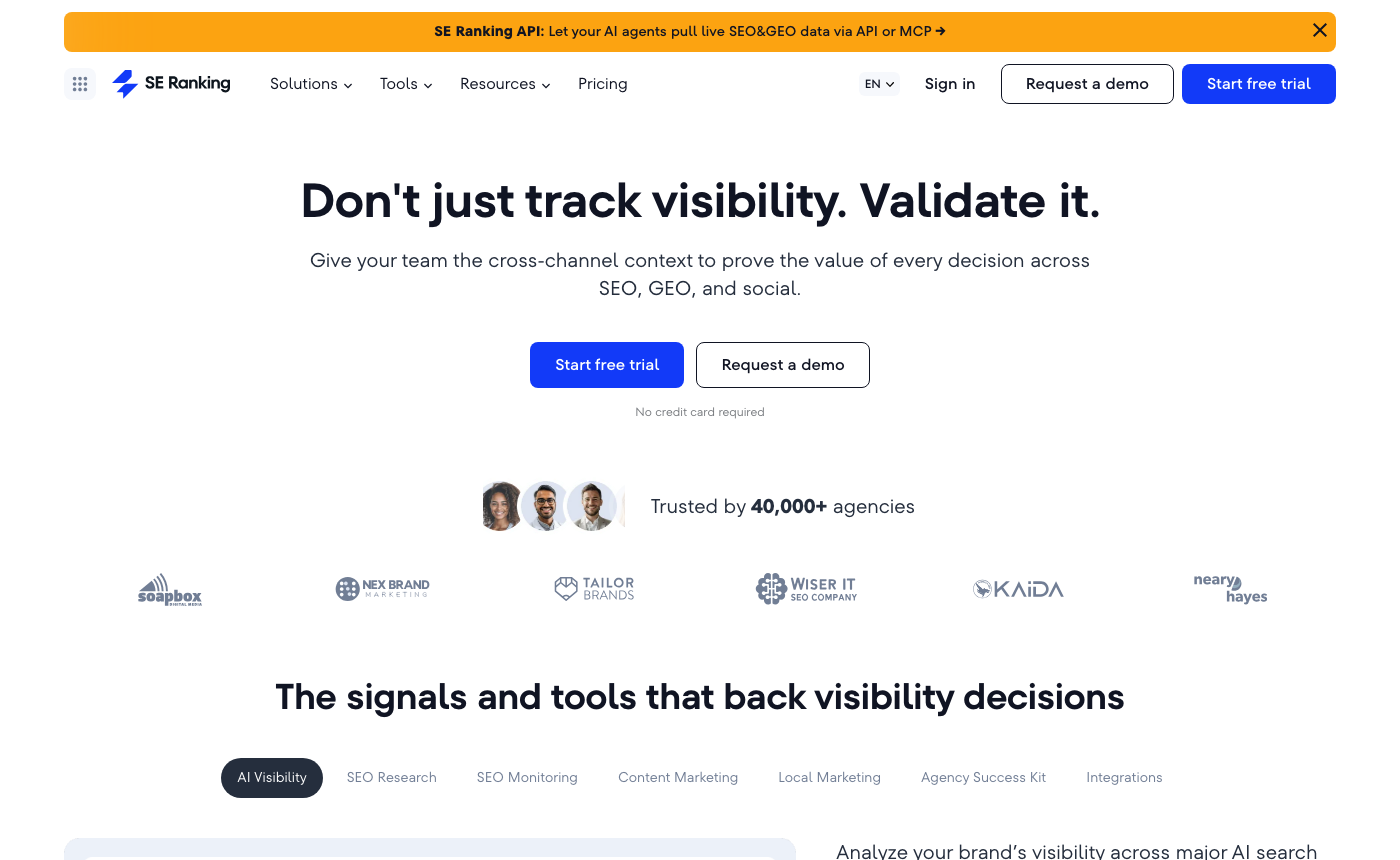
Best for: Content teams and agencies wanting to replace Surfer plus a separate SEO platform with one integrated tool.
SE Ranking's the strongest all-around replacement for Surfer SEO because it addresses every gap Surfer leaves open, flat-out. Keyword research, rank tracking, and site auditing are included. For teams currently running Surfer alongside Ahrefs or Semrush, SE Ranking is a genuine consolidation option.
The content marketing module covers the same ground as Surfer's content editor: NLP-based scoring, SERP analysis, and term recommendations. The scoring isn't as deep as Clearscope at the top end, but it's solid and integrates well with the rest of the platform.
AI search visibility tracking is available as an add-on rather than a differentiator that sets SE Ranking apart on its own now. It costs an extra €63.20 a month on top of a Core or Growth plan and covers AI Overviews, AI Mode, Perplexity, and ChatGPT through the SE Visible dashboard. Several other tools on this list, including Clearscope, Scalenut, and the AI-visibility specialist Rankability, cover the same ground, so this is a solid option rather than a unique one.
Pricing: Core from €87.20/month on annual billing (€109/month billed monthly), Growth from €188/month annual (€235/month monthly); AI Search Tracking add-on from €63.20/month; Enterprise is custom
Free trial: Yes (14 days)
Pros:
- Full SEO stack: rank tracking, keyword research, site audit, content optimization
- AI search visibility tracking available as an add-on
- Agency features including client reports and white-label options
- 14-day free trial with full platform access
Cons:
- Content optimizer isn't as deep as Clearscope or Surfer on NLP precision
- AI visibility tracking costs extra rather than being bundled
- Some advanced features require onboarding time
vs. Surfer SEO: SE Ranking addresses every gap Surfer has while matching its content optimization function. Teams paying for Surfer plus a separate rank tracker and keyword tool will likely save money by switching.
ContentForce runs a live SERP analysis, writes the full article or refreshes an existing post and syncs it to WordPress. You approve every change in a diff first. From €49/month, 7-day free trial.
2. NeuronWriter: Best Budget Alternative to Surfer SEO
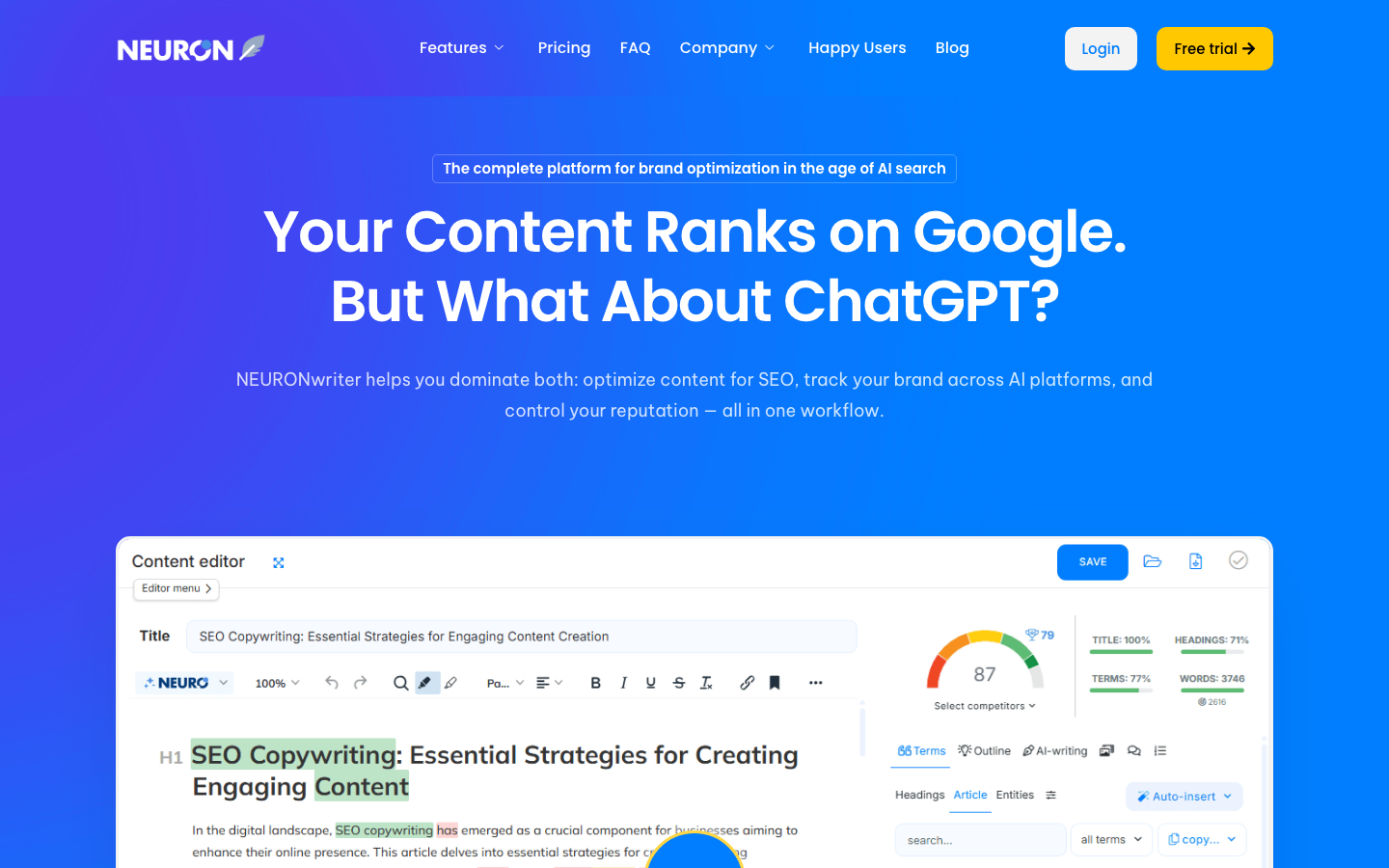
Best for: Solo bloggers, freelancers, and budget-conscious content teams wanting NLP content scoring without the Surfer price tag.
NeuronWriter is the closest functional match to Surfer's content optimization job at a lower price. It analyzes the top 30 SERP results for a keyword and produces a content score plus a list of recommended terms to include. The interface's clean and the feedback's fast.
One aspect that sets NeuronWriter apart: lifetime deal availability. Surfer runs on subscriptions only, but NeuronWriter doesn't. NeuronWriter has appeared on deal platforms with one-time payment options, which attracts cost-conscious creators who want to lock in a price permanently.
The feature set's narrower than Surfer's, though. No rank tracking, no site audit, limited keyword research. The UI's functional but not as polished as Clearscope. Integrations are thinner across the board.
Pricing: $23-$117/month on monthly billing (Bronze through Diamond), roughly 17% less on annual billing ($19-$97/month); lifetime deals available periodically
Free trial: Yes
Pros:
- Strong NLP scoring at its price tier
- Lifetime deal options available
- No seat limits on most plans
- Fast SERP analysis turnaround
Cons:
- Narrower feature set than Surfer
- No native Google Docs plugin
- Limited keyword research depth
- Less polished UI
vs. Surfer SEO: NeuronWriter covers Surfer's optimization job at a fraction of Standard-tier Surfer pricing. For teams whose primary need is content scoring and term recommendations, the results are comparable and the savings are significant.
3. Frase: Best for Content Workflow Efficiency
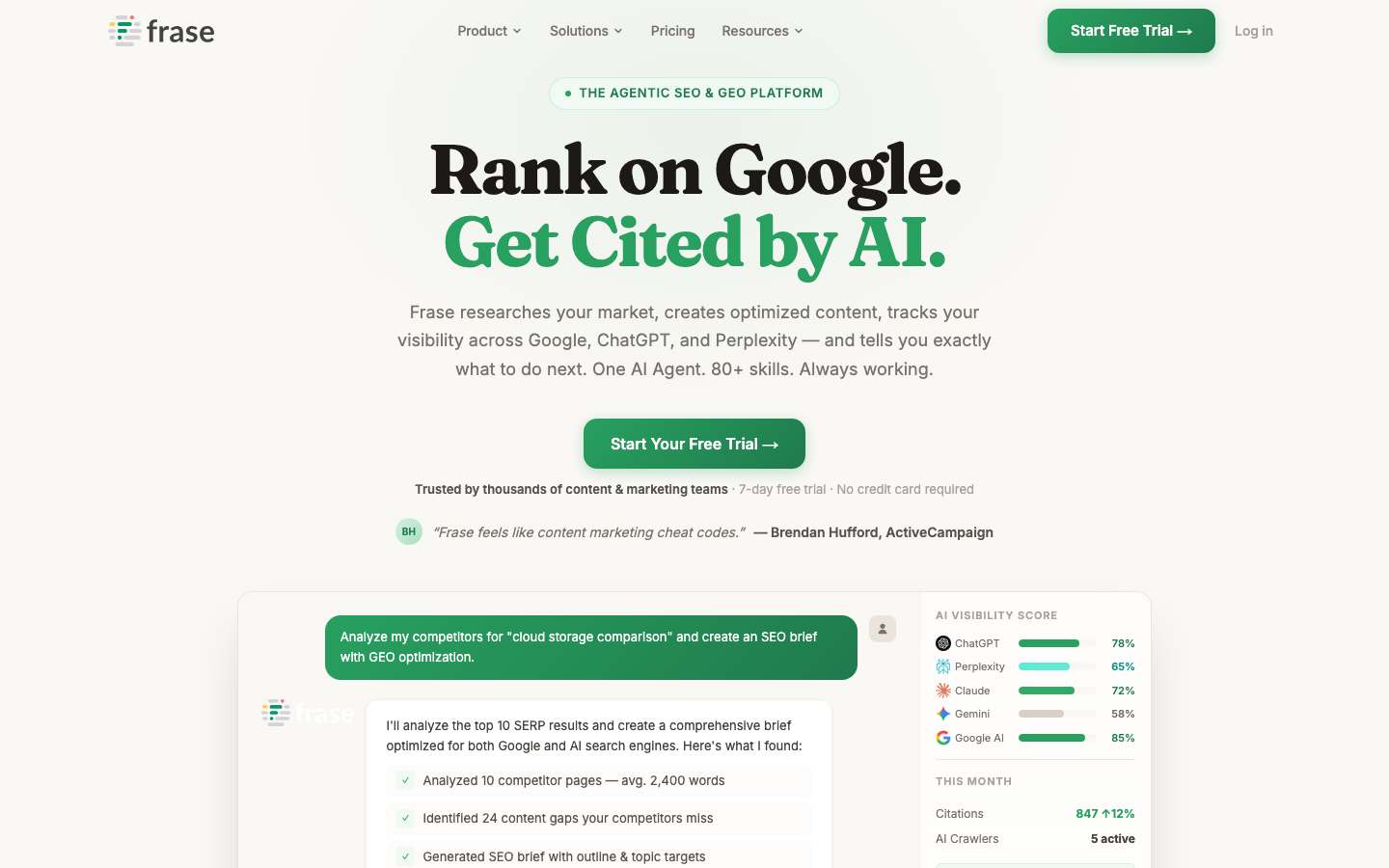
Best for: Content teams and agencies wanting research, brief creation, and optimization in one place with a fast end-to-end workflow.
Frase takes a workflow-first approach. Rather than jumping from keyword to scoring in one step, Frase walks through research, brief creation, and optimization inside a unified interface. A user gets competitor summaries, PAA questions, auto-generated outlines, and then the optimization editor, all without switching applications, which isn't something most rivals pull off cleanly.
Content refresh work's where Frase stands out. Frase's Content Guard feature watches published pages for Google ranking decay and flags them for a refresh, which fits teams running regular content audits better than Surfer's page-by-page approach.
AI writing's built directly into the editor, unlike Clearscope. Frase can generate section content pulling from the research summary to stay on-topic, rather than producing generic filler.
The tradeoff's scoring granularity. Frase's NLP scoring doesn't go as deep as Clearscope or Surfer at the enterprise level. The essentials are covered well; fine-grained term frequency weighting isn't a strength.
Pricing: $49/month (Starter), $129/month (Professional), $299/month (Scale) on monthly billing; roughly 20% less on annual billing; Enterprise is custom
Free trial: Yes (7-day free trial)
Pros:
- Research-to-brief pipeline is fast
- AI writing integration works inside the optimization editor
- Content Guard flags ranking decay automatically
- Multi-user support on team plans
- PAA data integration is well-implemented
Cons:
- NLP scoring depth is below Clearscope
- Higher tiers needed for larger article volumes
- Less useful for standalone scoring without the research context
vs. Surfer SEO: Surfer is stronger on raw SERP scoring. Frase wins on brief creation speed and refresh workflows. Teams that update old posts frequently tend to prefer Frase.
4. Clearscope: Best Enterprise Alternative to Surfer SEO
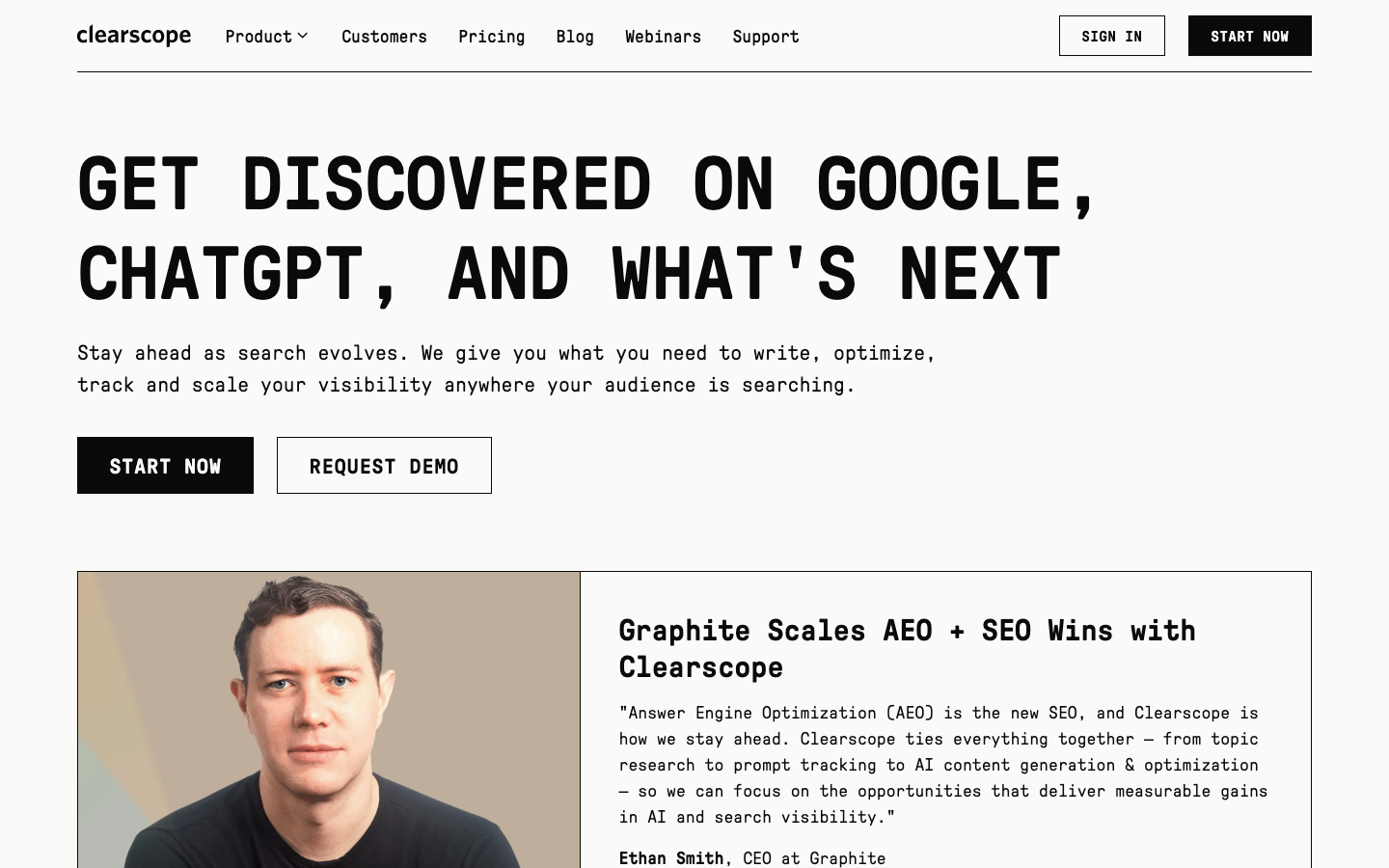
Best for: Enterprise content teams and large agencies needing reliable, stable optimization scoring with team collaboration built in.
Clearscope's the premium option in this category, without question. Its term-frequency grading system uses letter grades (A+ through F) across recommended terms. Unlike Surfer's numerical score, which can shift based on query context, Clearscope's grading is stable and legible to writers who aren't SEO specialists. A grade of B means something consistent across queries and teams, and that's not something Surfer's own fluctuating score can promise.
The portfolio view's a real differentiator. All published pages are visible in one dashboard with their optimization grades. Pages that have declined over time surface clearly, making prioritization for refreshes data-driven rather than guesswork. For teams managing hundreds of pages, this view alone saves hours per week.
Clearscope's also added AI prompt tracking since the last review: even the entry Essentials plan now includes 50 tracked prompts for brand visibility monitoring alongside its content scoring, closing part of the gap with dedicated AI-visibility tools like Rankability.
Integration depth's strong too. Native plugins for Google Docs and WordPress let writers optimize in their preferred environment without leaving the tool.
Pricing: $129/month (Essentials, 50 tracked prompts and 50 pages), $399/month (Business, 300 tracked prompts and 300 pages); Enterprise is custom
Free trial: 14-day free trial, no contract required
Pros:
- Most consistent scoring in this category
- Portfolio view across all published pages
- Native Google Docs and WordPress plugins
- AI prompt tracking now included from the entry tier
- Strong team collaboration
Cons:
- Expensive for small teams or solo users, especially at the Business tier
- No AI writing
- No keyword research
vs. Surfer SEO: Clearscope scores more reliably and now matches Surfer on AI-visibility tracking too; Surfer still wins on raw feature count for the price. For enterprise teams where scoring consistency and portfolio visibility are the priorities, Clearscope is the stronger pick.
5. Rankability: Best for AI Search Visibility
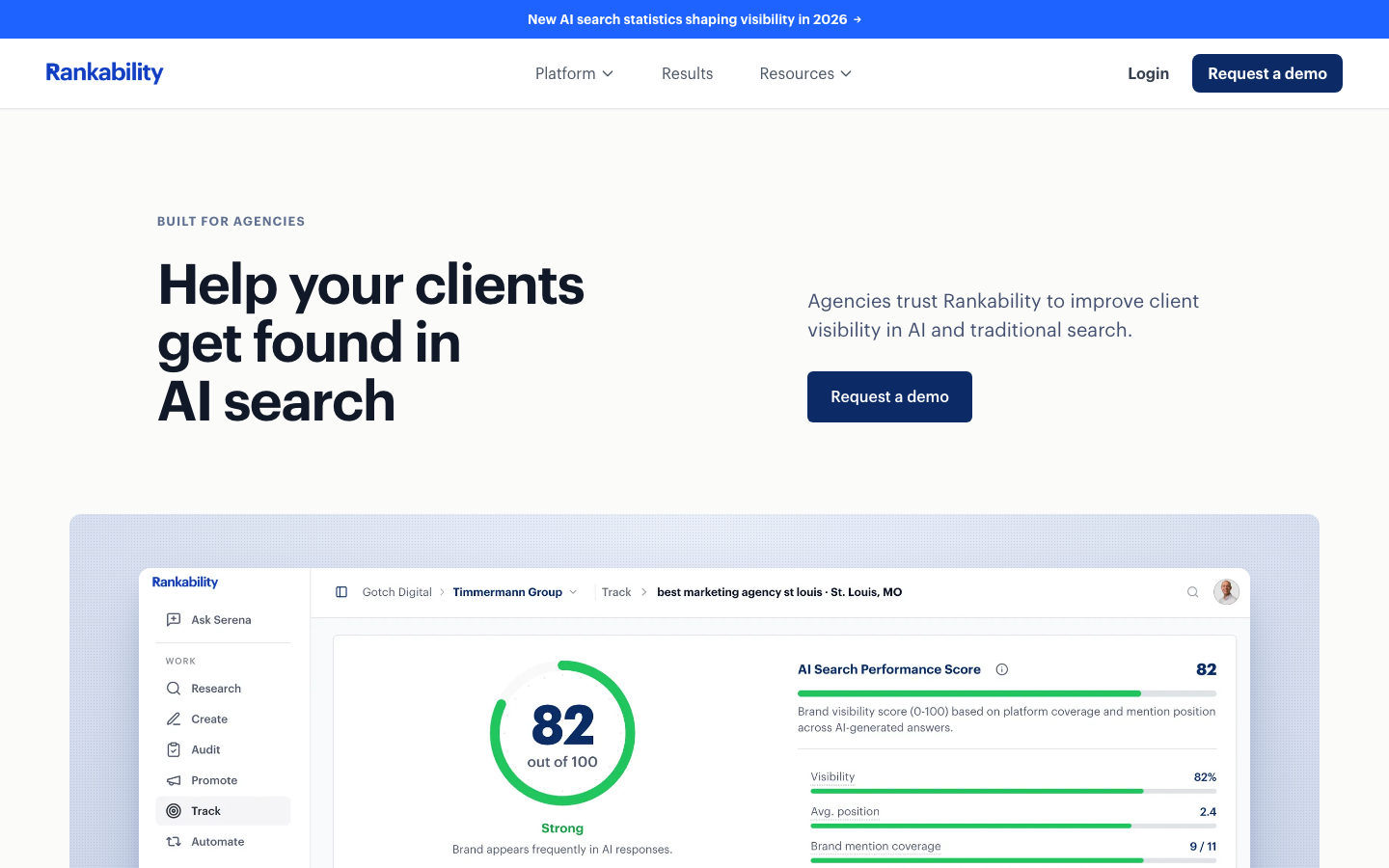
Best for: Agencies and in-house teams whose main question has shifted from "does this page rank" to "does this brand get mentioned in ChatGPT, Gemini, and AI Overviews."
Rankability isn't a direct Surfer replacement in the classic sense. It doesn't grade a page against SERP term frequency. Instead it tracks how often and how favorably a brand shows up across ChatGPT, Google AI Mode, Google AI Overviews, Perplexity, Claude, Gemini, Grok, and Microsoft Copilot, then ties that visibility back to specific content and prompt sets.
Teams that added Rankability alongside a content optimizer report it filling a real gap: traditional NLP scoring says nothing about whether an AI assistant actually cites or recommends the page, yet that's often the metric that matters most now. The daily-refresh prompt tracking (60 to 250 prompts depending on tier) gives a faster read on AI-visibility movement than most SEO suites, which typically refresh AI tracking weekly.
The tradeoff is scope. Rankability doesn't replace keyword research, content briefs, or on-page NLP scoring, so most teams run it next to a tool from earlier on this list rather than instead of it.
Pricing: $99/month (Starter, 60 daily prompts, 1 brand workspace), $199/month (Core, 125 daily prompts, 3 workspaces), $399/month (Team, 250 daily prompts, 10 workspaces), $799/month (Agency); roughly 17% less on annual billing
Free trial: Demo-based onboarding
Pros:
- Daily-refresh AI visibility tracking across eight AI engines
- Ties visibility data back to specific pages and prompts
- Unlimited seats on every tier
- API and hosted MCP access included at every tier
Cons:
- Does not do on-page NLP content scoring like Surfer
- No native keyword research or brief creation
- Priced as an add-on tool, not a Surfer replacement on its own
vs. Surfer SEO: Surfer optimizes the page for search engines and, since its own AI Search Analytics tier launched, tracks some AI visibility too. Rankability's deeper on the AI-visibility side across more assistants, but it skips page-level NLP scoring entirely. Teams that need both usually don't pick one; they pair Rankability with a scoring tool such as NeuronWriter or Frase.
6. Content Harmony: Best for Content Briefs
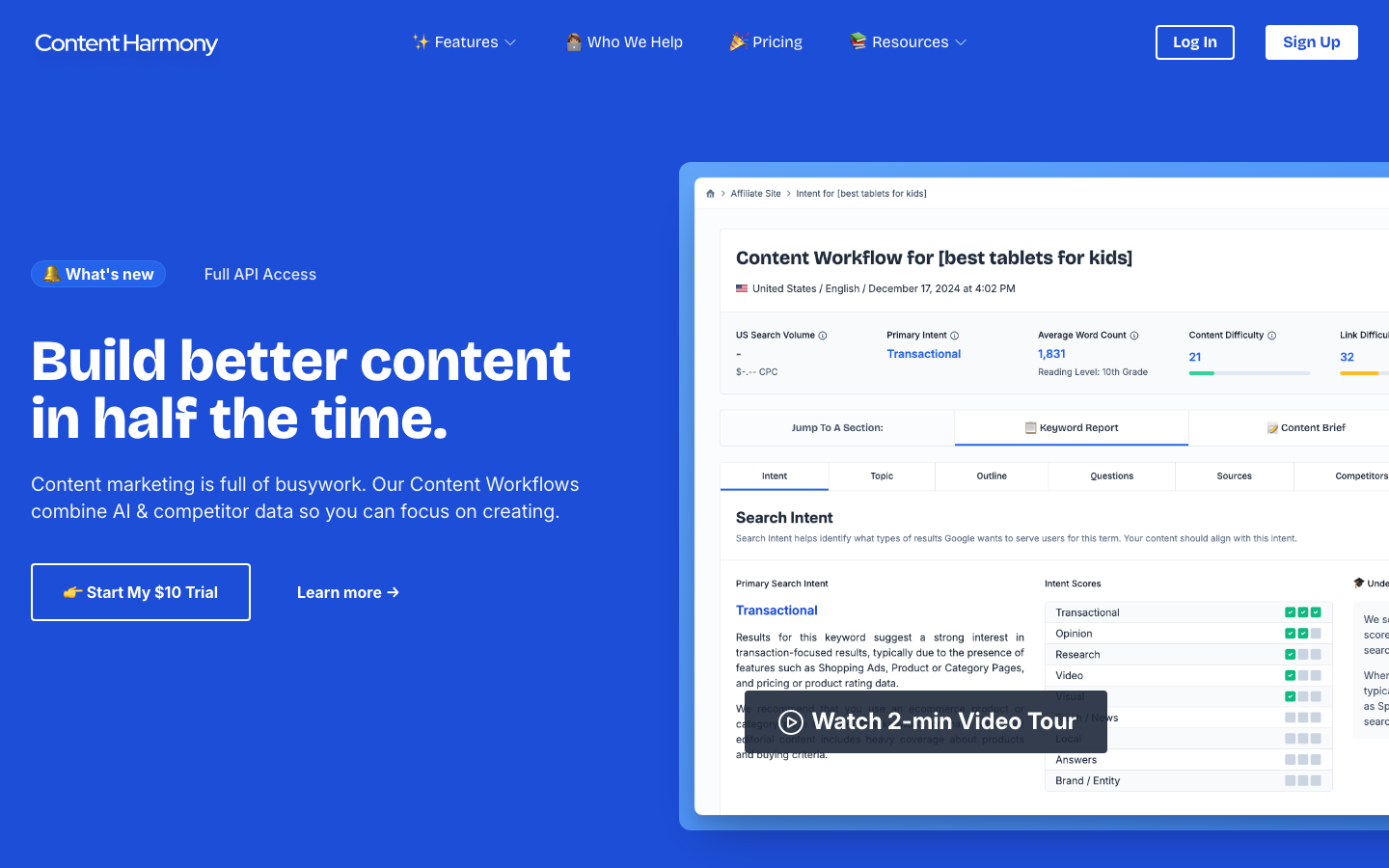
Best for: Content managers and editorial teams whose work centers on producing detailed briefs for writers rather than optimizing content themselves.
Content Harmony produces the best briefs in this category, period. The workflow starts with a comprehensive brief rather than a real-time scoring interface. Each brief includes competitor structure analysis, PAA questions sourced from Quora, Reddit, and Google, search intent classification, and visual content research showing what image and video formats appear in the top SERP results.
Search intent classification's what stands out most. Content Harmony explicitly categorizes each query's intent (informational, commercial, transactional, or navigational) and flags mixed-intent SERPs, which are a signal that ranking difficulty may be higher or unstable.
Pricing uses a workflow-credit model rather than a seat model, but it scales further than it used to: the top published Standard tier now covers 150 workflows a month before Enterprise pricing takes over, up from a lower ceiling previously.
Pricing: $50/month (5 workflows) up to $799/month (150 workflows) across six Standard tiers; Enterprise from $1,000/month for 200+ workflows; roughly 10% less on annual billing
Free trial: $10 for 10 workflow credits, no time limit and no automatic billing
Pros:
- Best-in-class brief depth in this category
- Search intent classification per query
- Visual and video content research included
- PAA aggregation from multiple sources
- No per-seat limits on team plans
Cons:
- Credit model becomes expensive at high volume
- No AI writing
- Primarily a briefing tool, not a full optimization platform
vs. Surfer SEO: Content Harmony wins on brief quality and research depth; Surfer wins on real-time optimization scoring. Brief-first teams that hand work to writers prefer Content Harmony. Teams where writers optimize directly in the editor prefer Surfer or Clearscope.
7. MarketMuse: Best for Topical Authority Strategy
Best for: Content strategists and large sites focused on topical authority through systematic gap analysis and topic modeling.
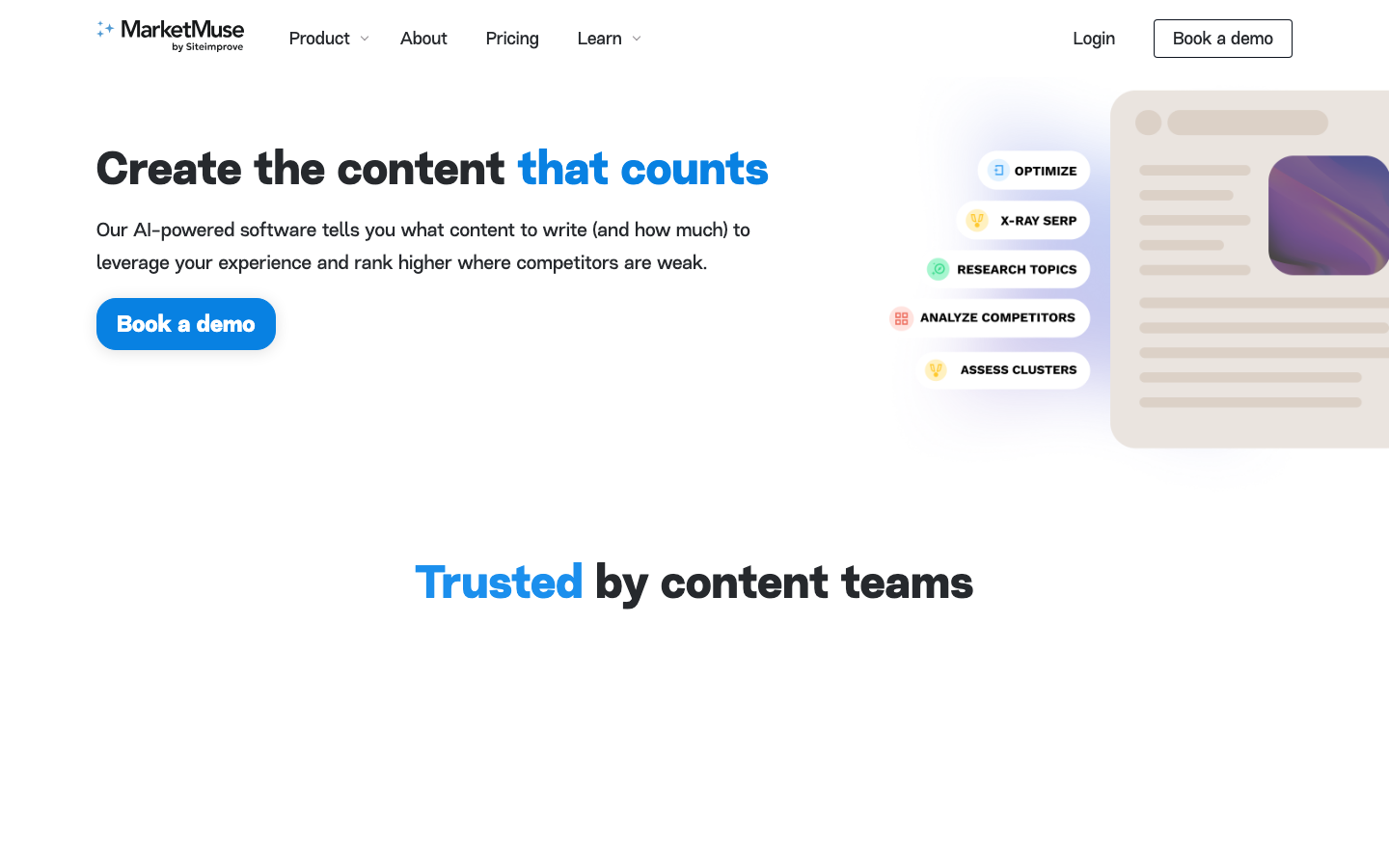
MarketMuse operates at a different level than most tools on this list, though. Page-level optimization isn't the main job. MarketMuse maps existing content against a topic universe, identifies gaps, and prioritizes pages to create or improve based on site-level authority signals.
The content inventory view's a genuine time-saver: it shows every page in a single dashboard with optimization scores, competitive scores, and ranking data. For sites with hundreds of pages, this overview replaces hours of manual auditing.
MarketMuse's still got the only meaningful free plan in this category, covering 10 monthly queries. What has changed is the paid tiers: MarketMuse no longer publishes fixed prices for Optimize, Research, or Strategy. All three now require a demo call, so budget-focused teams should treat any specific figure quoted elsewhere as outdated and confirm the current number directly with MarketMuse's sales team before committing.
Pricing: Free plan (10 queries/month); Optimize, Research, and Strategy tiers are demo-only, custom pricing
Free trial: Yes via the free plan
Pros:
- Only tool with a usable free plan
- Best site-level topical authority and gap analysis
- Content inventory view across the full site
- Strong for pillar page and cluster strategy
Cons:
- Overkill for single-page optimization
- Paid pricing is no longer public, so budgeting requires a sales call
- Topic modeling approach has a learning curve
- Page-level scoring is less precise than Clearscope
vs. Surfer SEO: MarketMuse and Surfer solve different problems. Surfer optimizes individual pages; MarketMuse builds strategy at scale. Teams needing both tools often run MarketMuse for planning and a lighter tool for real-time page optimization.
8. Scalenut: Best for Long-Form Content at Scale

Best for: Content teams producing high volumes of long-form SEO articles wanting generation and optimization in one tool.
Scalenut offers the most complete end-to-end long-form content workflow in this category, and that's not a small claim. The process starts with keyword planning and cluster creation, moves to AI-assisted drafting with a structured outline, and ends with the built-in NLP optimizer. Nothing leaves the platform.
Cruise mode's the headline feature: enter a keyword and target outline, and Scalenut produces a full draft in minutes. Quality's solid enough for a first draft that a writer then refines, but it's not a final product.
Scalenut's plans were renamed and repriced since the last review, and AI-visibility prompt tracking is now built into every paid tier rather than being a separate add-on: Starter tracks 10 prompts against ChatGPT and Google AI Overviews, and Professional extends that to 100 prompts and adds Perplexity coverage.
Pricing: $59/month (Starter), $89/month (Plus), $199/month (Professional) on monthly billing; a current site-wide 60%-off promotion brings it down to $24-$80/month (not tied to annual billing)
Free trial: Yes (7 days)
Pros:
- Complete long-form workflow: clustering, drafting, optimization
- Fast cruise mode for AI-assisted first drafts
- AI-visibility prompt tracking bundled into every tier
- Built-in keyword research
Cons:
- NLP scoring less precise than Clearscope or Surfer at the top end
- AI writing quality varies by topic and requires editing
- AI generation and optimization are bundled (a downside if only one is needed)
vs. Surfer SEO: Scalenut matches Surfer's optimization function, adds AI writing and content clustering, and now tracks AI visibility on every tier instead of gating it behind an add-on the way Surfer and SE Ranking do. Optimization precision is slightly lower; overall value per dollar is higher for volume-driven teams.
9. Outranking: Best for Structured Brief-to-Draft Workflows
Best for: Content teams wanting a step-by-step workflow from brief through published draft with clear stages and no ambiguity.
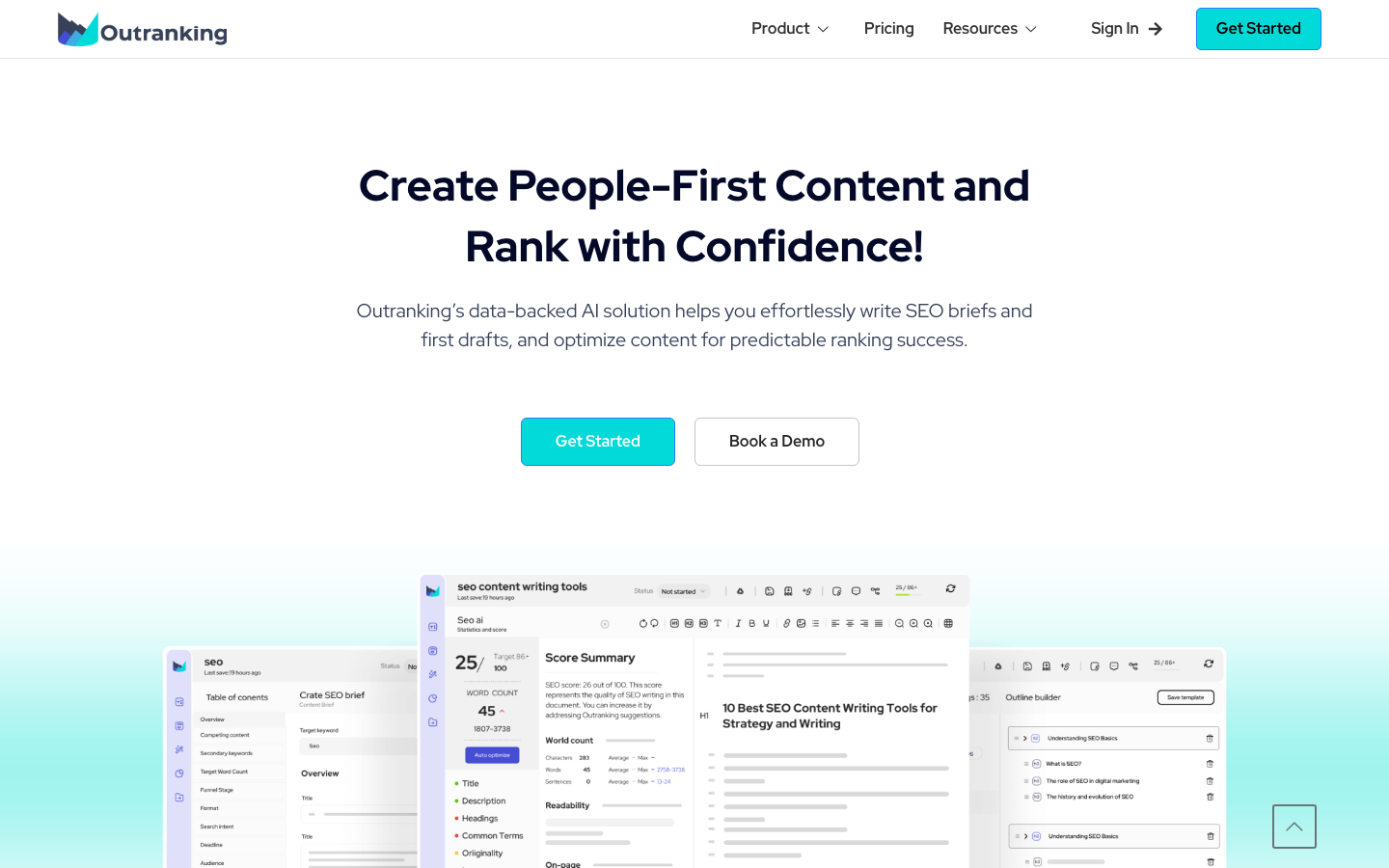
Outranking takes an opinionated approach to content creation, and it works. The platform breaks the process into explicit steps: define topic and intent, build outline, generate draft, optimize, review. Each step's visible and the tool enforces a forward progression, so nothing gets skipped by accident. This structure helps teams maintain consistency across multiple writers and clients.
Brief quality's strong relative to the price. Outranking pulls competitor structure, questions, and SERP data into a brief format more detailed than what most tools at this price produce. The on-page optimization score uses NLP analysis comparable to Surfer's function.
Entry pricing's still the lowest full-workflow option on this list, but third-party pricing trackers currently disagree on the exact tier names and numbers above the entry plan, a sign the lineup has changed recently. Confirm the current mid and top tiers directly on Outranking's pricing page before budgeting for a team plan.
Pricing: From roughly $19-29/month at the entry tier, with mid and top tiers in the $79-159/month range depending on the plan; confirm exact current tiers on Outranking's own pricing page
Free trial: Yes, plus a free tier with limited optimizations
Pros:
- Lowest entry price with a full optimization workflow
- Structured process that prevents workflow gaps
- Strong brief quality relative to price
- AI writing built in
Cons:
- Less flexible for experienced teams that skip steps
- AI writing quality is mixed on technical topics
- Optimization scoring isn't as deep as Clearscope
- Published pricing tiers have shifted recently and are inconsistent across sources
vs. Surfer SEO: Outranking costs far less at the entry tier and adds brief creation and AI writing that Surfer gates behind higher plans. Scoring precision is lower at the top end. For teams on a budget or teams building a content optimization workflow from scratch, Outranking is a practical starting point before moving to a premium tool.
10. Semrush SEO Writing Assistant: Best for Existing Semrush Users
Best for: Teams already paying for Semrush who want content scoring without adding a separate subscription.
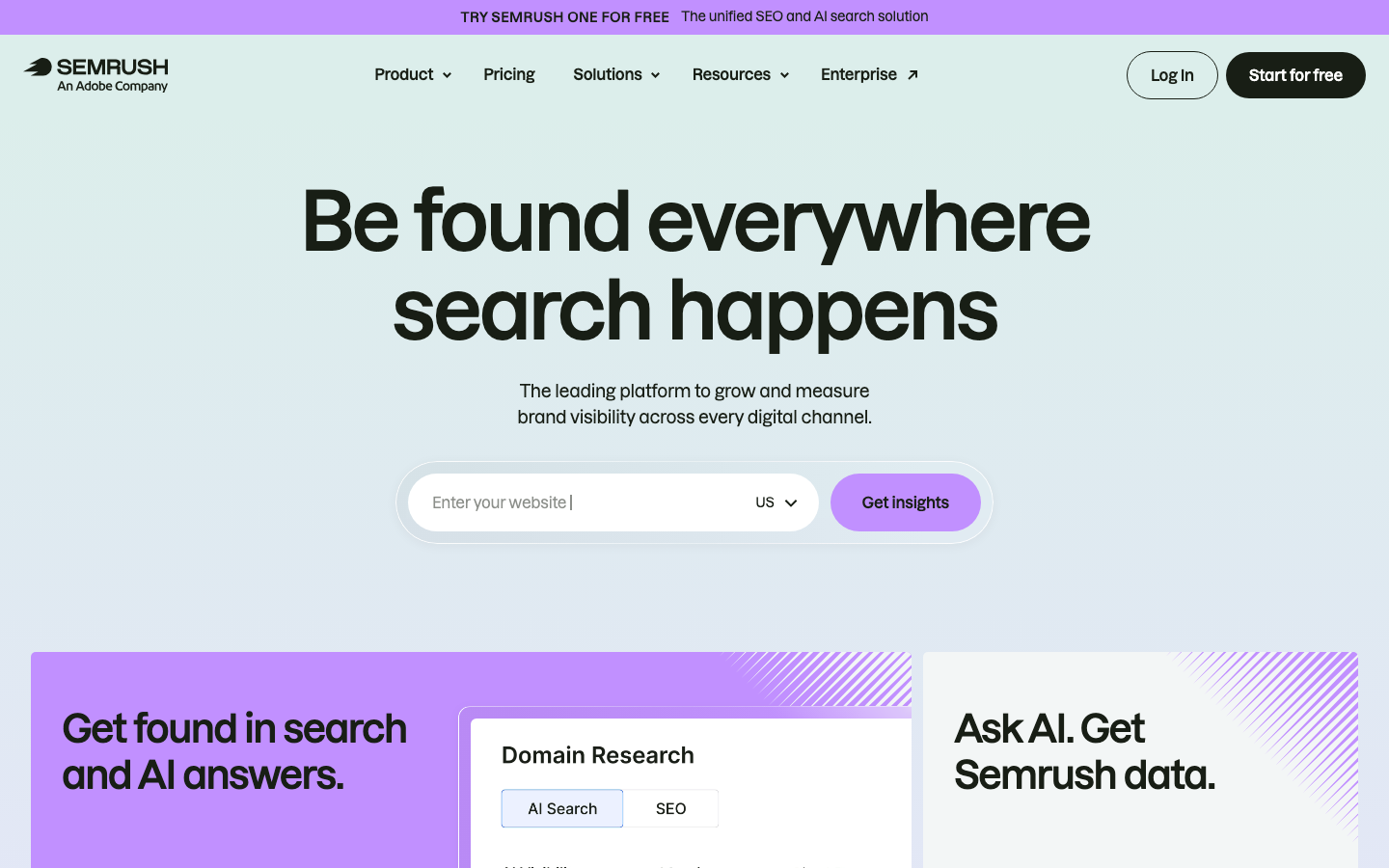
Semrush's SEO Writing Assistant isn't sold as a standalone product. It is a content-optimization module bundled into Semrush's main subscription tiers, which now run as Pro+ and Advanced (Semrush restructured its plans after Adobe's 2026 acquisition of the company). For a team that already runs Semrush for keyword research, rank tracking, or competitor analysis, the writing assistant is effectively a free add-on rather than a new line item.
The tool grades readability, tone, originality, and SEO term coverage against top-ranking pages for a target keyword, and it integrates directly with Google Docs, WordPress, and Microsoft Word. It won't match Surfer or Clearscope on scoring depth, since it's one module inside a much larger platform rather than a dedicated optimization engine.
The math only works if a team needs the rest of Semrush anyway, though. Buying a full Semrush tier solely to get the writing assistant costs far more than a dedicated content-optimization tool.
Pricing: No standalone price; bundled starting with the Pro+ plan at roughly €238/month annual billing, and the Advanced plan at roughly €437/month annual billing
Free trial: Yes, through Semrush's standard trial
Pros:
- No extra cost for teams already on a qualifying Semrush plan
- Integrates with Google Docs, WordPress, and Microsoft Word
- Full Semrush keyword, rank tracking, and competitor data available in the same account
Cons:
- Not available without a paid Semrush subscription
- Scoring depth is shallower than dedicated tools like Surfer or Clearscope
- Expensive as a dedicated content-optimization purchase if the rest of Semrush isn't needed
vs. Surfer SEO: Surfer is a deeper, purpose-built content optimizer. The Semrush writing assistant makes sense only as a bundled feature for teams that already need Semrush's broader SEO toolkit, not as a direct Surfer replacement on its own.
SEO Title Generator: eight title tag variations, sized for the SERP and intent-matched. Free, no signup.
Surfer SEO Alternatives Compared: Quick Reference Table
| Tool | Starting Price | Free Trial | Best For | Content Scoring | Keyword Research | AI Visibility Tracking |
|---|---|---|---|---|---|---|
| NeuronWriter | $19/mo | Yes | Budget optimization | Strong | Basic | No |
| Frase | $49/mo | Yes (7 days) | Content workflow | Good | Limited | No |
| Clearscope | $129/mo | 14 days | Enterprise teams | Excellent | No | Yes (from entry tier) |
| SE Ranking | €87.20/mo | Yes (14 days) | All-in-one stack | Good | Yes | Add-on (+€63.20/mo) |
| Rankability | $99/mo | Demo | AI search visibility | No | No | Yes (8 AI engines) |
| Content Harmony | $50/mo | Yes ($10 for 10) | Content briefs | Basic | Limited | No |
| MarketMuse | Free or custom | Yes (free plan) | Topical strategy | Good | Limited | No |
| Scalenut | $59/mo | Yes (7 days) | Long-form at scale | Good | Yes | Yes (from entry tier) |
| Outranking | ~$19-29/mo | Yes | Brief-to-draft | Good | Limited | No |
| Semrush Writing Assistant | Bundled (€238+/mo) | Yes | Existing Semrush users | Basic | Yes (via Semrush) | No |
How to Choose the Right Surfer SEO Alternative
Choose NeuronWriter or Outranking if you are on a tight budget
Both start under $30/month and include functional NLP content scoring. NeuronWriter covers the optimization function; Outranking adds brief creation and AI writing. Either is a defensible starting point before committing to a higher-tier tool.
Choose SE Ranking if you want one tool instead of three
Teams running Surfer plus a rank tracker plus an SEO platform are paying for overlap. SE Ranking consolidates all three functions and offers AI search visibility tracking as an add-on. The total bill is usually lower and the workflow is simpler.
Choose Rankability if AI visibility is the main scoreboard
When the real question is whether a brand gets mentioned by ChatGPT or shows up in an AI Overview rather than whether a page outranks a specific competitor, a dedicated AI visibility tracking tool like Rankability answers that more directly than a general content optimizer with a visibility feature bolted on.
Choose Frase or SE Ranking if you run an agency
Multi-client support, fast brief creation, and team collaboration are the agency requirements. Frase handles multiple clients cleanly with a fast research-to-brief pipeline. SE Ranking adds rank tracking and client reporting for full-service agencies.
Choose Content Harmony if content briefs are your core deliverable
Teams writing briefs for external writers, not optimizing content themselves, get the most value here. No other tool on this list produces briefs with Content Harmony's depth, search intent classification, and visual content research.
Choose Clearscope if you manage a large content portfolio
Portfolio view and grading stability make Clearscope the right call for teams tracking 50 or more published pages. The ability to see every page's optimization status and decline over time in one dashboard is worth the premium for content-heavy sites.
Choose MarketMuse if topical authority is the long-term goal
Pillar page strategy, content gap identification, and cluster prioritization are MarketMuse's strength. No other tool on this list was built for this job. The free plan is a genuine starting point, though budgeting for a paid tier now requires a sales conversation.
Frequently Asked Questions
What is the best free alternative to Surfer SEO?
MarketMuse's free plan includes 10 monthly queries with access to content scoring and topic research, and it's the only option on this list with a genuinely usable free tier rather than a time-limited trial. NeuronWriter and Outranking both offer trials for evaluating their NLP scoring before purchasing.
Has Surfer SEO changed since being acquired by Positive Group?
Yes, it's changed. Surfer SEO's pricing and plan structure changed after Positive Group acquired it in October 2025. Surfer now bills in euros across six plans instead of three, added a standalone AI Search Analytics tier for tracking brand visibility in ChatGPT, Gemini, and AI Overviews, and kept its co-founders on through the transition. The core content-scoring product and its gaps, no built-in keyword research and an inconsistent scoring model, haven't changed.
Is NeuronWriter as good as Surfer SEO?
NeuronWriter matches Surfer's content scoring and term recommendation function at a significantly lower price. For solo creators and small teams, the results are comparable for the optimization task itself. Surfer pulls ahead on additional features: audit tools, team collaboration, and integrations that matter more to larger organizations.
What does Surfer SEO do that these alternatives don't?
Surfer combines deep SERP analysis with a mature, polished content editor that has a large user community and extensive integrations, plus its own AI Search Analytics tier since the Positive Group acquisition. Its scoring methodology is trusted by teams already trained on it. None of the alternatives is a perfect drop-in replacement. Each involves different tradeoffs in scoring depth, feature breadth, and workflow design.
What is the cheapest Surfer SEO alternative?
NeuronWriter and Outranking both start under $30/month with functional NLP optimization. For entirely free access, MarketMuse's free plan (10 monthly queries) is the only option with genuine utility rather than just a short trial window.
Can Frase replace Surfer SEO?
For most content teams, yes. Frase covers research, brief creation, and optimization while adding AI writing that Surfer doesn't offer. NLP scoring is slightly less granular at the high end, but the difference isn't material for most content optimization tasks. Teams heavily dependent on Surfer's specific scoring methodology may want to keep Surfer for that function while using Frase for brief creation and research.