
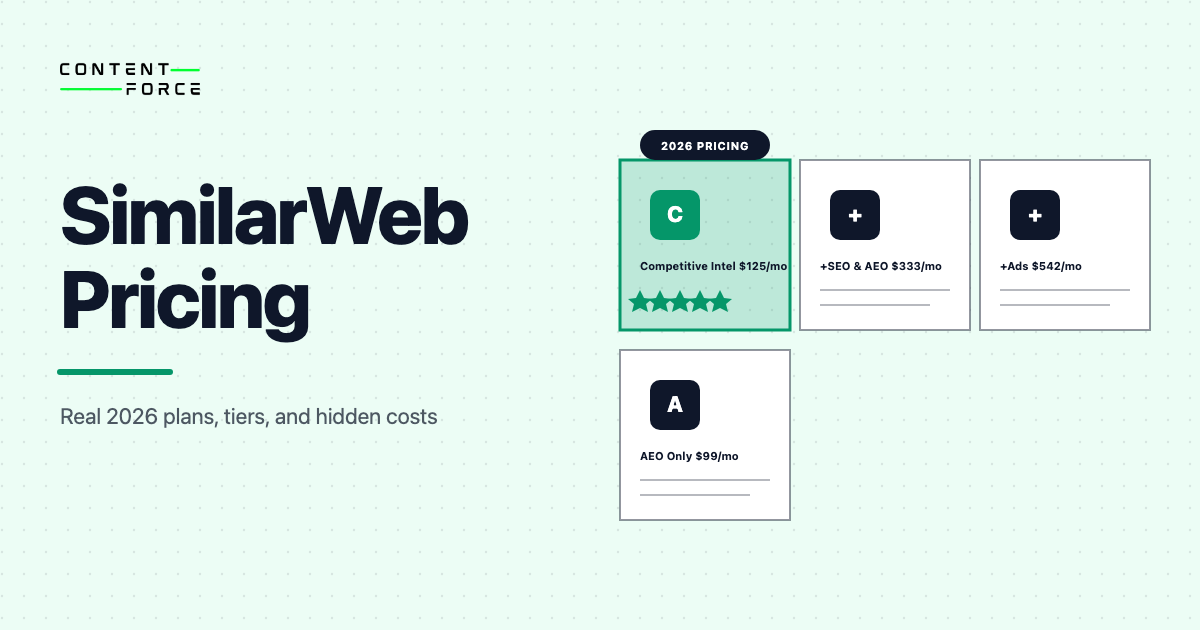
Similarweb starts at $125 per month on an annual plan ($1,500 per year) for a single-user Web Intelligence license, and the same tier costs $199 per month if you pay month to month. Most mid-market and enterprise teams pay far more than that. Across 111 real contracts tracked by Vendr, the median annual deal runs $37,800, with a spread from $14,220 to $96,000 depending on modules, seats and data depth. There’s no permanently free plan. What you get is a 7-day trial that bills your card the moment it ends.
Every price, seat count and limit on this page was checked against Similarweb’s live pricing pages on 6 September 2026. Here’s what that money buys, what pushes it up and how it compares to Semrush, Ahrefs, SpyFu and Moz.
Similarweb Pricing Plans
Similarweb sells three self-service Web Intelligence plans for individuals and small teams, plus Business and Enterprise packages that don’t carry a public price. Annual billing is cheaper than monthly on every tier. The jump from self-service to a sales-negotiated contract is steep, and there’s nothing in between.
If AI-search visibility is all you’re after, Similarweb also sells a standalone AEO Intelligence plan at $99 per month billed annually, or $129 per month on monthly billing. That plan covers AI brand visibility, 150 tracked prompts, sentiment analysis, citation analysis and AI traffic for one user with 3 months of historical data. It doesn’t include the website traffic and competitor benchmarking that the Competitive Intelligence plan below covers.
| Similarweb plan | Monthly price in USD | Annual price in USD per month | Seats | History in months | Data credits per month |
|---|---|---|---|---|---|
| AEO Intelligence | 129 | 99 | 1 | 3 | Not published |
| Competitive Intelligence | 199 | 125 | 1 | 3 | 100 |
| Competitive Intel & SEO & AEO | 399 | 333 | 1 | 6 | 100 |
| Competitive Intel, SEO & AEO & Ads | 649 | 542 | 1 | 6 | 500 |
| Business | Quote only | Quote only | Multi-seat | Up to 37 | Custom |
| Enterprise | Quote only | Quote only | Multi-seat | Up to 37 | Custom |
Prices and limits verified on Similarweb’s pricing page, 6 September 2026. Business and Enterprise packages carry no published price at all, and the $1,500 annual figure for Competitive Intelligence is simply 125 times twelve.
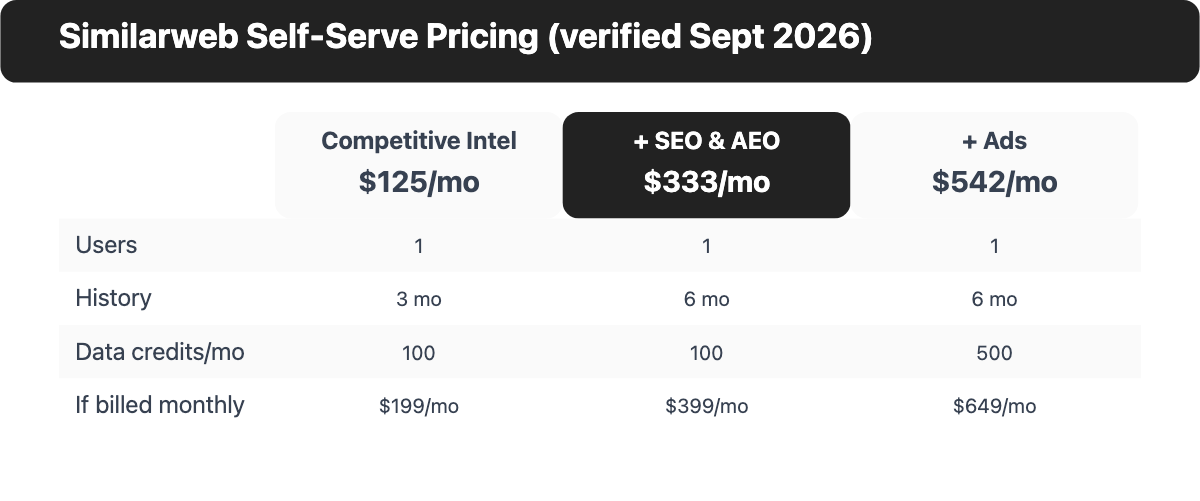
Data credits are the limit that catches people out. Every report download and API pull spends credits based on how many results come back, and they reset each month. Two of the three self-serve tiers give you the same 100 credits, so paying $333 instead of $125 buys you features and history, not more data volume. For scale, a Business contract carries 25,000 monthly credits, which tells you how small a 100-credit allowance really is.
Look at the seat column too. All three self-service plans are single-user, without exception. You can’t add a colleague without moving to a sales-negotiated contract, period.
Competitive Intelligence, $125/mo Annual
The entry plan covers website performance, traffic and engagement, customer demographics, a marketing channels overview and competitor alerts. You get one seat, 3 months of historical data and 100 data credits a month.
It works for a solo analyst or a freelancer who needs occasional competitive lookups, though it hits its ceiling fast. Three months of history isn’t enough to read a seasonal trend, and 100 credits disappear quickly once you’re exporting regularly.
Competitive Intel & SEO & AEO, $333/mo Annual
The middle tier adds a full SEO toolkit (organic search overview, keyword research, rank tracker, site audit and backlinks) plus the AEO suite with AI brand visibility, 150 tracked prompts, sentiment analysis and citation analysis. History doubles to 6 months.
The credit allowance doesn’t move, though. You’re still on 100 monthly data credits and still on a single seat, so the extra $208 a month buys tools and history rather than headroom. If it’s export volume you need, this tier won’t give it to you.
Competitive Intel, SEO & AEO & Ads, $542/mo Annual
The top self-service tier layers ad intelligence on top: creative and campaign insights, search, display and social insights, advertiser demand signals and ad spend. Credits jump to 500 a month, which is the real reason to step up.
Still one seat. At $542 per month billed annually it costs more than most standalone SEO platforms, and a second stakeholder pushes you into a quote outright.
What Similarweb Costs at Team and Enterprise Level
Similarweb doesn’t publish prices for its Business and Enterprise packages. The pricing page swaps the plan cards for a capability list and a “Talk to sales” button, so the only public numbers come from buyers who report what they paid.
Vendr, which negotiates software contracts on behalf of buyers, has handled 111 Similarweb deals. Its data puts the median annual contract at $37,800, with a range from $14,220 to $96,000 and an average negotiated saving of 12.27%. Vendr groups those deals into three bands rather than into named plan tiers:
- Entry and self-service style contracts around $15,000 per year
- Professional deployments in the $30,000 to $70,000 range
- Enterprise deployments from $75,000 to $200,000 and up
What that money buys, per Similarweb’s own capability list, is up to 37 months of historical data, country-level insights across 100+ countries, conversion analysis, managed services with custom dashboards, AI Studio for natural-language queries, custom data feeds, real-time and bulk APIs, MCP access for AI workflows and single sign-on.
Price is negotiable at this level, and the levers are well documented. Multi-year commitments cut the annual rate. Naming an active evaluation of Semrush or Ahrefs during the conversation moves the number again. Timing the discussion near a quarter end adds leverage. Treat the $37,800 median as your anchor before the first call. It isn’t a quote, and it shouldn’t be read as one.
Similarweb’s Other Product Modules
Similarweb isn’t a single product. It’s six separately sold product lines: Web Intelligence, AI Search Intelligence, App Intelligence, Retail Intelligence, Sales Intelligence and Stock Intelligence. Each carries its own contract, and adding one to an existing deal isn’t an upgrade, it’s a new negotiation.
Only three of the six show a price at all, whereas the rest send you straight to a form. Web Intelligence and AI Search Intelligence show the self-serve tiers above, Sales Intelligence shows one, and the rest are quote-only.
| Similarweb module | Annual-billing entry price in USD per month | Higher tiers |
|---|---|---|
| Web Intelligence | 125 | Quote only |
| AI Search Intelligence | 99 | 333 and 542, then quote only |
| Sales Intelligence | 99 | Quote only |
| Retail Intelligence | None published | Quote only |
| App Intelligence | None published | Quote only |
| Stock Intelligence | None published | Quote only |
One note on naming: the module that used to be called Shopper Intelligence is now Retail Intelligence. Plenty of comparison articles still use the old name, so you’ll see both.
Sales Intelligence Pricing
Sales Intelligence has one published tier. The Individual plan is $99 per month billed annually, or $129 per month monthly, and it includes one seat, 3 months of traffic data and 1,000 data credits. You get the AI prospecting agent, company analysis and contact details drawn from credits, AI meeting briefs, outreach messages, lead scoring, sales signals, the Chrome extension and CSV export.
Above that, the pricing disappears. The Business tier includes 5 seats, 25 months of traffic data, unlimited company analysis, 1,000 contact details a month, 2 custom intent topics, CRM integration and API and MCP access, all at a custom price. Enterprise raises that to 10 seats, 37 months of data, 2,500 contact details a month, 10 custom intent topics and SSO. Buyers who need both Sales Intelligence and Web Intelligence should negotiate them in one deal, since a combined contract gives you more room on both.
Retail, App and Stock Intelligence
Retail, App and Stock Intelligence are sales-only. None of the three has a self-service entry point or a published price. Retail Intelligence covers demand, traffic and sales signals across 650+ retailers with a consistent taxonomy, plus Amazon consumer analytics, price tracking and marketplace optimization. App Intelligence covers iOS and Android downloads, rankings, store ratings, usage, sessions, retention and audience insights, with paid add-ons for review and sentiment analysis, in-app purchase revenue analytics and SDK technographics across 3M+ apps and 2.8K SDKs. Stock Intelligence targets hedge funds and quant funds.
Budget accordingly. Bundling a second module onto a Web Intelligence contract is what turns a $37,800 deal into a six-figure one, and you won’t see that jump coming from any public page.
What Similarweb API Access Costs
Similarweb doesn’t publish a list price for its API, and there are three ways to get it. The Business plan bundles it with full platform access, the Enterprise plan does the same at larger scale, and an API-only plan sells the data on its own to teams that’ll never open the interface. All three go through sales.
What it does publish is the credit allowance behind each route, in its Batch API documentation. That’s the closest thing to a price signal you’ll get without a sales call.
- The Business plan comes with 25,000 monthly data credits, usable against the Batch API and the Standard REST API.
- The Enterprise plan comes with 50,000 monthly data credits across the same two APIs.
- The API-only plan starts at 10,000 monthly data credits and can be upgraded to 50,000 or 100,000 as usage grows.
Billing is credit-based rather than call-based. You pay for the data you receive, each endpoint carries a defined credit cost listed in the API reference, and credits reset monthly. A Request Validate endpoint estimates the cost of a query before you run it, which is worth using before any bulk job. Documentation sits at developers.similarweb.com.
No self-service tier includes API access, so a small team that needs programmatic data jumps straight to a quoted contract. The Batch API is also sold as an add-on to the Team plan, a tier Similarweb doesn’t list publicly any more but still sells.
Hidden Costs to Watch Out For
Plan prices cover the base subscription and nothing else. Several costs don’t surface until you’re deep in negotiation, and each one has caught buyers out.
Monthly billing premium. Paying month to month on Competitive Intelligence costs $199 instead of $125, a 59% premium. That’s $888 more per year for identical features, identical limits and identical data. The two higher self-service tiers carry a smaller premium of roughly 20%.
Add-on modules. Every product line is priced separately from Web Intelligence. Adding one isn’t a line item, it’s a fresh contract, and it’s flat-out the biggest driver of six-figure totals.
API access. Self-service plans don’t include any. You either move to a quoted Business or Enterprise contract or you buy the API as a standalone package.
Additional seats. Every self-service tier is capped at one user, full stop. Extra seats mean a quoted contract, and anything added mid-term is priced at a premium.
Implementation and onboarding. Larger deployments come with onboarding and training that’s scoped and priced separately. Ask for it in writing before you sign, because it rarely shows up in the first proposal.
Multi-year commitments. Longer terms cut the annual rate, but they lock you in. If your data needs might shift inside 24 months, that discount isn’t worth what it looks like.
Similarweb Free Trial and Free Tools
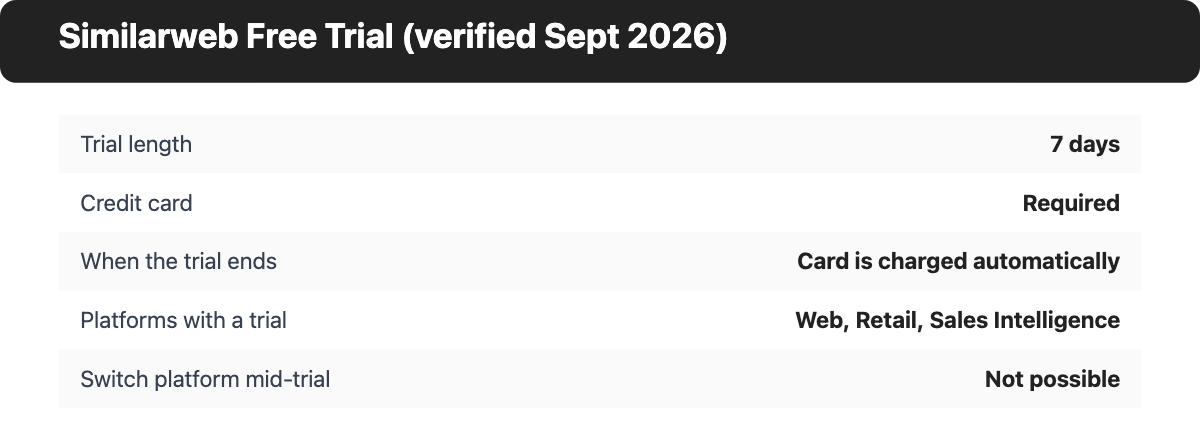
Similarweb has no permanently free plan. What it offers is a 7-day free trial that needs a credit card, and that card gets charged automatically when the trial ends unless you’ve cancelled first. Set a reminder for day 6 if you only want to look around.
Two details are easy to miss. Trials exist separately for Web Intelligence, Retail Intelligence and Sales Intelligence, and Similarweb’s own documentation disagrees with itself about switching between them. The support article on registering for a trial says a started trial can’t be switched and tells you to sign up again with a different email address. The FAQ on the pricing page says support can move you across. Pick the right platform before you sign up, and if you do need to change, open a support ticket rather than assuming either answer.
Cancellation works differently by plan family. Self-service customers cancel from the subscription page inside the platform and keep access until the current period ends. Business customers are bound by the termination terms in their contract, which usually means calling an account representative.
Similarweb also runs a set of free tools that need no account at all. Each one gives you a shallow read on any domain, but none of them touches the competitor data the paid tiers exist for.
- Website Traffic Checker for a top-level traffic estimate on any domain
- AI Traffic Checker for LLM referral estimates
- Free App Analytics for basic app metrics
- Keyword Generator and SERP Seismometer for search research
- A browser extension for Chrome, Edge, Firefox and Opera that shows traffic metrics on any site you visit, no account needed
They’re fine for a one-off lookup, and they’re nowhere near a substitute for a subscription. The data’s deliberately shallow, and low-traffic domains often return nothing usable. We put the same question to another paid tool in free Ahrefs alternatives: what you actually lose.
Similarweb vs Competitors: How Pricing Compares
Similarweb costs more at entry level than the SEO platforms it’s compared to. Here’s where those entry tiers sit today.
| Tool | Monthly price | Annual price per month | Primary use case |
|---|---|---|---|
| Similarweb Competitive Intelligence | $199 | $125 | Cross-channel traffic intelligence |
| Semrush SEO | €134 | €112.52 | SEO and competitive research |
| Ahrefs Lite | $129 | $107.50 | SEO and backlink analysis |
| SpyFu Basic | $39 | $29 | Paid and organic competitor tracking |
| Moz Pro Standard | $99 | $79 | SEO and site auditing |
Competitor prices verified on each vendor’s own pricing page, 6 September 2026. Semrush prices in euros rather than US dollars. Ahrefs advertises up to 17% off annual billing, which puts the Lite plan at $107.50 per month, and Moz sells a $49 Starter plan for a single site below the Standard tier shown here.
Two structural differences drive the gap. Semrush, Ahrefs, SpyFu and Moz all publish fixed tier prices from entry to enterprise, whereas Similarweb stops publishing above $542 a month. And where Semrush charges a flat rate per extra user, Similarweb doesn’t offer per-seat pricing on self-service at all, so a second user means a quoted contract.
The data type is what you’re paying for. Similarweb measures all traffic channels for any domain (direct, organic, paid, referral, social and email) through a panel-based methodology, which yields total visits, bounce rates and referral composition for sites you have no analytics access to. Semrush and Ahrefs don’t offer that. For keyword research, technical audits and backlink work, though, both give you a stronger toolkit for less money, without question. Our Ahrefs pricing breakdown walks through where those tiers and their hidden fees land.
Is Similarweb Worth the Price?
Similarweb earns its price for a narrow set of jobs. It isn’t a general-purpose SEO tool, and buying it as one is the most common reason teams regret the spend.
Who Should Use Similarweb
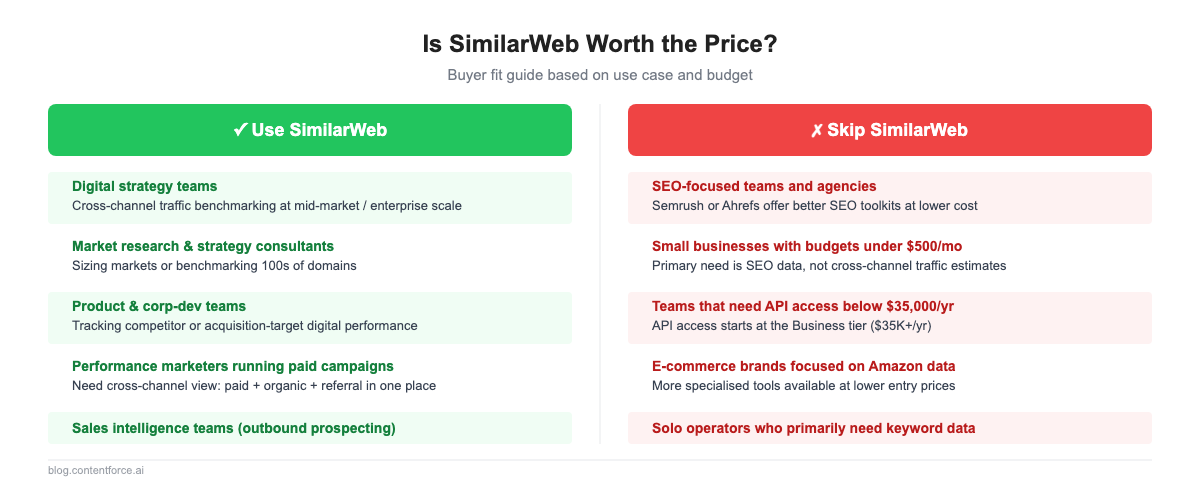
Similarweb makes sense for:
- Digital strategy teams that need traffic benchmarking across every channel rather than organic search alone
- Market research and strategy consultants sizing markets or benchmarking industry traffic across hundreds of domains
- Product and corporate development teams tracking competitors or acquisition targets
- Performance marketing teams running significant paid spend who need cross-channel benchmarks
- Sales teams using company traffic and intent signals for outbound, through the Sales Intelligence module
Who Should Skip It
Similarweb is the wrong purchase for:
- SEO teams and agencies that need keyword research, technical audits and backlink data, where Semrush and Ahrefs deliver more for less
- Small businesses and solo operators under a $500 monthly tools budget whose main need is SEO data
- Teams that need API access on a self-service budget, since no self-service tier includes it
- Teams that need more than one seat, because every self-service plan is single-user
- E-commerce brands focused on Amazon data, where specialist tools start cheaper
If your question is “why is this competitor ranking for this keyword,” Similarweb’s the wrong tool. If your question is “how much traffic does this competitor get and where does it come from,” it’s one of very few tools that’ll answer reliably at scale.
Frequently Asked Questions
How much does Similarweb cost?
Similarweb’s entry self-service plan costs $125 per month on annual billing ($1,500 per year) or $199 per month if you pay monthly. A standalone AEO Intelligence plan starts at $99 per month billed annually if AI-visibility tracking is all you’re after. Business and Enterprise packages don’t carry a published price, and across 111 contracts tracked by Vendr the median annual deal is $37,800, ranging from $14,220 to $96,000.
Does Similarweb have a free plan?
Similarweb has no permanently free plan. It offers a 7-day free trial that needs a credit card and bills automatically when the trial ends, plus free tools like the Website Traffic Checker and AI Traffic Checker that’ll give you shallow estimates for any domain without an account.
Can you negotiate Similarweb pricing?
You can negotiate the Business and Enterprise packages that go through sales, though the self-service tiers up to $542 a month are fixed-price and won’t move. Vendr reports an average negotiated saving of 12.27% across 111 Similarweb deals, and multi-year terms, competitive evaluations and quarter-end timing are the levers that move the number.
What is included in the Similarweb free trial?
The trial runs 7 days, needs a credit card and converts to a paid subscription when it ends unless you cancel. Similarweb runs separate trials for Web Intelligence, Retail Intelligence and Sales Intelligence, and you can’t switch between them once one has started.
Is the Similarweb API included in a plan?
API access comes with the Business and Enterprise plans or through a separate API-only plan, and no self-service tier includes it. Similarweb doesn’t publish a list price for any of them, though it does publish the allowances: 25,000 monthly data credits on Business, 50,000 on Enterprise and 10,000 on the API-only plan.
How does Similarweb pricing compare to Semrush?
At entry level Similarweb costs $125 per month billed annually against €112.52 for Semrush’s SEO plan (Semrush prices in euros, not dollars), so the two are close in absolute terms even though the currencies differ. The gap opens further up: Semrush publishes tiers all the way to €436.99 per month billed annually, while Similarweb stops publishing above $542 and pushes multi-seat buyers into quoted contracts that Vendr data puts near $37,800 a year.
Is Similarweb pricing negotiable for smaller teams?
Self-service plans are fixed-price subscriptions and there’s no negotiating them. Anything that needs a sales conversation is negotiable on price, contract length, seat count and included modules, so if you’re being quoted rather than shown a card, you’ve got room to move.

1 thought on “Similarweb Pricing: Plans, Costs, and What You’ll Actually Pay”