
How-to · 6 steps
What Is a Content Gap Analysis? A Simple Guide for Content Teams

A content gap analysis compares what your audience needs against what your site currently provides, across competitors, the SERP, your customer journey and AI platform answers. With this guide, content teams find missing, thin, outdated or mismatched content and close the gaps that matter most for traffic, trust and conversion in the right order.
- Set a business goal and define the scope of the analysis
- Inventory current pages with URL, topic, intent, funnel stage and status
- Map your existing content to each stage of the customer journey
- Benchmark competitors, the SERP and AI answers in ChatGPT, Perplexity and AI Overviews
- Label each gap type, then prioritize by business value, demand and effort
- Track results and review key clusters monthly, priority categories quarterly
Most content teams know they've got gaps. They just don't know which ones matter. A content gap analysis gives you a structured way to find out, comparing what your audience needs against what your site currently provides across competitors, the SERP, your customer journey and AI platform answers.
A content gap isn't just a missing keyword.
It can be a missing subtopic, a weak section, an outdated page, a missing format, or a topic your competitors answer clearly while you don't.
The point of the analysis is not to publish more pages. That much is obvious. It's to find the gaps that matter most for traffic, trust and conversion, and close them in the right order.
Quick answer: types of content gaps
| Gap type | What it means |
|---|---|
| Missing topic gap | You have no page for a relevant subject |
| Coverage gap | Your page exists but is too thin or incomplete |
| Underperforming content gap | A page that once ranked is now slipping or stale |
| Intent gap | Your page does not match what the searcher actually wants |
| Funnel gap | You cover one stage of the journey and ignore the rest |
| Format gap | You need a comparison, checklist or template, not another generic article |
| Information gain gap | Your content lacks unique data, perspective or depth that AI cannot generate from consensus |
What does a content gap analysis actually mean?
Content gap analysis means comparing what your audience needs against what your site currently provides. It's broader than it sounds. That comparison can happen across competitors, the search results, your customer journey, or what AI platforms surface when answering relevant queries.
The reason the term gets overused is that teams often reduce it to "find keywords competitors rank for." That can be part of it, but it's too narrow. A real gap analysis asks better questions:
- what questions do people have that we do not answer?
- where do competitors answer the topic better than we do?
- which pages exist but are too weak to compete?
- which buying or research stages do we ignore entirely?
That's why content gap analysis is, without question, as much an editorial exercise as an SEO exercise. Keywords tell you what topics have demand. They don't tell you what to do about it.
Why content gap analysis matters
Without a gap analysis, most content plans drift toward what feels familiar rather than what the audience actually needs. Teams keep publishing what one stakeholder requested or what fit last quarter's assumptions. It's a drift problem. Over time, the library grows but gets less useful.
You prioritize only what actually moves the needle
A gap analysis turns your content backlog from a gut-feel list into a ranked set of high-value opportunities. Instead of publishing what is easy or familiar, you focus on the missing topics with real demand, the weak pages that are losing ground and the funnel stages with no coverage at all.
You build topical authority faster
Topical authority comes from covering a subject cluster systematically, not from publishing random articles. When your site has comprehensive, connected coverage of a topic, search engines and AI platforms treat you as a reliable source. A gap analysis is the roadmap: it shows you exactly which pieces are missing and which existing ones need to be stronger.
You avoid creating duplicate content
Many teams create new pages when the smarter move is to fix an existing one. A gap analysis surfaces those underperforming pages before you duplicate the work. It turns content planning from "what should we create?" into "what do we have, what do we need and what should we fix?"
You map content to every stage of the funnel
Some sites cover awareness well but have nothing for evaluation or decision stages. Others have product pages with no educational content that builds demand earlier. If a buyer has to leave your site to keep researching, you've got a funnel gap. A gap analysis finds it before your competitors fill it.
What kinds of content gaps can you find?
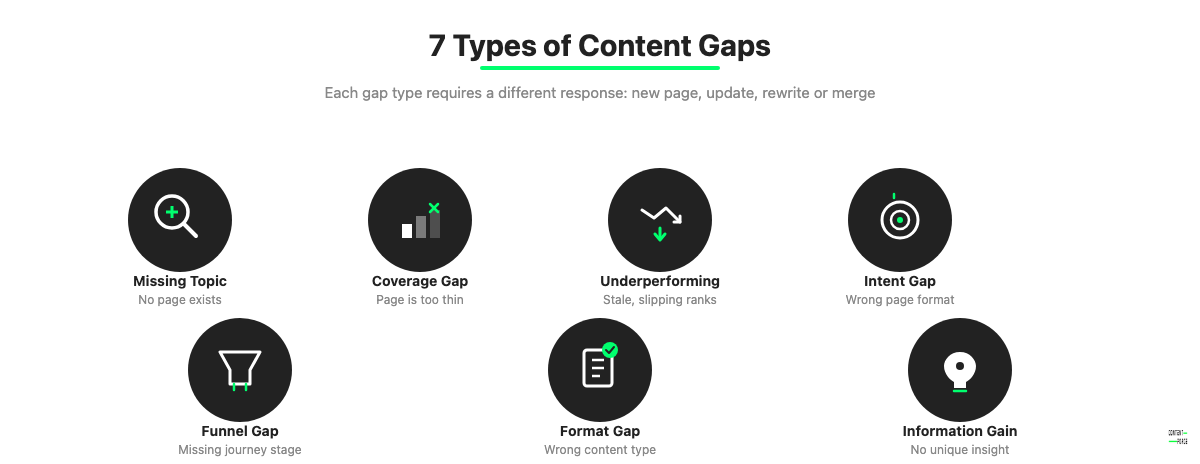
Not every gap deserves a new page. Before you act, you need to know what kind of gap you're looking at.
Missing topic gaps
These are the easiest to understand. A relevant topic exists in the market, but your site has no page for it.
Example: your audience searches for LLM SEO, but you have no page that explains it. The gap is clear.
Coverage gaps
You already have a page, but it is too weak. Maybe the page answers the question in broad terms while competitors include examples, checklists, comparisons and specific facts you do not.
Coverage gaps are common because teams often create a page once and never deepen it.
Underperforming content gaps
These are pages that existed and once performed but are now slipping in rankings or generating less traffic. They're stale. The content may be outdated, too thin for current SERP standards, or no longer matching the way the query has evolved.
Finding these pages early prevents bigger drops. Don't wait for a traffic cliff. An underperforming page often needs a targeted update rather than a new page.
Intent gaps
The page exists, but it doesn't match what the searcher wants. Maybe the query's comparative, but your page is a generic explainer. Maybe the query's beginner-focused, but your page assumes expert knowledge.
Intent mismatch is one of the most expensive content gaps because the page looks relevant internally while it's failing with real users.
Funnel gaps
Some sites cover awareness well but ignore evaluation and decision content. Others have product pages but no educational content that creates demand earlier in the journey.
If a buyer has to leave your site to keep researching, you've probably got a funnel gap.
Format gaps
Sometimes the problem isn't topic coverage. It is format coverage. You may need:
- a comparison table
- a checklist
- a template
- a step-by-step guide
- a calculator
- a case study
If the SERP expects a practical format and you publish another abstract opinion piece, you've got a format gap.
Information gain gaps
Information gain is the idea that content must add something AI models cannot easily generate on their own. If your page only repeats what every other guide says, it's got low information gain.
Information gain gaps appear when your content lacks:
- original data, research, or benchmarks
- real examples from direct experience
- a perspective or framing that differs from the consensus
- expert insight that goes beyond common knowledge
This gap type matters most in competitive topics where every guide covers the basics and only content with genuine depth earns visibility in both traditional search and AI-generated answers.
How to do a content gap analysis
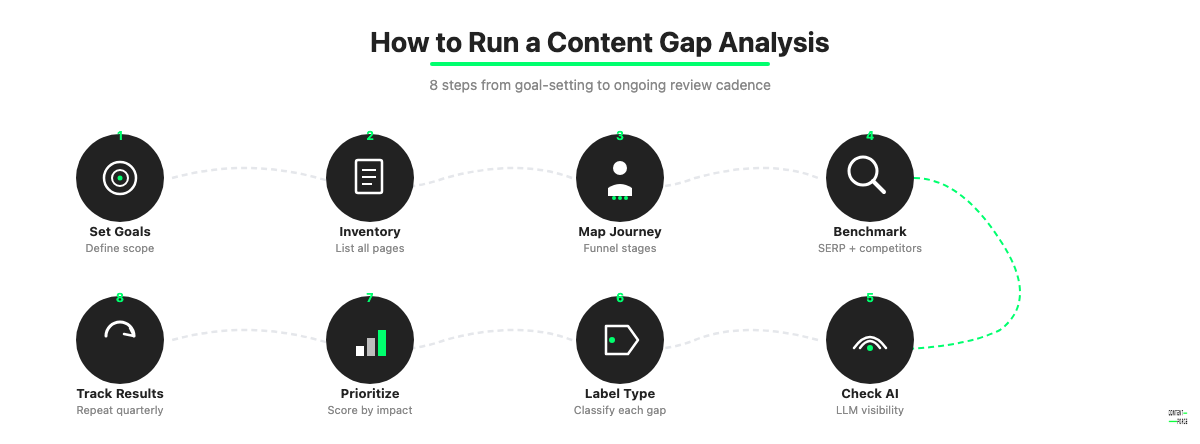
The cleanest workflow follows eight steps. Here's how it works.
1. Set goals and define the scope
Before analyzing anything, decide what business outcome this analysis serves. That clarity's what keeps the work useful. Are you trying to recover lost traffic? Build out a new topic cluster? Improve funnel coverage for a specific product line?
Starting with a clear goal keeps the analysis focused. A site-wide audit with no clear objective usually produces a backlog nobody's going to use.
Good scope examples:
- blog content for AI search visibility
- bottom-funnel pages for one product line
- comparison content for a SaaS category
2. Inventory your current content
List the pages you already have. Include the URL, topic, target intent, funnel stage and current status. You can't find gaps if you don't know what exists.
If you haven't done this before, a content audit is the right starting point. Look for thin pages, duplicates and underperforming pieces before deciding what to create next.
3. Map your customer journey
One of the most common gaps is not a missing keyword. It is a missing stage of the buying or research journey.
Map out the stages your audience moves through, from first awareness of a problem through research, evaluation and final decision. Then map your existing content to those stages. You will usually find that some stages are covered thoroughly while others have almost nothing.
For many B2B teams, the evaluation and decision stages are the biggest gap: plenty of top-of-funnel education, but very little for buyers who are ready to compare options or make a choice.
4. Benchmark against competitors and the SERP
Look at the pages already winning for your target topics. What headings do they use? What subtopics do they cover that you don't? What formats do they use? Where are they still weak?
The point isn't to copy competitors. It's to see where the market standard is higher than your current page. If the top three results all include a comparison table and you have none, that is a format gap you need to close.
5. Check for AI and LLM visibility gaps
Search is no longer only traditional results. AI Overviews, ChatGPT, Perplexity and other AI platforms answer queries directly, often without surfacing the pages that informed the answer.
To find these gaps:
- run your target queries in ChatGPT, Perplexity, Gemini and Google's AI Overview
- check which sources and brands appear in the answers, not just which pages rank
- check whether your content is cited or ignored
- note which third-party platforms (review sites, Reddit, YouTube) appear in AI citations. Presence on those platforms is a visibility gap in itself
- review your Google Search Console AI Mode Performance report for impressions in AI Overviews
- review your analytics for traffic arriving from AI referral domains
A page that ranks in Google but never appears in AI-generated answers has a content gap. It is usually a coverage gap or an information gain gap. AI systems prefer content that answers the core question directly in the opening, covers the topic completely and adds something no other source provides.
6. Label the gap type
For each issue you find, decide whether it is a missing page, a thin page, an underperforming page, an intent mismatch, a funnel gap, a format problem, or an information gain issue.
This classification prevents bad next steps. If the issue's weak coverage, don't create a duplicate page, improve the existing one. If the issue is intent mismatch, a rewrite's more useful than a new URL.
7. Prioritize by impact
Not every gap matters equally. Score each one by some mix of:
- business value
- search demand
- likelihood to win
- relevance to the offer
- effort required
This keeps the backlog realistic and ensures the team spends time on gaps that move the needle.
8. Track results and set a review cadence
A gap analysis isn't a one-time project. It's ongoing. After you act on the highest-priority gaps, track what improved: traffic, rankings, engagement and conversions.
Set a cadence for ongoing review. For most teams, that means monthly checks for key clusters and quarterly deep reviews for priority categories. When products, positioning, or search behavior changes, run an ad hoc review rather than waiting for the scheduled one.
Content gap analysis example
Imagine a site that sells content optimization software.
It already has:
- a homepage
- a pricing page
- a page about answer engine optimization
- a blog post about AI Overviews
During a gap analysis, the team finds:
- no page for LLM SEO (missing topic gap)
- a weak GEO SEO draft with no examples or concrete steps (coverage gap)
- a "content optimization guide" that once ranked but has slipped over the past six months (underperforming content gap)
- no comparison page for alternatives (intent gap: buyers searching that phrase need a different format)
- no checklist or template content for practitioners (format gap)
- no middle-funnel content on measurement and reporting (funnel gap)
- a blog post on AI content strategy that covers the same ground as every other guide without adding anything new (information gain gap)
That tells the team the next move is not "publish whatever sounds smart." It is to build the missing cluster pieces in the right order, starting with the gaps that have the most demand and the clearest path to ranking.
Common mistakes in content gap analysis
The method's simple, but teams still get it wrong in predictable ways.
Treating every competitor keyword as a gap
If the keyword's off-topic, low-value, or already covered by another page, it's not your gap. Chasing every term your competitors rank for without filtering by relevance dilutes your topical focus and wastes resources. It's not worth it.
Ignoring existing weak pages
Many teams create new URLs when the smarter move's to upgrade a page they already have. A gap analysis should surface underperforming pages as a high-priority fix before any new content's created.
Forgetting user intent
A list of keywords without intent is just a spreadsheet. You need to know what kind of page each query really wants: an explainer, a comparison, a step-by-step guide or something else entirely.
Looking only at top-of-funnel topics
Traffic content matters, but content gaps also exist in comparison, use-case and decision-stage pages. If your analysis only looks at awareness queries, you will miss where buyers are actually making decisions.
Not connecting the audit to execution
A gap analysis is useless if it ends as a deck nobody's going to use. It should feed directly into a prioritized content backlog with clear actions: create, update, merge, expand, or drop.
Skipping AI platform checks
Many teams still analyze only traditional SERP results and miss the AI visibility layer entirely. Don't be one of them. If your competitors appear in ChatGPT or Perplexity answers and you do not, you have a visibility gap that no amount of traditional SEO will automatically fix.
Best tools and inputs for content gap analysis
You don't need one perfect tool. The best gap analyses combine several inputs:
| Input | What it helps you find |
|---|---|
| Keyword research tools | Topic demand and competitor overlaps |
| Search results review | Intent and format expectations |
| Analytics and Search Console | Pages that underperform or attract the wrong visitors |
| GSC AI Mode Performance report | Which pages appear in Google's AI Overviews |
| Sales and support feedback | Recurring customer questions |
| Site inventory or crawl exports | Overlap, duplication and thin coverage |
| E-E-A-T signals review | Gaps in expertise, experience, authoritativeness, or freshness |
| AI platform testing | Topics and queries where your content is missing from AI-generated answers |
| LLM citation monitoring | Tracking which brands are cited in AI answers for your target topics |
The most important point: tools can suggest gaps, but people still need to judge which ones matter. That's the part you can't automate.
Blog Outline Generator: headings, key points and FAQ candidates for your topic. Free, no signup.
Content gap analysis vs keyword gap analysis
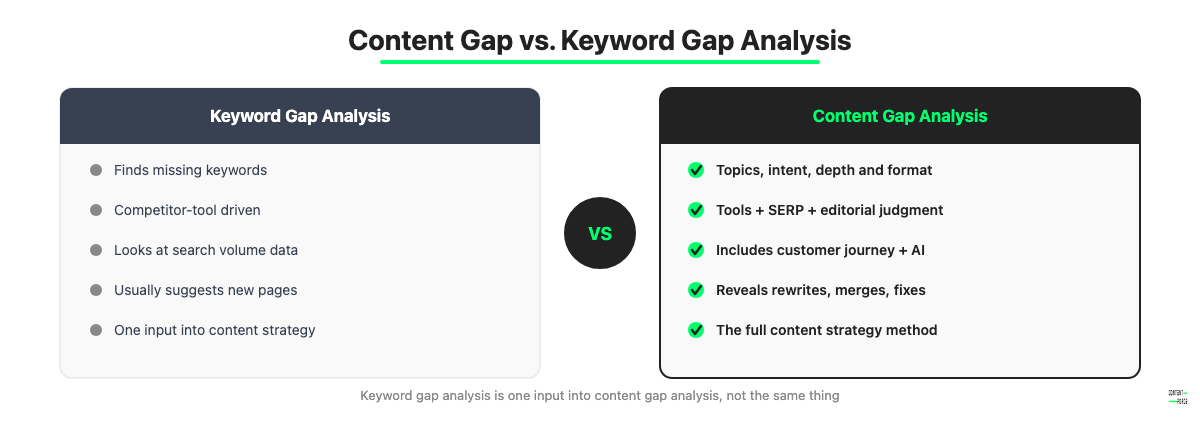
Keyword gap analysis is one input. Content gap analysis isn't the same thing. Content gap analysis is broader.
| Keyword gap analysis | Content gap analysis |
|---|---|
| Focuses on keyword overlap and missing terms | Focuses on topics, intent, depth, format and funnel coverage |
| Often competitor-tool driven | Combines tools, SERP review and editorial judgment |
| May suggest a missing keyword | May reveal that the real fix is rewriting, merging, or reformatting a page |
If you only run keyword-gap reports, you'll miss a lot of the real content work.
Frequently asked questions about content gap analysis
Is a content gap analysis only for SEO?
No. SEO's a major use case, but content gap analysis also helps with sales enablement, lifecycle content, product education and brand clarity. Any team responsible for covering a topic systematically can use the same process.
What is the main goal of a content gap analysis?
The main goal is to find the most important missing or weak content opportunities so your team can prioritize the right work next, not just publish more pages. That's the whole point.
Should every gap become a new page?
No. Some gaps should be solved by improving, merging or reframing an existing page. A new URL's only the right answer when no existing page can reasonably be upgraded to fill the gap.
How does content gap analysis relate to topical authority?
Topical authority doesn't come from ranking for a single keyword. It's about covering a subject cluster completely. A gap analysis shows you which pieces of the cluster are missing or weak.
How long does a content gap analysis take?
It depends on the scope. It's not a fixed time commitment. A single cluster review can be fast. A site-wide audit takes longer because inventory, intent review and prioritization all take time.
How often should you run a content gap analysis?
Run a light version continuously and a deeper version on a regular schedule. For many teams, that means monthly checks for key clusters and quarterly deep reviews for priority categories. Run an ad hoc review when products, positioning, or search behavior changes significantly.
What should happen after the analysis?
Turn the findings into a ranked backlog with clear actions: create, update, merge, expand, or drop. The analysis is only useful if it connects directly to what the team does next.
Can I run a content gap analysis specifically for AI search?
Yes. Checking AI visibility is now a standard step in any thorough gap analysis. Don't skip it. Run your target queries in ChatGPT, Perplexity and Google's AI Overview, note which sources appear and compare that to your own site's coverage. If your content is not appearing in those answers, you likely have a coverage gap, a format gap, or an information gain gap that traditional ranking would not reveal.
Does content gap analysis apply to AI search?
Yes. AI platforms like ChatGPT and Google's AI Overviews pull from existing content to answer queries. If your content is not comprehensive, well-sourced, or unique enough, it won't appear in those answers. Running your target queries through AI tools and checking which sources appear is now a standard step in gap analysis. For a deeper look at how this works, see our guide to answer engine optimization.
What is an information gain gap?
An information gain gap exists when your content covers the same ground as every other source without adding anything new. That can mean missing original data, real examples, or a perspective that differs from the consensus. Content with low information gain is increasingly filtered out by both traditional algorithms and AI systems that prefer unique, authoritative sources.