
Comparison
GEO vs SEO: Key Differences and What It Means for Your Content Strategy

SEO gets your pages ranked and clicked in traditional search results, while GEO (generative engine optimization) gets your content cited in AI answers from Google AI Overviews, ChatGPT search and Perplexity. SEO comes first, because GEO depends on crawlable, indexed pages. GEO then builds on that base with entity clarity, extractable answers and evidence-backed claims.
- SEO success is measured in rankings and clicks, GEO success in citations and share of voice
- SEO authority rests on backlinks, GEO authority on entity recognition and contextual mentions across the web
- GA4 and Google Search Console cannot track AI citations when users never click through
- Keyword stuffing and thin glossary pages underperform in GEO even where they hold SEO value
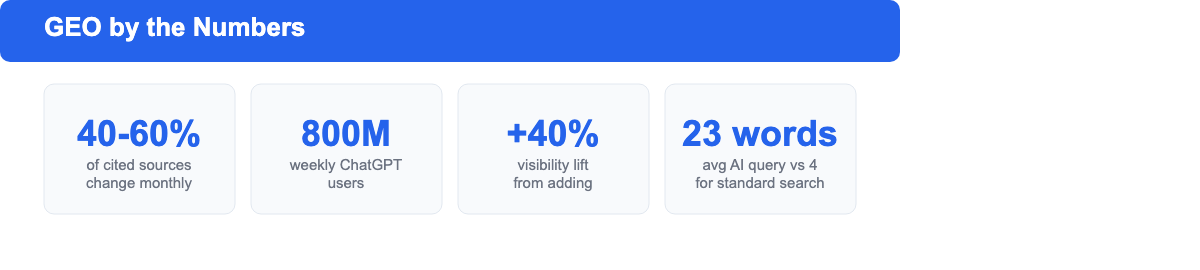
SEO and GEO pursue the same goal: getting your content in front of the right audience. They target different systems, though. SEO gets you ranked in traditional search results. GEO (generative engine optimization) gets you cited in AI-generated answers from tools like Google AI Overviews, ChatGPT search and Perplexity. ChatGPT now reaches over 800 million weekly users. Google Gemini has surpassed 750 million monthly users. The channel is real, and understanding the difference between SEO and GEO is now a practical content priority.
- SEO targets traditional search engines; GEO targets AI answer systems.
- SEO success = rankings and clicks; GEO success = citations and mentions in AI responses.
- The two are not opposites. Strong SEO is still the foundation for GEO.
- You don't need a separate playbook: clearer, evidence-backed pages work for both.
| Quick fact | Why it matters |
|---|---|
| Google says the best practices for SEO still apply to AI Overviews and AI Mode, with no extra technical requirements | GEO is mostly an extension of strong SEO, not a replacement for it |
OpenAI says any public site can appear in ChatGPT search if it is crawlable and not blocking OAI-SearchBot | AI visibility still depends on basic crawl access and indexability |
| The Princeton-led GEO paper reported visibility lifts of up to 40% on its benchmark and up to 37% on Perplexity tests | Structure, quotes and validated facts can improve citation visibility |
| AI queries average 23 words versus 4 words in traditional search (a16z, 2025) | Longer, more conversational queries mean AI systems need pages that answer broader intent, not just a single phrase |
| Between 40% and 60% of cited sources in AI answers change month to month (Semrush AI Visibility Index) | AI citations are volatile, but consistent structural and entity signals appear in sources that hold their position |
SEO vs GEO: what's the core difference?
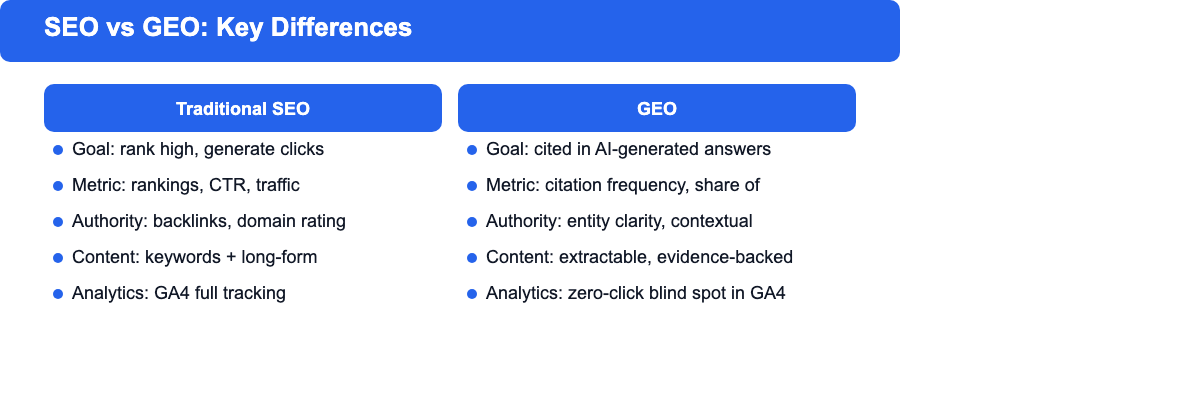
SEO optimizes for search engine ranking and clicks. GEO optimizes for citations in AI-generated answers. Both start from the same base: crawlable pages, solid information architecture, content that earns its place. They diverge in what the retrieval system rewards once it finds your page.
| Aspect | Traditional SEO | GEO |
|---|---|---|
| Goal | Rank high in search results and generate clicks | Be cited or mentioned in AI-generated answers |
| Success metric | Rankings, click-through rate, organic traffic | Citation frequency, share of voice in AI responses, AI-referred traffic |
| Target platforms | Google Search, Bing | Google AI Overviews, ChatGPT search, Perplexity |
| Content focus | Keywords, backlinks, long-form content | Entity clarity, direct answers, fact density, structured data |
| Key signals | Domain authority, keyword relevance, technical health | Source trust, extractable evidence, topic completeness |
| Authority model | Backlinks and domain authority | Entity recognition and contextual mentions across the web |
In traditional search, rankings and snippets are the main battlefield. In generative search, the system also cares about whether your page can be turned into a trustworthy extract. One useful way to think about it: search engines sort documents, while generative engines assemble answers from documents. If your page is hard to parse, vague about its subject or light on proof, it's harder to cite even when it's technically indexed.
One more difference that gets overlooked: GEO citations are invisible to standard analytics. When an AI tool recommends your brand or cites your content, the user may never click through to your site. That zero-click gap means GEO can drive brand awareness and influence purchase decisions in ways Google Analytics won't capture.
How do generative engines decide what to cite?
Generative engines select content based on semantic relevance, source trust and how easily your page can be parsed into a self-contained answer. Understanding those three factors explains most of the difference between a page that gets cited and one that doesn't.
Google's documentation explains that AI Overviews and AI Mode use a query fan-out approach: Google may run multiple related searches across subtopics and data sources to build a response. A page that doesn't fully cover a concept can lose to a source that handles the topic more completely.
OpenAI's publisher guidance points to a similar operational baseline. Public sites can appear in ChatGPT search if the content is accessible and the site doesn't block OAI-SearchBot. OpenAI also says publishers can track referral traffic from ChatGPT once they've allowed the crawler. That makes GEO measurable, not theoretical. Vercel publicly attributed 10% of its new signups to ChatGPT referrals in April 2025. Tally, the form builder, reported ChatGPT as its number one referral traffic source after focusing on clearer, more structured content.
The Princeton KDD 2024 paper on GEO adds another layer. It found that keyword stuffing didn't help in generative environments, while adding citations, quotations and statistics lifted visibility by up to 40% on its benchmark. That finding lines up with what most content teams already see in practice: AI systems need evidence they can safely reuse.
One qualifier matters here: between 40% and 60% of cited sources change month to month, according to Semrush's tracking of 2,500 prompts across Google AI Mode and ChatGPT. That's a high churn rate. Short-term gains are possible, but durable GEO visibility comes from the structural signals that appear in cited sources month after month: entity clarity, content extractability and multi-platform presence.
Blog Outline Generator: headings, key points and FAQ candidates for your topic. Free, no signup.
How to optimize content for GEO
Most of what makes a page good for SEO also makes it good for GEO. The strategy below isn't a GEO-only playbook: it's a content quality framework that works across both channels. GEO optimization comes down to three areas: making your entity clear and consistent, writing content AI can extract and reuse, and building presence across the platforms AI reads.
Make your entity clear and consistent
Before AI systems cite your brand, they need to know what it is, what category it belongs to and what it offers. That process depends on entity clarity: the consistency of how your brand is described across your own site and across third-party sources. Get it wrong, and you won't be cited.
The problem is easy to create accidentally. If your homepage calls you a "work operating system" and your LinkedIn profile calls you a "project management tool" and your Crunchbase listing calls you a "productivity platform," AI systems have three conflicting signals to reconcile. The less confident a system is about what you are, the less likely it is to cite you when a relevant query appears.
The practical fix is to audit your brand description across your main pages, schema markup and key third-party profiles. Your entity signals should agree on:
- what your brand does (product category, use case)
- who it's for (target audience)
- what makes it different (key attributes)
Schema markup helps, but it's a mirror, not the source. The visible page content needs to be consistent first. When schema reflects that clear structure, AI systems can cross-reference the signals and categorize you with higher confidence. The same logic applies to LinkedIn pages, Crunchbase profiles, G2 listings and review platforms: consistent descriptions across all of them strengthen the entity signal AI systems read.
Write content AI can extract and reuse
AI retrieval systems don't read pages the way humans do. They break content into chunks, convert those chunks into vectors, and retrieve the closest match to the user's query. The retrieved chunk gets assembled into a response, often with no surrounding context from your article. A passage that only makes sense if you've read the paragraph before it is much harder to cite than one that stands alone as a complete thought.
The difference is concrete. Compare these two ways of explaining the same idea:
Hard to extract: "There are a few reasons this matters. When you think about what we mentioned earlier, the implications become clearer for most content teams."
Easy to extract: "Salting eggplant for 15 minutes before cooking removes bitterness and excess moisture. This technique is used by professional chefs and makes a noticeable difference in the final dish."
The second version states the subject, the technique, the benefit and the result in one clear passage. That's what extractability means in practice. For your content, it translates into a few specific habits:
- answer the heading immediately in the first sentence, not after three sentences of setup
- keep each paragraph focused on one idea that makes sense when read on its own
- include the key claim, the evidence and the context in the same section rather than spreading them across paragraphs
- use descriptive headings so AI systems can identify which section answers which question
This extractability principle applies mainly to retrieval-augmented systems, which is what Google AI Overviews, Perplexity and the web-browsing versions of ChatGPT use. These systems retrieve content in real time. Passage quality at the retrieval moment determines whether your page gets cited. And because good extractability also improves SEO snippet eligibility, the investment pays off in both channels at once.
Build presence across platforms AI reads
AI systems pull from far more than your website when building answers. Reddit, LinkedIn and YouTube were among the top cited sources by LLMs in October 2025, according to Semrush tracking data. A brand that only exists on its own domain gives AI a narrow signal base to work from.
The multi-platform opportunity splits into two categories. Owned presence is content you or your team create on platforms beyond your website: a YouTube channel showing product features, your company's participation in relevant subreddit discussions, executive newsletters on LinkedIn. These platforms are high-authority sources the models already rely on, which is why your brand presence there matters for AI discovery.
Earned mentions are references to your brand you don't directly control: customer reviews on G2, Capterra or Trustpilot; journalist mentions in industry publications; community discussions on Reddit or Quora where users recommend your product. When multiple independent sources discuss your brand in relevant contexts, AI systems have stronger signals about your credibility and relevance. The Princeton GEO paper found that adding quotations and statistics improved citation visibility by up to 40%; third-party validation operates on the same principle.
Both categories work together. Owned content demonstrates expertise and provides detailed information AI can reference. Earned mentions validate your relevance independently of what you claim about yourself. Together they give generative systems a richer, more confident picture of what your brand represents.
What works in SEO but fails in GEO
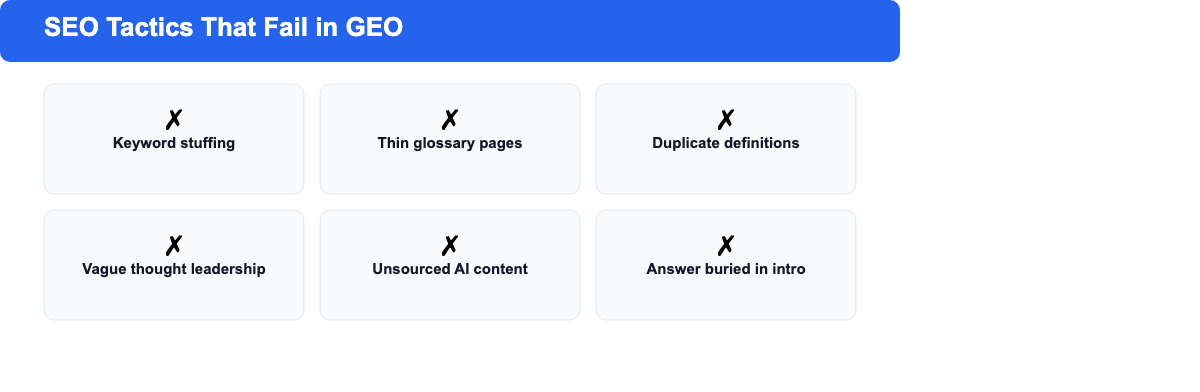
Several tactics that improve traditional SEO rankings actively hurt your GEO performance. AI systems parse meaning rather than phrase frequency, which changes what "optimization" actually means.
Tactics that underperform in GEO even when they hold value in traditional SEO:
- Keyword stuffing: AI systems score semantic meaning, not phrase repetition. Stuffing a term doesn't improve citation odds; it signals low-quality content.
- Thin glossary pages at scale: AI systems ignore padding. A 200-word page that restates the definition already covered on ten other pages offers nothing to extract.
- Repeating the same definition across multiple URLs: This dilutes topical authority instead of reinforcing it. A single comprehensive page outperforms a cluster of thin duplicates.
- Vague thought-leadership copy with no specific claims: If a section can't be extracted as a self-contained answer, it can't be cited. Generic copy about "the evolving digital landscape" fails the extract test.
- AI-generated content with no source support: AI systems are trained to favor evidence-backed sources. Content that makes claims without attribution or proof is a weaker citation candidate.
- Hiding the real answer below long intros: Generative retrieval pulls the most relevant passage. If the actual answer is on the fourth paragraph because the first three set up brand positioning, the extract often gets made from a competitor's page instead.
The KDD GEO paper found that traditional manipulative patterns underperformed in generative environments, while substantive additions like quotations and statistics performed better. AI systems summarize meaning rather than match phrases, so padding and thin glossary content aren't rewarded.
Measuring GEO performance
Standard analytics tools like GA4 and Google Search Console can't track AI citations. When an AI tool cites your content or recommends your brand, the user may never click through. No session, no measurable event. GEO visibility can drive brand awareness and influence purchase decisions while showing as zero traffic in your standard dashboard, which makes it one of the harder marketing channels to justify without dedicated tooling.
GEO measurement requires a separate set of metrics alongside your standard SEO reporting:
| GEO metric | What it measures | Why it matters |
|---|---|---|
| Citation frequency | How often AI platforms mention your brand when answering relevant questions | The core indicator of GEO visibility across AI systems |
| Share of voice | Your citation rate compared to competitors in AI responses for a given topic | Shows whether you're winning or losing ground in AI-driven discovery |
| Sentiment | Whether AI mentions are positive, neutral or negative | High citation frequency means little if AI is recommending against your product |
| Context and prompt coverage | Which specific questions or prompts trigger mentions of your brand | Identifies gaps in your GEO coverage across related queries |
Traditional analytics still matter. Google says AI-feature traffic is included in Search Console's web reporting, and publishers who allow OAI-SearchBot can track ChatGPT referral traffic in Google Analytics. Worth monitoring. But these signals only capture the part of GEO impact where users clicked through, which is a fraction of the total.
Dedicated GEO monitoring tools are becoming standard alongside analytics. Ahrefs Brand Radar tracks brand mentions inside Google AI Overviews specifically. Semrush's AI Toolkit monitors how your content appears across generative platforms and flags emerging mentions. Platforms like Profound and Goodie track how your brand appears in AI-generated responses across multiple LLMs, including sentiment and competitive share of voice. For a broader look at available options, see our guide to AI visibility tools.
One note from Contentful's SEO team: when GEO traffic does arrive, conversion rates run higher than organic search. The reason is simple. Users who've already had their question answered by an AI and still chose to click through are further along in their decision process. Lower volume, stronger intent.
Don't judge GEO performance on a single prompt. Track patterns across a cluster of related queries over at least 30 days. Citation rates fluctuate. The structural signals that earn recurring mentions are what you're optimizing for, not any one data point.
SEO and GEO readiness checklist
Here's a compact starting point that covers both SEO and GEO readiness before you publish:
- confirm one canonical topic and search intent for the page
- write a direct answer under every major heading, not after a long setup paragraph
- add at least one real proof point per important section (statistic, study, official source)
- audit entity naming for consistency across your site, schema and third-party profiles
- use terminology consistently throughout so AI systems can classify the page correctly
- write each key paragraph so it makes sense when read in isolation
- include a table or list where comparison or process clarity helps
- link official sources for platform-controlled facts
- check indexability, snippet eligibility and crawler access for all relevant bots including OAI-SearchBot
- link the page into a broader topical cluster through internal links
The SEO and GEO signals overlap more than they diverge. Getting the fundamentals right for traditional search builds the base that generative visibility depends on.
FAQ: SEO and GEO
Is GEO replacing SEO?
No, GEO doesn't replace SEO; it builds on it. Google's own documentation says standard SEO best practices still apply to AI features, so the right model is expansion, not replacement. Google still processes over 14 billion searches daily compared to around 37 million for ChatGPT, which means traditional search remains the dominant channel by a large margin.
Should I do SEO or GEO first?
SEO comes first. GEO depends on your pages being indexed, crawlable and eligible to appear in search features. Get the technical and content fundamentals right for SEO, then layer on GEO-specific improvements like answer-first writing, entity consistency and evidence density. If you are deciding whether to bring in outside help, see what generative engine optimization services typically cost before you request quotes.
Is GEO only about Google AI Overviews?
No, GEO covers all generative search and answer systems including ChatGPT search, Perplexity and Google's AI features. Each platform has its own crawling and retrieval behavior, but the core optimization principles, entity clarity, content extractability and multi-platform presence, apply across all of them.
Do you need special schema for GEO?
Not universally. Google says there aren't additional technical requirements for appearing in AI Overviews or AI Mode beyond normal search eligibility. Schema can still help clarify meaning when it fits the page. Organization, Article, WebPage and Breadcrumb schemas give AI crawlers structured context they can use alongside visible page content.
What is the fastest GEO win for an existing SEO page?
The fastest win is to rewrite key sections so each heading starts with a direct answer and each important claim has a credible source behind it. That single change improves both SEO snippet eligibility and GEO citation likelihood at the same time.
Does ranking on Google improve AI visibility?
Strong Google rankings help but don't guarantee AI citations. Pages that rank well tend to have the trust signals, entity clarity and content quality that AI systems also favor. But AI retrieval isn't a direct function of rank position. A page can appear in an AI answer for a query where it doesn't rank in the top ten. And a top-ranking page can be passed over if its content isn't extractable or evidence-backed enough to cite.
What is the difference between GEO, AEO and LLM SEO?
These labels overlap considerably. In practice, they all point to the same shift: content needs to be understandable, trustworthy and easy for AI systems to cite. The differences are mostly emphasis. GEO is the broad generative-engine frame, AEO focuses on answer extraction and visibility and LLM SEO often focuses more on model-facing content structure and retrieval behavior.