
How-to · 6 steps
AI Visibility: How to Get Cited in AI Search

AI visibility is your brand's ability to appear inside AI-generated answers, source cards, and supporting links across tools like Google AI Overviews, ChatGPT search, and Perplexity, measured through mentions, citations, position, and sentiment rather than clicks alone. Building it starts with one canonical page per topic, answer-first content, proof and source support, and consistent brand messaging across the web.
- Choose one canonical page per query class
- Make answer extraction easy with direct headings
- Add proof and source support to key claims
- Build topical authority across a content cluster
- Keep the site technically clean and crawlable
- Keep brand messaging consistent across the web
AI visibility is your brand's ability to appear inside AI-generated answers, source cards and supporting links across tools like Google AI Overviews, ChatGPT search and Perplexity. It matters because users now get many answers without clicking through a traditional list of blue links. If your brand isn't present in those answers, you can lose attention before the visit even starts. If you're evaluating which of those tools to trust in the first place, see our comparison of the best AI search engines ranked on citation accuracy.
- AI visibility is broader than rankings.
- It includes citations, mentions, supporting links and branded recall inside AI tools.
- Strong AI visibility usually comes from strong content systems, not one-off prompt tricks.
- The goal is to become an easy source to retrieve, trust and cite.
| Quick fact | Why it matters |
|---|---|
| Google reports AI-feature traffic in Search Console’s Web reporting | You can measure at least part of AI visibility with existing search tooling |
OpenAI says publishers can track ChatGPT referrals when they allow OAI-SearchBot | ChatGPT visibility is not fully opaque |
| Google says there are no extra technical requirements for AI features beyond standard Search requirements | Most AI visibility failures start with weak SEO and weak content structure |
For a closer look at exactly which SEO practices generative AI has changed and which ones still work the same way, see this breakdown of what changes and what stays the same.
What is AI visibility?
AI visibility is the percentage of relevant prompts where your content or brand becomes part of the answer experience. It takes two forms: mentions and citations. When an AI tool names your brand in an answer without linking to you, that's a mention. A citation is a linked reference inside the answer pointing to your page. Citations drive referral traffic; mentions build brand recall without a click.
That makes AI visibility a broader metric than search ranking. Ranking asks where you appear in a list. AI visibility asks whether you appear in the answer layer at all.
The distinction matters because many teams still measure only clicks. Clicks still matter, but they no longer tell the whole story. If an AI system quotes your product category definition, cites your research or links your page as a supporting source, that's visibility even if the user doesn't click in that moment.
Why AI visibility matters now
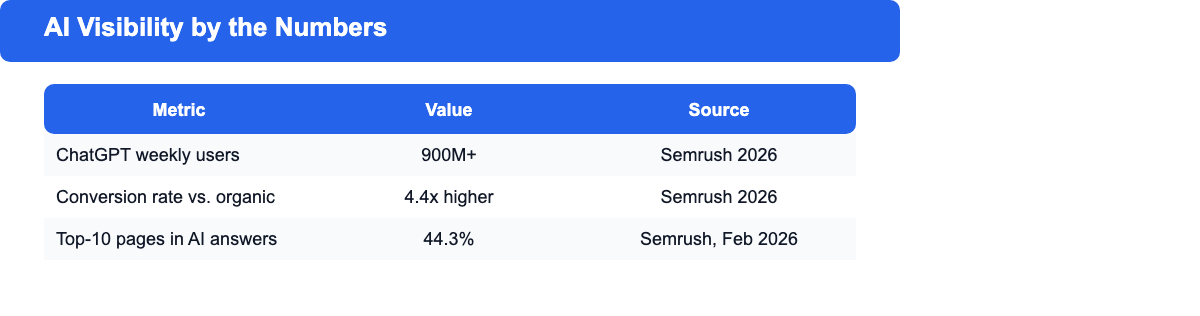
ChatGPT has surpassed 900 million weekly users, according to Semrush research, making it one of the fastest-growing decision-making platforms in history. AI-referred visitors also convert 4.4 times better than traditional organic search visitors, according to the same research. That combination of scale and intent quality makes AI visibility a commercial priority outright. It's not a marketing experiment for later.
Google's AI Overviews now appear across a significant share of searches, and AI Mode is becoming a mainstream access point for complex queries. OpenAI's search experience shows inline citations and supporting sources. In both cases, publishers and brands compete for inclusion inside the answer, not just for a ranking position beside it. Brands absent from those answers will lose discovery before the visit starts.
AI-generated results are projected to overtake traditional organic listings as the primary search response format for many query types. That shift changes the operating model for content teams:
- answer quality matters more
- brand and entity clarity matters more
- source trust matters more
- topical authority across a cluster matters more
How AI visibility differs from traditional SEO
SEO and AI visibility share a technical foundation, but they measure different things and reward different behaviors. A February 2026 Semrush study found that only 44.3% of pages ranking in the Google top 10 appeared in at least one AI-generated answer across four platforms. Strong rankings don't guarantee AI presence. That's the key gap many teams miss.
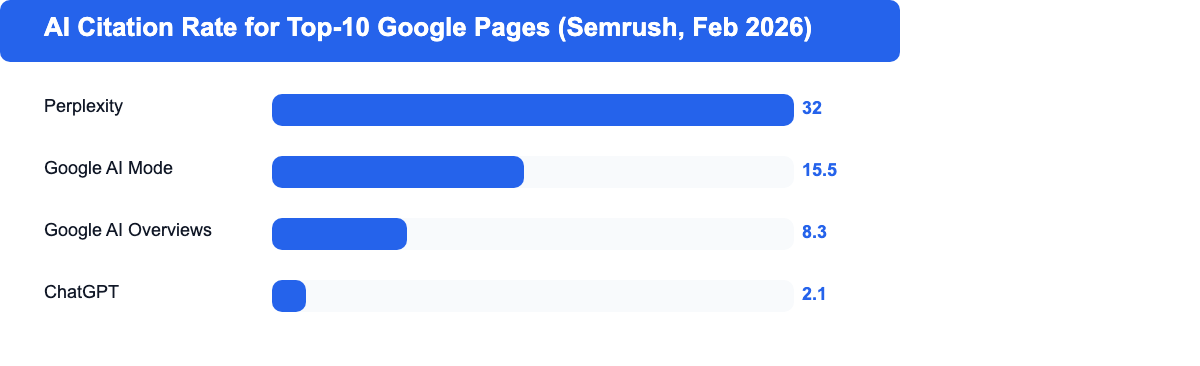
The gap varies by platform. Perplexity cited top-10 pages 32% of the time. Google AI Mode cited them 15.5% of the time. Google AI Overviews cited them 8.3% of the time. ChatGPT cited them just 2.1% of the time. Ranking well is a necessary but not sufficient condition for AI visibility.
| Dimension | Traditional SEO | AI visibility |
|---|---|---|
| Goal | Rank in results list | Appear inside AI-generated answers |
| Success metric | Position, clicks, CTR | Mentions, citations, position in answer, sentiment |
| Content signal | Keywords, links, authority | Answer-extraction quality, entity clarity, evidence |
| Overlap with top 10 | 100% by definition | 44.3% across four AI platforms (Semrush, Feb 2026) |
| Technical requirements | Crawl access, indexability, canonicals | Same as SEO plus bot access for OAI-SearchBot |
The key difference is what drives inclusion. AI systems select pages for answer-extraction quality: how clearly the page answers the question, how trustworthy the source appears and whether the content fits the specific prompt context. A page that ranks because of its link profile can still be passed over by an AI system that's found a cleaner answer elsewhere.
How do you improve AI visibility?
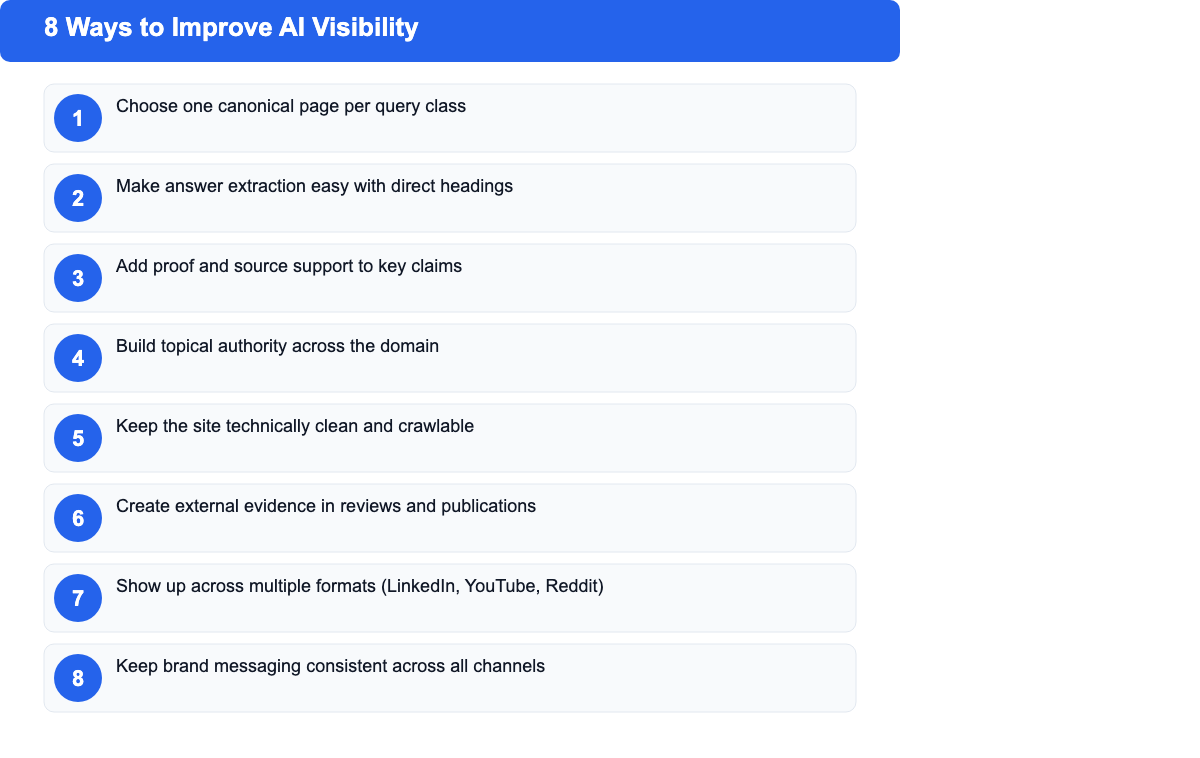
The best AI visibility programs are systematic. They don't rely on gaming a single interface.
1. Choose one canonical page per query class
If three pages on your site all try to own the same concept, you're making retrieval messier than it needs to be. Pick one canonical page for each major query class and support it with related pages around the cluster. This reduces cannibalization and gives AI systems a cleaner source hierarchy.
2. Make answer extraction easy
Every important heading should have a direct answer underneath it. Keep intros short, use descriptive headings and break up dense text. If an LLM has to guess where the useful part begins, your odds of inclusion go down.
Freshness matters too. According to Seer Interactive research cited by Semrush, approximately 90% of pages crawled by AI bots were published within the past three years. That's why keeping content current will improve your crawl priority.
3. Add proof and source support
AI systems are more likely to trust pages that behave like sources. Use primary documentation for platform facts, named studies for research claims and concrete examples where abstraction would be weak.
4. Build topical authority across the domain
One page can earn visibility, but clusters will earn it more reliably. Publishing interconnected pages that cover a subject cluster makes it far more likely you'll get cited across related prompts. If you cover AI visibility, GEO SEO, AI Overviews optimization and content gap analysis, each page reinforces the others.
5. Keep the site technically clean
Google says AI-feature inclusion depends on normal Search eligibility. OpenAI's requirement is simpler: allow its crawler. AI visibility still rests on crawl access, indexability, canonical hygiene and pages that render correctly.
6. Create external evidence where it's natural
AI systems reflect what the broader web says about an entity, not what you've told them. External mentions in reviews, publications and industry sources increase citation likelihood. Hostinger, for example, appeared in over 51,000 AI-generated answers with 40,100 cited pages, according to Semrush research. That scale of external presence makes a brand hard to ignore.
7. Show up across multiple formats
LinkedIn, YouTube and Reddit are among the most frequently cited domains in AI-generated answers, according to Semrush. A brand that publishes only on its own site has a narrower footprint than one that publishes in the formats and communities that AI systems already treat as trusted sources.
8. Keep messaging consistent
AI tools synthesize what the web says about a brand, not just what the brand says about itself. Consistency across your own pages, third-party reviews, industry directories and social profiles will reduce the risk of AI tools generating inaccurate or conflicting descriptions. Respond to reviews, correct factual errors in public profiles and treat brand clarity as an ongoing maintenance task.
How do you measure AI visibility?
Measurement starts with four metrics: mentions (your brand named in an AI answer without a link), citations (a linked reference to your page), position (how prominently your brand appears within the answer) and sentiment (whether the description is positive, neutral or negative). You'll get a clearer picture than click data alone when you're tracking all four together.
Prompts fall into three intent categories worth tracking separately: research prompts (definition and overview queries), comparison prompts (your brand vs alternatives) and evaluation prompts (specific feature or use-case questions). Monitoring all three shows where you're visible and where competitors dominate.
Use Search Console for Google-side movement
Google includes traffic from AI features in Search Console's Web reporting. You can track page and query movement for pages that target AI-heavy prompts, even if Search Console doesn't always label every AI surface the way SEOs would like.
Track ChatGPT referrals in analytics
OpenAI says publishers can track referral traffic from ChatGPT when they allow OAI-SearchBot. If the crawler's allowed and the content is public, watch whether meaningful referral traffic appears over time. That traffic is a practical proxy for ChatGPT citation frequency.
Run a fixed prompt set manually
For high-value topics, maintain a consistent prompt set and test it on a regular schedule. Look for:
- whether your brand is mentioned
- whether the right page is cited
- whether the explanation is accurate
- whether competitors dominate the answer
- whether follow-up prompts still surface you
Score the whole cluster
Don't track only one hero keyword. AI visibility's cluster-shaped. Measure prompt groups across definitions, comparisons, alternatives, use cases and how-to queries together and you'll see the full picture.
Tools for tracking AI visibility
Manual prompt testing gives you a starting point, but you'll need dedicated software for systematic tracking. These platforms are built to monitor brand mentions and citations across AI tools at scale.
For a closer look at how these platforms actually differ under the hood, see our comparison of what GEO tools measure and how they differ.
Semrush AI Toolkit
Semrush's AI Toolkit connects to an existing SEO workflow and tracks brand performance across ChatGPT, Google AI, Gemini and Perplexity. It draws on a database of over 180 million prompts and includes Share of Voice (SoV) data showing how frequently your brand appears relative to competitors in a given category. It's the strongest fit for teams already on Semrush who want to unify AI tracking and traditional SEO reporting in one platform.
Ahrefs Brand Radar
Ahrefs Brand Radar is an add-on to the main Ahrefs platform. It monitors how often your brand is mentioned and cited in AI-generated responses and provides competitive benchmarking against other brands in your niche. If you're doing most of your SEO work inside Ahrefs, it's the natural choice for AI visibility tracking.
Profound
Profound tracks AI visibility across ten major answer engines and includes content recommendation features that suggest specific edits to increase citation probability. The agency version supports multiple client accounts with shared reporting workspaces. It's the more comprehensive option for teams that need both monitoring data and optimization guidance in one product.
Otterly.AI
Otterly.AI is among the more accessible entry points for smaller teams. It monitors brand mentions and citations across key AI platforms and flags when competitors appear in answers where your brand doesn't. Pricing starts at the lower end of the market, which makes it practical for freelancers and small SEO teams.
Peec AI
Peec AI focuses on prompt-level tracking with a reporting layer that shows which prompts trigger mentions, which trigger citations and which return answers that are accurate about your brand. The tool's share-of-voice trend data integrates with popular SEO and analytics dashboards.
ZipTie
ZipTie provides deep analysis reports across Google AI Overviews, ChatGPT and Perplexity. An AI Success Score gives a top-level health indicator, and the platform breaks down citation patterns to show which pages earn the most references and which topics are still missing from your AI footprint.
For a full side-by-side comparison, the guide to best AI visibility tools covers each platform with detailed feature and pricing information.
SEO Title Generator: eight title tag variations, sized for the SERP and intent-matched. Free, no signup.
AI visibility audit checklist
If a site is underperforming in AI search, audit it in this order:
- Is there one clear page for each important topic?
- Does each page answer its heading directly?
- Are key claims backed by current sources?
- Are the pages indexable and crawlable?
- Is the brand and entity named consistently across the site?
- Does the site have topical depth beyond one thin page?
- Are there external mentions or proof signals that support trust?
This order matters. Most AI visibility problems aren't caused by missing "AI tactics." They're caused by messy content systems.
Common reasons brands stay invisible in AI search
The usual failures are predictable:
- the site has overlapping pages with no canonical topic owner
- content is generic and says nothing better than everyone else
- important sections don't answer the heading directly
- factual claims are ungrounded
- crawler access is blocked
- the brand has weak entity reinforcement across the web
- the team measures only rankings and misses answer-layer visibility
Fix those basics and you'll see AI visibility improve before any advanced experimentation starts. Without question, the technical and structural work matters far more than chasing platform-specific tricks.
AI visibility workflow for content teams
The cleanest operating model is simple:
| Step | Outcome |
|---|---|
| Map prompt clusters | know which prompts matter by intent |
| Assign canonical pages | reduce duplication and topic drift |
| Rewrite for extraction | make answers easier to cite |
| Strengthen evidence | improve trust and representation |
| Check technical access | remove crawl and index blockers |
| Monitor prompt set and referrals | see whether inclusion improves |
AI visibility works best as part of ongoing content operations rather than a one-off project. You're not done when the article is published. AI systems update their source selection continuously, so a page that earns citations today needs maintenance to keep earning them. If keeping that workflow running in-house is not realistic, see what generative engine optimization services typically cost before you hire it out.
FAQ about AI visibility
Is AI visibility the same as ranking?
No, they're different metrics. Ranking is one part of discovery. AI visibility asks whether your brand or page appears in the generated answer experience itself, not just in the list of results beside it.
What are the four metrics for measuring AI visibility?
The four standard metrics are mentions (brand named without a link), citations (linked reference inside the answer), position (how prominently the brand appears) and sentiment (positive, neutral or negative framing). Tracking all four will give you a more complete picture than click data alone.
Can you measure AI visibility directly?
Partly. Google includes AI-feature traffic in Search Console's Web reporting, and OpenAI says ChatGPT referrals can be tracked when publishers allow OAI-SearchBot. Manual prompt tracking is still needed for the full picture across platforms.
What is the fastest way to improve AI visibility?
Clean up canonical pages, answer each heading directly and replace vague claims with source-backed explanations. Those three changes remove the most common barriers to AI citation.
Does AI visibility require a separate content strategy?
Usually not. It's a sharper version of your existing content strategy. The winning pages are the ones with the clearest topic ownership, structure and proof.
What should teams watch first?
Watch pages that target informational and comparison-heavy prompts. Those are often the first places where AI answer layers change how visibility works.
Does strong SEO help with AI visibility?
Strong SEO is a foundation, not a guarantee. Pages need to rank to have any chance of AI citation, but ranking alone doesn't determine whether an AI system picks your page as the best answer. Clear structure, factual density and consistent entity coverage matter separately from link count.