

An AI SEO agency helps your brand get cited and recommended inside AI Overviews, ChatGPT, Perplexity and other AI-driven search surfaces, not just ranked on a classic results page. Before you sign with one in 2026, you need a way to tell a real search optimization practice from a rebranded content shop. This guide gives you five things: an evaluation framework, the exact questions to ask on a sales call, the red flags that predict a bad engagement, current pricing ranges and a way to check an agency’s claims yourself instead of taking its word for it. The goal is not to find the single best AI SEO agency on the market. It is to find the best AI SEO agency for your business, budget and current gaps.
Quick answer: judge a prospective AI SEO agency on five things: AI Overview visibility, LLM citations, technical/structured-data foundation, content and entity authority, and documented results. Ask for named-client pipeline proof, not citation screenshots, and expect to pay $1,000 to $15,000+ a month depending on business size.
What Is an AI SEO Agency?
An AI SEO agency optimizes your content and site so it gets cited or recommended inside AI Overviews, ChatGPT, Gemini and similar answer engines, on top of ranking in classic search. You will also see this work called generative engine optimization (GEO) or answer engine optimization (AEO). Different agencies use different labels, but the underlying job is the same: make your brand identifiable and trustworthy enough that a language model chooses to reference it in an answer.
This work sits alongside traditional SEO, not instead of it. Most AI answer engines still draw heavily on indexed, well-structured web content, so a site with weak technical SEO rarely earns strong AI citations either. If you want the deeper mechanics of how AI Overviews work or how large language models select sources, read our guides on AI Overviews and LLM SEO. This article focuses on one question: how do you tell whether the agency you are about to pay knows how to do this work?
How Is an AI SEO Agency Different From a Traditional SEO Agency?
An AI SEO agency and a traditional SEO agency are complementary, not competing, because they optimize for different retrieval mechanics on top of the same content foundation. A traditional SEO engagement is judged on rankings, organic clicks and backlinks. An AI SEO engagement adds three things on top of that: entity authority (whether AI systems recognize your brand as a distinct, trustworthy source), structured data that makes your content machine-parseable, and measuring citations and referrals from AI platforms instead of only search engine result pages.
In practice this means the agency should be able to show you work in three areas: content structured for extraction (clear, direct answers near the top of a page), technical markup that helps a crawler or model parse your site correctly, and a way to track when your brand gets cited or recommended by an AI system. An agency that only talks about keyword rankings, with no mention of citations, entities, or answer engine optimization, is probably selling you traditional SEO with an AI label on top.
The 5-Part Framework for Evaluating an AI SEO Agency
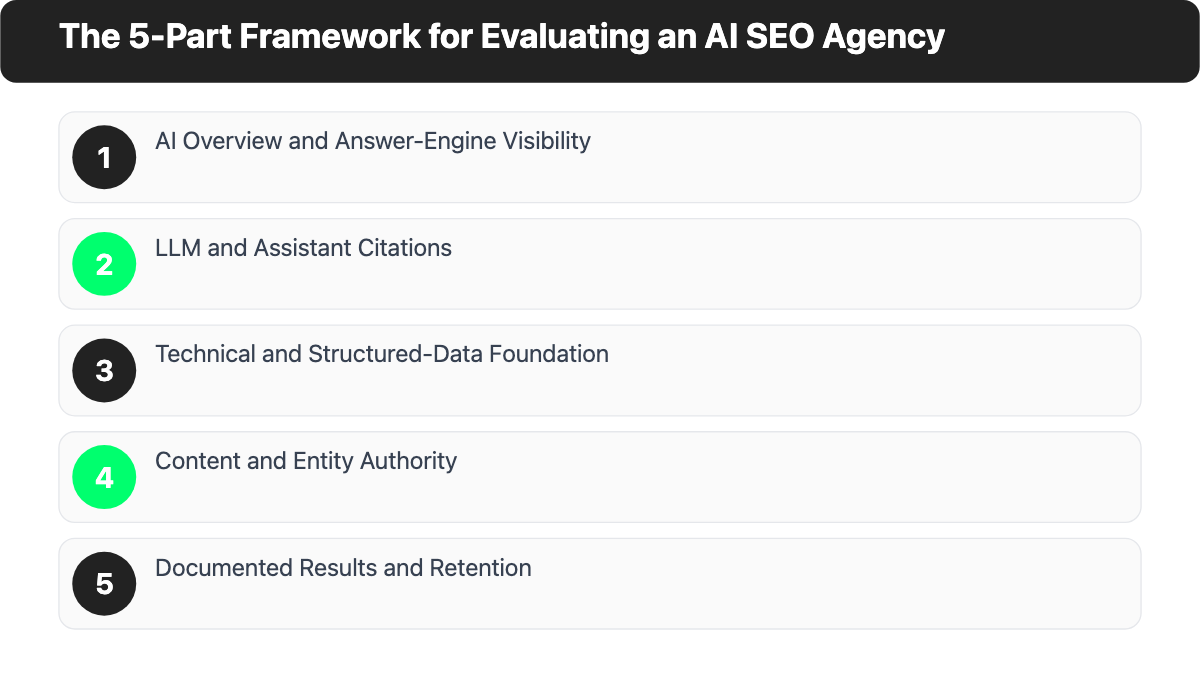
Judge a prospective AI SEO agency across five areas: AI Overview and answer-engine visibility, LLM and assistant citations, technical and structured-data foundation, content and entity authority and documented results. An agency that is strong on paper but weak on two or more of these usually turns out to be a traditional SEO shop with new terminology.
AI Overview and Answer-Engine Visibility
Ask the agency to show you a real example of a client appearing inside a Google AI Overview or a similar answer box, and ask what specifically they did to earn that placement. A credible answer names concrete tactics: restructuring a page to answer a question in the first two sentences, adding FAQ schema or consolidating scattered content into one authoritative page. A vague answer like “we optimize for AI search” with no example is a sign they have not shipped this work.
LLM and Assistant Citations
Ask whether they track citations in ChatGPT, Perplexity or Gemini specifically, and ask how. Assistant citation tracking is newer and noisier than classic rank tracking, so expect the agency to describe a mix of manual prompt testing and emerging monitoring tools rather than a single polished dashboard. What matters is that they can describe a repeatable method, not that the method is perfect yet.
Technical and Structured-Data Foundation
A real AI SEO practice audits your schema markup, site architecture and crawlability before touching content, because a model cannot cite what it cannot parse. Ask what schema types they implement by default, using Google’s own structured data guidelines as the reference point (Organization, Article, FAQPage and Product are common starting points), and whether they run a technical audit as part of onboarding. If the agency jumps straight to content without mentioning a technical audit, that is a gap worth pressing on.
Content and Entity Authority
This criterion covers whether the agency builds genuine topical depth and a recognizable entity, versus publishing thin, generic pages. Ask to see a content plan or topic cluster example from an existing client. Strong entity work usually shows up as a cluster of interlinked pages around a subject, each answering a distinct question, rather than isolated blog posts chasing separate keywords.
Documented Results and Retention
Ask for a client reference or a documented case, and specifically ask for referral traffic or pipeline data from AI platforms, not just a screenshot of a citation. Citation screenshots prove visibility exists somewhere; they do not prove that visibility produced a business result. Also ask about client retention. An agency doing durable work tends to keep clients longer than one running short, transactional engagements.
Questions to Ask Before You Sign
Ask these six questions on your first call, in order. Expect a specific answer to each one, not a general pitch.
- “Can you show me a named client’s AI referral traffic or pipeline, not just a citation screenshot?” This is the single highest-value question on this list. A citation is easy to screenshot and hard to verify. Referral traffic or pipeline data in analytics is harder to fake and tells you whether the visibility mattered.
- “Do you run AEO and traditional SEO as one system, or as two separate services with separate billing?” Agencies that treat these as one integrated program tend to avoid duplicated work and conflicting recommendations. Agencies that bill them separately sometimes have two disconnected teams working from different playbooks.
- “What does your AI-search method actually look like, step by step?” Listen for concrete steps: audit, entity mapping, content restructuring, schema implementation and a measurement cadence. A vendor with only a service label and no described method is selling a concept, not a process.
- “How do you make our site legible and trustworthy to large language models specifically?” A strong answer covers structured data, clear extractable answers and consistent entity signals across the web, not just on your own site.
- “How often will you report on AI visibility, and what will that report contain?” Get a concrete reporting cadence and a list of metrics before you sign, so you are not negotiating reporting expectations after the contract starts.
- “Is there a way to tell whether your brand is being cited versus actually recommended?” Being mentioned once in a list is different from being the brand an AI system consistently suggests first. An agency that has thought about this distinction is further along than one that treats every mention as equal.
Red Flags That Signal a Weak AI SEO Agency
Watch for these warning signs during the sales process, before you commit budget.
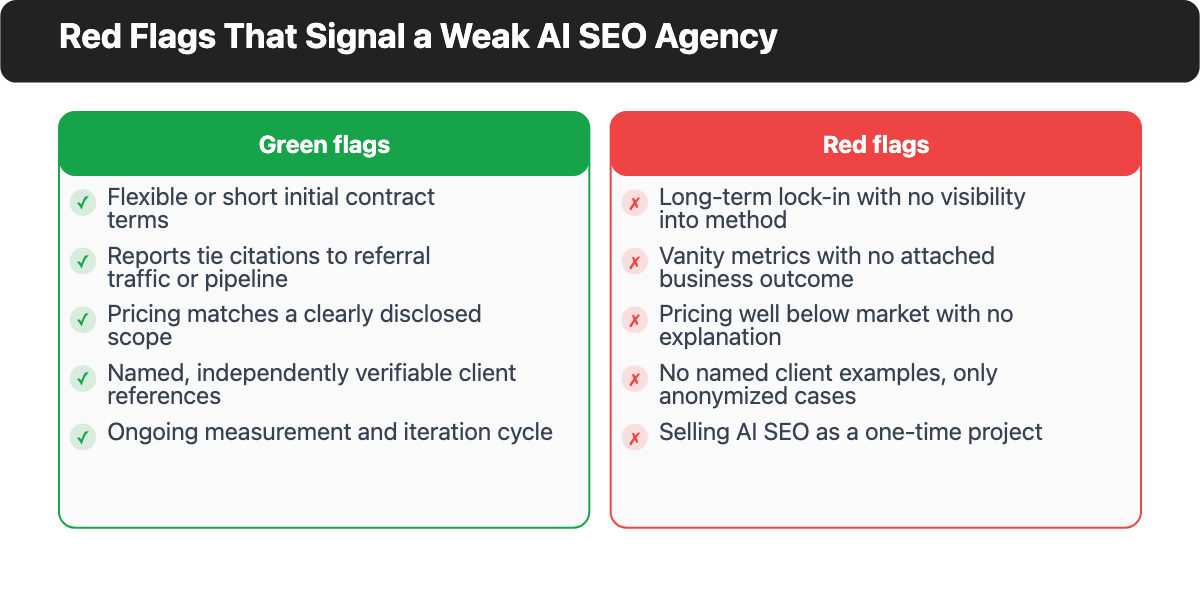
- Long-term lock-in with no visibility into method. A 12-month contract signed before you have seen a documented process is backwards. You should understand the method before you commit to the term.
- Vanity metrics with no attached business outcome. A rising citation count means little without referral traffic, leads, or pipeline attached to it. If every report leads with citation volume and nothing else, ask why.
- Pricing well below market with no explanation. Offers priced far under typical market rates for the stated scope usually mean less senior staff time, a template-driven process, or scope that quietly shrinks after the first month.
- No named client examples, only anonymized or “confidential” case studies. Some confidentiality is normal, but an agency that cannot produce even one verifiable reference after you ask directly is a risk.
- Selling AI SEO as a one-time project. AI answer engines change their retrieval behavior often. An agency pitching a one-and-done engagement instead of an ongoing measurement and iteration cycle does not understand how this work holds up over time.
How Much Does an AI SEO Agency Cost?
As a reported market estimate rather than an official price list, small and local businesses pay roughly $1,000 to $5,000 a month for AI SEO, mid-market companies typically pay $5,000 to $15,000 a month, and enterprise programs often run $15,000 a month or more depending on scope. Treat these figures as benchmark ranges, not fixed quotes, since scope, content volume and the number of AI platforms tracked all move the number for any individual agency.
Be cautious of AI SEO priced under roughly $1,000 a month. At that price point, the agency is usually running a light, templated service rather than the technical audit, content restructuring and ongoing citation tracking that real AI SEO work requires.
| Business size | Typical monthly range | What’s usually included |
|---|---|---|
| Small / local business | $1,000 to $5,000 | Basic technical audit, schema setup, limited content restructuring |
| Mid-market | $5,000 to $15,000 | Full technical audit, ongoing content production, citation tracking across 2 to 3 platforms |
| Enterprise | $15,000 or more | Multi-brand entity management, dedicated reporting, broader platform coverage, scope-dependent add-ons |
The three biggest cost drivers are the number of AI platforms tracked (Google AI Overviews alone costs less to monitor than Google plus ChatGPT plus Perplexity), the volume of content that needs restructuring or rewriting, and whether the engagement assumes your technical foundation is already solid or includes a full technical and schema audit.
How to Verify an Agency’s AI Visibility Claims Yourself
You do not need to take an agency’s word for its own results. Run this three-step check before or during an engagement.
- Ask for one specific, current citation example, then check it yourself. Open ChatGPT, Perplexity, or Google and run the same or a similar prompt the agency claims produced the citation. If you cannot reproduce anything close to what they described within a few tries, treat the claim as unverified.
- Ask for referral traffic from AI platforms in your own analytics, not a slide deck. Most modern analytics setups can segment traffic by referral source. If an agency claims AI-driven visibility, that should eventually show up as measurable, labeled referral traffic you can see directly, not only in a report they compile themselves.
- Re-run the check periodically, not just once at kickoff. AI answer engines change how they select and cite sources fairly often. A citation that was accurate three months ago may not hold today. Periodic spot checks tell you whether the agency is still doing active work or coasting on an early win.
If you want to go deeper on measuring AI visibility yourself rather than relying only on a vendor’s reporting, our roundup of AI visibility tools covers options built specifically for this kind of independent tracking.
Frequently Asked Questions
What is an AI SEO agency?
An AI SEO agency is a firm that optimizes your content, site structure and entity signals so AI systems like Google AI Overviews, ChatGPT, and Perplexity cite or recommend your brand, in addition to standard search engine optimization.
How much does an AI SEO agency cost?
Most engagements fall between $1,000 and $15,000 a month depending on business size and scope, with small local businesses at the lower end and mid-market companies typically paying $5,000 to $15,000 a month. Enterprise programs often exceed $15,000 a month.
How long does it take to see results from an AI SEO agency?
Results usually take longer to show than classic SEO reporting cycles, because AI citation tracking is newer and less standardized than search rank tracking. Expect an agency to set expectations around a multi-month iteration cycle rather than promise a fixed timeline, and be skeptical of anyone who guarantees citations within a specific number of weeks.
Can my existing SEO agency handle AI SEO, or do I need a separate agency?
Some SEO agencies have built out real AI-search capability. Others have relabeled their existing service without changing the underlying work. Ask your current agency the same five-part framework and question list in this guide. If they can answer specifically, you may not need a separate vendor. If their answers stay generic, that gap is worth addressing before you pay for AI SEO as a bolt-on.
How do I know if an agency’s case studies or reviews are real?
Ask for a named client you can independently verify instead of an anonymized case study, and cross-check the agency’s own reputation on a third-party review platform such as Clutch. Then check the specific citation or traffic claim yourself using the verification method described below. A genuine result should survive you checking it directly.
What’s the difference between being cited and being recommended by an AI system?
Being cited means an AI system mentions your brand once, often alongside several competitors. Being recommended means your brand is the answer an AI system consistently surfaces first for relevant queries. An agency that only tracks citation counts is measuring the easier, less valuable signal. Ask specifically how they track the difference.
