


Semrush and Ahrefs still get compared the same way they did five years ago, but the tools underneath that comparison have changed more in the last twelve months than in the previous three years combined. A new owner and a full pricing rebuild on both sides mean a lot of what’s written about this matchup is already out of date (details below). If you’re reading a “Semrush vs Ahrefs” article that still lists Semrush’s old Pro, Guru, and Business plans, you’re reading something written before the rebrand.
This comparison uses the actual 2026 plan names, live pricing pulled directly from both vendors, and the current backlink and keyword database figures from each company’s own numbers. It’s also not published by either vendor. Backlinko, one of the most-cited comparisons in this space, is owned by Semrush. Ahrefs’s own “vs” page is, unsurprisingly, written by Ahrefs. Neither is wrong exactly, but neither can call an honest winner either.
Semrush vs Ahrefs at a Glance
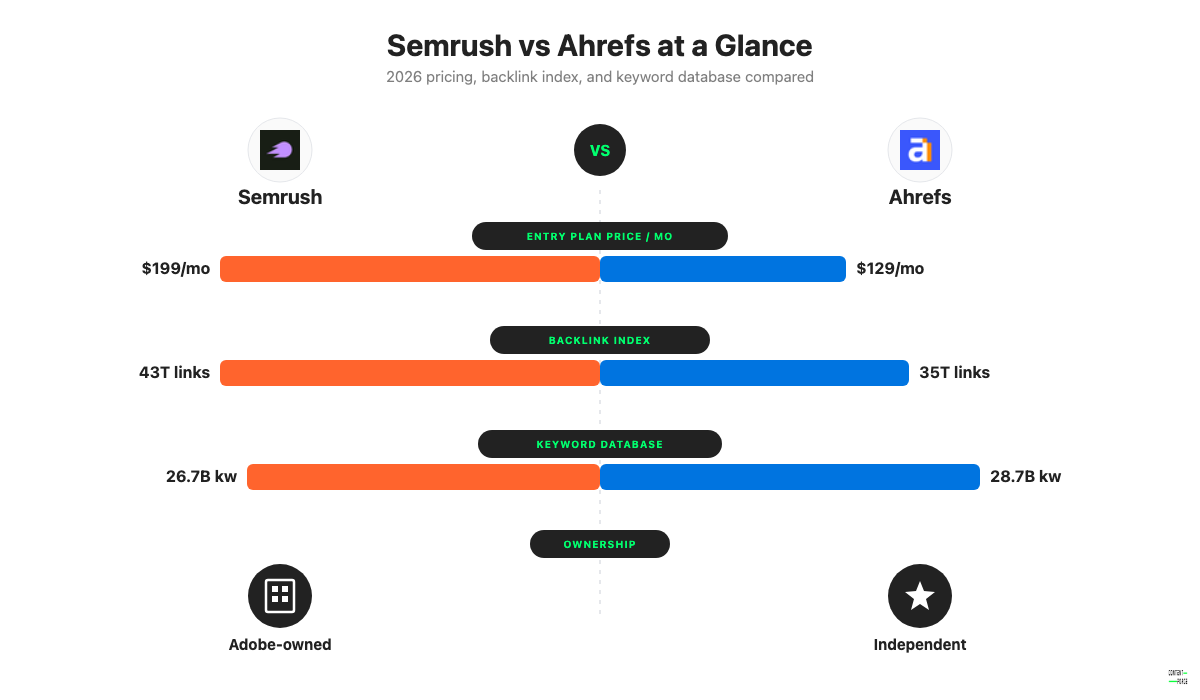
Here’s the short version before the category breakdown below.
| Semrush | Ahrefs | |
|---|---|---|
| Cheapest plan | $139.95/mo (SEO) | $29/mo (Starter, limited) |
| Full-feature entry plan | $199/mo (Starter) | $129/mo (Lite) |
| Top standard plan | $549/mo (Advanced) | $449/mo (Advanced) |
| Backlink index | 43 trillion | 35 trillion |
| Referring domains indexed | 390 million | 213.3 million |
| Keyword database | 26.7 billion | 28.7 billion |
| Free plan | No (trial only) | Yes (Ahrefs Free) |
| AI visibility tracking | Bundled from the entry tier | Bundled from the entry tier |
| Owned by | Adobe (since April 2026) | Independent, bootstrapped |
Semrush has the bigger backlink index and the bigger price tag at every comparable tier. Ahrefs has the bigger keyword database, a real free plan, and a much cheaper way in. Neither fact settles the argument on its own, which is the whole point of the sections below.
What Changed Between Semrush and Ahrefs in 2026?
Two things happened this year that most existing “Semrush vs Ahrefs” content hasn’t caught up with yet.
First, Adobe closed its acquisition of Semrush in a deal reported at roughly $1.9 billion in late April 2026. Semrush now operates as part of Adobe’s marketing and creative software portfolio rather than as an independent public company. Ahrefs, by contrast, remains privately owned and bootstrapped, and its own comparison page now leads with that distinction as a selling point: independence versus a large parent company’s roadmap priorities. Whether that matters to you depends on how much you care about a tool’s product decisions being made by its original SEO-focused team versus a larger corporate structure.
Second, Semrush retired its long-running Pro, Guru, and Business plans (priced at $139.95, $249.95, and $499.95 a month) and replaced them with a four-tier structure: SEO, Starter, Pro+, and Advanced, priced at $139.95, $199, $299, and $549 a month respectively. The new entry-level SEO plan is cheaper than the old Pro plan but covers less: it’s built around core SEO tracking and a basic AI visibility layer, while the AI Search Toolkit’s fuller feature set (competitor AI-visibility comparisons, more tracked prompts, keyword optimization tools) starts at the Starter tier and up. Ahrefs made a smaller but still real change, folding its Brand Radar AI-visibility product and prompt-tracking allowances into every paid plan by default rather than selling it as a pure add-on, while keeping larger prompt-tracking volumes behind separate paid packages.
If a comparison you’re reading still calls Semrush’s mid-tier plan “Guru,” it’s describing a plan that no longer exists.
Which Has Better Data Quality, Semrush or Ahrefs?
Data quality is usually the first real disagreement in any Semrush vs Ahrefs comparison, and both companies publish numbers that make themselves look bigger.
Backlink Index Size and Freshness
Semrush claims a backlink index of 43 trillion backlinks across 390 million referring domains. Ahrefs claims 35 trillion live backlinks across 213.3 million domains, and markets itself as the most active crawler in the SEO category, citing Cloudflare Radar data placing AhrefsBot among the ten most active web crawlers online.
The gap is real but it isn’t simply “bigger equals better.” Semrush’s larger total includes both live and historical (dead) backlinks, while Ahrefs’s headline number is specifically live backlinks. Ahrefs also indexes fewer total referring domains but crawls more frequently by its own account, which matters more for catching a competitor’s newest links than for total historical coverage. If your work depends on catching link changes fast (agency link-building audits, disavow monitoring), crawl freshness matters more than raw index size. If you need the deepest possible historical link-graph view of an old, established domain, the larger total index has an edge.
Keyword Database Depth
Ahrefs reports 28.7 billion keywords, filtered down from a raw 110 billion. Semrush reports 26.7 billion. The two databases are close enough that neither is a decisive factor on its own, and both pull from a mix of clickstream and search-engine data to estimate volume and difficulty. In practice, the bigger differentiator between the two tools for keyword work isn’t index size, it’s how each interface surfaces that data (covered next).
Keyword Research: Semrush vs Ahrefs
Semrush and Ahrefs both do keyword research well; the difference between them is workflow, not raw capability.
Semrush Keyword Overview
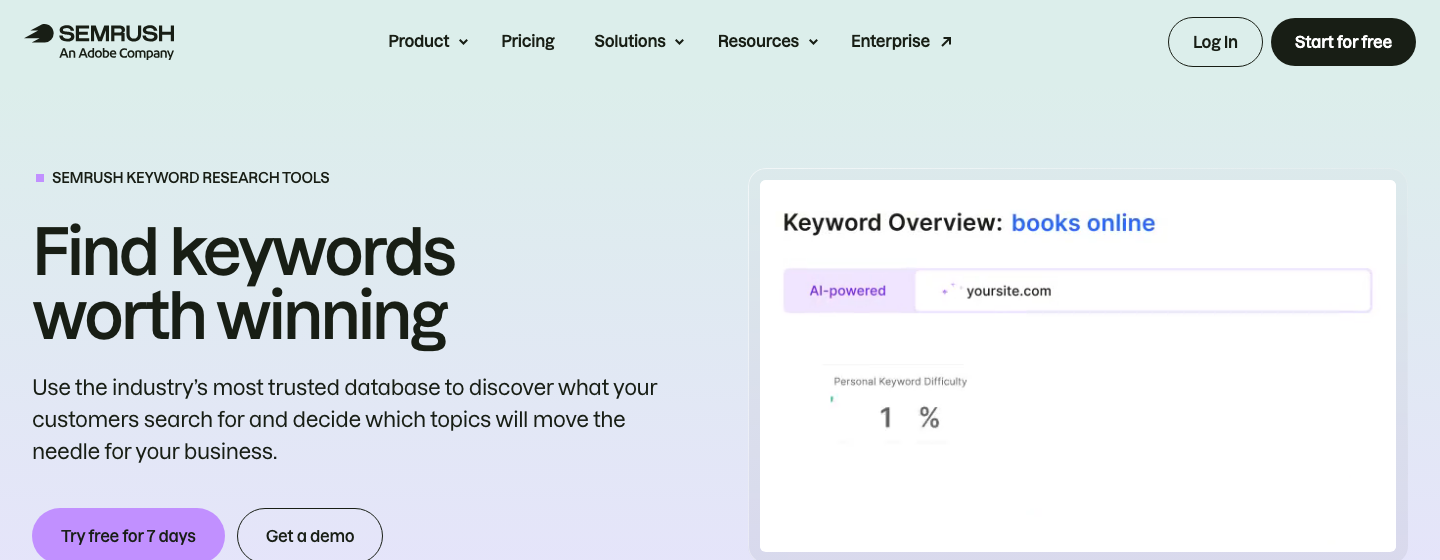
Semrush’s Keyword Overview tool is built for breadth. A single search returns volume, difficulty, intent classification, a full list of related and question-based keywords, and a ranked SERP snapshot in one screen, which suits marketers who need to move from “one keyword” to “a content brief” quickly. Semrush also layers in its Keyword Magic Tool for building out large topic clusters, and, on the newer AI-visibility-inclusive plans, tracks how often a target keyword’s topic surfaces in AI Overviews and chatbot answers.
Ahrefs Keyword Explorer
Ahrefs’s Keyword Explorer leans toward precision over breadth. Its “Parent Topic” feature groups keyword variants that already rank for the same page on competing sites, which is genuinely useful for avoiding accidental keyword cannibalization before you write. Ahrefs’s difficulty score is also widely regarded as more conservative and harder to game than Semrush’s, largely because it’s still primarily anchored in referring-domain counts of ranking pages rather than a broader weighted model.
Neither tool is meaningfully “better” for keyword research in 2026 than the other; the choice mostly comes down to whether you prefer Semrush’s broader single-screen workflow or Ahrefs’s tighter, cannibalization-aware grouping.
Backlink Analysis: Semrush vs Ahrefs
Semrush Backlink Analytics
Semrush’s Backlink Analytics tool pairs its larger historical index with a “Backlink Gap” feature for finding link opportunities a competitor has that you don’t. Toxic-link flagging lives in a separate Backlink Audit tool (Toxicity Score, 45+ toxic markers) rather than inside Backlink Analytics itself, but both ship in the same Semrush subscription. It’s a strong fit if you want backlink auditing bundled into the same dashboard as your rank tracking and content tools rather than a separate specialist product.
Ahrefs Site Explorer
Ahrefs’s Site Explorer remains the tool most link-building specialists reach for first, largely on reputation built over a decade of link-focused positioning, and its faster-updating index (see above) means newly acquired or lost links tend to show up sooner. Ahrefs also exposes more of its raw backlink data through API access at lower plan tiers than Semrush does, which matters if you’re piping backlink data into your own reporting rather than working inside the vendor’s dashboard.
AI Search Visibility: Which Tool Tracks LLM Rankings Better?
This category didn’t meaningfully exist in most “Semrush vs Ahrefs” comparisons two years ago, and it’s now bundled into every paid plan on both sides.
Semrush’s AI Search Toolkit and Ahrefs’s Brand Radar both answer the same question: does your brand or your competitor’s show up when someone asks ChatGPT, Perplexity, or Google’s AI Overviews something in your category? Semrush tracks visibility across Google AI Overviews, ChatGPT, Perplexity, and Gemini starting on its entry SEO plan, with prompt allowances scaling from roughly 50 a day on Starter to 200 a day on Advanced, making it somewhat more generous by default at the entry tier. Ahrefs bundles Brand Radar (drawing on a claimed index of 460 million-plus monthly AI prompts) into every plan starting at Lite, with a small default allowance and separate paid packages (roughly $46 to $234 a month) for tracking larger custom prompt sets, which scales more predictably once you outgrow the bundled amount. Neither company had a real answer to this question as recently as 2024, so expect this category to keep shifting faster than the others on this page.
Technical SEO and Site Audit
Both tools include a crawler-based Site Audit product that flags the standard technical issues: broken links, missing meta tags, duplicate content, crawlability problems, Core Web Vitals data, and site-health scoring over time. Semrush’s entry plans include crawl-credit allowances tied to the number of sites monitored (starting around monitoring five sites on the SEO plan), while Ahrefs ties its crawl credits to page volume, starting at 100,000 credits on Lite and scaling to 1.5 million on Advanced. For a single mid-sized site, either tool’s entry-tier crawl allowance is generally enough; the practical difference shows up if you’re auditing multiple large sites, where Ahrefs’s higher credit ceilings at comparable price points tend to go further.
How Much Does Semrush Cost vs Ahrefs in 2026?
Here’s the full breakdown, verified directly against both vendors’ pricing pages, with monthly billing shown first.
Semrush Pricing 2026
- SEO: $139.95/mo. 5 sites, 500 keywords tracked daily, core research and position tracking, basic AI visibility tracking.
- Starter: $199/mo. Everything in SEO plus keyword optimization tools, competitor insights, and a broader AI visibility layer (50 tracked prompts a day, one brand domain).
- Pro+: $299/mo. Everything in Starter plus 15 sites, 1,500 tracked keywords, historical data, content optimization, and cannibalization analysis.
- Advanced: $549/mo. Everything in Pro+ plus 40 sites, 5,000 tracked keywords, share-of-voice reporting, and API access.
Annual billing brings each tier down by roughly 17%. Enterprise pricing is custom.
Ahrefs Pricing 2026
- Starter: $29/mo. Foundational competitor and keyword research access, monthly billing only, no full project management.
- Lite: $129/mo. 5 projects, 6 months of historical data, 750 tracked keywords, 100,000 crawl credits, Brand Radar included.
- Standard: $249/mo. 20 projects, 2 years of historical data, 2,000 tracked keywords, 500,000 crawl credits.
- Advanced: $449/mo. 50 projects, 5 years of historical data, 5,000 tracked keywords, 1.5 million crawl credits.
- Enterprise: from $1,499/mo. Uncapped API access, SSO, unlimited historical data, annual commitment required.
Ahrefs also offers a permanently free tier (Ahrefs Free) with limited site-analysis features. Semrush’s cheapest way in remains a free trial rather than an ongoing free plan.
At every directly comparable tier, Ahrefs is clearly cheaper than Semrush; Ahrefs’s Advanced plan at $449/mo undercuts Semrush’s Advanced at $549/mo while offering a comparable keyword-tracking ceiling. Semrush’s advantage is that its lower tiers pack in more adjacent marketing tooling (content, social, and advertising features) alongside SEO, so the comparison isn’t purely apples to apples once you look past the headline price.
Which Tool Fits Your Situation?
- Agencies managing many client sites: Ahrefs’s per-project pricing and higher crawl-credit ceilings at comparable price points tend to stretch further across a large site portfolio, and its API access at lower tiers helps if you’re building client-facing reports outside the vendor dashboard.
- Solopreneurs and small businesses: Semrush’s bundled marketing toolkit (SEO plus content, social, and advertising tools in one subscription) often replaces two or three separate subscriptions, which can make it the better value even at a higher sticker price.
- Local businesses: Semrush’s local SEO features, including local keyword research and Google Business Profile tracking, are more built-out than Ahrefs’s, which stays narrowly focused on organic search and backlinks.
- In-house teams needing raw data access: Ahrefs’s lower-tier API access and faster-updating backlink index suit teams piping data into their own dashboards or monitoring competitor link velocity closely.
- Budget-conscious solo users just starting out: Ahrefs’s free tier and $29/mo Starter plan give a genuinely usable entry point that Semrush doesn’t match; Semrush’s cheapest ongoing option is its $139.95/mo SEO plan.
- Teams running PPC campaigns alongside SEO: neither tool replaces a dedicated Google Ads or Microsoft Ads platform, but Semrush’s advertising and PPC keyword tools are more built-out than anything in Ahrefs, which stays organic-search-only.
FAQ: Semrush vs Ahrefs
Is Semrush a Russian company?
No. Semrush was founded in 2008 by Oleg Shchegolev and Dmitri Melnikov, who are Russian, and the company has historical roots in Russia, but Semrush has been headquartered in Boston, Massachusetts for years, was a US-listed public company until Adobe’s $1.9 billion acquisition closed in April 2026 (at which point Semrush was delisted from the NYSE and became a wholly owned Adobe subsidiary), and has stated it does not operate in Russia.
How much does Semrush cost per month?
Semrush’s cheapest ongoing plan, SEO, costs $139.95 a month billed monthly, or about $117 a month billed annually. Its top standard plan, Advanced, runs $549 a month before any add-ons.
Can Semrush be trusted?
Yes. Semrush is a long-established, publicly documented SEO platform used by large agencies and enterprise marketing teams, and it’s now part of Adobe’s product portfolio. As with any SEO tool, its reported metrics (traffic estimates, keyword volumes) are modeled estimates rather than exact figures, which is true of Ahrefs and every other major SEO platform as well.
Which is easier to learn, Semrush or Ahrefs?
Ahrefs is generally considered to have the steeper initial learning curve because it exposes more raw data with less hand-holding, while Semrush’s broader, more guided toolkit (with built-in workflows like SEO Content Templates) tends to be friendlier for people newer to SEO. Neither tool is difficult to use for its core reports once you’re past the first week.
Are Semrush and Ahrefs the only SEO tools worth considering?
No. They’re the two most-compared platforms and a safe default for most teams, but Moz Pro and SE Ranking are the next tier down worth a look: Moz for its long-standing Domain Authority metric and simpler interface, SE Ranking for a noticeably cheaper price with a smaller but still solid feature set. For most agencies and in-house teams, though, the real decision comes down to Semrush or Ahrefs first.
Semrush or Ahrefs, which one should you actually pick?
If price and a real free plan matter most, or you’re doing heavy backlink and link-building work, Ahrefs is without question the stronger pick. If you want SEO bundled with content, social, and advertising tools in one subscription, or you run local SEO campaigns, Semrush’s broader toolkit is worth the higher price. Larger agencies with wide site portfolios tend to lean Ahrefs for the pricing structure; solo marketers and small local businesses tend to lean Semrush for the bundled feature set.
