


Most generative engine optimization services cost between $1,500 and $50,000 or more per month, depending on how much work you’re outsourcing and how big your brand’s footprint needs to be. Freelancers and DIY tools sit at the low end, while full-service agencies running content, technical, and PR programs together sit at the high end. Almost nobody selling GEO services publishes these numbers, though, which is exactly why you’re here.
We pulled pricing data from agency rate cards, cost-breakdown guides published by GEO and SEO firms, and marketplace listings to put real ranges next to what you’re actually buying. Here’s what generative engine optimization services cost in 2026, what’s included at each price point, and how to tell if a vendor’s quote is reasonable.
What Generative Engine Optimization Services Actually Cost
Generative engine optimization, or GEO, is the practice of getting a brand mentioned, cited, or recommended inside AI-generated answers from tools like ChatGPT, Google AI Overviews, Perplexity, and Copilot. If you’re new to the term, our guide to GEO vs. SEO covers how the two disciplines differ before you read further here. As a paid service, GEO spans a wide range: roughly $10 to $1,000+ a month for do-it-yourself monitoring tools, and $1,500 to $50,000 or more a month for agency-run programs.
That’s a wide spread because “GEO services” doesn’t mean one fixed scope of work. A small business buying a light monitoring-and-content package pays close to the bottom of that range. A company competing for visibility across ten industry topics, tracking mentions on five AI platforms, and running a content and digital PR program in parallel pays much closer to the top instead. Freelance and project-based GEO work fills the middle, typically $50 to $300 an hour or $5,000 to $50,000 for a defined project.
None of the GEO agencies we reviewed for this piece, including Percepture, Power Digital, and Orange Mantra, list a price anywhere on their service pages. That’s standard for services-marketing pages, but it still leaves buyers with almost no way to sanity-check a quote before they get on a sales call. So the ranges below come from public pricing guides and rate cards rather than any single agency’s own page.
GEO Pricing by Business Size
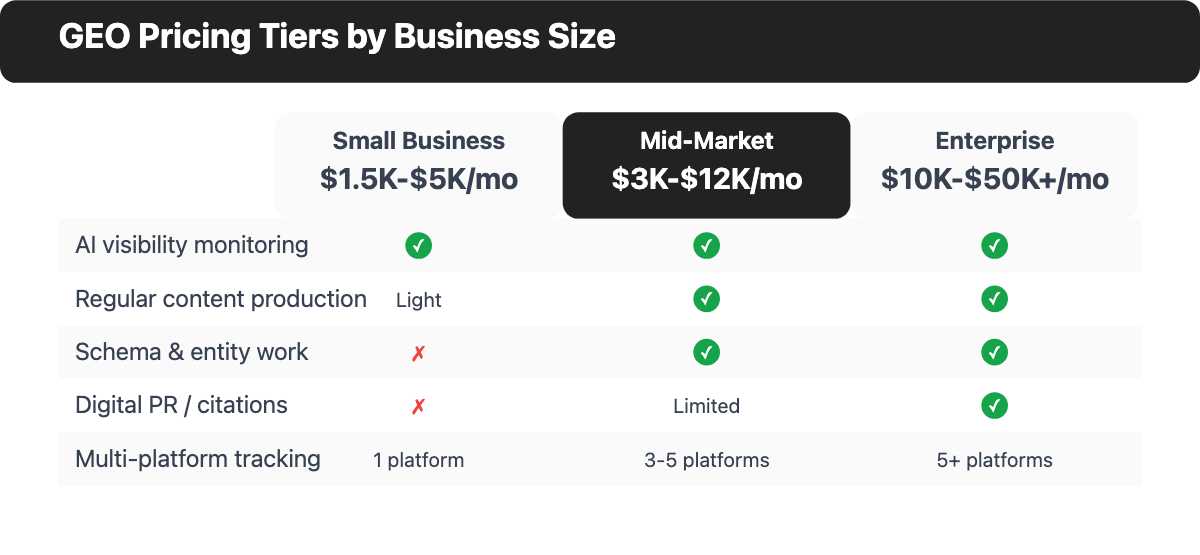
Most GEO retainers fall into one of three bands, and the band you land in usually tracks your company’s size and how competitive your industry is inside AI answers.
| Business size | Typical monthly range | What it usually buys |
|---|---|---|
| Small business / solo brand | $1,500 to $5,000 | Baseline AI visibility monitoring, light content optimization, no dedicated PR budget |
| Mid-market | $3,000 to $12,000 | Regular content production, schema and entity work, citation monitoring across 3 to 5 AI platforms |
| Enterprise | $10,000 to $50,000+ | Full-service program across content, technical, PR, and multi-platform monitoring, often with a dedicated account team |
First Page Sage, one of the few firms that publishes its own GEO pricing rather than gating it behind a contact form, lists three public tiers: $2,000 to $3,000 a month for placements on already-ranking websites, $4,000 to $7,000 a month adding placement monitoring and one or two “best-of” list articles at the start of a campaign, and $8,000 to $12,000 a month for ongoing list-article production plus reputation management and earned media work. It’s not the whole market, but it’s a useful real-world anchor for where the small-business-to-mid-market boundary actually sits.
Mid-market retainers in the $5,000 to $12,000 range commonly include 20 to 50 pages of content production a month, on top of the audit, schema, and monitoring work described below. If a quote in that price band includes noticeably less content than that, it’s worth asking what’s absorbing the rest of the budget instead.
What’s Included at Each Price Point
Regardless of price tier, most GEO retainers are built from the same five categories of work. What changes with price isn’t the categories themselves but their depth and frequency.
- AI visibility audit. A baseline assessment of how often, and how favorably, your brand already shows up in ChatGPT, Perplexity, Google AI Overviews, and similar tools (see our breakdown of how to get cited in AI search for what a strong audit looks for), plus a map of the topics and prompts where you’re currently invisible.
- Content optimization and production. Restructuring existing pages for direct-answer formatting, plus new content built around the questions your buyers are actually prompting AI tools with. This is usually the single biggest line item in a mid-market or enterprise retainer.
- Entity and schema work. Structured data (FAQ, HowTo, Organization, Product schema) and entity-building work such as a stronger Wikipedia or Wikidata presence, aimed at making your brand easier for AI systems to identify and connect to your content.
- Digital PR and citation building. Securing mentions and placements on sites that AI models already treat as trustworthy sources, since unlinked brand mentions on reputable sites have been shown to carry real weight with AI systems, not just backlinks. This overlaps heavily with the citation-building tactics in our answer engine optimization guide.
- Monitoring and reporting. Ongoing tracking of citation share, sentiment, and referral traffic from AI platforms, usually delivered monthly, so you can see whether the spend is moving the needle.
Entry-level packages tend to compress all five into a lighter monthly cadence, while enterprise programs run all five in parallel, often with separate specialists on content, technical schema, and PR.
DIY Tools vs. Freelancers vs. Agencies: Three Ways to Buy GEO
Not every business needs a full agency retainer. There are three realistic ways to buy GEO work, and they suit different budgets and levels of in-house capability.
| Buying path | Typical cost | Best for |
|---|---|---|
| DIY monitoring tools | $10 to $1,000+ per month | Teams that already have content and SEO resources and just need visibility tracking |
| Freelancer or gig work | $50 to $500 per task, or $50 to $300 per hour | One-off audits, schema implementation, or narrow content projects |
| Agency retainer | $1,500 to $50,000+ per month | Businesses that want the strategy, execution, and reporting handled end-to-end |
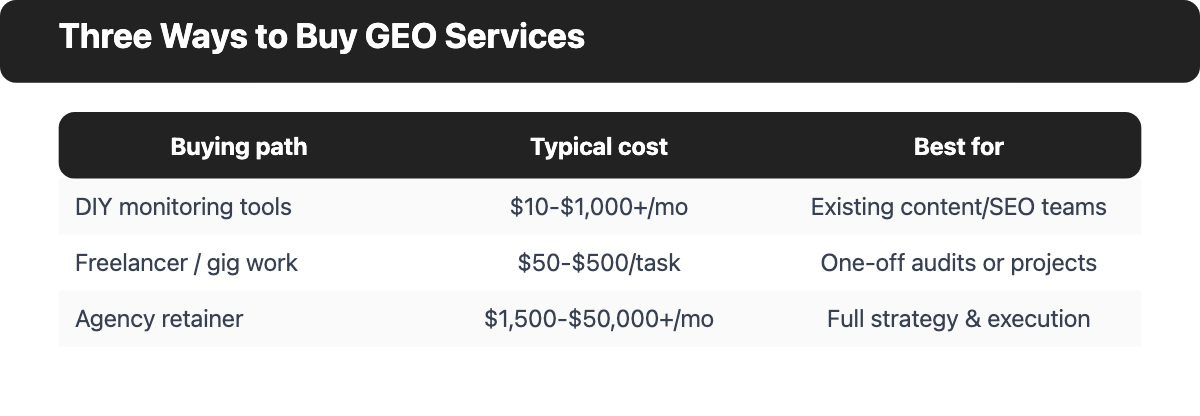
DIY tools alone won’t get content written or citations built. They tell you where you stand, which is valuable if your team can act on the findings, but not if you also need the execution work done for you. Freelance marketplaces list GEO-adjacent gigs (schema setup, single-page optimization, AI-visibility audits) at prices well below any agency retainer, which makes sense given the narrower scope. You’re still responsible for stitching the pieces into a strategy yourself, though. An agency retainer buys that strategy and the coordination between content, technical, and PR work instead, which is what most of the price difference in the tiers above is actually paying for.
What Drives the Price Up or Down
A handful of factors explain most of the spread inside each pricing band:
- How many AI platforms you’re tracking. Monitoring just Google AI Overviews costs less than tracking ChatGPT, Perplexity, Copilot, and Gemini simultaneously.
- Content volume. Retainers built around 20 to 50 new or rewritten pages a month cost more than ones built around a handful of updates.
- Industry competitiveness. A crowded category where competitors are already running GEO programs requires more PR and content volume to move the needle, which pushes cost toward the top of a given tier.
- In-house vs. full-service. If your team already handles content production, you may only need the audit, schema, and monitoring pieces, which trims the retainer meaningfully compared to a full-service package.
- Contract length and minimums. Some agencies require a project floor (an upfront research and strategy fee before the ongoing retainer starts) and a minimum commitment of six to twelve months. That floor and the lock-in period both affect the real first-year cost, not just the advertised monthly number.
Questions to Ask Before You Sign a GEO Contract
Because so few GEO agencies publish pricing, the contract conversation, not the website, is where most of the real scope gets defined. A few questions are worth asking before you sign anything:
- What AI platforms are actually being tracked and optimized for, by name? “AI visibility” is vague enough to mean anything from Google AI Overviews alone to a five-platform program.
- How much content is included per month, and who owns it if you leave? Get the page or word count in writing, not just “regular content production.”
- Is there a minimum contract length or lock-in period? Some GEO and SEO firms require six- to twelve-month commitments, and a separate upfront project fee before the monthly retainer begins. Both change the real cost of a first-year engagement.
- What does the monthly report actually measure? Ask to see a sample report. Citation share, sentiment, and referral traffic from AI platforms are the metrics that matter; a report that only shows activity (posts published, audits run) doesn’t tell you if it’s working.
- Who does the PR and citation-building work, in-house or subcontracted? This affects both quality and how much of the budget is markup versus actual placement cost.
Is GEO Pricing Really a New Line Item, or Existing SEO Spend Repackaged?
For most companies, GEO isn’t a completely separate budget from SEO. The two disciplines lean on the same underlying assets: crawlable, well-structured content that a search engine can index and an AI system can extract an answer from, and much of the technical groundwork overlaps with optimizing content for large language models. A guide from Semrush makes this point directly, describing GEO as something that builds on existing SEO work rather than replacing it, since AI systems largely source their answers from the same web content that ranks in traditional search anyway.
In practice, that means part of what you’re paying a GEO vendor for overlaps with SEO you may already be doing (content production, technical structure, authority building). The genuinely new spend isn’t that overlap, though. It’s usually the AI-specific layer: multi-platform citation monitoring, schema tuned for AI extraction, and PR aimed at the sources AI models cite most. When you’re comparing a GEO quote against your existing SEO retainer, ask a vendor to separate out what’s incremental from what overlaps with work you’re already paying for elsewhere.
How to Know You’re Getting Your Money’s Worth
GEO is harder to measure than traditional SEO because there isn’t one single ranking position to point to. Even so, a retainer that’s worth the money should still show movement on a few concrete signals within 60 to 90 days:
- Citation share: how often your brand appears in AI-generated answers for your target topics, compared to a baseline measured before the engagement started.
- Sentiment: whether the mentions that do appear are neutral, positive, or negative, not just present.
- Referral traffic: actual visits arriving from AI platforms, tracked separately from organic search traffic.
- New citation sources: whether the PR and content work is landing your brand on sites that AI models weren’t citing before.
If a vendor can’t show you at least directional movement on citation share and referral traffic within a full quarter, that’s a fair reason to ask hard questions before renewing, regardless of what tier you’re paying for.
Frequently Asked Questions
Is GEO worth paying for?
For brands in categories where buyers are already using AI tools to research purchases, yes. If your competitors are showing up in ChatGPT or AI Overviews answers and you aren’t, that’s lost visibility at the exact moment someone is deciding what to buy. For very small, hyper-local businesses that don’t face much competitive pressure in AI answers yet, though, a lighter DIY approach may still be enough for now.
How is GEO usually billed?
Most agencies bill it as a monthly retainer, the same way they’d bill an SEO or content marketing engagement. Freelancers and smaller shops sometimes bill hourly or per project instead. Some full-service agencies also charge a one-time project fee upfront to cover initial research and strategy before the ongoing retainer starts.
How long until GEO pricing shows results?
Most agencies and guides point to a 60- to 90-day window before citation share and referral traffic show measurable movement, similar to the ramp-up period for traditional SEO. Enterprise programs with heavier PR components can take longer to show citation gains, since earned media placements take time to land and get indexed.
Can I do GEO without an agency?
Yes, if you already have in-house content and technical SEO resources. DIY monitoring tools in the $10 to $1,000-a-month range will tell you where you stand, and much of the execution work (schema markup, direct-answer content formatting, earned mentions) isn’t a completely new discipline. It’s the same skill set as existing SEO and PR work. What you don’t get without an agency is the coordinated strategy across all five service categories at once.

1 thought on “Generative Engine Optimization Services: What You Actually Pay For”