Tool list
AI SEO Tools for Small Businesses: What Is Worth Paying For

AI SEO tools for small businesses are worth paying for only after the free foundation of Google Search Console, Bing Webmaster Tools and a free SEO plugin is in place. Then add one paid tool for your biggest gap: Mangools or SE Ranking for keywords, Frase or NeuronWriter for content, or Otterly.ai for AI visibility.
As of October 2026
Most small businesses should not pay for an AI SEO tool until the free foundation is in place: Google Search Console, Bing Webmaster Tools and a free SEO plugin. After that, add one paid tool that closes your biggest gap, that's usually keyword and rank tracking, content optimization or tracking how often AI answers mention you. Entry prices start at roughly $23 to $50 per month, and the tools that cost $150 or more per month only make sense when someone has time to act on the output.
Every price below comes from the vendor's own pricing page, checked on 27 October 2026. Prices change often, so confirm the number before you buy; we can't promise they'll hold.
Which AI SEO tools are worth paying for?
Pick by the problem you have today, not by the longest feature list. Honestly, most buying mistakes come from skipping that step. If you can't name the problem, you don't need the tool yet. The table matches each situation to a starting point; don't read it as a ranking.
| Your situation | Start with | Add when |
|---|---|---|
| No SEO tooling yet, a site with a few pages | Google Search Console, Bing Webmaster Tools, a free SEO plugin | You can name a question the free data can't answer |
| You publish one or two posts a month and want to know what to write | An all-in-one suite such as Mangools or SE Ranking | You publish weekly and want help refreshing drafts |
| You publish weekly and want drafts to cover the topic fully | A content optimizer such as Frase or NeuronWriter | You also need rank and backlink data |
| Customers say they found you through ChatGPT or Perplexity | An AI-visibility tracker such as Otterly.ai, or a suite that includes one | You have a baseline and want to see what changes |
| You run a local business with a handful of service pages | Free tools plus your Google Business Profile | Almost never: a paid suite rarely pays back at this size |
If none of these rows fits, start with the free tools in the next section and come back once you've got a specific question.
What should a small business use for free first?
Use Google Search Console, Bing Webmaster Tools, Ahrefs' free plan, the free version of Screaming Frog and a free SEO plugin for your CMS. Together they show what you rank for, which pages Google can crawl and which technical errors exist, and none of them has a time limit.
| Tool | What it covers | Free limit |
|---|---|---|
| Google Search Console | Queries, clicks, indexing and page experience for your own site | Free for verified sites |
| Bing Webmaster Tools | The same for Bing | Free for verified sites |
| Ahrefs free plan (formerly Ahrefs Webmaster Tools) | Site audit and a limited view of your backlinks and keywords | Unlimited verified sites, 5,000 crawl credits per project per month, 1,000 backlinks and 1,000 keywords shown in Site Explorer |
| Screaming Frog SEO Spider | A desktop crawler that finds broken links, redirects and missing titles | 500 URLs per crawl in the free version; the paid licence costs £199 per year |
| Rank Math or Yoast SEO | Titles, descriptions, schema and sitemaps inside WordPress | Free plugin versions; Rank Math Pro is €7.99 per month billed yearly |
Search Console is the one that matters most, because it's the only source of the real queries people used to find you. The limit of the free set's depth is simple: Screaming Frog stops at 500 URLs per crawl and Ahrefs' free plan caps crawl credits, so a larger site or a keyword-discovery job is where a paid tool starts to earn its place.
What do AI SEO tools actually do for a small business?
AI SEO tools do four jobs for a small business: they find keywords, they score and draft content, they track whether AI assistants mention your brand, and they audit technical problems. Only some of those jobs use AI for the core work, and the label is applied more freely than the technology.
- Keyword and topic research. The tool suggests searches worth targeting and shows how hard they are. This was automated long before the AI label; the newer part is clustering and prompt ideas. Examples: Mangools, Ubersuggest, SE Ranking.
- Content optimization and drafting. The tool compares your draft with the pages that rank and suggests missing subtopics, or writes a first draft. That's where generative AI does real work. Examples: Frase, NeuronWriter, Surfer.
- AI-visibility tracking. The tool runs a list of prompts through ChatGPT, Perplexity and similar assistants and records whether your brand is cited. It's the newest category and the most useful one if your customers ask assistants for recommendations. Examples: Otterly.ai, the AI add-ons in SE Ranking and Mangools. Our comparison of AI visibility tools goes deeper.
- Technical auditing. A crawler lists broken links, slow pages and missing metadata. AI is mostly used to explain the findings. The free tools above already do this well, so don't pay for it twice.
Before you buy, check what the tool saves. If it hands you a to-do list you could write yourself, the AI label adds little. If it saves hours of reading competitor pages, it can be worth it, with one catch: it only suggests, and you still write, fix and publish.
SEO Title Generator: eight title tag variations, sized for the SERP and intent-matched. Free, no signup.
How much do AI SEO tools cost?
Paid AI SEO tools for small businesses start at about $23 per month for a content optimizer and about €38 per month for an all-in-one suite, while standalone AI-visibility tracking starts at €29 per month for 15 prompts. The table lists the tools in order of what a small business is likely to buy. Prices are as shown on each vendor's page on 27 October 2026, in the currency the page displayed.
| Tool | Job | Price | Key limit | Worth it when |
|---|---|---|---|---|
| Mangools Basic | Keywords, rank tracking, AI visibility | €37.70 per month billed annually (€61 on monthly billing) | 200 tracked keywords, 500 AI prompts monitored, no extra seats | You want one tool for topics and AI visibility |
| Ubersuggest | Keywords, site audit, AI writing | From $29 per month; lifetime Individual plan €290 | Individual plan: 1 project, 125 tracked keywords | You prefer a one-time payment and have a single site |
| SE Ranking Core | Keywords, rank tracking, audits | €109 per month, €87.20 billed annually | 10 projects, 1 seat, 2,000 tracked keywords | You manage several sites or client sites |
| Frase Starter | Content briefs and drafts | $49 per month, $39 billed annually | 10 articles per month, 1 site | You publish weekly and want faster briefs |
| NeuronWriter Bronze | Content optimization | $23 per month | Entry tier: 2 projects, 25 content analyses | You want the cheapest content score |
| Surfer Discovery | Content optimization | €49 per month billed yearly | Entry tier of four plans | You already know Surfer's editor |
| Otterly.ai Lite | AI-visibility tracking | €29 per month, 15% less billed annually | 15 prompts | You only need to track a few brand prompts |
| SEO.ai Single Site | Automated content | $149 per month | One site | Rarely, see the section on waste below |
Compare prices within a currency, not across, and treat the last column as our judgment, not the vendor's claim.
All-in-one suites
Suites combine keyword research, rank tracking and some AI features in one subscription. Mangools is the cheapest entry in the table that includes AI-visibility tracking: its Basic plan lists 500 prompts monitored, and it comes with a 48-hour money-back guarantee. Ubersuggest is unusual because it sells a lifetime plan, €290 for the Individual tier on its pricing page, which can beat a subscription if you'll still use it in two years. SE Ranking Core costs more but includes 10 projects and offers a 14-day free trial without a card, which suits freelancers and small agencies.
Semrush and Ahrefs are the large suites. Semrush's entry SEO plan was €134 per month on its EUR page, and Ahrefs' paid plans start at the Starter tier at $29 per month. They're strong, but they're built for teams that live in the tool every day. If you'd like the details, read our breakdowns of Semrush pricing and Ahrefs pricing.

Content optimization tools
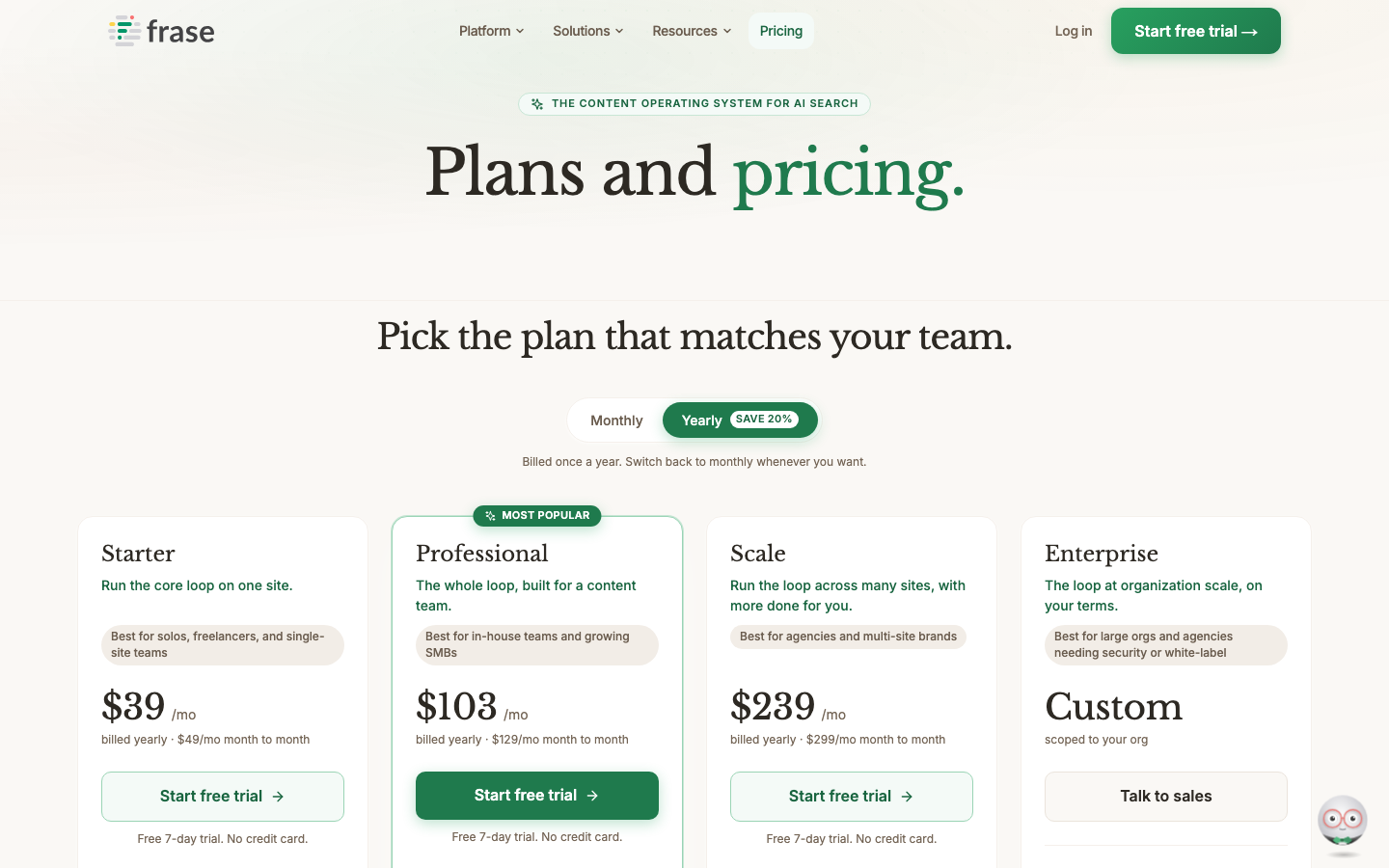
Content tools help you cover a topic as thoroughly as the pages that rank. Frase starts at $49 per month ($39 billed annually) for 10 articles per month and offers a 7-day free trial without a card. NeuronWriter's Bronze plan is $23 per month, the lowest price in this group. Surfer's Discovery plan is €49 per month billed yearly; our Surfer SEO pricing guide explains how its tiers scale. If you want to see what a brief-and-draft tool is like in practice, we wrote a Frase review.
AI-visibility trackers
If you're mentioned in AI answers, a tracker shows how often and for which prompts. Otterly.ai Lite is €29 per month (15% less billed annually) for 15 prompts, that's enough to track one brand name, a few product searches and a couple of competitor comparisons. Mangools and SE Ranking include similar tracking inside their suites, so you may not need a separate tool at all. You can also do it by hand, and it's free: list the prompts a customer might ask, run each one in ChatGPT, Perplexity and Google's AI features once a month, and record whether your brand is named. Peec AI is another name that appears often, but its vendor page showed no prices when we checked, so we've left it out of the table.

What budget fits which stage of a small business?
At $0 use the free foundation, at about €40 per month add one suite, and only above roughly $100 per month combine a suite with a content tool. The tiers below are sums of the listed prices, with annual billing where the vendor offers it.
| Stage | Stack | Approximate monthly cost |
|---|---|---|
| Starting out | Search Console, Bing Webmaster Tools, Ahrefs free plan, Screaming Frog free, free SEO plugin | $0 |
| Publishing regularly | Starting-out stack plus Mangools Basic | €37.70 |
| Publishing weekly | Mangools Basic plus Frase Starter | €37.70 plus $39, about 75 to 80 |
| Competing in AI answers | Mangools Basic plus Frase Starter plus Otterly.ai Lite | About 100 if you need a separate tracker; skip Otterly.ai if Mangools' built-in tracking is enough |
The sums mix euros and dollars because the vendors do, so we'd treat the totals as approximate. The practical rule: don't add a tool until the last one has paid its way. Add one at a time and wait for it to change something before you add the next.

When is a paid AI SEO tool a waste of money?
A paid tool is a waste when nobody has time to act on its output, when the site has too few pages to optimize, or when it promises to publish for you. Do you need SEO software for a small website? Not at first: if Search Console already answers your questions and you have the hours to act on them, wait. Buy once you can name a question the free data can't answer. The real cost is rarely the subscription alone; it's the hours of reading reports that lead nowhere.
- No capacity to act. A suite that finds 40 fixes is worthless if you don't fix any. Buy the tool after you've found the hours, not before.
- A very small site. With a handful of pages, Search Console shows you everything a paid tool would, and a local business is usually better served by a complete Google Business Profile (GBP) and local SEO basics.
- Auto-publishing tools. Some tools write and deploy pages on their own. SEO.ai starts at $149 per month for one site, and Alli AI's Business plan is $299 per month ($249 billed annually) for 5 sites. Google's spam policy on scaled content abuse applies no matter how content is created, and it names using generative AI to mass-produce pages that add nothing for users as an example. Mass output is the risk, so we'd keep a person approving what goes live. Our guide to AI SEO agents explains where to draw the line.
- Tools that promise rankings. No tool controls your rankings, and of course no vendor can guarantee them. Don't trust any claim of guaranteed results; treat it as a reason to look elsewhere.
How do you test an AI SEO tool before you commit?
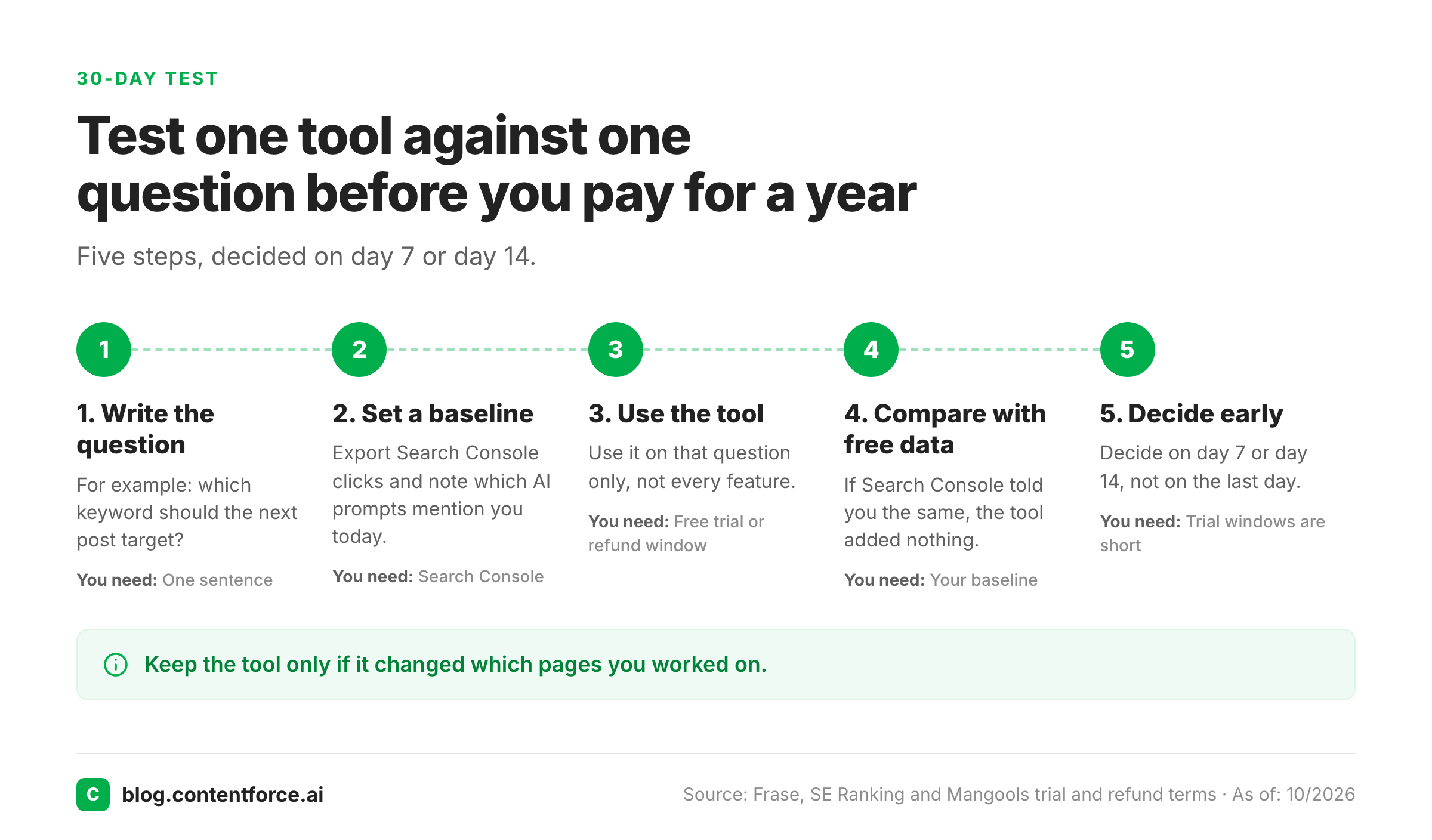
Test one tool for 30 days against one question you already have, such as "which five pages should I refresh?", and keep it only if it changed a decision. Free trials make that cheap: Frase offers 7 days without a card, SE Ranking offers 14 days without a card, and Mangools refunds within 48 hours.
- Write the question first. For example: which keyword should the next post target, or which of my pages is losing clicks.
- Set up your baseline. Export your current Search Console clicks and note which AI prompts mention you today.
- Use the tool on that question only. Don't explore every feature; that's how trials run out, and you won't learn anything.
- Compare the answer with free data. If Search Console already told you the same thing, the tool added nothing.
- Decide on day 7 or day 14, not on the last day. Trial windows are short, and a refund window can close within two days, so don't wait for the last day.
If the tool clearly changed which pages you worked on, keep it. If you only enjoyed the dashboard, cancel. That's the whole test.
FAQ about AI SEO tools for small businesses
What is the AI version of SEO called?
It's usually called generative engine optimization (GEO), answer engine optimization (AEO) or AI search optimization, and it covers getting cited in AI answers.
What is an AI marketing tool?
An AI marketing tool is software that uses a language model for one marketing job, such as Frase for briefs, NeuronWriter for content scores or Otterly.ai for brand mentions in AI answers, and it only works on the data and prompts you give it, so you still review the output.
Are there free AI SEO tools?
Yes: Google Search Console, Bing Webmaster Tools, Ahrefs' free plan and the free Screaming Frog crawler cover the foundation, though each has a cap such as Screaming Frog's 500 URLs per crawl, and several paid tools offer free trials.
Can ChatGPT replace an SEO tool?
A chatbot can brainstorm topics and rewrite text, but it can't give you your own search data, rankings or competitor links unless it's connected to a tool that does.
Does Google penalize AI content?
Google's spam policy targets scaled content abuse, meaning many pages made mainly to manipulate rankings, and it applies no matter how the content is created.
What is the best AI search engine for business?
There's no single best one, because it depends on where your customers ask: ChatGPT, Perplexity and Google's AI features are the main ones. Check your analytics for which of them already sends visitors and track your brand in that one first; if none does, classic search still matters more.
How long until AI SEO tools show results?
Tools don't produce results by themselves, and they won't rank a page you haven't improved. Google's SEO Starter Guide says some changes take effect in a few hours and others several months, and suggests waiting a few weeks before judging whether your work helped, so judge a tool by the changes you made with it, not by its first week.