
Guide
Digital Marketing Tips That Work: A Practical Guide From Practitioners

The digital marketing tips that pay off fastest are to tie every campaign to one customer action, track revenue per channel, answer the main question in the first two sentences and follow up with every lead. The ContentForce guide groups the tips by job and adds tips from six practitioners.
- Define one customer action per campaign and mark it as a key event
- Track won revenue by channel in a CRM or a spreadsheet
- Write and schedule a follow-up sequence for every new enquiry
- Rewrite the opening of your ten most important pages
- Make your Google Business Profile and website say the same thing
- Add bylines and author pages, then compare channels by revenue
The digital marketing tips that pay off fastest are to tie every campaign to one customer action, track how much revenue each channel brings in, write pages that answer the main question in the first two sentences, show who's behind your content, keep your business details identical everywhere and follow up with every lead. None of them needs a bigger budget, but each one needs a decision. This guide groups the tips by job, ties each one to what Google says in its own documentation where it applies, and adds first-hand tips from six practitioners.
Which digital marketing tips matter most?
Small teams don't usually fail because they picked the wrong channel. They fail because they can't tell which channel worked, so they'll keep spreading money thin. The table below is our own assessment of effort and impact for a small business that already has a website and some traffic.
| Tip | Effort | Impact | Where it is covered |
|---|---|---|---|
| Define one customer action per campaign | Low | High | Measurement tips |
| Track revenue per marketing channel | Low | High | Measurement tips |
| Speak to a narrow, well-fitting audience | Low | High | Audience and message tips |
| Answer the main question in the first two sentences | Low | Medium | Audience and message tips |
| Add bylines and real author pages | Medium | Medium | Trust tips |
| Make your Business Profile and website agree | Low | High for local businesses | Local tips |
| Plan the follow-up before buying more leads | Low | High | Follow-up tips |
Look at the effort column. Almost every row is low effort, although the impact isn't, because these tips are mostly decisions, not projects. That's the point: decide first, then spend.
Measurement tips: Decide what counts before you spend
Traffic, likes and impressions are easy to grow, yet they're also easy to misread. Two of our contributors, Krisbo Liu and Robin Agricola, start from the same place: know which action and which channel actually produce revenue, and only then decide where the next dollar goes.
Define one customer action per campaign
Pick the action that shows real use or real intent, not just a visit. That's harder than it sounds. For a software product, that's an activation step, like a connected domain or a first project. For a service business, it's a booked call or a quote request. For a shop, it's a purchase. In Google Analytics 4 you can mark the matching event as a key event; Google allows up to 30 key events on a standard property, which is far more than a small team needs. Read that number next to traffic and revenue, the way Krisbo Liu describes below, and you'll quickly see which source sends people who actually use what you sell.
Track revenue per channel, even in a spreadsheet
Robin Agricola's advice is blunt: you need to know how much revenue each channel generates, and a simple spreadsheet beats having nothing. Add a "how did you hear about us" field to every enquiry, store the answer with the deal, and total won revenue by source each month. When you've outgrown the sheet, a CRM does the same job with less typing; our comparison of AI CRM tools covers the options and which ones have free plans.
Headline Generator: 10 headlines across 4U, AIDA, PAS and curiosity frameworks. Free, no signup.
Audience and message tips: Say one clear thing to the right people
Broad messages attract broad audiences, and broad audiences fill a pipeline with people who won't buy. A narrow message does the filtering for you, before a salesperson spends time on the wrong lead.
Speak to a narrow audience directly
Write down who your best three customers are, what they do and what problem made them buy. Then rewrite your home page headline, your main ad and your email signup so they speak to that person's role and situation. You'll get fewer clicks from some campaigns. That's fine, and frankly it's the goal, because the clicks you keep are the ones that turn into sales.
Answer the main question in the first two sentences
Nick Magiera's tip is about service pages: open with a sentence an AI assistant could quote as a complete answer. That's good practice for classic search too, because the same sentence works as a snippet. Google says there are no additional requirements to appear in AI Overviews or AI Mode, and that a page must be indexed and eligible to show with a snippet. So the work clearly isn't special AI optimization; it's clear writing at the top of the page. Our guide to answer engine optimization shows how to structure the rest of the page.
| Weak opening | Stronger opening |
|---|---|
| Welcome to our website. We are passionate about helping you. | We fix leaking flat roofs in Leeds within 48 hours, and quotes are free. |
| Our team has years of experience in marketing. | We run Google Ads for dental practices, and most clients start with a budget of a few hundred pounds a month. |
| Discover our innovative solutions. | Our tool sends a reminder to every lead that hasn't replied after three days. |
The examples in the right column are made up for illustration. Each one names the service, the audience and one concrete detail, and that's what makes a sentence quotable.
Trust tips: Show who is behind your content
Lorenzo Mariani recommends detailed author pages, and Google's own guidance points the same way. Its helpful content documentation asks whether it's self-evident who authored a page, whether pages carry a byline where readers would expect one, and whether the byline leads to background about the author. Google says it strongly encourages accurate authorship information and warns against deceptive authorship.
- Add a byline to every article and link it to an author page.
- On the author page, list the person's role, relevant experience, any certifications and a LinkedIn link.
- Say what the author has actually done in the topic, such as campaigns run, clients served or years in the job.
- Keep the page current when people change roles or leave.
Author pages help readers first, but they're not only for readers. A visitor deciding whether to trust advice on a costly decision will check who wrote it, and a real name with a real background answers that in seconds. They also fit into a wider plan; our guide to content marketing strategies covers how authors, topics and distribution work together.
Local tips: Make your Business Profile and website agree
Nathan Constance sees the same mistake again and again: one service area on Google, another on the website, a third on directories. Google's local ranking guide says businesses with complete and accurate information are more likely to show in local results, and that local results are mainly based on relevance, distance and prominence. Its Business Profile guidelines ask for an accurate and precise address or service area, and a business name that matches how you're known on your storefront, website and stationery.
- Write down the towns you really serve and the services you really offer.
- Update your Google Business Profile to match, including the service area and categories.
- Give each core service its own page on your website, and mention the same towns.
- Fix your name, address and services on the directories that rank for your business name.
Google also says there's no way to request or pay for a better local ranking. However, complete, consistent details and genuine reviews are fully in your hands.
Follow-up tips: Keep the leads you already paid for
Karen King's tip is the one most small businesses skip: they don't have a lead problem, they have a follow-up problem. Every enquiry already cost you money in ads, content or time, whether or not it turns into a sale. Losing it to a slow reply is the most expensive waste in marketing, and it's also the cheapest to fix.
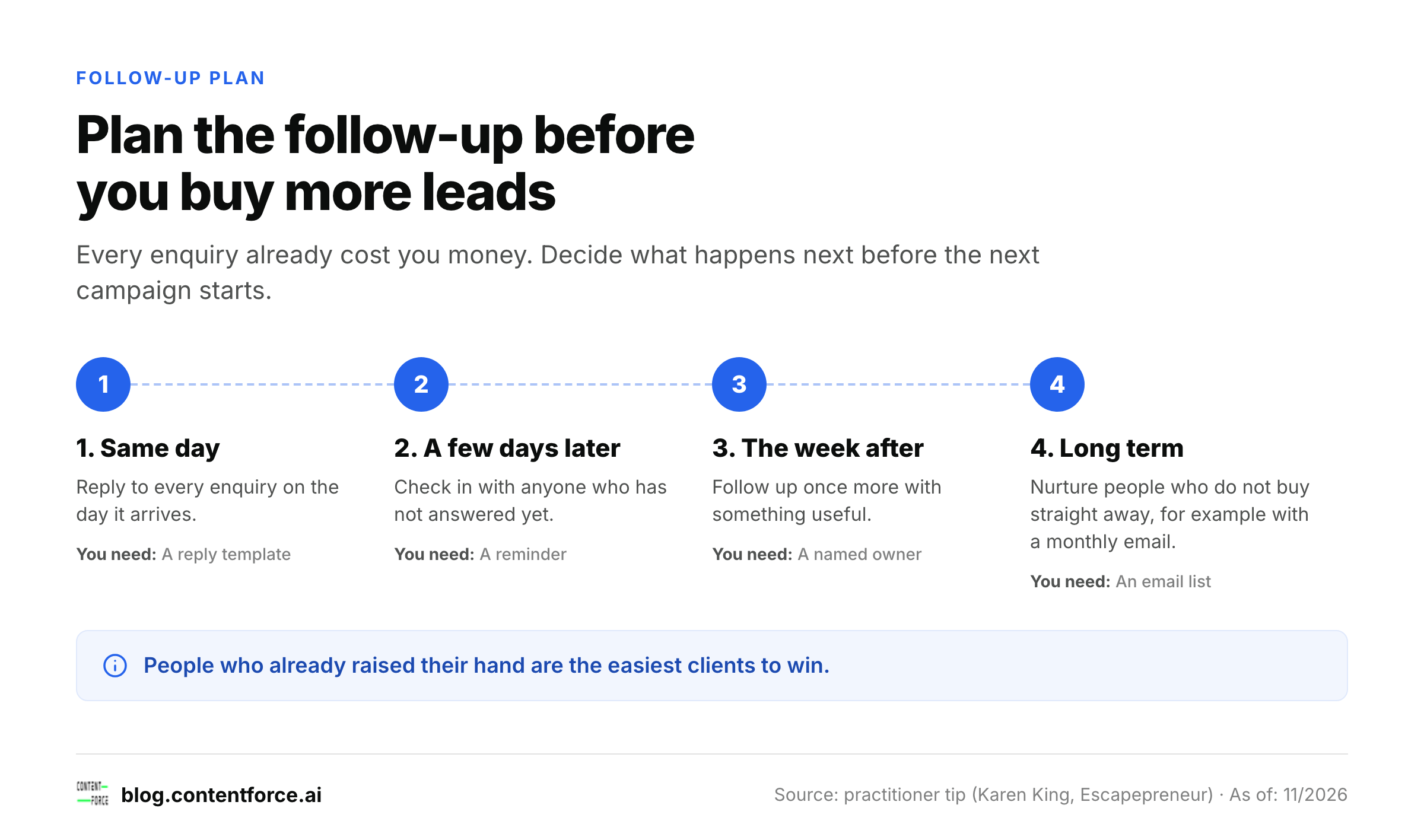
Write each message once as a template, put a reminder in your calendar or CRM, and decide who sends it. For people who don't buy straight away, a monthly email with something useful keeps you in mind until they're ready.
Expert tips: digital marketing tips from 6 practitioners
We asked practitioners for the single tip they'd give a small team that can't afford to waste budget. These six are quoted from their submissions and only lightly edited for clarity. Figures inside a tip are the contributor's own statements, not numbers we have verified. After each tip, we add a short note on why it works and how to start.
Define the customer action each campaign should produce (Krisbo Liu, Founder at RedirHub)
Before creating more content or buying more traffic, define the customer action each campaign should produce. At RedirHub, our focus on agencies gives us a sharper question than "Did traffic grow?": "Did the right people connect a domain and put a redirect live?" Pick an activation milestone that reflects actual product use, then read it next to acquisition and revenue data to decide what deserves more investment. Over the last two months, visitors from AI assistants connected a domain at roughly three times the rate of organic-search sign-ups, even though search brought far more sign-ups overall.
Krisbo Liu, Founder at RedirHub.
Our take: The example shows why sign-ups alone mislead: the bigger channel wasn't the better one. Choose one activation step that only a real user would take, then compare channels on that step, not on visits. It's worth repeating every quarter, because channel quality shifts.
Know your audience and adopt a CRM (Robin Agricola, CEO & Founder at Birdhouse Marketing & Design)
Know your target audience, and speak to them directly; it's better for your message to resonate with 100 highly-qualified prospects than 100,000 poor-fit prospects who are going to gum up your pipeline and waste your sales team's time.
Adopt a CRM. You need to know exactly how much revenue each of your marketing channels is generating. This data will drive better decision-making about where to allocate your marketing dollars, while helping you grow your business more predictably. It doesn't have to be complicated or expensive; a simple spreadsheet is better than nothing, and many of the top CRMs have free pricing tiers to get you started.
Robin Agricola, CEO & Founder at Birdhouse Marketing & Design.
Our take: The two halves belong together, even though they sound unrelated. A narrow audience makes your message sharper, and revenue per channel tells you whether that sharper message reached the right people. Start the spreadsheet this week with three columns: lead, source and won revenue.
Write the first two sentences as if an AI will quote them (Nick Magiera, Founder at LoanSites)
Write the opening two sentences of every service page as if ChatGPT will quote them, because more and more it will. AI answer engines pull short, direct answers, so a page that opens with "FHA loans require as little as 3.5% down, and here's who qualifies" gets cited, while one that opens with "Welcome to our website" gets skipped. The fix is cheap: rewrite the opening of your ten most important pages so each one answers its main question in one plain sentence.
Nick Magiera, Founder at LoanSites.
Our take: This is one of the cheapest fixes on the list. List your ten most visited service pages, write the question each one answers at the top of a document, and answer it in one sentence that names the service, the audience and one concrete detail. Then make that sentence the page's opening line.
Invest in detailed author pages (Lorenzo Mariani, SEO Specialist at Mediaboom)
One SEO tip I always recommend is to invest in detailed author pages for your blog posts. Include the author's professional background, relevant experience, certifications, and a link to their LinkedIn profile. Make it easy for readers to understand who is behind each blog post and why that person is qualified to write about the topic.
Lorenzo Mariani, SEO Specialist at Mediaboom.
Our take: Author pages are a small, one-time job, yet every future article benefits from them. Begin with the two or three people who write most of your content, and make sure each byline actually links to their page; an author page nobody can reach doesn't help anyone.
Make your Google Business Profile and website say the same thing (Nathan Constance, Founder and Web Developer at NC Digital)
My tip: before spending a penny on ads, make sure your Google Business Profile and your website say exactly the same thing about where you work and what you do. I see small businesses list one service area on Google, another on their site and a third on directories, and Google ends up unsure who to show them to. Pick the towns you really serve, give each core service its own page, and keep your name, address and services identical everywhere.
Nathan Constance, Founder and Web Developer at NC Digital.
Our take: For a local business, this is often worth more than any campaign, because it fixes the base every campaign lands on. Search your business name, open the first five directory results and compare them line by line with your Business Profile.
Fix your follow-up before buying more leads (Karen King, Founder at Escapepreneur® & ESC Hub)
Most small businesses don't have a lead problem. They have a follow-up problem. Before you spend another dollar on ads or content, decide exactly what happens after someone enquires: a reply the same day, a check-in a few days later, and another the week after. And how will you look after them if they don't buy straight away? People who already raised their hand are the easiest clients you'll ever get, and most businesses let them go cold. Nurturing them in the long term can bring in customers that you would have otherwise lost.
Karen King, Founder at Escapepreneur® & ESC Hub.
Our take: Count how many enquiries from last month got a reply the same day; it's often fewer than you'd guess. If it's fewer than all of them, fix that before the next campaign. A written sequence with three dates and a named owner is enough to start.
Measure and prioritize: Which digital marketing tips to do first
Start with measurement, because every later decision depends on it. Then work through the order below; it takes a small team a few weeks, not a few months.

- Define one customer action per campaign and set it up as a key event in your analytics.
- Start tracking revenue by channel in a CRM or a spreadsheet.
- Write and schedule your follow-up sequence for every new enquiry.
- Rewrite the opening of your ten most important pages, and make your Business Profile match your website.
- Add bylines and author pages, wait a few weeks, then compare channels by revenue and shift budget to the best one.
Once the basics are in place, tools can take over some of the repetitive work. Our overview of AI marketing tools compares options for content, ads, email and analytics, and our SEO tips cover the search side in more depth.
Do these digital marketing tips still work with AI search?
Yes. Google says there are no additional requirements to appear in AI Overviews or AI Mode, so clear pages, accurate business details and visible authors serve both classic search and AI answers. The measurement tips matter even more as AI assistants send traffic of their own. Krisbo Liu's numbers above show that a smaller channel can still send the more valuable visitors, and you'll only see that if you track the right action.
FAQ
What is the most important digital marketing tip for a small business?
Measure revenue by channel before you spend more. Without it, you can't tell which campaign worked, so every other tip becomes guesswork. A spreadsheet with lead, source and won revenue is enough to start.
How can I do digital marketing on a small budget?
Fix what you already have before you buy more traffic: reply to every enquiry the same day, make your Business Profile and website agree, and rewrite the opening of your most important pages. Most of these tips cost time, not money.
Do I need a CRM for digital marketing?
Not on day one, and that's fine. A simple spreadsheet that records each lead's source and value does the core job. Move to a CRM when you have more leads than you can track by hand; many CRMs offer free plans to start.
How do I get my business cited by AI assistants?
Make every important page answer its main question in the first one or two sentences, keep your business details consistent, and show who wrote your content. Google says AI Overviews have no extra requirements beyond being indexed and eligible for a snippet.
How long until digital marketing changes show results?
Follow-up and messaging fixes can show results within weeks, because they act on leads you already have. Search and local changes usually take longer. Compare the same numbers after a few weeks before you change anything else.
Sources: Google Analytics: Mark events as key events, Creating helpful, reliable, people-first content, AI features and your website, Tips to improve your local ranking on Google, Guidelines for representing your business on Google. Checked 13 November 2026.