Review
Writesonic Review: AI Search Tracking, Article Writer and What It Costs

Writesonic is an AI search visibility platform that tracks how ChatGPT, Gemini and Google AI Overviews mention a brand, with an article writer and site audits added. Plans cost $79, $199 and $399 per month on yearly billing, or $99, $249 and $499 billed monthly. Marketing teams wanting tracking and articles in one subscription fit best.
- Plan limits for prompts, answers, articles, audits and seats are published for every self-serve tier
- Tracking and article production sit in one product, so a found gap can become a draft
- A free trial without a credit card and a seven-day refund make testing cheap
- Self-serve plans track three AI platforms, while Enterprise covers nine including Perplexity and Claude
- The Action Center is Enterprise only, with a small trial on Growth
- Starter tracks only 50 prompts, and agentic workflows are trial runs on every self-serve plan
- Good fit for
- Marketing teams that want AI visibility tracking and article production in one subscription and publish articles every month
- Not a fit for
- Solo writers who want a cheap writing assistant, since the old low-price writing plans are gone
- Starter plan
- $79 per month yearly, $99 monthly, 15 articles
- Basic plan
- $199 per month yearly, $249 monthly, 25 articles
- Growth plan
- $399 per month yearly, $499 monthly, 50 articles
As of November 2026
Writesonic isn't mainly an AI writing tool. In 2026 it sells an AI search visibility platform that tracks how ChatGPT, Gemini and Google AI Overviews mention your brand, then adds an article writer and site audits to act on the gaps. Plans cost $79, $199 and $399 per month on yearly billing, or $99, $249 and $499 billed monthly, and Enterprise is quoted on request. Every figure here comes from Writesonic's own pages, checked on 8 November 2026.
- Best fit: marketing teams that want AI visibility tracking and article production in one subscription, from $199 per month upward.
- Weak spot: self-serve plans track only three AI platforms, and the Action Center is an Enterprise feature with a small trial on Growth.
- Not a fit: someone who just wants a cheap writing assistant. The old low-price writing plans are gone.
What is Writesonic in 2026?
Writesonic is a San Francisco software company that began as a GPT-3 writing tool and now positions itself as an "AI Search Growth Engine". Its homepage headline is about what AI says about your brand, not about generating copy. The About page tells the story of Samanyou Garg, an engineer who built one of the first generative AI products when GPT-3 launched, and says the company has 50+ engineers and researchers.
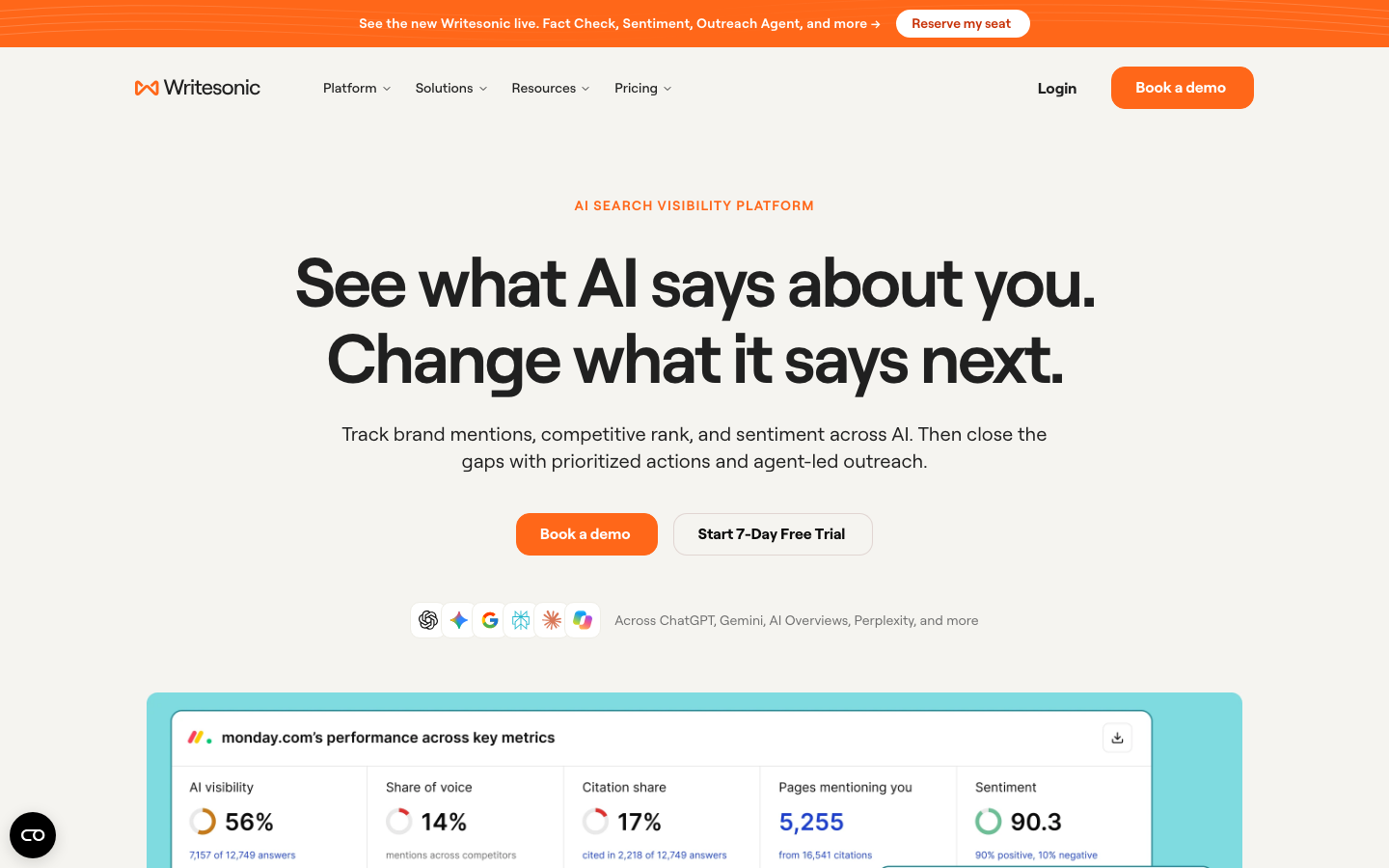
The product now runs as a loop: track where your brand appears in AI answers, prioritize fixes, act on them with content and outreach agents, then measure the change. If you knew Writesonic from the template-and-word-credit era, it's a different purchase today. Our Writesonic pricing guide covers the plan history in detail.
What does Writesonic actually do?
Writesonic bundles five things, but the plan you pick decides how much of each you get.
- AI visibility tracking: daily runs of your chosen prompts across AI platforms, with visibility, citations and share of voice against named competitors. Writesonic says it crawls the web interface of each assistant instead of calling an API, so the answers match what a buyer sees. That's a vendor claim we couldn't test.
- Action Center: a ranked list of fixes such as missing prompts, citation gaps, content refreshes and technical issues.
- AI Article Writer: a pipeline Writesonic describes as 100+ steps across ten phases, with research, outline, multi-step writing, expert review and a humanizer pass.
- AI Content Agent: one agent for LinkedIn posts, sales emails, ads, newsletters and other formats in a saved brand voice.
- Site audits: crawls that flag technical problems, limited by page count per plan.
Two free tools are also available: an llms.txt generator and an AI crawl checker. You don't need a subscription for either.
Paragraph Generator: concrete sentences and specific verbs in plain English. Free, no signup.
How much does Writesonic cost?
Writesonic has three self-serve plans, Starter, Basic and Growth, plus a custom Enterprise tier. Annual billing takes 20 percent off and means paying for twelve months upfront. The monthly prices below are the yearly price plus the saving Writesonic states per plan.
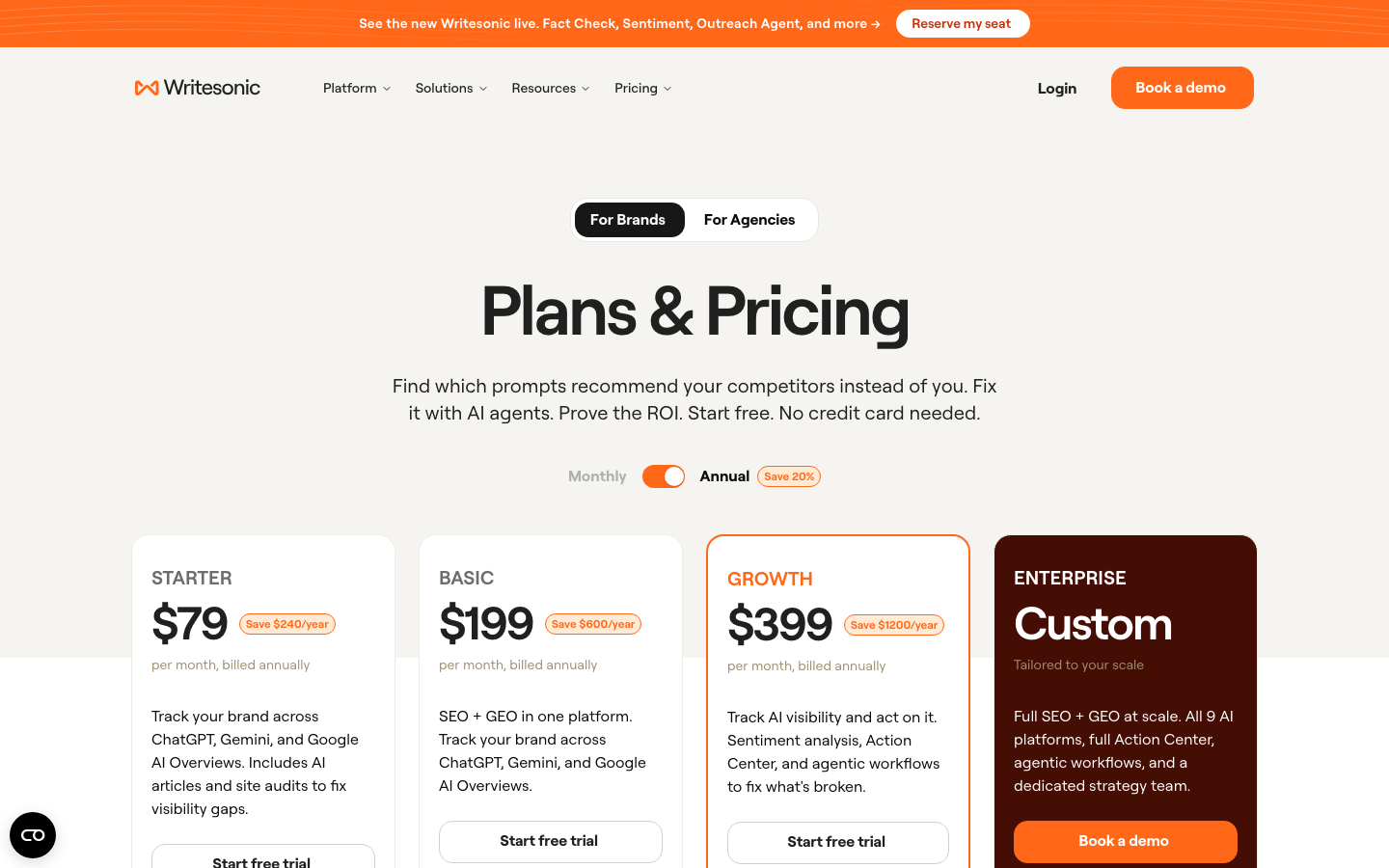
| Plan | Yearly billing | Monthly billing | Yearly saving | Users and projects |
|---|---|---|---|---|
| Starter | $79 per month | $99 per month | $240 | 1 user, 1 project |
| Basic | $199 per month | $249 per month | $600 | 2 users, 1 project |
| Growth | $399 per month | $499 per month | $1,200 | 3 users, 2 projects |
| Enterprise | Custom | Custom | Quoted on request | Custom |
Writesonic's pricing page, checked on 8 November 2026. Prices are in US dollars. The monthly column is our arithmetic from the stated yearly savings.
You can start a free trial without a credit card. Upgrades apply immediately, and downgrades and cancellations take effect at the next billing cycle, and Writesonic promises a no-questions-asked refund within seven days.
What do the plan limits mean in practice?
The limits are clearly the real price. Each tier caps the number of tracked prompts, tracked answers, articles, audits and seats, so the table below matters more than the headline price.
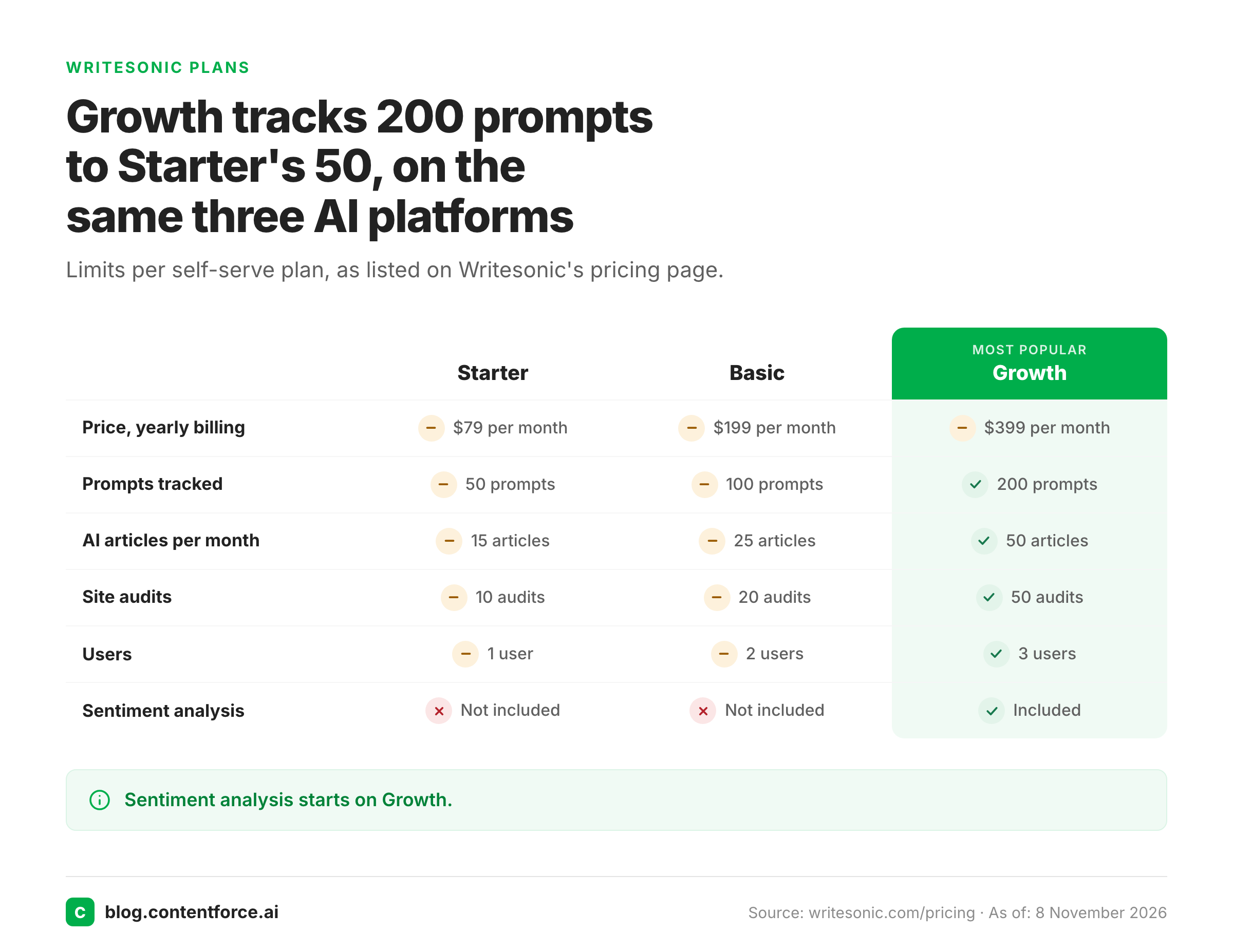
| Limit | Starter | Basic | Growth |
|---|---|---|---|
| Prompts tracked | 50 | 100 | 200 |
| Answers tracked daily | 50 | 300 | 600 |
| AI articles per month | 15 | 25 | 50 |
| Site audits | 10 (100 pages each) | 20 (1,200 pages each) | 50 (2,500 pages each) |
| Agentic workflow runs | 10 trial runs | 50 trial runs | 100 trial runs |
| Sentiment analysis | No | No | Yes |
| Action Center | No | No | Trial: 5 off-page and 5 on-page actions a month |
| Support | Standard email | Standard email | Priority email |
Writesonic's pricing page, checked on 8 November 2026.
Two details are really easy to miss. First, "agentic workflows" are listed as limited trial runs on every self-serve plan, so the automation that the homepage leads with isn't unlimited anywhere below Enterprise. Second, the ratio of answers to prompts is one to one on Starter and three to one on Basic and Growth. Writesonic doesn't explain it, but it really reads as one platform per prompt on Starter and all three on the higher tiers. Treat that as our reading, not a published rule.
What do add-ons and extra seats cost?
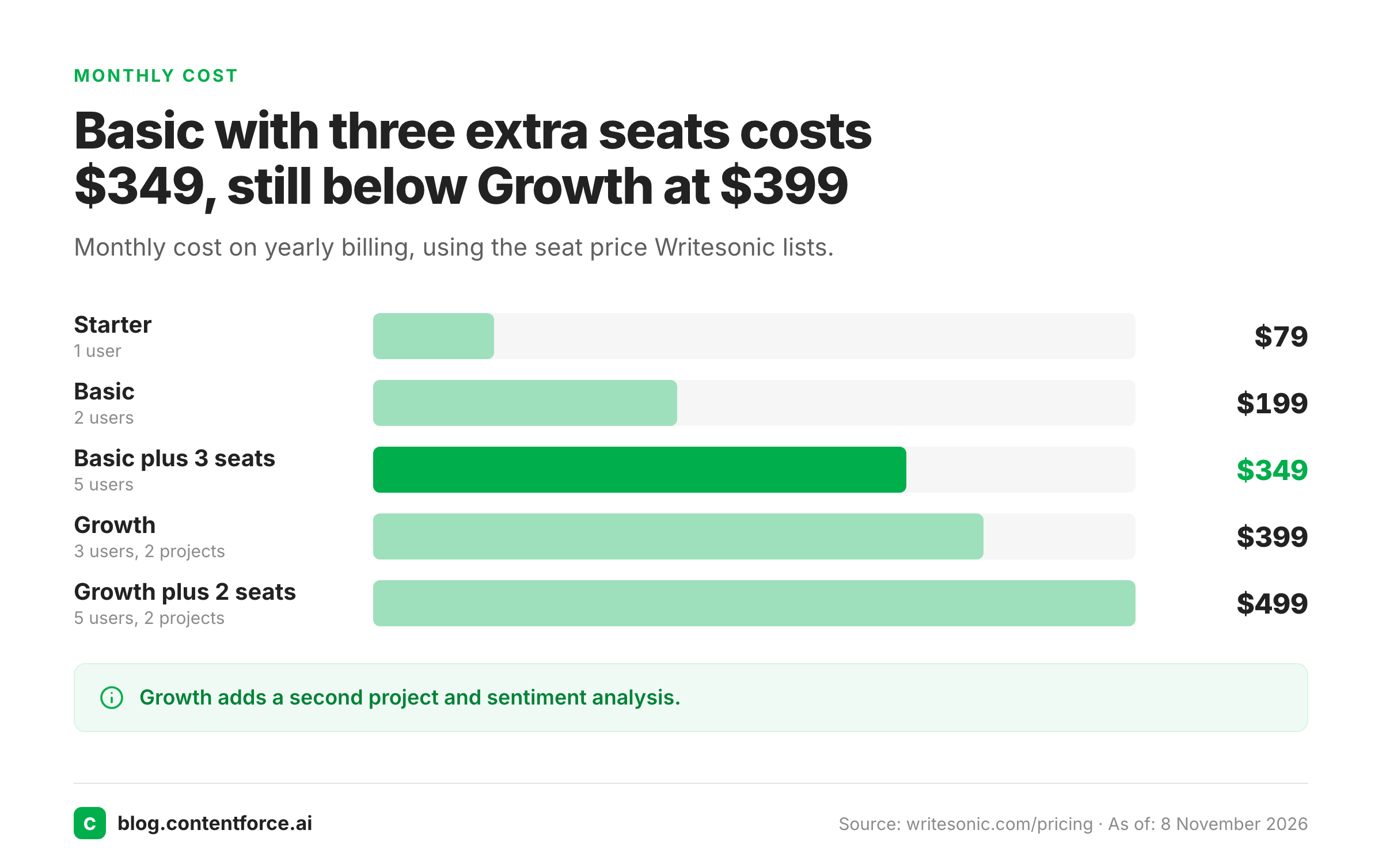
Extra seats are $50 per user per month on Basic and Growth, and extra articles cost $100 per pack of 20 on Growth. Starter lists no add-ons.
| Add-on | Price | Limit |
|---|---|---|
| Extra user on Basic | $50 per month | Up to 3 more, 5 users maximum |
| Extra user on Growth | $50 per month | Up to 2 more, 5 users maximum |
| 20 extra articles on Growth | $100 | Not capped on the pricing page |
Writesonic's pricing page, checked on 8 November 2026.
Here's the arithmetic that changes decisions. Basic with three extra seats costs $199 plus $150, which is $349 per month on yearly billing, and gives five users on one project. Growth costs $399 for three users on two projects with double the prompts and sentiment analysis. If your team has four or five writers and one brand, Basic plus seats is the cheaper route, and it's highly likely to cover you. If you run two brands or need sentiment data, Growth is the cheaper way to get there. An extra article pack works out at $5 per article.
Which AI platforms does Writesonic track?
Starter, Basic and Growth track ChatGPT, Gemini and Google AI Overviews. Only Enterprise tracks all nine platforms Writesonic lists, including Perplexity, Claude, Microsoft Copilot, Grok, Google AI Mode and Muse Spark. The platform pages themselves are not consistent about the count: the homepage and tracker page say 8 platforms, the pricing page says 9.
That gap matters if your buyers use Perplexity or Claude, and it's the main reason some teams go straight to Enterprise. On a self-serve plan you won't see those answers in the dashboard. Writesonic also says its prompts come from a dataset of 2 billion+ AI conversations, Search Console data, Keyword Planner and Reddit. That's a vendor figure, and we couldn't verify it.
What is the Writesonic Article Writer like?
Article Writer is the part that carries on the old product's job. Writesonic says each article runs through research on the live results, competitor analysis, an outline, multi-step writing, review against 11 expert frameworks and a final humanizer pass. It also advertises verified citations and author and last-updated signals.
Those are claims about a pipeline, not measured results, and the gap between the two can be wide. We didn't generate articles on a paid account, so we can't say how much editing the drafts need. What the pricing page does let you plan around is volume, not quality: 15, 25 or 50 articles per month, and $5 for each extra article on Growth. An AI draft still needs a human fact-check, and that's true of every tool in this category. If you want a read on what separates a usable AI draft from filler, our AI writing tools roundup compares the field.
What are Writesonic's pros and cons?
Writesonic's strengths are clear pricing with limits listed and a track-and-fix setup in one place. Its weaknesses are a high entry price for what Starter includes, plus limits that bite early.
Pros
- Plan limits for prompts, answers, articles, audits and seats are published for every self-serve tier.
- Tracking and content production sit in one product, so a gap found in the dashboard can become a draft without another tool.
- A trial without a credit card and a seven-day refund make it cheap to test.
- Enterprise lists SOC 2 Type II, HIPAA, GDPR and SSO with SAML.
Cons
- Starter tracks 50 prompts on one answer each, which is very thin for a real brand.
- Self-serve plans cover three AI platforms, not the nine on Enterprise.
- The Action Center, the feature the pitch is built around, is Enterprise only, with a small trial on Growth.
- Agentic workflows are trial runs on every self-serve plan.
- No permanent free plan, and the cheapest tier costs more than several dedicated trackers.
- The homepage shows a 4.8 rating from 2,031 reviews without naming the review site, so the number is hard to check.
Who should use Writesonic, and who should skip it?
Writesonic especially suits marketing teams that already know they need AI visibility data and also publish articles every month. It doesn't suit a solo writer who wants a cheap drafting tool.
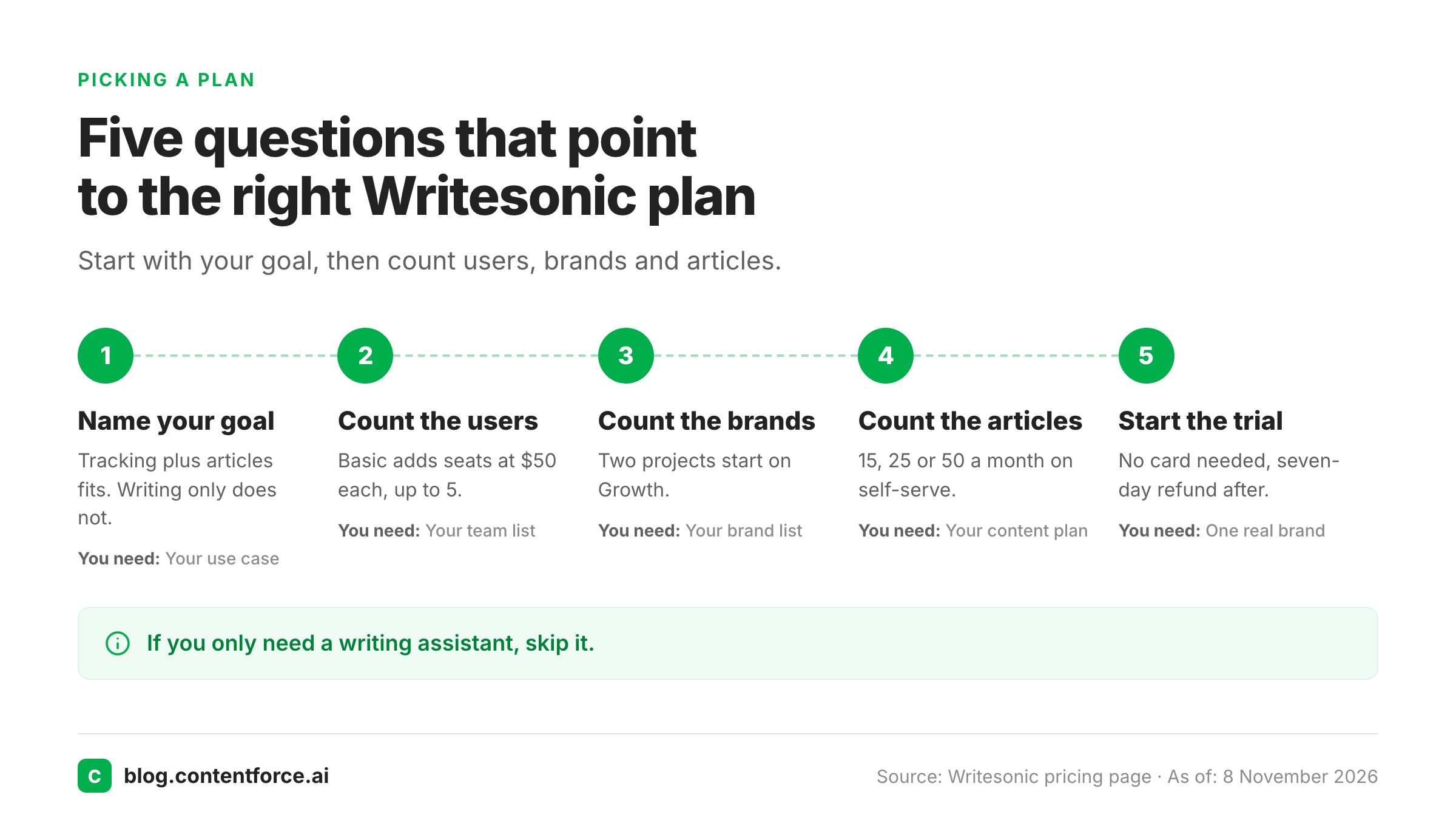
- Choose Starter only to test whether tracking's useful for one small brand, since it's the thinnest tier.
- Choose Basic if you have a small team, one brand and a monthly publishing plan of up to 25 articles.
- Choose Growth if you need sentiment analysis, two projects or 50 articles a month.
- Ask for Enterprise if buyers use Perplexity, Claude or Copilot, or if you need custom regions, languages and compliance paperwork.
- Skip Writesonic if you only need a writing assistant, or if you just want a tracker at a lower price rather than a full platform.
What are the best Writesonic alternatives?
The right alternative depends on which half of Writesonic you actually use. Prices below come from each vendor's own page when we last checked, and billing terms differ.
| Tool | Closest to | Starting price | Checked |
|---|---|---|---|
| Jasper | Writing and brand voice | $59 per seat per month yearly, $69 monthly | 6 Nov 2026 |
| Frase | SEO content briefs | Starter from $49 per month | 2 Nov 2026 |
| Otterly.ai | AI visibility tracking only | Lite from $29 per month | 27 Oct 2026 |
| Semrush AI Visibility Toolkit | Tracking inside an SEO suite | $99 per month | 22 Oct 2026 |
Jasper is the closest match for the writing side, and our Jasper AI review shows where it differs. For tracking alone, our best AI visibility tools list covers cheaper options, and the Profound alternatives page does the same for enterprise buyers. We make ContentForce, which competes in AI content, so weigh our comparisons with that in mind.
How we evaluated Writesonic
We read Writesonic's pricing, platform, About and product pages on 8 November 2026 and recorded every plan, limit and add-on. We didn't run a paid account, so features are described as Writesonic lists them, not as tested. Claims we couldn't check, such as article quality, tracking accuracy and review counts, are labeled as vendor claims.
Is Writesonic worth it?
Writesonic's worth it for a team that will use both the tracking and the article volume, and the Basic plan at $199 per month is where that case is easiest to make. It's poor value as a writing-only tool, since most of what you pay for is visibility tracking, not drafting. If you're unsure, use the free trial and the seven-day refund to test one real brand before committing to a yearly plan.
Writesonic FAQ
Is Writesonic free?
No permanent free plan is listed. You can start a free trial without a credit card, and paid plans carry a seven-day no-questions-asked refund.
How much does Writesonic cost per month?
Starter is $79, Basic $199 and Growth $399 per month on yearly billing. Billed monthly, the same plans cost $99, $249 and $499. Enterprise is priced on request.
Who owns Writesonic?
The footer lists Writesonic, Inc. in San Francisco, and the About page credits engineer Samanyou Garg with building the first product. Neither page names a parent company.
Does Writesonic still write articles?
Yes. Every self-serve plan includes AI articles: 15 on Starter, 25 on Basic and 50 on Growth per month. It also offers a content agent for other formats such as emails and social posts.
Can I cancel Writesonic anytime?
Yes. Cancellations and downgrades take effect at the next billing cycle, and Writesonic offers a seven-day refund. Yearly plans are paid for twelve months upfront.