Guide
The Future of SEO With AI: What the Data Shows So Far

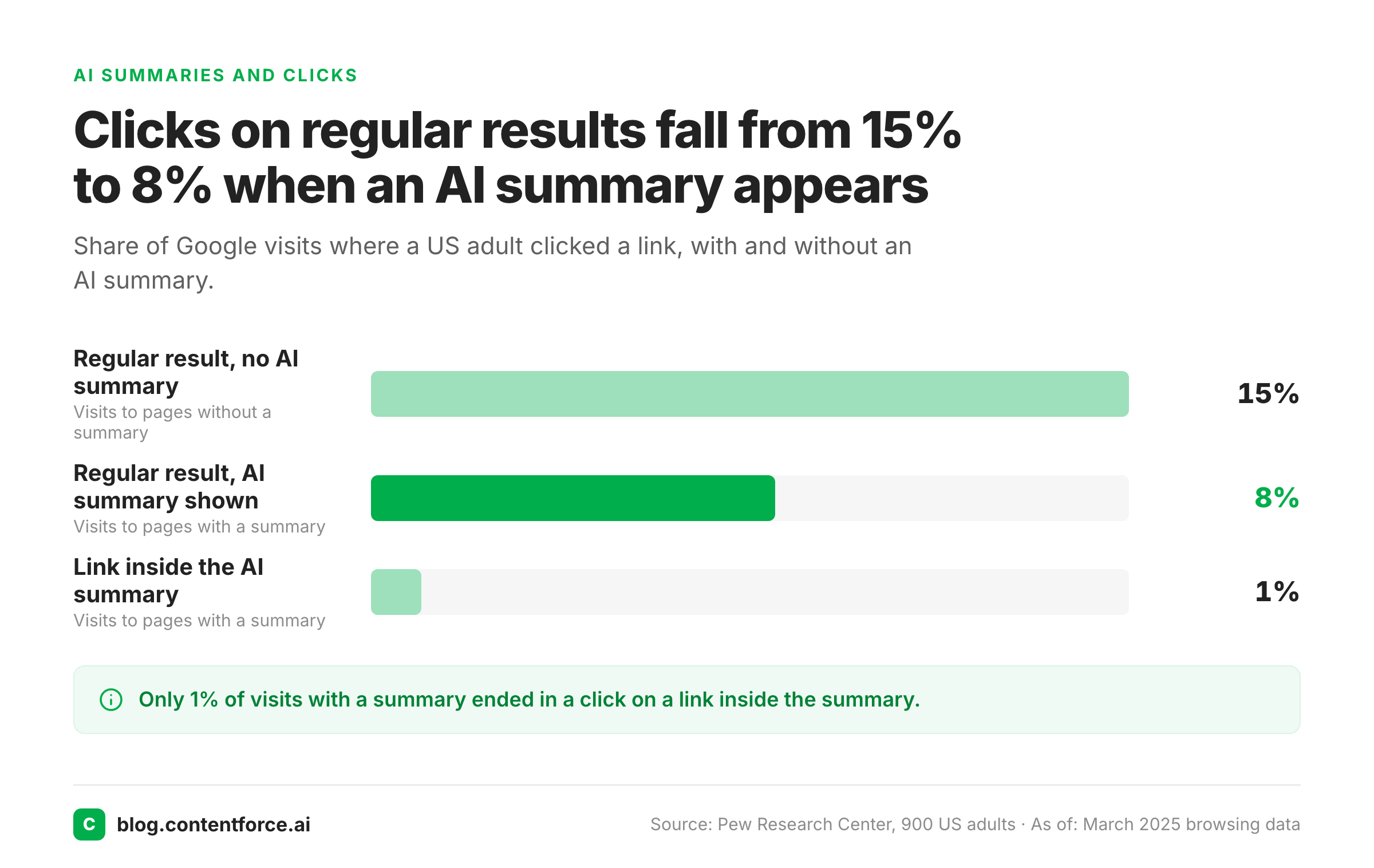
The future of SEO with AI keeps Google's ranking fundamentals while AI summaries come with fewer clicks on classic results. Pew Research Center found regular results were clicked on 8% of visits with an AI summary versus 15% without. The five steps below cover eligibility, commodity pages, follow-up questions and measurement in Search Console.
- Check that key pages are indexed, show a snippet and the generative AI setting is on
- Find commodity pages and add first-hand data, screenshots, tests or a clear point of view
- Answer follow-up questions inside one useful page instead of creating thin pages per variation
- Measure clicks and conversions plus impressions in the Search Console generative AI report
- Skip llms.txt, content chunking and special schema for Google Search
The future of SEO with AI looks like this: AI answers take some clicks away from the results page, and the pages that get cited still win on the same things that always mattered, which are useful content, a clean technical base and a real reason to be quoted. The data so far shows fewer clicks per search, a small but growing stream of AI referrals, and Google saying in plain words that its AI features sit on top of its normal ranking systems.
This page sticks to figures we could read at the source. Each number below comes with who measured it, when and how big the sample was, because a statistic without those three things is really just a mood. We read every source on 31 October 2026. Anything that's a forecast is labelled as one.
- Clicks: AI summaries correlate with fewer clicks, by a lot in some datasets (Pew, Ahrefs).
- Traffic: AI assistants send a small share of visits today, roughly a third of one percent in one large sample (SE Ranking).
- Strategy: Google says SEO fundamentals still apply and that "AEO" and "GEO" tricks like llms.txt don't help in Google Search.
What does the data say about AI and clicks?
When an AI summary appears, fewer people click the classic results, and the gap is large in both studies below. Neither study proves cause and effect, so read them as strong signals, not as laws.
| Study | Sample | Period | Result |
|---|---|---|---|
| Pew Research Center | 900 US adults | Browsing in March 2025 | Clicked a regular result on 8% of visits with an AI summary versus 15% without; clicked a link inside the summary on 1% of visits; session ended on 26% versus 16% |
| Ahrefs | 300,000 keywords, half with AI Overviews | December 2025 vs December 2023 | Position-one click-through rate on AI Overview keywords fell from 0.073 to 0.016; Ahrefs puts the effect at 58% lower than expected |
Ahrefs also says that a significant part of the fall isn't about AI at all. Informational keywords without an AI Overview dropped from 0.076 to 0.039 over the same two years, and the 58% figure compares the real result with a forecast built from that control group. The study is correlational, it covers desktop click-through rates from Google Search Console data, and the keyword set comes from Ahrefs' own database.
The practical reading is clear: a ranking in position one is worth less than it was when an AI Overview sits above it, so impressions and rankings alone overstate what a page earns. If you want to see how AI Overviews work, our guide to Google AI Overviews covers the mechanics.
How much traffic does AI search actually send?
Not much yet, at least measured as referral visits. SE Ranking's study of 101,574 websites, published in June 2026, found AI platforms accounted for 0.32% of total website traffic in January to April 2026, up from 0.24% in 2025 and 0.02% in 2024. In the same sample organic search accounted for 42.75% of traffic, which is roughly 130 times more than AI platforms send.
ChatGPT made up 74.78% of those AI referrals in 2026, down from 79.74% in 2025, so the mix is shifting, but one assistant still dominates.
Three caveats matter before you act on this:
- Referral data tracks visits that arrive from AI tools. It says nothing about how often your brand is mentioned in an answer that nobody clicks.
- SE Ranking doesn't list Google's AI Overviews among its tracked AI sources, so those clicks most likely sit inside organic search. That's our inference, not something the study states.
- The 2026 figure covers only four months, and attribution depends on how each platform passes referrer data.
So the honest summary is definitely not a panic story: AI answers change how many people click and what they see, while AI referral traffic itself is still small. Both are true at once. Visibility inside answers is a separate thing to track, and the AI visibility guide explains how.
SEO Title Generator: eight title tag variations, sized for the SERP and intent-matched. Free, no signup.
What changes in SEO, and what stays the same?
Most of the work stays the same, but how you judge success and what kind of content earns a citation both shift. Google's own description is that its generative features rely on its core Search ranking and quality systems, so ranking signals haven't been replaced by a separate AI rulebook.
| Area | Stays the same | Changes |
|---|---|---|
| Eligibility | Page must be indexed and eligible to show with a snippet | A site must also be included in the generative AI features setting in Search Console, per Google's guide |
| Content | Helpful, reliable, people-first writing | Commodity summaries lose value; first-hand, specific takes gain it |
| Technical SEO | Crawlability, speed, clean structure, no needless duplicates | Nothing new is required for Google, according to its guide |
| Queries | Match what the searcher wants | One question can fan out into several related searches behind the scenes |
| Measurement | Rankings, impressions, clicks | A separate Search Console view of impressions in AI features |
| Brand signals | Quality coverage across the web | Mentions in answers matter, but Google says chasing inauthentic mentions isn't helpful |
For the wider ranking picture, see our overview of SEO ranking factors.
What does Google say you should do?
Google's advice, published on 15 May 2026 in its guide to optimizing for generative AI features, boils down to four points: write non-commodity content, keep the technical basics solid, ignore the "AEO/GEO" hacks, and measure with Search Console. John Mueller announced the guide on the Search Central blog.
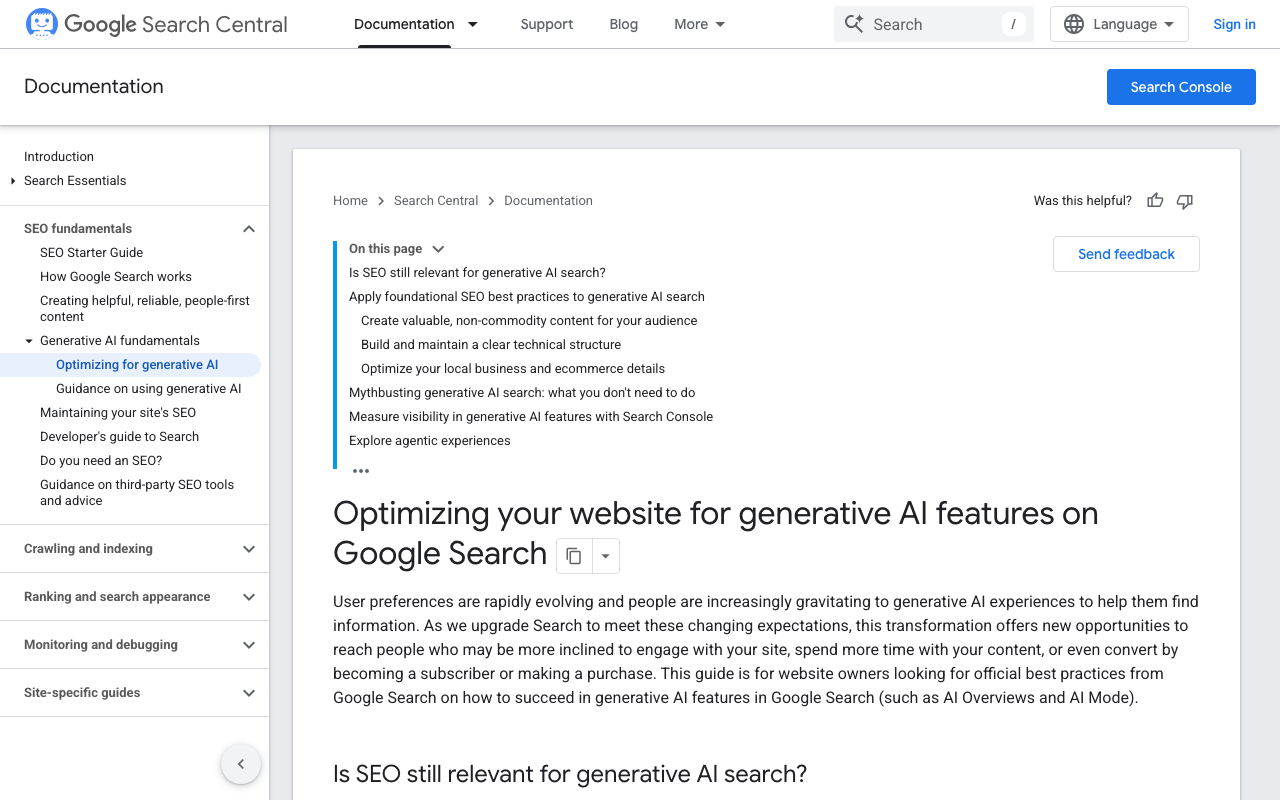
Here is what the guide says, paraphrased:
- Non-commodity content. Google says unique, useful content will likely influence presence in AI search more than any other tip in the guide. Its example of commodity content is a generic tips list that anyone could write; non-commodity content is an experienced, specific account that goes beyond common knowledge.
- How the systems work. The features use retrieval, also called grounding, to pull current pages from Google's index, and query fan-out, where the model runs several related searches at once to build an answer.
- No separate discipline. From Google's perspective, optimizing for generative AI search is optimizing for the search experience, and so still SEO.
- Don't write a page for every fan-out query. Doing that mainly to manipulate results can violate the scaled content abuse policy.
The guide also lists things you can ignore for Google Search. The same list reads like a myth check:
| Claim | Google's position in the guide |
|---|---|
| You need an llms.txt file | Google Search doesn't use it; creating one neither helps nor harms |
| Break content into tiny chunks | No requirement to chunk; there's no ideal page length |
| Rewrite pages in a special way for AI | Not needed; the systems understand synonyms and meaning |
| Collect lots of mentions | Inauthentic mentions aren't as helpful as they seem |
| Add special schema for AI | Structured data isn't required, though it's still useful for rich results |
One limit to keep in mind: this guide speaks for Google's features only. It doesn't tell you how other assistants pick sources, so don't read it as proof about ChatGPT or Perplexity. For those, our pages on generative engine optimization and answer engine optimization cover the wider field.
How do you measure visibility in AI features?
Use the Search Console generative AI performance report. Google announced it on 3 June 2026, with separate views for Search and for Discover, and a note on the post says it had rolled out to all websites worldwide as of 31 August 2026.
According to Google's announcement, the report shows:
- Impressions: how often your URLs appeared in generative AI features such as AI Overviews and AI Mode
- Pages: which URLs appeared
- Countries and devices (devices for Search results)
- Dates, with hourly, daily, weekly and monthly granularity
Google says this data is also included in the overall performance report, and the new view is a separate cut of it. The announcement describes impressions only, with more metrics possible later, so you can't yet read click-through rate for AI features from this report alone.
Google also warns that no third-party tool has access to its internal ranking or AI systems, and that you should judge any tool's advice against its official guidance. That's worth remembering when you compare AI visibility tools: use them for tracking across assistants, not as a source of Google's inner workings.
What should you do now?
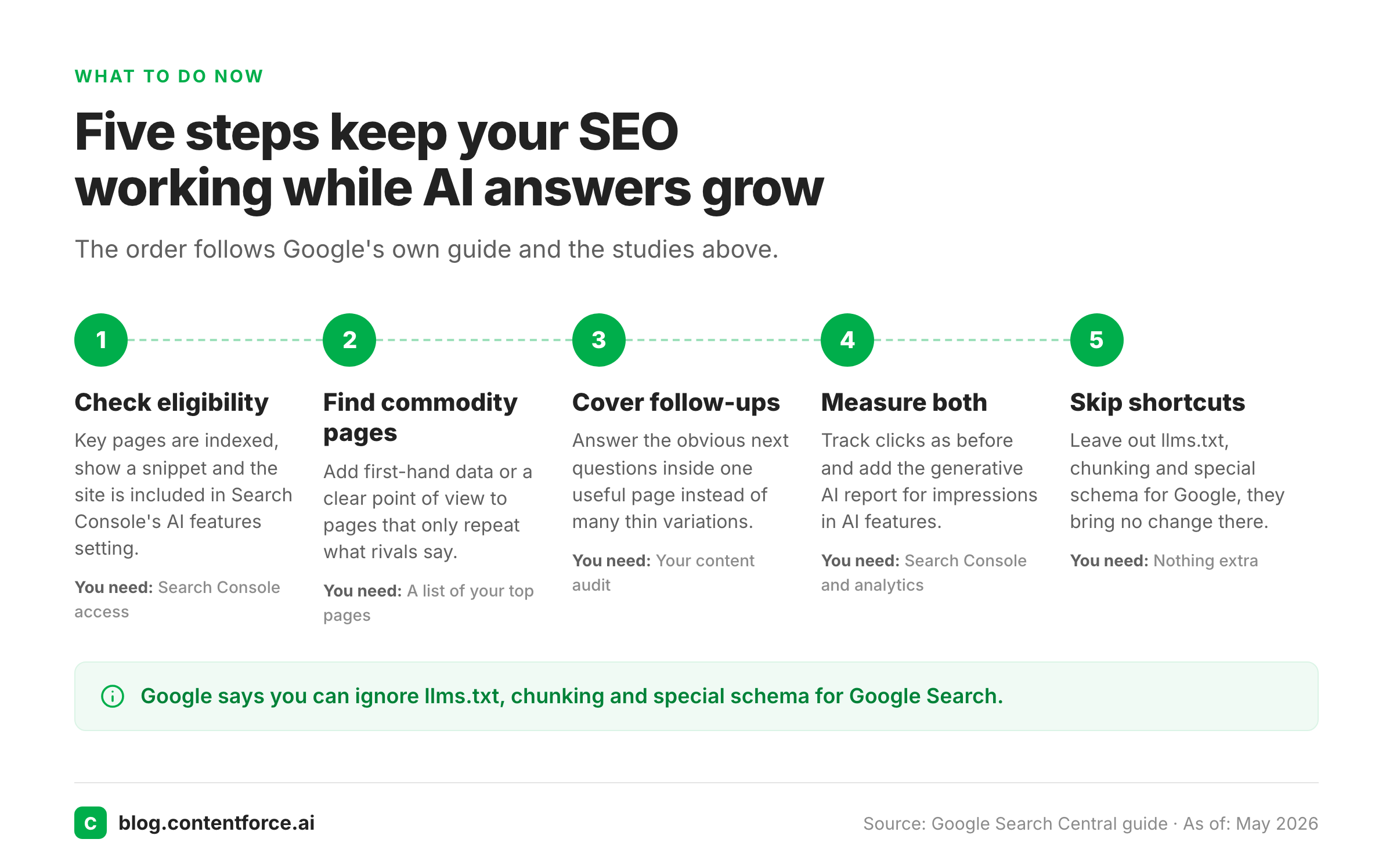
Treat AI search as a reason to sharpen your SEO, not to start a second strategy. This five-step list follows the sources above.
- Check eligibility. Make sure key pages are indexed, show a snippet and aren't blocked, and that your site is included in the generative AI features setting in Search Console.
- Find your commodity pages. List pages that only restate what every competitor says. Add first-hand data, screenshots, tests or a clear point of view, or merge and cut them. Our guide to content decay shows how to spot pages that are fading.
- Cover the follow-up questions. Answer the obvious next questions inside one useful page instead of spawning thin pages for every variation. Google says that scaled approach can break its spam policy.
- Measure two things. Track clicks and conversions as before, and add the Search Console generative AI report for impressions in AI features. Treat AI referral traffic as a separate, small line.
- Skip the shortcuts. You don't need llms.txt, content chunking or special schema for Google. If you add them for other systems, that's your call, but expect no change in Google Search.
For the topical groundwork behind step 3, see semantic SEO.
FAQ
What is the impact of AI on SEO?
AI summaries correlate with fewer clicks on the classic results. Pew found a click rate of 8% with an AI summary versus 15% without, and Ahrefs found position-one click-through rates 58% lower than expected on AI Overview keywords. Google says SEO fundamentals still apply.
Is SEO dead because of AI?
No source we read says so. Organic search was 42.75% of website traffic in SE Ranking's 2026 sample, against 0.32% for AI platforms. What's changing is the value of a single ranking and the importance of being cited.
Do I need GEO or AEO on top of SEO?
For Google Search, Google says optimizing for generative AI features is still SEO. For other assistants the picture is less clear, and Google's guide doesn't speak for them.
Does llms.txt help me rank in Google?
Google's guide says Google Search doesn't use llms.txt files, so it neither helps nor harms your visibility there.
Is Google Search technically AI?
Google's generative features, AI Overviews and AI Mode, use AI techniques such as retrieval and query fan-out on top of its core ranking systems, according to its guide. Classic results still come from those ranking systems.
How can I see if my site shows up in AI Overviews?
Open the generative AI performance report in Search Console. It shows impressions, pages, countries, devices and dates for AI features, but not clicks.