
Guide
SEO Ranking Factors: What the Evidence Actually Supports

SEO ranking factors sort into four evidence tiers, from systems Google documents itself to factors Google has denied, and this guide teaches readers to weigh a claim by its tier before acting. The guide moves from confirmed systems and NavBoost testimony through E-E-A-T-level correlation to denied factors such as domain age.
- Invest confidently in Tier 1 and Tier 2 factors
- Verify Tier 3 correlations across multiple studies before over-investing
- Ignore Tier 4 factors such as domain age and social signals
- Re-check each factor's tier periodically as Google's documentation and evidence evolve
Type "SEO ranking factors" into Google and you'll find lists claiming anywhere from 8 to over 200 items, most presented with equal confidence whether Google has confirmed them, denied them, or never mentioned them at all. That's the real problem with most ranking-factor content: it treats a Google engineer's sworn court testimony and a blogger's educated guess as the same kind of evidence.
This guide sorts SEO ranking factors into four evidence tiers: systems Google documents itself, systems revealed through leaked internal documents and antitrust trial testimony, factors with strong correlational support but no official confirmation, and factors Google has explicitly said it does not use. Knowing which tier a claim sits in is what actually determines whether you should act on it.
What Counts as a Confirmed SEO Ranking Factor?
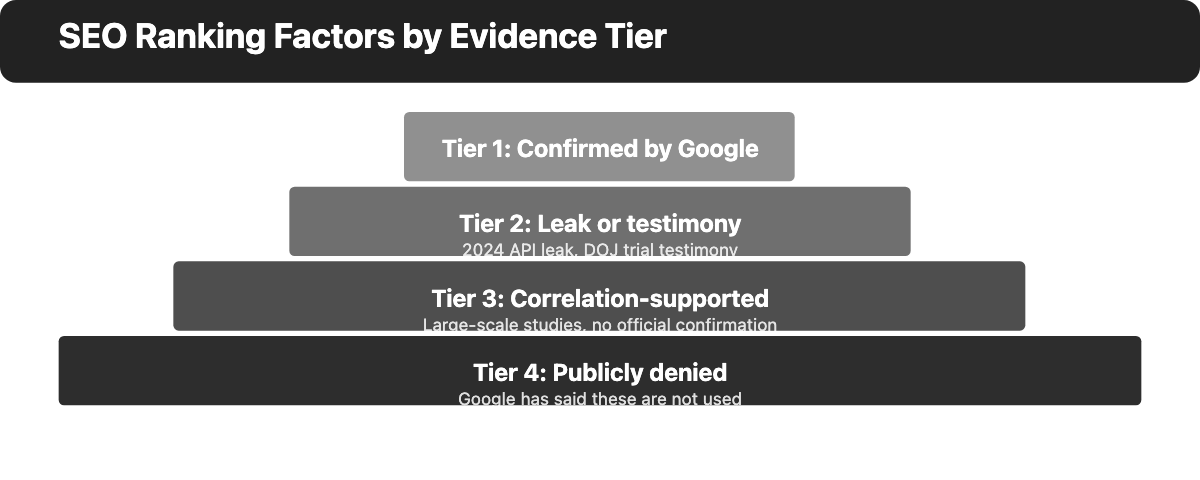
A confirmed SEO ranking factor is one Google itself has named and documented, not one a third-party study has merely correlated with higher rankings. That distinction matters because the industry's most-repeated number, "200 ranking factors," has never been published by Google as an official list. It originates from third-party SEO publishers who compiled and numbered items from patents, interviews, and correlation studies. Some of those items are certainly real. Others are outdated, disputed, or flatly denied by Google. Treating all 200-plus with the same confidence is where most ranking-factor content goes wrong.
A more honest framework sorts claims into four tiers, ranked from most to least trustworthy:
- Tier 1: Confirmed by Google. Named and described in Google's own documentation, such as its Search Central ranking-systems guide.
- Tier 2: Revealed by leak or testimony. Surfaced through the May 2024 Google API document leak or sworn testimony in Google's antitrust trials, not through Google's own marketing materials.
- Tier 3: Correlation-supported. Backed by large-scale correlation studies and broad industry consensus, but never confirmed by Google as a specific, scored input.
- Tier 4: Publicly denied. Factors Google's own representatives have explicitly said do not directly affect rankings.
The rest of this guide works through each tier, then closes with a single table you can use as a quick reference and a priority rule for where to actually spend your time.
Tier 1: Ranking Systems Google Confirms Itself
Google's own Search Central documentation names and describes the specific ranking systems it runs, which makes this the single highest-trust source available for this topic. The guide covers systems including PageRank, RankBrain, Neural Matching, Passage Ranking, and a cluster of freshness, spam-detection, and content-quality systems, several of which were originally announced as standalone algorithm updates before being folded into Google's core ranking systems.
| System | What it does | Status |
|---|---|---|
| PageRank | Analyzes how pages link to each other to help determine relevance and importance; one of Google's original core ranking systems | Active, core system |
| RankBrain | Helps Google understand how words relate to concepts, so relevant content can surface even without an exact keyword match | Active |
| Neural Matching | Understands representations of concepts in both queries and pages, then matches them to each other | Active |
| Passage Ranking | Identifies individual sections, or "passages," of a page to judge how relevant that specific section is to a search | Active |
| Freshness systems | Surface newer content for "query deserves freshness" searches, such as breaking news or recent reviews | Active |
| Original Content systems | Prioritize original reporting and first-hand sources over sites that merely cite or repackage them | Active |
| Reviews system | Rewards high-quality reviews written by people with real expertise, with original research and insightful analysis | Active |
| Helpful Content system | Ensures original, people-first content is favored over material made mainly to capture search traffic | Folded into core ranking systems, March 2024 |
| Panda system | Targeted low-quality and thin content, originally announced as the "Panda" update in 2011 | Integrated into core ranking systems, 2015 |
| Penguin system | Targeted manipulative link-spam tactics, originally announced as the "Penguin" update in 2012 | Integrated into core ranking systems, 2016 |
Google's guide makes one more point worth taking seriously: good site-wide signals don't guarantee that every individual page on that site will rank well, and the reverse holds too. A strong domain doesn't rescue a thin, unhelpful page, and one weak page doesn't necessarily drag down an otherwise strong site. Ranking is decided page by page, informed by, but not dictated by, the site around it.
SEO Title Generator: eight title tag variations, sized for the SERP and intent-matched. Free, no signup.
Tier 2: What the 2024 API Leak and DOJ Trial Testimony Revealed
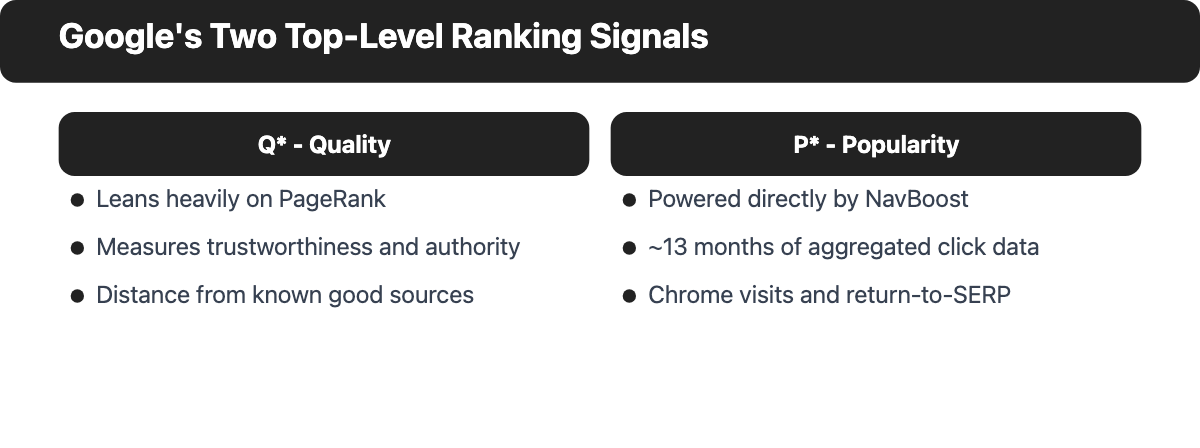
NavBoost is a click-based re-ranking system that Google's own VP of Search, Pandu Nayak, confirmed under oath is one of the company's "most important" ranking signals, during the United States v. Google antitrust trial. That single piece of sworn courtroom testimony carries more evidentiary weight than any third-party correlation study, because it's a Google executive describing Google's own system, on the record, under legal obligation to tell the truth.
According to Nayak's testimony, Google's ranking system ultimately reduces to two top-level signals it calls Q* and P*. Q*, for Quality, leans heavily on PageRank and measures a page's trustworthiness and its "distance" from known good sources. P*, for Popularity, is powered directly by NavBoost and reflects how widely a page is visited and clicked, drawing on roughly 13 months of aggregated user click data, including which results people click, how long they stay, and whether they return to the search results page afterward. This was, by most industry accounts, the first time a senior Google executive confirmed on the record that click data functions as a direct ranking signal, something Google's public communications had denied for years, more on that in Most Searched Keywords on Google.
Separately, in May 2024, over 2,500 internal Google API documents were leaked and analyzed publicly, first by Rand Fishkin at Sparktoro and Mike King at iPullRank. The documents reportedly described roughly 14,000 ranking attributes across more than 2,500 modules, exposing a system far more complex than the industry's simplified "200 factors" models suggest. Among the details reported: an internal site-authority-style metric, despite years of Google statements downplaying or denying that concept; and evidence that Chrome-derived click and visit data feeds directly into ranking through systems like NavBoost.
Google confirmed the leaked documents were authentic but pushed back on how they were being interpreted, cautioning against drawing conclusions from what it called "out-of-context, outdated, or incomplete information." That's a fair caveat, and worth taking seriously: leaked API documentation describes what a system can measure, not necessarily the exact weight that measurement carries in a live ranking calculation. Still, sworn trial testimony and a large corpus of internal documentation are a meaningfully different category of evidence than an SEO blog's inferred correlation, and that's exactly why NavBoost, Q*/P*, and the API leak deserve their own tier.
Tier 3: Correlation-Supported Factors, Strong Evidence Without Official Confirmation
These are the factors nearly every SEO resource agrees on, and for good reason: they're backed by large-scale correlation studies and consistent Google guidance, even where Google has never confirmed the exact mechanism or weight involved. "Correlation, not confirmation" isn't a knock against these factors. It's an honest description of the evidence, and it's exactly the framing most competing guides skip.
On-Page and Content Quality
Google's own Search Quality Rater Guidelines describe experience, expertise, authoritativeness, and trustworthiness, together known as E-E-A-T, as the lens human quality raters use to judge content, and Google has repeatedly said its automated systems are built to approximate that same judgment. E-E-A-T itself isn't a single scored input; it's a framework Google's systems try to detect through proxies like author credentials, citations, accuracy, and depth. Content that's original, well-sourced, and written by someone who can demonstrate real experience with the topic consistently correlates with stronger rankings across industry studies.
Backlinks and Off-Page Authority
Backlinko's own analysis of 11.8 million Google search results found a positive correlation (r=0.38) between the number of referring domains linking to a page and that page's ranking position, the strongest single correlation the study measured, and the number-one result in that dataset carried roughly 3.8 times more backlinks than results in positions two through ten. A 2026 survey of 131 SEO professionals, who scored over 100 possible ranking factors, put backlinks second only to topical relevance, named by 54.8 percent of respondents as a top-three factor. None of this is Google confirming a specific backlink-count formula; it's a consistent pattern across large, independently gathered datasets, which is exactly the standard this tier is built on.
Technical Health and Core Web Vitals
Core Web Vitals are a page-experience signal Google has confirmed it uses, measured across three metrics: Largest Contentful Paint (LCP, good is under 2.5 seconds), Interaction to Next Paint (INP, good is 200 milliseconds or less), and Cumulative Layout Shift (CLS, good is under 0.1), each assessed at the 75th percentile of real-user data in Google's Chrome UX Report. HTTPS, mobile-friendliness, and structured data round out the technical baseline, the same checkpoints a full technical SEO audit walks through. What Google hasn't published is the exact weight Core Web Vitals carries relative to content quality or backlinks, which is why it sits in this tier rather than Tier 1 despite being a genuinely confirmed signal category.
Engagement and User Interaction
Click-through rate, dwell time, bounce patterns, and return-to-SERP behavior are the same category of signal NavBoost draws on per Tier 2's trial testimony, but industry correlation studies treat them as a broader, looser bucket than NavBoost's specific mechanics. Pages that hold attention and get revisited tend to rank better, though isolating engagement as a standalone cause, separate from the content quality that produces good engagement in the first place, is difficult in any correlational dataset.
Tier 4: Ranking Factors Google Has Publicly Denied
Some of the most commonly repeated ranking factors are ones Google has explicitly said it does not use. Treating these with the same confidence as Tier 1 or Tier 2 factors is where a lot of ranking-factor content quietly misleads readers.
- Domain age. Google's John Mueller has said domain age by itself "helps nothing." An old, dormant domain gets no inherent trust boost simply for existing longer.
- Social signals. Likes, shares, and follower counts on social platforms are not a direct ranking input. Google has said its crawlers don't reliably access the private engagement data most social platforms would need to expose for this to even be technically possible.
- The meta keywords tag. Google has stated for years that this legacy HTML tag is ignored entirely for ranking purposes, following widespread keyword-stuffing abuse in the tag's early years. Frankly, filling it in today does nothing but waste a few seconds of your time.
- Search Console click-through rate as a direct input. Google has said it does not use Search Console's own CTR data as a ranking signal. This is the one denial worth reading carefully: it's specifically about Search Console's reported CTR metric, not about click data in general. Tier 2's NavBoost testimony confirms Google does use click and visit signals gathered through other channels, including Chrome. The two statements aren't necessarily contradictory, but they sit close enough to the line that treating either one as the whole story would be a mistake.
SEO Ranking Factors by Evidence Tier: The Full Table
Here's every factor covered above in one place, with its evidence tier and primary source, so you can check any claim you encounter elsewhere against where it actually sits.
| Factor | Evidence tier | Primary source | What to do |
|---|---|---|---|
| PageRank / link analysis | Tier 1: Confirmed | Google ranking-systems guide | Invest confidently |
| Freshness systems | Tier 1: Confirmed | Google ranking-systems guide | Invest confidently |
| Helpful Content system | Tier 1: Confirmed | Google ranking-systems guide | Invest confidently |
| NavBoost / click data | Tier 2: Leak / testimony | Pandu Nayak, DOJ trial testimony | Invest confidently |
| Site authority score | Tier 2: Leak / testimony | 2024 Google API leak | Treat as real, weight unknown |
| E-E-A-T / content quality | Tier 3: Correlation | Google Quality Rater Guidelines + industry studies | Invest confidently |
| Backlink quantity and quality | Tier 3: Correlation | Backlinko 11.8M-result study | Invest, verify before over-spending |
| Core Web Vitals | Tier 3: Correlation (confirmed category, unconfirmed weight) | Google page-experience documentation | Invest confidently |
| Engagement metrics (broad) | Tier 3: Correlation | Industry correlation studies | Verify before over-investing |
| Domain age | Tier 4: Denied | Google public statements (John Mueller) | Ignore |
| Social signals | Tier 4: Denied | Google public statements | Ignore |
| Meta keywords tag | Tier 4: Denied | Google public statements | Ignore |
| Search Console CTR (direct input) | Tier 4: Denied, with Tier 2 tension | Google public statements; see NavBoost note above | Ignore the metric, not the behavior it reflects |
How Ranking Systems Shape AI Overviews and AI Search Citations
AI Overviews and AI search answer engines largely draw their source material from Google's own already-ranked, already-indexed organic results, rather than running an entirely separate discovery and evaluation process. That means the Tier 1 through Tier 3 signals covered above don't just determine your position in a traditional results list; they materially affect whether an AI-generated answer cites your page at all. A page that already struggles to rank on content quality, authority, or technical health is unlikely to surface as a well-sourced AI citation either, since both systems are drawing from the same underlying ranked, indexed layer of the web.
One Tier 1 system is worth calling out specifically here: Passage Ranking, which identifies individual sections of a page rather than judging the page as one undifferentiated block. That's the same mechanic AI Overviews rely on when they pull a single paragraph or sentence out of a longer article to build an answer. A page that buries its actual answer inside a long, unstructured block of text gives both Passage Ranking and an AI Overview less to work with than a page where each section opens with a clear, self-contained answer. Clean heading structure, declarative opening sentences, and well-sourced factual claims aren't just good writing practice; they're the same structural qualities that make a passage easy for an AI system to lift and cite with confidence. Strengthening the Tier 1 through Tier 3 fundamentals covered in this guide is the most direct lever available for improving AI-search visibility, not a separate, parallel set of tactics.
How to Prioritize Ranking Factors by Evidence Tier
With four tiers on the table, the practical question is where to actually put your time and budget. A simple rule follows directly from the evidence quality behind each tier:
- Invest confidently in Tier 1 and Tier 2. These are backed by Google's own documentation or sworn testimony and leaked internal evidence. Content quality, technical health, original reporting, and the click-and-engagement behavior NavBoost rewards all belong here. In practice, that means budget goes toward genuinely original research and first-hand experience, clean crawlability, and pages structured so users actually want to click through, stay, and come back.
- Verify before over-investing in Tier 3. These factors are real and worth pursuing, but the exact mechanism and weight aren't published. Don't let a single correlation study justify an outsized budget shift; treat consistent findings across multiple independent studies, the way this guide cross-checked Backlinko's 11.8-million-result study against a separate 2026 survey of 131 SEO professionals, as your signal to act. The same skepticism applies to any single keyword difficulty score you're tempted to treat as gospel.
- Ignore Tier 4 entirely. Domain age, social signal counts, and the meta keywords tag are settled questions. Redirect any time currently spent on them toward Tier 1 or Tier 2 work instead.
- Re-check the tiers periodically, not just the facts inside them. A factor's tier can move. Google adds systems to its own documentation over time, court cases and leaks don't happen on a schedule, and today's Tier 3 correlation could become tomorrow's Tier 1 confirmation. Treat this framework as a lens to keep applying to new claims, not a one-time checklist.
Frequently Asked Questions
What are the top 3 SEO ranking factors?
By evidence strength, the top three are content quality and E-E-A-T, backlink authority, and the click-and-engagement signals captured by Google's NavBoost system. All three show up consistently across Google's own documentation, sworn trial testimony, and independent correlation studies, which is a stronger evidentiary bar than any single ranking-factor list can offer on its own.
What is the 80/20 rule in SEO?
The 80/20 rule in SEO holds that roughly 80 percent of your ranking results come from about 20 percent of possible ranking factors, meaning content quality, backlink authority, and core technical health, rather than chasing every item on a 200-factor checklist with equal effort. The evidence tiers in this guide point at the same conclusion from a different angle: Tier 1 and Tier 2 factors carry more real weight than the long tail of Tier 3 and Tier 4 claims combined.
How do you determine SEO ranking?
Google determines ranking by combining signals from confirmed systems like PageRank, RankBrain, and its freshness and content-quality systems with click-and-engagement data captured through NavBoost, then weighing page-level relevance and quality against the page's authority and technical health. Per Pandu Nayak's trial testimony, this ultimately reduces to two top-level signals: Q* for quality and P* for popularity, combined across thousands of underlying ranking attributes.
Does Google really use 200 ranking factors?
No single official Google source publishes a numbered list of exactly 200 ranking factors. That figure originates from third-party SEO publishers who compiled and counted items from patents, interviews, and correlation studies over the years. The 2024 API leak suggests the real number of underlying ranking attributes is far larger, around 14,000, but a large attribute count in a leaked internal system isn't the same thing as a clean, official, numbered public list, and Google has never published one.