Review
Peec AI Review: What It Tracks, What It Costs and Where It Falls Short

Peec AI is worth it for SEO teams and agencies that want daily, prompt-level tracking of AI engine mentions of their brand. Brand plans start at $95 per month for 50 prompts and three engines. Peec AI is a poor fit for teams that only watch a handful of prompts or want the lowest entry price.
- Unlimited users on every plan, so whole teams share one dashboard
- Source and citation analysis, including gap analysis against competitors
- MCP access included on every plan from Starter up
- Three engines per base plan, with each extra engine adding $30 to $140 per month
- API access starts on Pro and the Data Studio connector on Advanced
- Logged-out view only, so personalized answers are not shown
- Good fit for
- SEO teams and agencies that need daily AI visibility tracking and can act on source data
- Not a fit for
- Teams that only watch about 15 prompts or need a fourth engine on a small budget
- Brand plans
- $95, $245 and $495 per month
- Tracked prompts
- 50, 150 and 350 on brand plans
- Engines
- Any three of eight on every base plan
As of November 2026
Is Peec AI worth it?
Peec AI is worth it for SEO teams and agencies that want daily, prompt-level tracking of how AI engines mention their brand and that can act on the source data it returns. It's a poor fit if you only need to watch a handful of prompts or want the lowest entry price.
Peec AI runs the questions your buyers ask in ChatGPT, Perplexity, Gemini and Google's AI features, then reports how often your brand appears, where it ranks in the answer and which sources the engines cite. Brand plans start at $95 per month for 50 prompts and three engines. This review covers what the tool measures, how it collects data, what each plan includes and where it falls short. We read vendor pages and documentation and did not run the product ourselves.
| Peec AI at a glance | |
|---|---|
| Price | $95, $245 and $495 per month for brands; $245, $495 and $795 for agencies; Enterprise is custom |
| Tracked prompts | 50, 150 and 350 on brand plans |
| Engines | Any three of eight on every base plan, more as paid add-ons |
| Best for | SEO teams and agencies with content to improve and a need to report on AI visibility |
| Main limit | Three engines per plan, so a fourth engine adds $30 to $140 per month |
What does Peec AI do?
Peec AI tracks how your brand appears when AI engines answer questions in your market. It runs a list of prompts you define every day and turns the answers into five core metrics, plus the sources behind them.
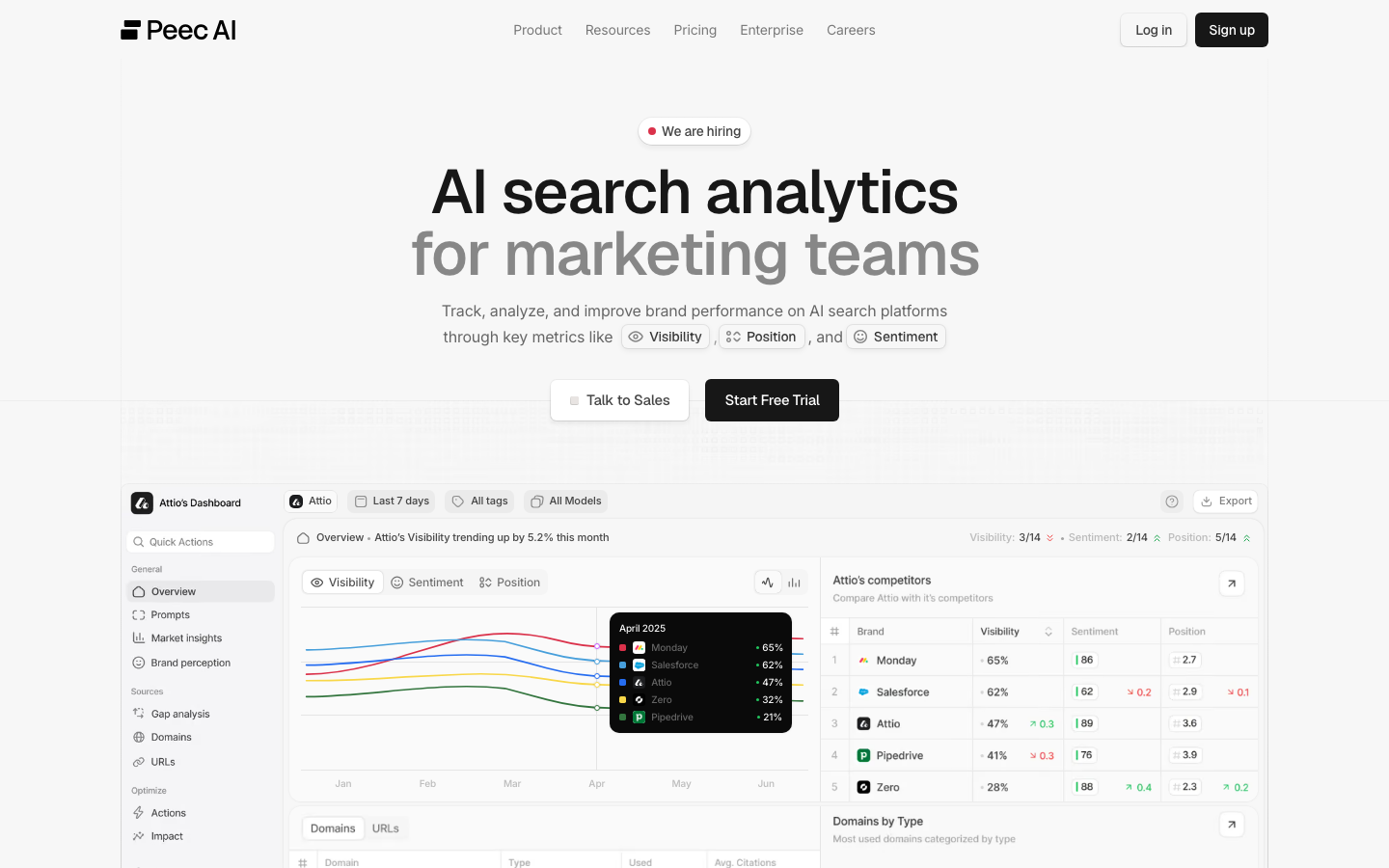
Here's how Peec AI's documentation defines the metrics:
| Metric | What it measures | How it's calculated |
|---|---|---|
| Visibility | Share of AI responses that mention your brand | Responses mentioning you divided by all responses |
| Position | Your average rank when you're named | Average rank among all brands detected in the answer |
| Sentiment | Tone of the mentions, scored 0 to 100 | Language analysis of each mention; most scores land between 65 and 85 |
| Share of voice | Your mentions compared with competitor mentions | Your mentions divided by all brand mentions |
| Win rate | Answers where you're named first | Chats ranking you first divided by all chats |
Win rate can't exceed visibility, because a brand has to be mentioned before it can rank first. Position counts every brand in the answer, not only the competitors you track, so an unlisted rival can push you down.
The metrics sit on top of sources, meaning the pages and domains the engines pull from. Peec AI's gap analysis lists sources that often name your competitors but not you. Its Actions list ranks opportunities as earned (other sites) or owned (your own pages).
The product has clearly grown beyond tracking. The current pricing page lists brand perception scoring, AI shopping with product-level tracking, an ads library for prompts where AI answers carry sponsored placements, a crawlability audit of more than 40 AI bots, and Peec Agent, a built-in assistant that runs on credits. An MCP connection lets other AI tools read your Peec AI data.
Outline, title, intro, conclusion, FAQ, rewriter and summarizer, each on its own page. No signup.
How does Peec AI collect its data?
Peec AI collects data by driving the web interfaces of AI engines with browser automation, not through their APIs. Its documentation says this captures what real users see, because API answers often differ in wording and in the number of sources.
The company describes the setup as a logged-out user's view. For most engines, the engine decides which model answers and whether it searches the web. Peec AI runs your prompts daily and looks at patterns over time, because AI answers vary from day to day.
That choice has two consequences. The numbers match what an average visitor sees, which is useful for reporting. They don't show what a logged-in user with a personal history sees, though, and a single day's answer can swing. Otterly, a competitor, says tracking 100 prompts daily for 30 days cut variation in brand coverage by about 73% compared with 10 prompts. That's a vendor figure, but the direction fits Peec AI's own advice to read trends rather than single chats, and it's why prompt count matters more than it looks.
How much does Peec AI cost?
Peec AI brand plans cost $95, $245 and $495 per month, and agency plans cost $245, $495 and $795 per month, as listed on its pricing pages on 24 November 2026. These are dollar prices. Some visitors see euro prices on the same plans, so check the currency before you budget.
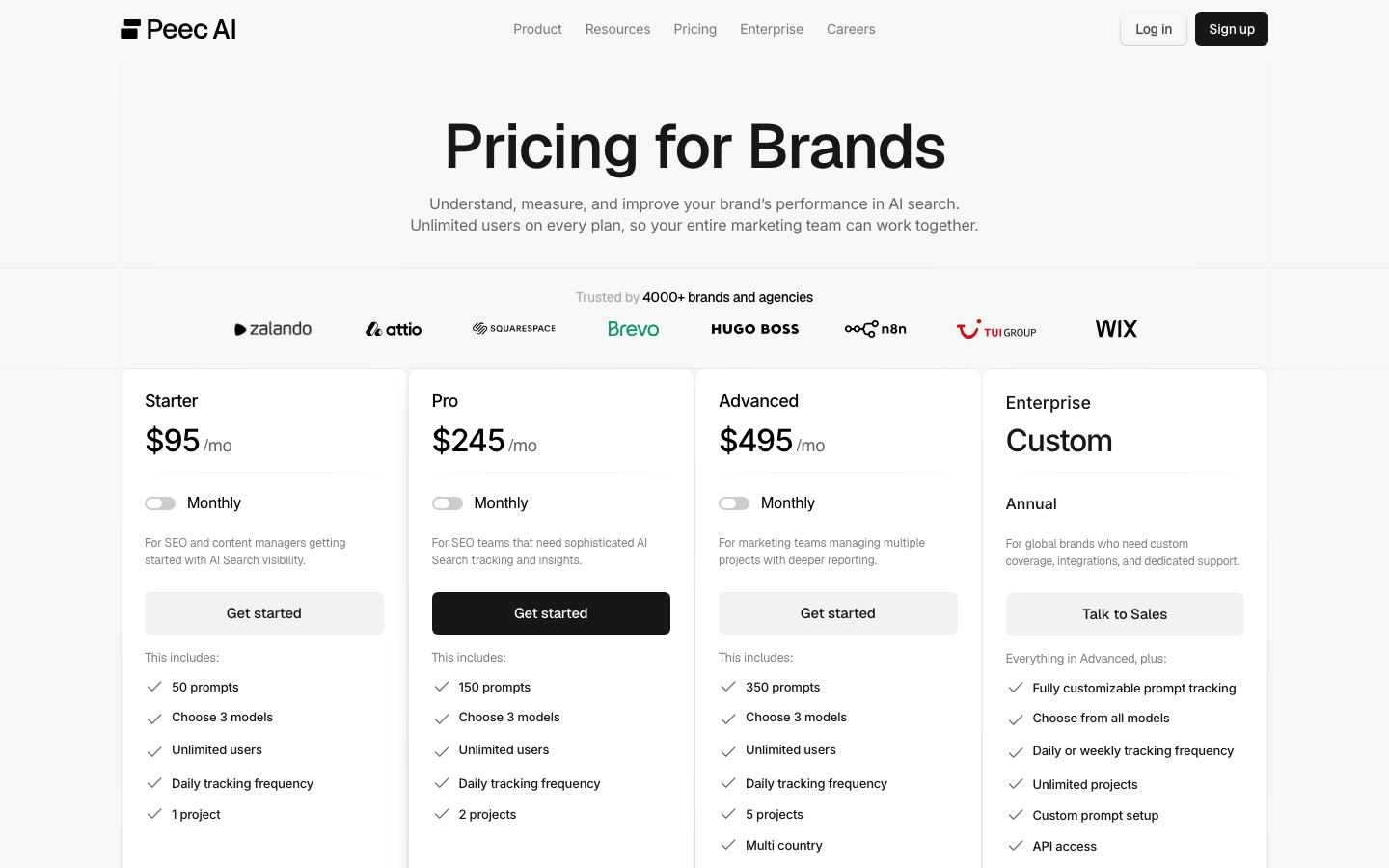
Brand plans
Peec AI's Starter plan costs $95 per month and covers 50 prompts, three engines, one project and one country. Each step up adds prompts, projects and countries.
| Starter | Pro | Advanced | Enterprise | |
|---|---|---|---|---|
| Price per month | $95 | $245 | $495 | Custom, billed annually |
| Tracked prompts | 50 | 150 | 350 | Unlimited |
| Engines | 3 | 3 | 3 | Up to 26 models |
| Projects | 1 | 2 | 5 | Unlimited |
| Countries | 1 | 3 | 3 | Unlimited |
| AI answers per month | 4,500 | 13,500 | 31,500 | Unlimited |
| Peec Agent credits | 500 | 750 | 1,000 | Custom |
Every plan includes unlimited users, unlimited competitors and unlimited languages, with daily tracking. An AI answer is one chat result from one engine. Fifty prompts on three engines over 30 days make 4,500 answers, which is what the plan's volume figure counts.
You choose your three engines from ChatGPT, Perplexity, Google AI Overviews, Google AI Mode, Gemini, Naver AI Briefing, ERNIE (Baidu) and Bing AI Mode. Peec AI offers a free trial, though the public pricing page doesn't state its length.
Agency plans
Agency plans work on credits instead of prompts. The Essential plan costs $245 per month for 10,000 credits, Growth costs $495 for 25,000 and Scale costs $795 for 65,000. Peec AI describes Growth as built for agencies with 3 to 10 clients and Scale for 11 to 25 or more, although the credits matter more than the client count.
On the page's example setup of three engines tracked daily, those credits work out to 111, 277 and 722 prompts. Agencies get client projects under one invoice, view-only client links and free 7-day pitch projects for prospects. A Comprehensive tier is custom and annual.
Add-ons and annual billing
Extra engines cost $30 per month on Starter, $70 on Pro and $140 on Advanced for each additional model. A fourth engine therefore takes Starter to $125, Pro to $315 and Advanced to $635 per month. Annual billing carries a 15% discount, according to Peec AI's pricing FAQ.
What does a tracked prompt cost?
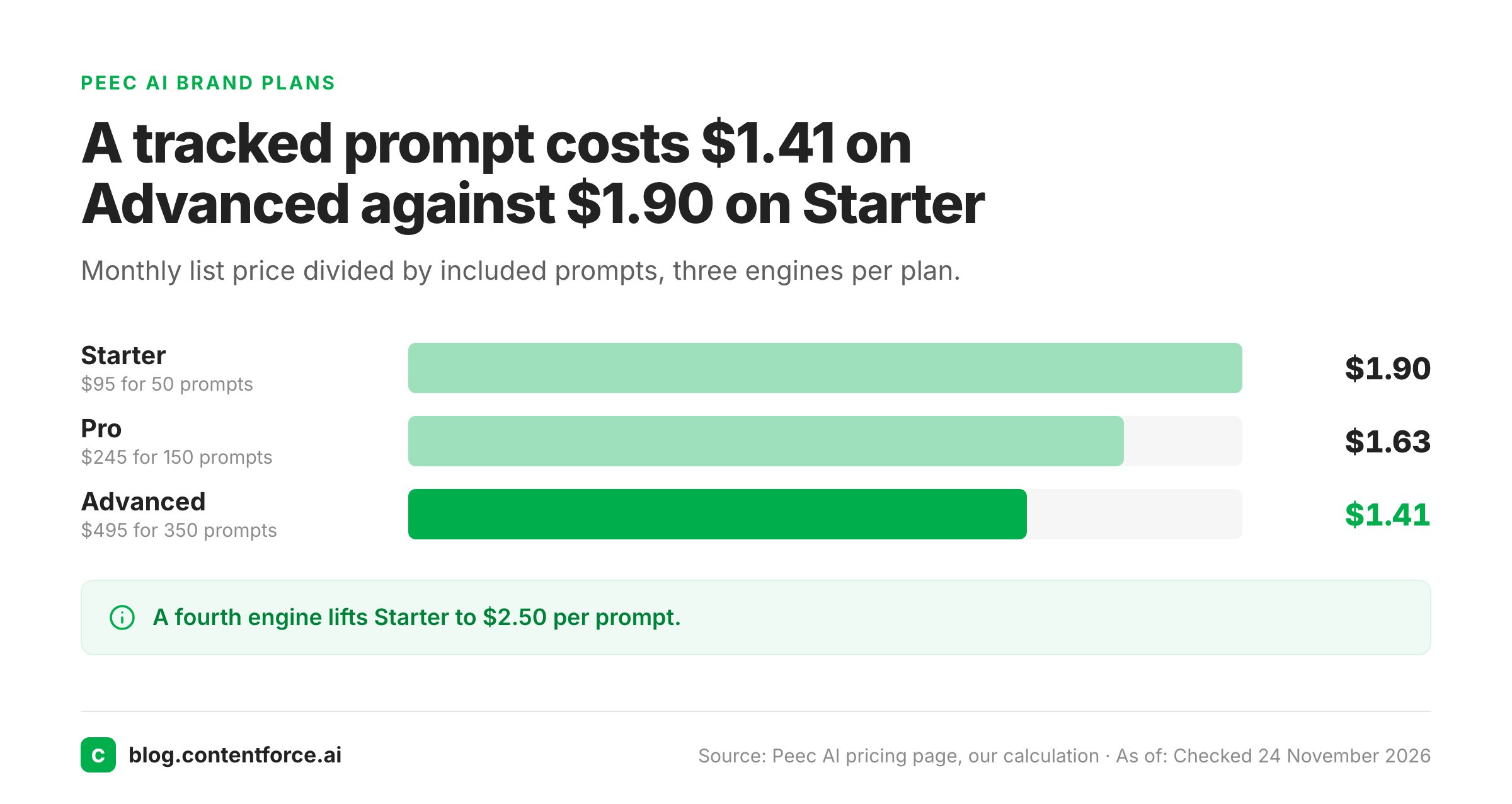
A tracked prompt costs $1.90 per month on Starter, $1.63 on Pro and $1.41 on Advanced, based on the list prices and three engines. Those figures are our calculation from the listed plans.
| Starter | Pro | Advanced | |
|---|---|---|---|
| Cost per prompt per month | $1.90 | $1.63 | $1.41 |
| Cost per prompt with a fourth engine | $2.50 | $2.10 | $1.81 |
The drop from Starter to Advanced is about 26%, and that's before add-ons. If you know you'll outgrow 50 prompts, Pro costs less per prompt and adds two more countries and a second project, so it's worth the jump.
What is missing on Starter and Pro?
Starter lacks API access, the Data Studio connector, custom attributes and objection tracking, and Pro still lacks the Data Studio connector and custom attributes. Single sign-on is Enterprise only.
| Feature | Starter | Pro | Advanced | Enterprise |
|---|---|---|---|---|
| API access | No | Yes | Yes | Yes |
| Data Studio connector | No | No | Yes | Yes |
| Custom brand attributes | No | No | Yes | Yes |
| Objection tracking | No | Monthly | Weekly | Weekly |
| Prompts fact-checked | 5 | 10 | 25 | Unlimited |
| Support | Chat | Chat and email | Chat and email | Dedicated |
| Single sign-on | No | No | No | Yes |
Fact-checking compares tracked answers with statements you set about your brand, and it's limited on Starter. Starter allows 5 facts per brand against 20 on Pro and 50 on Advanced. Teams that report to clients in Looker Studio need Advanced, because the connector isn't on the two lower plans. Of course, you can still export CSV files on every plan.
Where is Peec AI strong?
Peec AI is clearly strongest on access and on source analysis. Its plans give every team unlimited seats, competitors and languages, so cost doesn't grow with headcount.
- Unlimited seats. Every plan includes unlimited users, which suits teams where SEO, content and PR all need the dashboard.
- Source and citation analysis. Domain and URL detail, fanout views and gap analysis show which pages the engines retrieve when they name competitors.
- Crawl and referral data. Peec AI's crawlability audit shows which of more than 40 AI bots your robots.txt allows, partly allows or blocks, and its agent analytics reads server logs from Cloudflare, Vercel, Fastly, Netlify and other providers.
- MCP on every plan. MCP access is included from Starter up, so you can query your Peec AI data from an AI assistant.
- Security. According to Peec AI, a SOC 2 Type II report covers every plan.
- Agency tooling. Pitch projects, client links and one invoice across clients are built in.
The company says more than 4,000 brands and agencies use it, but we can't verify that figure.
Where does Peec AI fall short?
Peec AI falls short on engine count, noisy answers and price creep. A base plan tracks three engines, and every extra engine adds $30 to $140 per month, which is where budgets slip.
- Three engines per plan. If your buyers use ChatGPT, Perplexity, AI Overviews and Gemini, you'll pay for a fourth engine, and there's no way around that on a base plan. Enterprise is the plan that lists up to 26 models, including API-based ones.
- Single answers are noisy. Peec AI says answers vary daily. With 50 prompts on Starter, a swing of a few points in visibility may be chance, not progress, and you'll notice it most on small prompt sets.
- Logged-out view. The data shows what a visitor without an account sees. It can't show personalized answers.
- Features locked by plan. API access starts on Pro and the Data Studio connector on Advanced. One country on Starter rules out multi-market tracking.
- Vendor claims are untested. Peec AI's comparison page says every plan gives more than Profound at a better price. We haven't verified that, and the plan structures differ.
Peec AI measures and recommends, but it doesn't prove that visibility turns into traffic or revenue. That still depends on your own analytics, which Peec AI reads through Google Analytics and Google Search Console connections.
How does Peec AI compare with Profound and Otterly?
Peec AI publishes self-serve prices, Profound now sells brand plans only through sales, and Otterly starts lower at $29 per month. These three tools are the ones buyers weigh most often, and they're priced very differently.
| Peec AI | Profound | Otterly | |
|---|---|---|---|
| Entry price per month | $95 | Custom | 29 (Lite) |
| Self-serve plans | Yes | No | Yes |
| Prompts on the entry plan | 50 | Custom | 16 |
| Engines on the entry plan | 3 of 8 | Custom | 4 of 7 |
| Mid plan | Pro: $245, 150 prompts | Custom | Standard: 189, 120 prompts |
| Top listed plan | Advanced: $495, 350 prompts | Custom | Premium: 489, 403 prompts |
Otterly's pricing page lists these plans in euros, while its comparison pages list the same numbers in dollars. Profound's pricing page says it retired its Starter and Growth plans for brands in September 2026, so a quote is now the only route, and the entry price is unknown until you ask. Its Enterprise plan lists up to ten answer engines, SSO and SOC 2.
For a deeper look at the other two, read our Profound review, the Otterly and Profound comparison and the list of Profound alternatives. Our guide to the best AI visibility tools ranks more of the field.
Who should buy Peec AI?
Buy Peec AI if you need daily tracking, shared access for a whole team and source-level detail, and skip it if your needs are small or your budget's tight.
| Choose Peec AI if | Skip it if |
|---|---|
| You track 50 or more prompts and want unlimited seats | You only need to watch about 15 prompts, where Otterly's $29 Lite plan costs less |
| You run client projects and need pitch projects and one invoice | You need a fourth engine on a small budget, since each extra engine adds $30 or more |
| You want server-log data on AI bot visits next to visibility | You need SSO but can't buy Enterprise |
| You report in Looker Studio and can afford Advanced at $495 | You want to track the same four engines on every project, since base plans cap engines at three |
If you're new to the field, start with what AI visibility means and how LLM SEO changes content work, then pick a tool. Our overview of generative engine optimization tools shows where Peec AI sits in the market.
FAQ
What does Peec AI do?
Peec AI tracks how often and how favorably AI engines such as ChatGPT, Perplexity and Gemini mention your brand. It runs your prompts daily and reports visibility, position, sentiment, share of voice and the sources behind each answer.
Who are Peec AI's competitors?
Peec AI's closest competitors are Profound and Otterly, while SEO suites such as Ahrefs and Semrush also offer AI visibility tracking. Peec AI publishes its own comparison pages against Profound, Ahrefs and Semrush.
How many prompts and engines should you track?
Start with the prompts your buyers really ask and the engines they're using. Peec AI's plans begin at 50 prompts and three engines. Otterly advises 50 to 100 prompts per topic or market, so Starter fits one topic and Pro or Advanced fits several.
Does Peec AI use APIs or scrape the engines?
Peec AI scrapes the web interfaces of AI engines with browser automation. Its documentation says this shows the answer a logged-out user sees, and that it avoids differences between API output and the live interface.
Is Peec AI worth it for agencies?
Peec AI is worth it for agencies that manage several clients, because the Growth plan at $495 per month includes 25,000 credits, client projects, view-only client links and one invoice. A smaller agency can start on Essential at $245 per month and run free 7-day pitch projects for prospects.
What are Peec AI's pros and cons?
Peec AI's pros are unlimited users, source and citation analysis, MCP access on every plan and self-serve plans with listed prices. Its cons are three engines per plan, $30 to $140 for each extra engine, API access starting on Pro and the Data Studio connector starting on Advanced.
What are the best Peec AI alternatives?
The best Peec AI alternatives are Otterly for smaller budgets, from $29 per month, and Profound for enterprises that buy through sales. Our guide to the best AI visibility tools lists more options.
Is Peec AI legit?
On the points you can check, Peec AI publishes its prices and documentation, and according to Peec AI it holds a SOC 2 Type II report from an independent auditor. We have not seen that report ourselves, so request it through sales and use the free trial before you commit.
Is there a free Peec AI plan?
Peec AI has no free plan on its pricing page, only a free trial. The trial length isn't stated there, so you'll want to confirm it when you sign up.
Is Peec AI SOC 2 compliant?
According to Peec AI, it holds a SOC 2 Type II report from an independent auditor. Enterprise customers can request the report through sales during a vendor review.