
Pricing
Copy.ai Pricing: Plans, Credits, Seats and What Each Tier Fits

Copy.ai costs $24 to $29 a month for the Chat plan, $249 a month for the Agents plan, and a custom quote for Enterprise, with no ongoing free plan. New accounts get a one-time grant of 200 bonus credits that never expire, and cancelled subscriptions drop to a view-only Free plan that blocks new generations until you resubscribe.
- Chat plan price
- $29 a month, or $24 a month billed annually ($288 a year)
- Agents plan price
- $249 a month for up to 10 seats and 10,000 workflow credits
- Enterprise plan price
- Custom pricing, handled through Copy.ai's sales team
- Free plan
- No ongoing free plan, only a one-time 200 bonus credits grant
- Refund policy
- 5-day money-back guarantee from the date of your initial purchase
- Retired tiers
- Growth, Expansion and Scale plans up to $3,000 a month are hidden from the pricing page
As of September 2026
Copy.ai's public pricing page shows two things today: a self-serve Chat plan at $29 per month ($24 per month billed annually) and a sales-led Enterprise plan at custom pricing. Copy.ai's own help center adds a third paid tier, Agents, at $249 per month for up to 10 seats and 10,000 workflow credits. The four-figure Growth, Expansion and Scale plans that most 2025 coverage still quotes are no longer displayed on the pricing page.
Prices below were verified on Copy.ai's live pricing page and help center on 6 September 2026.
That gap between what the pricing page shows and what older articles claim is the single biggest trap on this topic. Copy.ai was acquired by RevOps platform Fullcast in October 2025, its help center moved to a Fullcast domain, and the plan lineup was cut down. Here's what a buyer actually pays now.
| Copy.ai plan | Monthly price (USD) | Annual price (USD) | Seats | Workflow credits | Best fit |
|---|---|---|---|---|---|
| Chat | $29/mo | $24/mo, billed $288/yr | 5 | None included | Small teams that want shared AI chat with top models |
| Agents | $249/mo | Not published | Up to 10 | 10,000/mo | Teams producing the same content types repeatedly |
| Enterprise | Custom | Custom | Custom | Custom | Orgs that need implementation help, API access and bulk workflow runs |
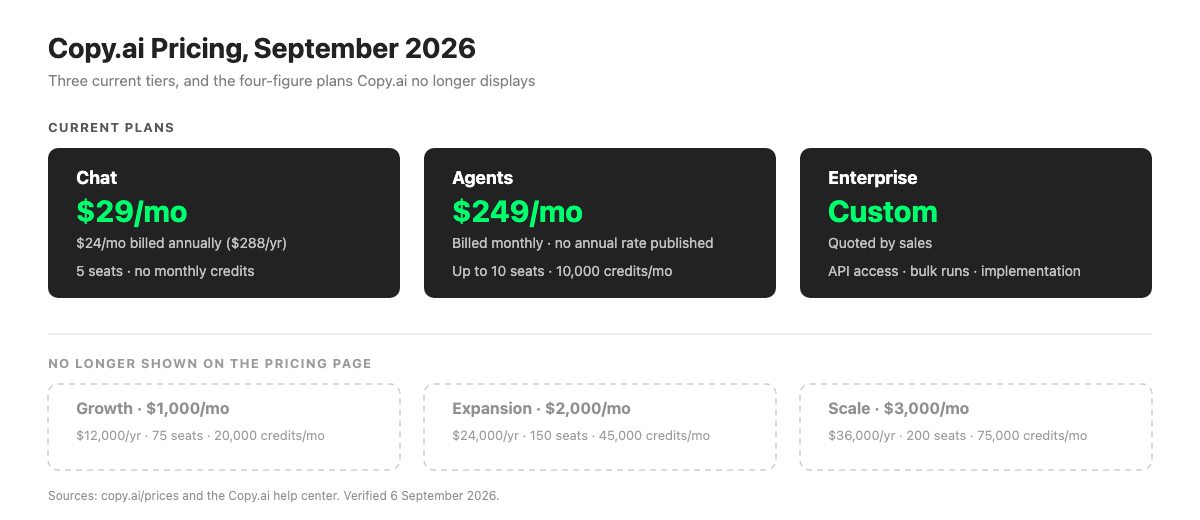
The infographic sets the three current tiers against the four-figure plans Copy.ai has pulled from public view, so you can see which numbers in older reviews are still worth anything.
How much does Copy.ai cost?
Copy.ai costs $24 to $29 a month for the Chat plan, $249 a month for the Agents plan, and a custom quote for Enterprise. Chat is $29 billed monthly and $24 a month when you pay for the year, which works out to $288 up front against $348 paid monthly. Copy.ai badges that as a 20% saving, though the arithmetic lands closer to 17%.
Per seat, Chat is cheap. $24 a month across 5 included seats is $4.80 per person, which undercuts a per-seat ChatGPT or Claude team subscription by a wide margin for a team that will genuinely use all five.
Agents sits nearly ten times above Chat, and the jump buys a different product rather than more of the same one. Chat is a shared AI chat workspace. Agents adds Content Agent Studio plus a monthly pool of 10,000 workflow credits, which is what actually powers automated generation.
One caveat matters before you budget: the $249 Agents figure comes from Copy.ai's help center, not from the pricing page, which currently shows Chat only in its Self-Serve view. Check the plan picker inside your workspace before you assume it's available to you.
What do you get in each Copy.ai plan?
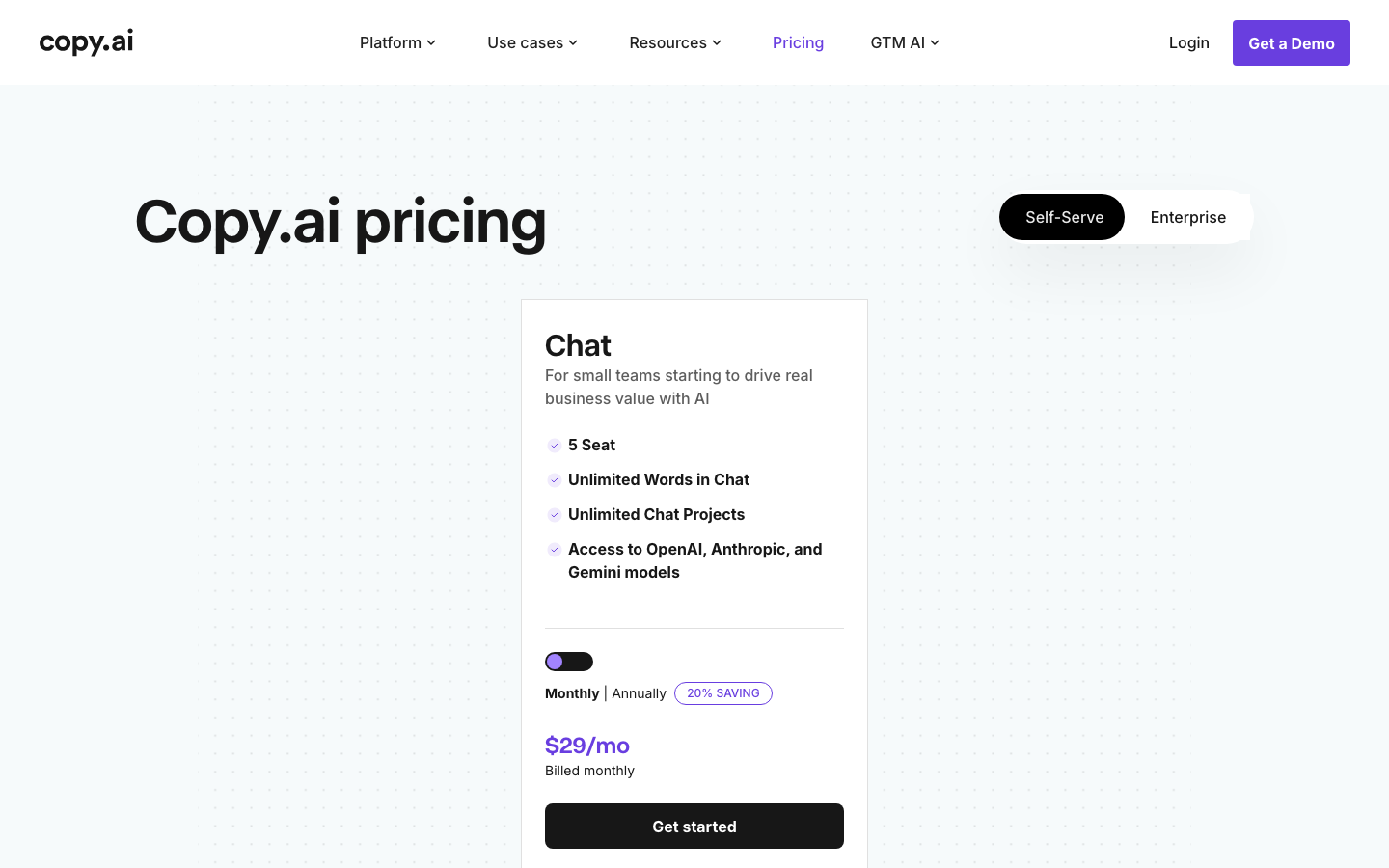
Copy.ai sells three tiers today: Chat at $29 a month for shared AI chat, Agents at $249 a month for automated workflows, and custom-priced Enterprise for API access and bulk runs. Each tier maps to a different way of working, and Copy.ai's own documentation says so: its help center splits the platform into crawl, walk and run, with Chat for one-off tasks, Content Agent Studio for repeatable content, and Workflows for multi-step automation. Price follows that split almost exactly. The screenshot shows how the Chat card reads on the live pricing page.
Chat at $29 a month
Chat is the entry-level self-serve tier at $29 a month, or $24 a month billed annually. It covers 5 seats, unlimited words and unlimited chat projects, with access to models from OpenAI, Anthropic and Gemini. For a small team that wants one shared AI workspace for drafting, research and everyday prompting, that's a clean starting point at a predictable cost.
Chat doesn't include a monthly workflow credit allowance. New accounts get a one-time grant of 200 bonus credits that never expire, and once those are gone, automated generation stops until you move up or buy more.
Agents at $249 a month
Agents is the automation tier at $249 a month, billed monthly, with up to 10 seats and 10,000 workflow credits a month. It carries everything in Chat and adds Content Agent Studio, where a team trains reusable content agents instead of re-prompting from scratch every time.
Copy.ai pitches this at teams that produce the same content shapes on repeat: LinkedIn posts, outbound emails, recap summaries. If your team writes the same five things every week and cares that they come out consistent, this is the tier that pays for itself. If it doesn't, Chat covers the job and you shouldn't pay the difference.
Enterprise at custom pricing
Enterprise is the sales-led tier and Copy.ai doesn't publish a price for it. The pricing page lists what the contract buys rather than what it costs: guided jumpstart implementation, API access and bulk workflow runs, 20-plus tech integrations, unlimited customizable workflows, a designated account and support team, and enterprise-grade security protocols.
Two of those items are the real gate, and they're easy to miss. API access and bulk workflow runs are Enterprise-only, so any plan to call Copy.ai from your own stack lands in a sales conversation regardless of headcount.
What happened to Growth, Expansion and Scale?
Growth, Expansion and Scale aren't shown on Copy.ai's pricing page any more. Until recently the same page listed Growth at $1,000 a month ($12,000 a year) with 75 seats and 20,000 credits, Expansion at $2,000 a month ($24,000 a year) with 150 seats and 45,000 credits, and Scale at $3,000 a month ($36,000 a year) with 200 seats and 75,000 credits. Those cards are still sitting in the page markup, hidden from view.
Treat those numbers as historical anchors, not as quotes you can act on. Two of the three didn't have a self-serve checkout in the first place: Expansion and Scale carried a "Contact Accounts Team" button, not "Get started". If a review published in 2025 tells you Copy.ai starts at $1,000 a month, that review is describing a lineup Copy.ai has taken down and won't sell you.
What are Copy.ai workflow credits and what do they cost?
A workflow credit costs no fixed dollar amount and never will, because Copy.ai prices it by computational work instead: a credit is the unit Copy.ai uses to meter the work behind a task such as generating text, running an internet search, or scanning a website. A credit's value depends on the complexity of the task, so a one-line generation and a multi-step research run burn very different amounts.
Four rules from Copy.ai's credit documentation decide what your real monthly usage looks like.
- Credits are pooled per workspace, not handed out per user, so one heavy automation can drain the team's allowance.
- Credits reset every month and do not roll over. Unused credits are gone at the reset, so you can't bank a quiet month.
- Test runs are free. Building and testing a workflow costs nothing, so the meter only starts on live runs.
- Platinum Actions cost more than standard actions, because the work behind them is heavier.
Copy.ai publishes no dollar figure per credit, but the plans imply one. Agents bundles 10,000 credits into $249 a month, so a bundled credit costs about $0.025. The retired Growth tier bundled 20,000 credits into $1,000, or $0.05 each, which means the current automation tier is roughly twice as credit-efficient as the plan it replaced.
You can buy more credits instead of jumping a whole tier, which Copy.ai confirms in its pricing FAQ, but it publishes no top-up rate. Ask for that number before you sign anything, because it's the one price on this page nobody can look up.
Is Copy.ai free?
Copy.ai doesn't have a free plan you can sign up for. Its help center states plainly that the old free plan was sunset, and the pricing page offers no free option next to Chat and Enterprise. What survives is a lot narrower than the "free forever" claims still floating around review sites.
Three kinds of free access do exist, and they're worth knowing apart.
- 200 bonus credits on a new account. Every new account starts with them and they never expire, which is the closest thing Copy.ai now has to a trial.
- A view-only Free plan after cancellation. When a paid subscription ends, the workspace converts to a Free plan where saved workflows stay visible but new generations are blocked until you resubscribe or buy credits.
- Free public tools. Copy.ai keeps a set of no-login writing generators on its site, separate from the product itself.
So the free tier is a landing pad, not an on-ramp, and it isn't a trial either. You can keep an account alive at $0 and read what you built, but you cannot run the product on it.
What discounts does Copy.ai offer?
Copy.ai publishes exactly two discounts: annual billing on Chat, and a non-profit discount. Everything else you'll find in a search result is either expired or invented, so don't budget around it.
- Annual billing. Paying yearly drops Chat from $29 to $24 a month, badged as a 20% saving on the pricing page.
- Non-profit discount. Copy.ai applies one on request. The documented route is to start an account, email the support address in its help center, then supply documentation proving the organisation's legitimacy.
There's no published student or education discount, and there hasn't been one. Copy.ai's billing and pricing documentation covers refunds, subscription management, credits and the non-profit case, and there's nothing in it about academic pricing. Lifetime deals are a harder no: Copy.ai sells a monthly and annual subscription, so any "Copy.ai lifetime deal" listing is selling something Copy.ai doesn't sell.
Coupon and promo-code pages for Copy.ai are worth almost nothing right now, flat-out. The plan names those codes were written against have changed twice, so a code built for a "Standard" or "Growth" plan has no tier left to apply to. Test any code at checkout before you count on it.
What changes the real cost of Copy.ai?
Seat count, automation volume, billing cadence and API needs change the real cost of Copy.ai. Seats set the floor and credits set the ceiling. A five-person team that only chats pays $29 a month and nothing else, ever. A team running automations pays $249 and then watches its credit burn, because credit exhaustion, not headcount, is what forces the next move.
These four factors move the number most.
- Team size. Chat covers 5 seats and Agents covers up to 10. Past 10 people you're into an Enterprise conversation.
- Automation volume. 10,000 credits a month is the Agents ceiling, and heavier actions eat it faster.
- Billing cadence. Annual billing saves 20% on Chat. Agents is quoted monthly only.
- API and integrations. API access and bulk workflow runs are Enterprise features, which moves the whole conversation out of self-serve.
Can you change your Copy.ai plan later?
Yes, you can change plans from the Subscription page at any time, but the mechanics run one way. Upgrades apply immediately and you pay a prorated amount for the rest of the period. Downgrades are credited against your next bill instead of refunded, and a switch from monthly to annual only takes effect at the end of the current cycle.
Going the other way is blocked. Copy.ai doesn't let customers move from yearly back to monthly on their own, so that change needs a support ticket. Decide the cadence before you commit to a year, because you can't walk it back.
Can you get a refund from Copy.ai?
Copy.ai offers a 5-day money-back guarantee from the date of your initial purchase, and you have to contact support inside those five days to claim it. Cancelling on its own doesn't trigger a refund.
Two limits catch people out. Copy.ai won't refund a month you've already used the account in, and it doesn't pay out anything for partial billing periods, so a mid-cycle cancellation just runs the plan out to its end date with your remaining credits intact. Payment problems have their own clock: a failed charge sends Stripe retrying for up to 7 days before the subscription is cancelled.
Copy.ai pros and cons
Weighed against what you actually pay, Copy.ai's pricing has clear strengths and clear limits. Here's the short version before you decide which tier, if any, fits.
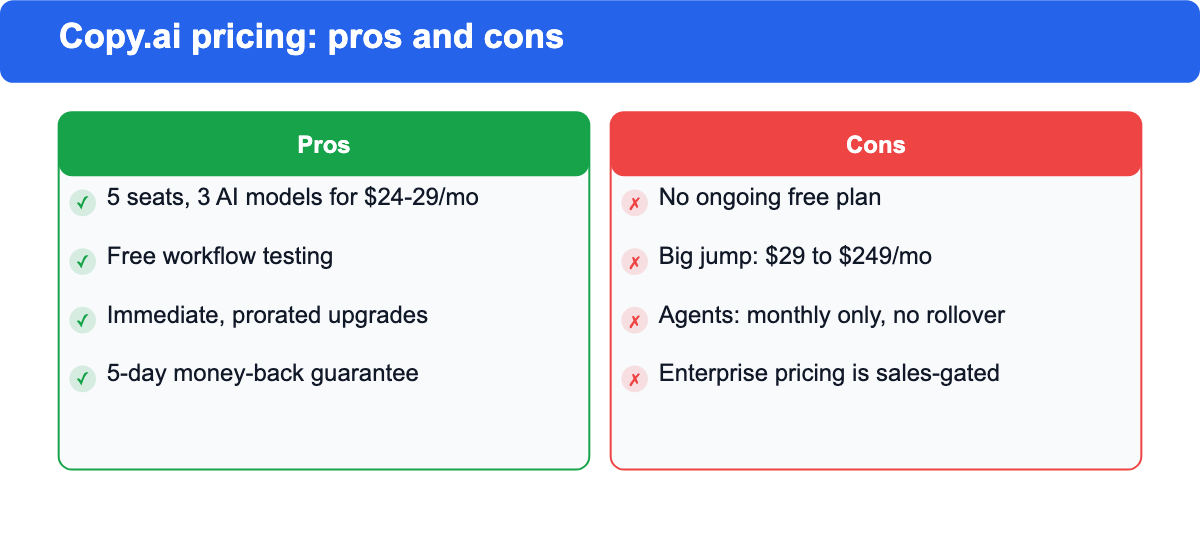
- Pros: Chat covers 5 seats and three model providers (OpenAI, Anthropic, Gemini) for $24 to $29 a month, which is cheap per seat for a team that uses all five. Workflow credits are usage-based rather than time-boxed, and building or testing a workflow costs nothing, so you can design automations before you commit live credits to them. Plan changes follow documented, predictable rules: upgrades apply immediately and prorate, and there's a 5-day money-back guarantee on a new purchase.
- Cons: There's no ongoing free plan, only a one-time 200-credit grant for new accounts. The jump from Chat to Agents is a single $220-a-month step with no self-serve bridge in between, since the old Growth, Expansion and Scale tiers were discontinued. Agents is billed monthly only, so it carries none of Chat's annual discount, and its credits don't roll over, which punishes uneven usage. Enterprise pricing is opaque and routes through sales even when API access or bulk workflow runs, not headcount, is the only reason you need that tier.
Why do Copy.ai pricing sources conflict?
Copy.ai changed owners, and the pricing record hasn't caught up. Fullcast, a go-to-market and RevOps platform, announced its acquisition of Copy.ai on 15 October 2025 and is folding the product into its suite as Fullcast Propel. Copy.ai's help center now lives on a Fullcast domain, which is why older support links from review articles land on a knowledge-base homepage instead of the article they promised.
That churn produced three layers of stale information, and you can date a source by which layer it repeats.
- Pre-2024 sources describe a "Standard" plan around $49 a month with word-count limits and a free 2,000-word tier. None of that exists.
- 2025 sources describe the five-tier ladder up to $3,000 a month. Those tiers are hidden on the live page.
- Current sources should show Chat, Agents and Enterprise. Very few of them do.
Rank your sources accordingly. The live pricing page decides plan names and prices, the current help center decides operational rules like refunds and credit behaviour, and review posts are background reading. The costliest mistake here is budgeting against a $1,000 entry point that Copy.ai doesn't show anyone any more.
Is Copy.ai worth the price?
Copy.ai is worth $24 a month if you want a shared AI chat workspace for a small team, and worth $249 a month if that team produces the same content types on repeat and wants them consistent without re-prompting. Outside those two cases the value gets thin fast, and it doesn't recover.
For a solo writer it's weak value, without question. $29 a month for a five-seat team tool is money spent on capacity you'll never use, and cheaper single-user options do the drafting job for less. Our breakdowns of Rytr's pricing and Writesonic's pricing cover that end of the market, and the Jasper vs Copy.ai comparison is the closer call for teams.
The ownership change adds one non-price consideration. Copy.ai is now a component of a larger RevOps platform rather than a standalone writing product, and its roadmap follows Fullcast's. If you're buying an annual Chat plan, that's a small risk. If you're scoping an Enterprise contract, ask directly how the Propel rebrand affects your term.
Quick fit check.
- Chat suits small teams that want shared AI chat with top models at a predictable monthly cost.
- Agents suits teams of up to 10 producing repeatable content who need credits and Content Agent Studio.
- Enterprise suits organisations that need API access, bulk runs, integrations or guided implementation.
- Nobody else. Solo users and occasional drafters should look at cheaper Copy.ai alternatives instead.
Copy.ai vs Jasper and Writesonic pricing
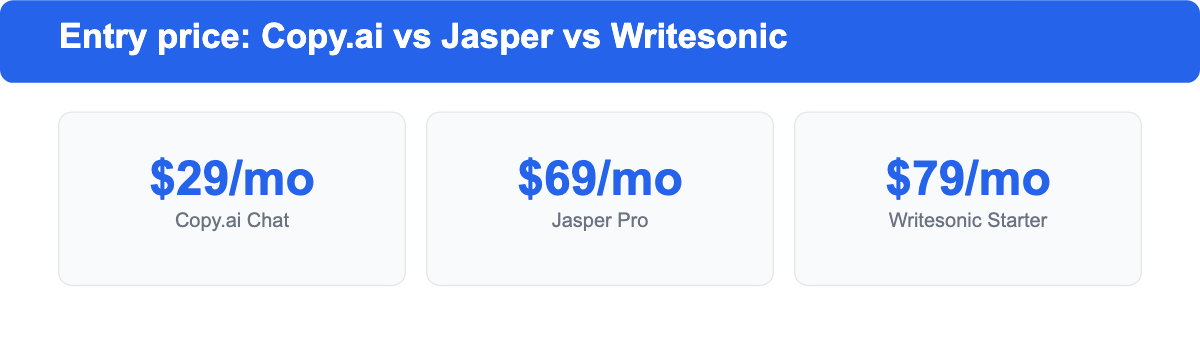
Copy.ai's $29-a-month Chat plan sits below Jasper's cheapest tier and well below Writesonic's current entry price, though the three products aren't really selling the same thing any more. Jasper's Pro plan is $59 a month billed yearly, or $69 a month billed monthly, aimed at individual and small-team content creation with more built-in brand and campaign tooling than Copy.ai's Chat tier. Writesonic has moved further away: it now markets itself as an AI Search Visibility platform for tracking and improving how a brand appears in ChatGPT, Gemini and Google AI Overviews, and its cheapest Starter plan is $79 a month billed annually. The sub-$20 Writesonic plan that older comparison posts still quote is gone; if you came here comparing cheap AI writers, Writesonic no longer competes in that category.
| Tool | Cheapest paid plan (USD) | What it's for |
|---|---|---|
| Copy.ai | $29/mo, $24/mo billed annually | Shared AI chat and, on the Agents tier, repeatable content workflows |
| Jasper | $69/mo, $59/mo billed yearly | Brand-consistent marketing content for individuals and small teams |
| Writesonic | $79/mo billed annually | AI search visibility tracking and GEO/AI Overview optimization, not general AI writing |
Read that table by what you're actually buying rather than by price alone. Copy.ai and Jasper still compete head to head on AI writing and content workflows, where Copy.ai's seat count and credit model usually works out cheaper for a small team. Writesonic no longer belongs in that comparison; its current product solves a different problem, and treating its old pricing as a cheap-alternative baseline will lead you to the wrong conclusion.
Paragraph Generator: concrete sentences and specific verbs in plain English. Free, no signup.
Copy.ai pricing FAQ
What is the cheapest Copy.ai plan?
Chat is the cheapest Copy.ai plan at $29 a month, or $24 a month if you pay for a full year up front.
Does Copy.ai still have a $1,000 plan?
Copy.ai no longer displays the $1,000-a-month Growth plan, or the $2,000 Expansion and $3,000 Scale tiers above it. The pricing page now shows Chat and Enterprise, with Agents documented in the help center at $249 a month.
Does Copy.ai have a free plan?
Copy.ai sunset its free plan and doesn't sell one any more. New accounts get 200 bonus credits that never expire, and cancelled accounts drop to a view-only Free plan that cannot run new generations.
Does Copy.ai offer a student discount?
Copy.ai doesn't publish a student or education discount. The only documented discounts are annual billing on Chat, worth 20%, and a non-profit discount you request from support with proof of status.
Is Enterprise pricing public?
Enterprise pricing is custom and it's handled through sales. It's the only route to API access, bulk workflow runs and guided implementation, so those requirements decide the tier more than seat count does.
How many credits does a Copy.ai workflow run use?
A workflow run's credit cost scales with its complexity, so Copy.ai doesn't publish a per-run price. You can read the exact consumption of any run in the side panel under "Credits used", and test runs during building cost nothing.