
Glossary
What Is Topical Relevance? Definition, Importance, and How to Build It

Topical relevance is the degree to which a webpage's content aligns with a specific subject and covers the subtopics, questions and related concepts that users and search engines associate with it. Since Hummingbird, RankBrain and BERT, Google evaluates topical relevance through semantic understanding. Comprehensive topic coverage, not keyword repetition, is the actual ranking requirement.
- Google models read missing subtopics as an incomplete treatment and rank deeper pages higher
- Strong topical relevance widens rankings for related queries and improves crawl prioritization
- Keyword relevance optimizes one page for a term, topical relevance builds site-level subject ownership
- A pillar page linked to cluster pages on audits, calendars and distribution signals content strategy depth
What Is Topical Relevance?
Topical relevance is the degree to which a webpage's content aligns with a specific subject and covers the subtopics, questions, and related concepts users and search engines associate with that subject. Does your page belong to a topic, or does it just mention one? That's the distinction that drives how Google evaluates content today.
Search engines moved past keyword matching years ago. Google's Hummingbird algorithm in 2013 introduced semantic understanding. RankBrain and BERT followed. Each update deepened Google's ability to evaluate whether a page genuinely covers a topic, not just whether it uses particular words.
Here's the concrete consequence. A page can rank for "best project management tools" without using that exact phrase, provided it covers the topic well. One that repeats a phrase ten times but skips everything a project manager needs to know will lose rankings to competitors with deeper coverage. Keywords signal the topic. Comprehensive coverage of the topic is the actual ranking requirement.
Why Topical Relevance Matters for SEO
Three things happen when a site's topical relevance is strong. It ranks for more related queries. It accumulates topical authority over time. Googlebot prioritizes it during crawls. These effects are separate, and each one moves rankings.
How Google Evaluates Topical Relevance
BERT, deployed at scale by Google in 2019, gave the search engine the ability to read content as a subject-matter expert would. Before BERT, a query like "can you get medicine for someone pharmacy" was parsed as a keyword string. After BERT, Google understood it as a question about picking up another person's prescription.
For site owners, here's the specific implication. Write about project management without mentioning timelines, task ownership, or resource allocation, and Google's models read that page as an incomplete treatment of the topic. Incomplete pages lose on competitive informational queries. Depth of coverage is the mechanism.
Topical Relevance and E-E-A-T
E-E-A-T stands for Experience, Expertise, Authoritativeness, and Trustworthiness. It's a site-level connection, not a page-level one.
Consider two sites. One publishes 40 articles about SEO tools and strategy. The other publishes 5 SEO articles alongside 20 cooking posts and 15 travel posts. Google treats the first site as a concentrated authority on SEO. The second one's a generalist. Topical concentration clearly converts good individual articles into recognized domain expertise.
Ranking Impact
Sites with strong topical relevance get benefits you can actually measure:
- Rankings for a wider range of related queries beyond the target keyword
- Faster recovery from algorithm updates, because the authority is structural
- Better crawl prioritization from Googlebot
- Higher likelihood of appearing in AI Overviews and knowledge panels as a recognized source
SEO Title Generator: eight title tag variations, sized for the SERP and intent-matched. Free, no signup.
Topical Relevance vs. Keyword Relevance
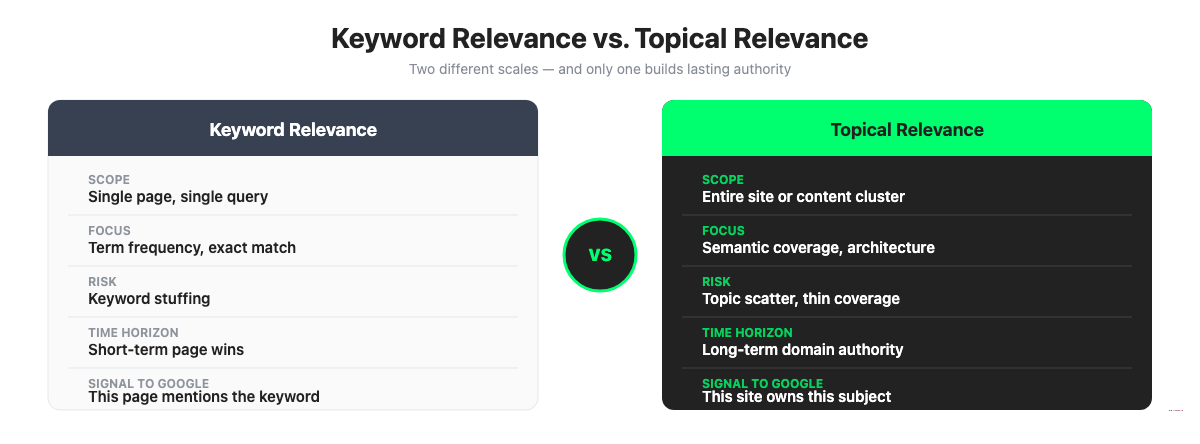
Two different scales, and confusing them isn't harmless. It leads to page-level optimization that misses the site-level game.
Keyword relevance asks: does this page use the right words? Topical relevance asks: does this site own this subject? Both questions matter. The problem: keyword relevance delivers short-term wins that don't hold up without topical depth behind them.
Here's how the differences map out. Keyword relevance works at the page level. Topical relevance works at the site or content cluster level. Keyword relevance focuses on term frequency and match quality. Topical relevance focuses on semantic completeness and content architecture.
Over-index on keyword relevance and you'll drift into keyword stuffing and over-optimization. Ignore topical relevance and you'll end up with thin coverage scattered across too many unrelated topics.
Keyword research still identifies which terms to target. The output of that research should feed a topic coverage plan. Optimizing isolated pages one by one isn't a topical relevance strategy.
The Building Blocks of Topical Relevance

Four elements, and none of them work well on their own.
1. Content Depth and Breadth
Depth means a reader doesn't need to visit another site to get a complete answer. Breadth means covering all the important subtopics and related questions in the subject area.
Try this exercise. Write out every question a curious person might ask about your topic. Group those questions into subtopic clusters. Check which clusters your existing content addresses. Those gaps are topical relevance gaps, and they'll show up in Google's crawl data before they show up in your analytics.
One common mistake: a single 5,000-word article about one narrow angle doesn't create topical relevance for the broader subject. Breadth requires multiple pages across multiple subtopics.
2. Topic Clusters and Pillar Pages
A topic cluster is made up of three components:
- A pillar page covering the core topic broadly
- Cluster pages, each going deep on one specific subtopic
- Internal links connecting the cluster pages to the pillar and to each other
An SEO blog building topical relevance for "content strategy" might have a pillar on content strategy, plus cluster pages covering topic clusters, content audits, editorial calendars, content distribution, and repurposing workflows. Link them together and Google sees a structured content ecosystem. Skip that step and it's just a collection of unrelated posts.
3. Internal Linking
Internal linking's doing two jobs at once. It distributes authority between pages in a cluster. It also tells Google which pages are contextually connected.
A well-built internal link structure: the pillar page links to every cluster page. Every cluster page links back to the pillar. Cluster pages link to each other where content overlaps and the reader benefits. Anchor text reflects the actual topic of the linked page.
It's a common failure mode. Sites produce good content and leave cluster pages link-isolated. An isolated page gets treated as a standalone article. No page in that situation benefits as much as it would've in a connected cluster.
4. Relevant Backlinks
When backlinks come from topically related pages, that's a domain-level topical relevance signal. A link from a recognized SEO publication to an SEO article tells Google that the content has standing within that topic community.
A high-DR backlink from an unrelated domain adds general authority. A lower-DR backlink from a closely related domain adds topical authority. Both have their place. For building topical relevance specifically, topic proximity matters more than domain rating in isolation.
How to Build Topical Relevance: A Step-by-Step Guide
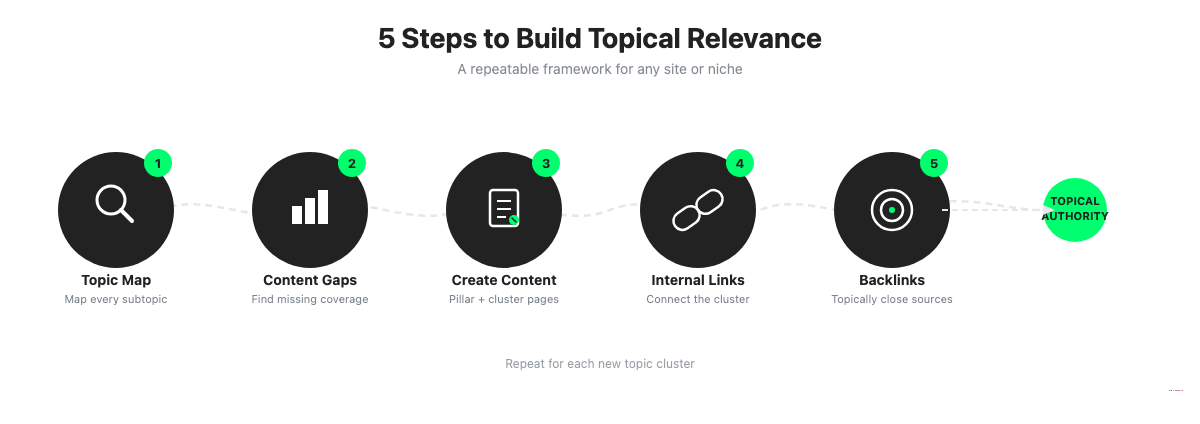
Five steps, and they apply whether you're building from scratch or you've already got a site to strengthen.
Step 1: Create a Topic Map
A topic map's a structured inventory of every subtopic, question, and related concept in your subject area. Everything else you'll do derives from it.
Start with the core topic. Branch out by identifying:
- Main questions users ask (pull from "People Also Ask," Google autocomplete, and keyword research tools)
- Subtopics that belong under the core topic
- Adjacent topics that connect to yours without being the same thing
- User intents across the topic area: informational, navigational, commercial, transactional
Group the results into clusters. Each one needs enough distinct material to support at least one dedicated page, or it isn't ready yet.
Step 2: Identify Content Gaps
Run a content gap analysis by comparing your topic map against your existing content. Two types of gaps exist: pages you haven't built yet, and topics you've covered too shallowly to compete.
Here are three tools that'll help you find gaps. Ahrefs Content Gap shows queries competitors rank for that you don't. Google Search Console shows queries you appear for at low impressions, which are subtopics you're touching but not owning. Manual SERP review of the top five results for your target topic shows which headings and subtopics the ranking pages use. Replicate the necessary coverage. Add what's missing.
Step 3: Create Pillar and Cluster Content
Write each page so well that a reader doesn't need to go elsewhere for that specific question. Match the depth of the strongest competitor for that subtopic, or exceed it where you have real additional information to contribute.
Keep the scope tight. Each cluster page owns one subtopic, and thin placeholder content's worse than no content at all. A cluster page with 300 words of generic text signals weak subtopic coverage and drags down the cluster.
Step 4: Optimize Internal Linking
The pages exist. Now you've got to connect them.
Priority order:
- Pillar page links to every cluster page
- Every cluster page links back to the pillar
- Cluster-to-cluster links where content overlaps and the reader benefits
- Audit for isolated pages receiving zero internal links from the cluster
Use descriptive anchor text. "How to build a content calendar" is useful to Google and to readers. "Click here" isn't. Natural variation across links is fine, and forcing exact-match anchors everywhere isn't necessary. An internal linking tool can surface isolated pages faster than a manual crawl.
Step 5: Build Relevant Backlinks
You'll want to target publications and resources in topics close to yours. Tactics that work:
- Guest posts on niche publications in your subject area
- Resource page outreach: find pages that list tools and guides in your topic domain
- Digital PR targeting publications that already cover your topic
- Broken link building on topically related pages
- Link reclamation for unlinked mentions of your brand or content
Track which pages in your cluster are attracting backlinks. Use internal linking to push that authority toward cluster pages that need it.
How to Measure Topical Relevance
No single metric captures topical relevance on its own. Five proxy signals together give you an accurate picture.
Keyword coverage and ranking spread: export your top queries from Google Search Console and group them by subtopic cluster. If topical relevance is strong, you'll appear across many subtopics in a cluster, not just rank for one or two primary terms.
Position distribution across the topic: a site with real topical authority ranks many cluster queries in positions 1 to 10. One flagship page that outranks everything else while the rest of the cluster sits at position 25 or worse is a weak topical authority signal, not a strong one.
Crawl coverage: run a site audit with Screaming Frog or Ahrefs to check how many cluster pages are indexed and how many receive internal links. If a page's indexed but link-isolated, it isn't contributing to topical authority.
Topical authority score: Semrush's Topic Research and Keyword Strategy Builder tools, plus Ahrefs' Content Gap and domain-level topic breakdowns, provide approximate estimates within topic categories. Semrush's own September 2026 "Topical Gravity" framing pushes the same idea further: it treats a topic, not a single keyword, as the real unit of a search strategy. Treat any of these scores as directional. Trend over months is the signal worth watching, not the absolute number.
AI Overview presence: check whether your site appears as a source in Google's AI Overviews for informational queries in your topic area. AI Overview citations correlate with topical authority, and that link's not a coincidence. Google pulls sources it recognizes as subject-matter authorities for those panels.
Common Mistakes That Hurt Topical Relevance
Keyword cannibalization without resolution: multiple pages targeting overlapping queries compete against each other and split the topical signal. Audit for cannibalization first. Then either consolidate competing pages or differentiate them by subtopic scope.
Thin cluster content: a cluster page that can't function as a standalone resource for its specific subtopic does more harm than good. Fewer well-developed pages outright outperform a pile of thin ones.
Topic drift: a site that starts covering SEO and gradually adds articles on social media, graphic design, and email marketing loses topical concentration. Off-topic content isn't penalized on its own. It just doesn't contribute to topical relevance in the target area, and it dilutes the signal from pages that do.
Broken internal link structure: a topic cluster where the pillar exists but cluster pages aren't connected to it functions as a set of disconnected articles. No authority flows. No cluster signal reaches Google. The structure's only worth building if the links are actually there.
Expanding too far from current authority: building topical relevance takes time. A site that's already recognized as an authority in SEO tools will build topical relevance in content strategy or link-building faster than in an unrelated field. Adjacent clusters are, quite plainly, more tractable than distant ones.
Frequently Asked Questions
What is the difference between topical relevance and topical authority?
Topical relevance is how well a specific page aligns with a given topic. Topical authority is the domain-level recognition that a site is an expert on a subject. Authority builds as topical relevance accumulates across many pages over time. Relevance is page-level. Authority is site-level.
How long does it take to build topical relevance?
In low-competition niches, topical relevance can compound within three to six months of consistent publishing. In competitive areas, measurable authority gains typically take six to eighteen months. Consistency matters more than speed.
Does a single long article create topical relevance?
No, a single article doesn't create site-level topical relevance on its own, though it can rank well for its own topic. Site-level topical relevance requires coverage across multiple related pages connected by internal links. One article creates page-level depth. Multiple connected articles create domain-level expertise.
Is topical relevance the same as semantic SEO?
They overlap but aren't the same. Semantic SEO is the methodology: optimizing for meaning, context, and concept relationships rather than keyword matching. Topical relevance is one of the main outcomes that methodology builds. Semantic SEO is the approach. Topical relevance is the signal it generates.
How does topical relevance affect link-building?
Backlinks from topically related pages contribute more to topical authority than links from unrelated domains. In practice, this means prioritizing outreach to publishers, blogs, and resources in your topic area. Lower domain ratings with high topic proximity can outperform high-DR links from unrelated sites for topical authority specifically.