
Guide
B2B Content Marketing: A Practical Playbook for Pipeline

B2B content marketing builds sales pipeline when every article, case study or webinar answers a question a real buyer asks at a specific stage, and you can trace that content to pipeline, not just traffic. The playbook shows you how to map the buying group, match formats to funnel stages, plan a 90-day content calendar and measure content against pipeline.
- Tie content goals to a revenue number from the sales plan, not to blog topics
- Map the buying group's roles and the question each role needs answered
- Collect topics from sales calls, support tickets and churn interviews, ranked by blocked deals
- Choose three to five problem areas and build a topic cluster around each
- Match formats to stages and plan distribution for each asset before production
- Agree with sales how content influence is counted, then review results monthly and quarterly
B2B content marketing is the practice of creating and distributing useful content that helps a company's buyers understand a problem, compare ways to solve it and get their buying group to agree on a vendor. It works when every article, case study or webinar answers a question a real buyer asks at a specific stage, and when you can trace that content to sales pipeline, not just traffic.
This playbook covers what most guides skip, and it's built to be copied: how B2B buyers actually decide in 2026, a funnel matrix with a KPI for every stage, a role map for the buying group, a 90-day sample content calendar and a way to measure content against pipeline. The buyer and marketer numbers come from the 2026 6sense Buyer Experience Report, Gartner's 2025 buyer survey and the Content Marketing Institute's 2027 B2B research. We didn't run our own survey.
What is B2B content marketing?
B2B content marketing is content made for people who buy on behalf of a company: articles, research, guides, webinars, case studies, calculators and newsletters that teach them something before, during and after a purchase. The goal isn't a quick sale. It's to be the vendor the buying group already understands and trusts when it starts to evaluate.
Three things set it apart from consumer content, and they're easy to underestimate. The buyer's a group, not a person. The purchase usually takes months, and it often stalls or restarts. And the content has to survive internal scrutiny, because a champion forwards it to finance, IT and procurement, who each read it with a different question in mind. That's where most programs quietly fail.
| B2B content marketing | B2C content marketing | |
|---|---|---|
| Who decides | A buying group of several roles | One person or a household |
| Buying cycle | Months, often with a pause or restart | Minutes to weeks |
| What the content must do | Help a group agree on a problem, a category and a vendor | Create desire or solve a personal need |
| Typical formats | Research reports, guides, webinars, case studies, ROI calculators, newsletters | Social video, product pages, reviews, lifestyle content |
| Main proof | Customer outcomes, expert depth, data | Social proof, price, emotion |
| Success metric | Pipeline and revenue from target accounts | Sales, repeat purchase, engagement |
B2B content creation, the production side, is only half the job, but it's the half most teams over-invest in. The other half is getting each piece in front of the right role at the right moment, which is why distribution and measurement get their own sections below. For the general concept behind all of this, see our explainer on what content marketing is.
How do B2B buyers buy, and what does that change for content?
B2B buyers do most of their deciding before they talk to you. In the 2026 6sense Buyer Experience Report, buyers first contacted a vendor on average 59.2% of the way through their journey, and by then they'd picked a preliminary winner in 91.4% of journeys. Your content is the sales conversation for the first half of the process, whether you planned it that way or not.

Here's what the current research says and what each finding means for a content plan:
| Finding | Source | What it means for your content |
|---|---|---|
| Buying groups average 10 members | 6sense, 2026 | Write for supporting roles (finance, IT, procurement), not only the champion |
| First vendor contact happens 59.2% of the way through the journey | 6sense, 2026 | Buyers must be able to self-educate on your site without a sales call |
| A preliminary winner exists before first contact in 91.4% of journeys | 6sense, 2026 | Content that reaches buyers after they shortlist is late |
| 85% of buyers have largely or fully set their decision criteria by first seller contact | 6sense, 2026 | Publish the criteria you want buyers to use, early and ungated |
| 71% of buying groups start with preferences for two or more different vendors | 6sense, 2026 | Give the group material that settles internal disagreement |
| 56.4% say agreeing on the category was harder than choosing the vendor | 6sense, 2026 | Make the case for the category, not only for your product |
| Only 26% use LLMs to find new vendors | 6sense, 2026 | AI answers matter, yet peers, events and vendor sites still shape shortlists |
| 61% prefer a rep-free buying experience | Gartner, 2025 | Pricing, implementation and comparison pages carry real weight |
| Buyers spend 24% of their buying time with potential suppliers | Gartner | Three quarters of the work happens without you in the room |
| 95% of potential buyers aren't ready to buy today | LinkedIn B2B Institute | Most content should build memory with future buyers, not chase leads |
Two practical conclusions follow, and they're both uncomfortable for sales-led teams. First, you need content for people who aren't shopping yet, because 6sense found that 96% of buyers keep up with their category between buying cycles and 94% start a new evaluation with existing opinions about vendors. Second, you need content a champion can forward to a skeptical colleague. A blog post that only works for the person who found it won't help a group of 10 reach a decision.
That doesn't mean sales content is useless. It means it's late if it's all you've got.
Sources: 6sense 2026 B2B Buyer Experience Report, Gartner sales survey, June 2025, Gartner commercial strategy guide, LinkedIn B2B Institute on the 95-5 rule.
Headline Generator: 10 headlines across 4U, AIDA, PAS and curiosity frameworks. Free, no signup.
How to build a B2B content marketing strategy in 7 steps
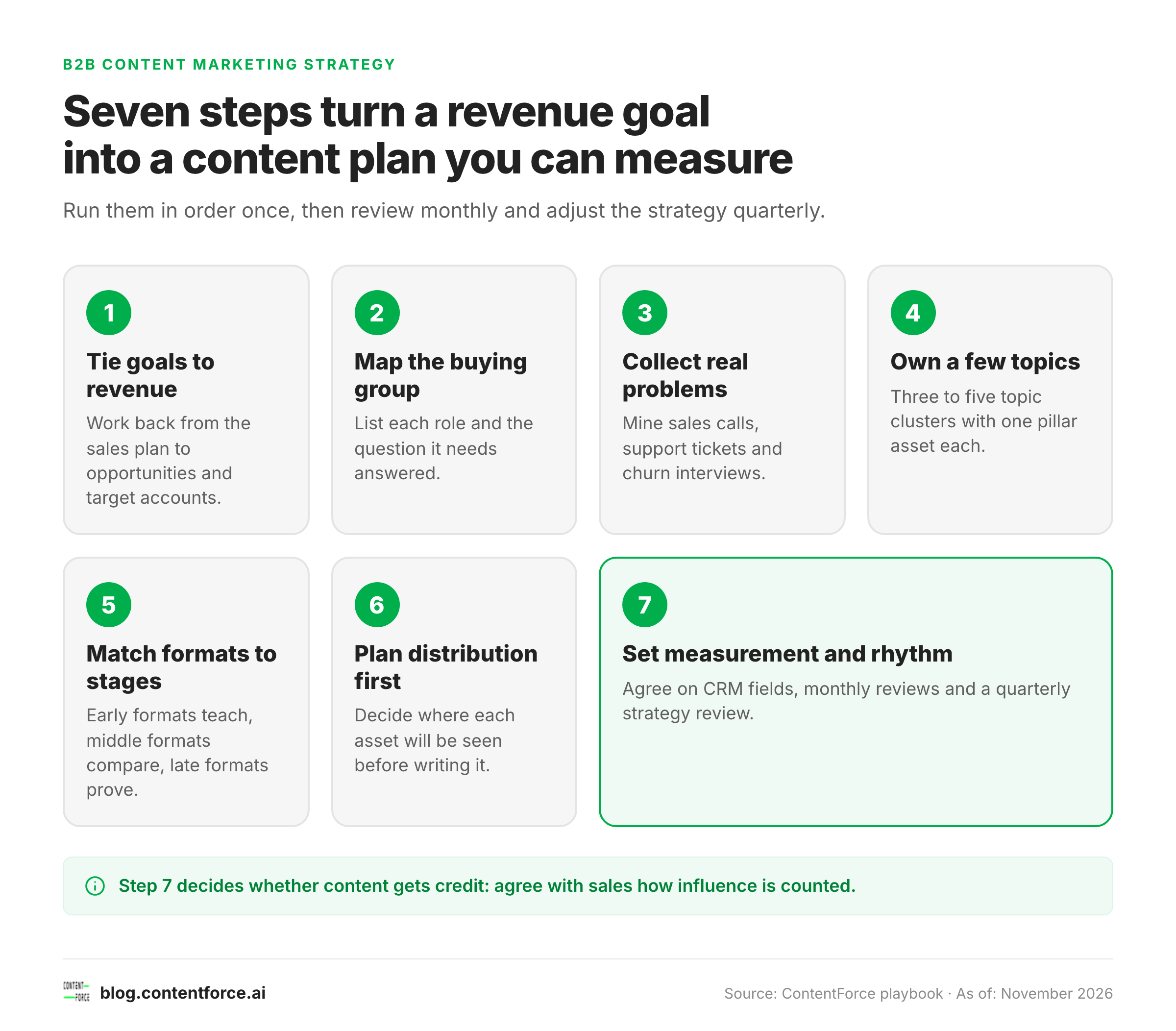
A B2B content marketing strategy is a written plan that names which buyers you serve, which problems you cover, which formats and channels you use and how you'll judge success. These seven steps produce that plan in a few weeks. In the Content Marketing Institute's 2027 research (861 B2B marketers surveyed in mid-2026), marketers who rated their work effective named content relevance and quality (47%) and alignment with sales (26%) among the main reasons, so both are built into the steps.
1. Tie content goals to a revenue number
Start from the sales plan, not from a list of blog topics. It's tempting to skip this step, but it's the one that gets content a budget next year. If the company needs 40 new customers in a segment next year, work backward: how many qualified opportunities does that take, how many target accounts must know you, and which questions block deals today? Content goals then read like "influence 30% of new opportunities in the mid-market segment" rather than "publish four posts a month".
2. Map the buying group, not one persona
List the roles that join a typical deal and the question each one needs answered. Don't stop at job titles; write down what each person's afraid of. Most B2B content serves the champion and ignores everyone who can say no.
| Role | Question they need answered | Content that answers it |
|---|---|---|
| Champion (the person who feels the problem) | Is this problem worth fixing now, and how? | Problem guides, benchmarks, how-to articles |
| Economic buyer or final decision maker | What does it return, and what's the risk of waiting? | Business case template, ROI calculator, customer outcomes |
| Finance | What does it really cost over three years? | Transparent pricing page, total cost breakdown |
| IT or security | Will it integrate and pass our review? | Integration docs, security overview, architecture notes |
| Procurement | How do we compare vendors fairly? | Evaluation checklist, comparison pages, contract FAQ |
| End users | Will this make my work easier or harder? | Product walkthroughs, short videos, templates |
3. Collect problems from sales and customer calls
The best topics come from what buyers say on recorded sales calls, support tickets and churn interviews, not from brainstorming. Pull the exact phrases buyers use, group them by stage and role, and rank them by how often they block or delay deals. A short monthly call with two account executives keeps this list current, and it's usually the cheapest research you'll ever do.
4. Choose a few topics you can own
Don't spread yourself thin. Pick three to five problem areas where you've got real expertise and build a topic cluster around each: one pillar asset plus supporting pieces that answer narrower questions. It's depth on a few topics that earns more trust with an experienced buying group than thin coverage of everything. Buyers in these groups have usually been through several evaluations already, so they'll spot shallow content quickly.
5. Match formats to stages
Decide which format does which job, and don't let one asset try to do three. The funnel matrix in the next section is the reference. As a rule, early-stage formats teach, middle-stage formats help compare and late-stage formats prove.
6. Plan distribution before production
Decide where each asset will be seen, and who'll see it, before anyone writes it: newsletter, LinkedIn, sales sequences, partner channels, events or organic search. An asset without a distribution plan is a cost, not an investment. Frankly, it's the easiest gap to miss when you're busy producing.
7. Set the measurement model and the review rhythm
Agree with sales how content influence will be counted (see the measurement section), which CRM fields record it and when you'll review results. A monthly content review and a quarterly strategy review are enough for most teams, although fast-moving markets may need a tighter loop. Run a content audit once a year to prune or update what no longer earns its place.
B2B content funnel matrix: stage, format and KPI
The classic funnel has three stages, but B2B buyers spend much of their time outside any active purchase, and they keep buying after the contract's signed. This matrix adds both, so every format has a job and a number attached.

| Stage | Buyer's job | Formats that do the job | KPI to watch | Hand-off |
|---|---|---|---|---|
| Out of market (the 95%) | Stay current on the category | Newsletter, original research, podcasts, LinkedIn posts by experts | Newsletter subscribers from target accounts, return visitors | Retarget and nurture |
| Top of funnel: problem | Name and size the problem | Problem guides, benchmark reports, explainer videos | Engaged visits from target accounts, time on page | Offer a deeper asset |
| Middle of funnel: category and options | Compare approaches and set criteria | Buyer's guides, comparison pages, webinars, templates, calculators | Return visits, asset downloads or views, account engagement score | Sales alert when an account engages repeatedly |
| Bottom of funnel: vendor choice | Validate the shortlist and the business case | Case studies, ROI calculators, pricing and security pages, demos | Opportunities created, content viewed in open deals | Sales uses content in follow-ups |
| Customer: adoption and expansion | Get value and justify renewal | Onboarding guides, best-practice webinars, community content | Product adoption, renewal rate, expansion pipeline | Customer success |
A worked example: a company selling payroll software to mid-size firms might publish a yearly report on payroll errors (out of market and top of funnel), a guide to choosing payroll software with a downloadable evaluation checklist (middle), a three-year cost calculator and two customer case studies by company size (bottom) and a year-end payroll checklist for customers (customer stage). Each asset has one stage, one KPI and one hand-off, even though some of them will get reused later. That's the whole trick, and it's why the matrix is worth printing.
Which B2B content formats work best?
The formats that work best in B2B prove expertise and help a group decide: practical guides, original research, customer stories and content led by subject matter experts. When the Content Marketing Institute asked B2B marketers what builds trust with an audience in its 2027 report, the top answers were consistently useful practical information (64%), demonstrated industry expertise (59%), customer stories and testimonials (50%), featured subject matter experts (42%) and original research (27%).
| Format | Best stage | Effort | What makes it work in B2B |
|---|---|---|---|
| Practical guides and how-to articles | Top and middle | Medium | Answers one real question with steps, examples and numbers |
| Original research or benchmark report | Out of market and top | High | Data no one else has; feeds articles, talks and sales decks for a year |
| Newsletter | Out of market | Low per issue | Keeps you in memory between buying cycles |
| Webinars and recorded panels | Middle | Medium | Lets buyers hear experts answer live questions |
| Buyer's guides, checklists and templates | Middle | Medium | Gives the group shared criteria to compare vendors |
| Case studies | Bottom | Medium | Shows outcomes for a company like the buyer's, in numbers |
| ROI or cost calculators | Bottom | High | Turns the business case into the buyer's own figures |
| Short video and expert posts on LinkedIn | All stages | Low | Puts a real person and a point of view in front of buyers |
If you're short on resources, don't try everything. Start with two formats: one practical guide per month on a problem your sales team hears constantly, and one case study per quarter. Add research once you've got data or customers willing to share theirs. Research is clearly the format with the longest shelf life, but it's also the one teams abandon halfway when nobody owns the data.
B2B content marketing examples from real companies
Good B2B content marketing examples share one trait: a buyer learns something specific they couldn't easily get elsewhere. Four public examples show the main patterns.

- Stripe Guides (stripe.com/guides): a library of long guides on payments and running an online business. It's top and middle of funnel content that teaches the problem before anyone looks at a product.
- HubSpot State of Marketing (hubspot.com/state-of-marketing): a yearly marketing report, now in its 2026 edition. It's original research that feeds articles, talks and sales conversations for a full year.
- Salesforce State of Marketing (salesforce.com): a recurring research report, now in its tenth edition. Running the same study every year turns one report into a benchmark buyers come back to.
- Atlassian Team Playbook (atlassian.com/team-playbook): free "plays", workshop formats that teams can run themselves. It's practical template content that end users adopt long before a purchase.
None of these is a product brochure, of course. Each one serves a buyer's job first, then lets the brand sit next to the answer. Smaller companies can't match that budget, but they can copy the pattern at their own scale: a yearly survey of 100 customers, a template library for one workflow or a guide series written by the product team.
Where should B2B content be distributed?
B2B content should be distributed where buyers already spend attention: your own email list and website, LinkedIn, the sales team's conversations, partner channels and events, with organic search and AI assistants as long-term discovery channels. In the Content Marketing Institute's 2027 report, owned media was the top area for increased investment (42% of B2B marketers, up 10 points from the year before).
| Channel | Role | KPI |
|---|---|---|
| Email newsletter | Owned reach to subscribers, including out-of-market buyers | Subscribers from target accounts, click rate |
| Website and blog | Home for every asset, the place buyers self-educate | Engaged visits, return visits, conversions to next step |
| LinkedIn (company page and employee experts) | Reach decision makers with a person and a point of view | Engagement from target roles, profile visits |
| Sales enablement | Put content into live deals | Content used in opportunities, win rate where content was used |
| Partners and communities | Borrow trusted audiences | Referred visits, co-marketing leads |
| Events and webinars | Live conversations with buyers | Attendees from target accounts, follow-up meetings |
| Paid promotion | Push the best assets to target accounts | Cost per engaged account, not cost per click |
| Organic search and AI assistants | Long-term discovery for problem and category questions | Visibility for priority topics, citations in AI answers |
Website traffic's less predictable than it was, but it isn't collapsing across the board. In the same CMI survey, 31% of B2B marketers reported more website traffic over the last 12 months and 31% reported less, while 79% of those with falling traffic pointed to AI-powered search. That's a reason to build owned channels, not a reason to abandon search. Our guide to search visibility covers how to show up in AI answers as well as classic results.
One distribution rule matters more than any channel: keep the message consistent. Gartner's 2025 survey of 632 B2B buyers found that 69% saw inconsistencies between a supplier's website and what its sellers told them. Give sales the same assets, numbers and claims the website uses, and keep one shared fact sheet they can check before a call.
Sample 90-day B2B content calendar
A 90-day B2B content calendar works best when it's built around one pillar asset and its derivatives, rather than a stream of unrelated posts. Here's a sample quarter for a team of one or two marketers working with one subject matter expert, built around a benchmark report.
| Weeks | Asset | Stage | Channel | Owner | KPI |
|---|---|---|---|---|---|
| 1-2 | Survey or data pull for the benchmark report; interview two customers | All | Internal | Content lead, SME | Responses or data rows collected |
| 3 | Problem guide on the topic the report covers | Top | Blog, newsletter | Content lead | Engaged visits from target accounts |
| 4 | Benchmark report published (ungated web version, optional PDF) | Out of market, top | Website, newsletter, LinkedIn | Content lead | Report views, newsletter sign-ups |
| 5 | Three LinkedIn posts by the SME on findings | Out of market | SME | Engagement from target roles | |
| 6 | Webinar: walk through the findings with a customer | Middle | Event, email | Content lead, SME | Attendees from target accounts |
| 7 | Buyer's guide and evaluation checklist | Middle | Blog, sales sequences | Content lead | Checklist views, return visits |
| 8 | Webinar recording cut into short clips | Middle | LinkedIn, YouTube | Content lead | Views from target roles |
| 9 | Case study one | Bottom | Website, sales enablement | Content lead, sales | Use in open deals |
| 10 | Cost or ROI calculator update with report data | Bottom | Website, sales | Content lead, product marketing | Calculator sessions from open opportunities |
| 11 | Case study two | Bottom | Website, sales enablement | Content lead, sales | Use in open deals |
| 12 | Customer checklist based on the report | Customer | Email, community | Customer success | Opens, adoption actions |
| 13 | Quarter review: what influenced pipeline, what to cut | All | Internal | Content lead, sales lead | Influenced pipeline vs target |
Every week publishes or reuses something from the same research, whereas a typical calendar spreads effort across unrelated topics. That keeps the workload realistic and the message consistent. You won't need a big team for this, but you'll need the SME's time blocked in weeks 1, 5 and 6. For more planning templates, see our guide to content planning, and brief each piece with a content brief so writers know the stage, role and KPI before they start.
How to measure B2B content marketing against pipeline
Measure B2B content marketing in layers: engagement shows whether the right people read it, account signals show whether target companies are warming up, and pipeline and revenue show whether content changed deals. Measuring content effectiveness was the third-biggest content challenge in the Content Marketing Institute's 2026 report (33% of B2B marketers), behind creating content that prompts action (40%) and resource constraints (39%). Most teams struggle because they stop at the first layer. Trust is measurable too: in CMI's 2027 report, marketers tracked it mainly through customer retention or referral rates (50%) and website engagement (45%).
| Layer | Metrics | Where the data lives |
|---|---|---|
| Engagement | Engaged visits, return visits, newsletter subscribers, webinar attendance | Web analytics, email platform |
| Account | Engagement from target accounts, number of contacts per account, content consumed by role | CRM, marketing automation, account engagement tools |
| Pipeline | Opportunities created where content was consumed before or during the deal, self-reported source, content used by sales in open deals | CRM opportunity records |
| Revenue | Win rate and deal cycle length for deals with content touches vs without, expansion revenue from customer content | CRM, finance |
Three practices make the numbers believable:
- Add a required "How did you hear about us?" free-text field to demo and contact forms. Self-reported attribution catches the podcast, the newsletter or the colleague's forward that click tracking misses.
- Agree with sales on one definition of content-influenced pipeline, for example "an opportunity where at least two contacts from the account viewed a middle or bottom stage asset in the 90 days before creation". Write it down, and don't change it every quarter just because a number looks bad.
- Compare cohorts instead of claiming credit. Look at win rate and cycle length for deals where content was used against deals where it wasn't, over at least two quarters.
Attribution will never be perfect in B2B, and that's fine. What you're after is a number that sales and finance both accept, not a model that gives content credit for everything.
How should B2B teams use AI in content production?
B2B teams should use AI to speed up research, drafts, repurposing and distribution, and keep humans responsible for expertise, facts and point of view. AI is already standard: in the Content Marketing Institute's 2027 report, 88% of B2B marketers said their organization uses AI-powered content creation tools, and 59% experiment with or use AI agents, up from 28% a year earlier.
Yet the same research shows the limits. Marketers said AI improved speed (78%), efficiency (59%) and volume (44%), but only 17% named quality. Their biggest AI challenges were ensuring accuracy (54%), maintaining quality control (54%) and keeping brand voice (52%). And 65% reported pressure to produce content faster over the last 12 months, with burnout (35%), less original thinking (32%) and more generic content (29%) as the most common results.
Where AI helps in B2B content:
- Summarizing sales call transcripts into topic and objection lists
- Drafting outlines and first drafts that an expert then corrects
- Turning a report or webinar into posts, emails and clips
- Checking drafts against your style guide and fact list
Where humans stay in charge:
- Original data, customer interviews and expert opinions, which are exactly the things buyers trust
- Final fact checks on every number and product claim
- The point of view: what your company believes buyers get wrong
Here's a simple rule that works: every published piece should contain at least one thing only your company could say, such as a customer result, a data point from your product or an expert's judgment. If a draft doesn't have one, it isn't ready, however fast it was produced.
Common B2B content marketing mistakes
Most B2B content programs don't fail for exotic reasons. They fail for the same few, and they're fixable. Check your plan against this list before you're three months in:
- Writing only for the champion and ignoring finance, IT and procurement
- Gating everything, so buyers who research quietly never see your best material
- Publishing late-stage content only, when buyers have already picked a favorite before talking to sales
- Counting downloads and traffic as success without checking whether target accounts engaged
- Producing posts with no distribution plan
- Letting sales use different claims and numbers than the website
- Sending generic outreach with content attached: Gartner's 2025 survey found 73% of B2B buyers actively avoid suppliers who send irrelevant outreach
- Changing strategy every quarter before content has had time to influence deals
FAQ
What are some examples of B2B content marketing?
Typical examples are an annual industry benchmark report, a library of how-to guides, customer case studies sorted by industry, a webinar series with experts, a cost calculator and a newsletter written by a named specialist. Stripe Guides, HubSpot's State of Marketing report and the Atlassian Team Playbook are well-known public examples.
What is the difference between B2B, B2C, C2C and D2C?
B2B means a business sells to other businesses. B2C means a business sells to consumers, often through retailers. D2C (direct to consumer) is a B2C model where the brand sells to consumers without intermediaries. C2C means consumers sell to each other, usually through a marketplace.
What roles does a B2B content team need?
A small team doesn't need many people. It usually needs a content lead who owns strategy and the calendar, a writer or editor, access to at least one subject matter expert and someone who handles distribution and reporting. Product marketing and sales should join the monthly review. Larger teams add a research analyst, a designer and a video producer.
How long does B2B content marketing take to work?
Engagement signals usually appear within the first quarter, but pipeline doesn't move that fast. Pipeline influence tends to show after two to three quarters, and closed revenue follows your sales cycle: if deals take nine months, content published today shows up in revenue much later.
Should B2B content be gated?
Gate little, even if your sales team asks for more leads. Buyers research on their own long before contacting a vendor, so your most useful guides and research should be readable without a form. Ask for contact details only when the buyer gets clear extra value in return, such as a calculator result, a workshop seat or the raw data behind a report.
Is B2B content marketing the same as B2B SEO?
No. B2B SEO is one channel: earning visibility in organic search for business topics. B2B content marketing is the wider program, covering newsletters, events, sales enablement and customer content, and SEO is one way to distribute it.